by Ben Habegger | Feb 28, 2019 | Eschatology
Post #2 “Zechariah 14:1–5: The Lord’s Coming to Jerusalem,” Part 1
Post 1
The
opening verses of chapter 14 portray the final conflict between the nations and
the holy city. This conflict culminates in the sudden arrival of the Lord God
and his heavenly hosts.
1 Behold, a day is coming for the Lord when the spoil taken from you will be divided among you. 2 For I will gather all the nations against Jerusalem to battle, and the city will be captured, the houses plundered, the women ravished and half of the city exiled, but the rest of the people will not be cut off from the city. 3 Then the Lord will go forth and fight against those nations, as when He fights on a day of battle. 4 In that day His feet will stand on the Mount of Olives, which is in front of Jerusalem on the east; and the Mount of Olives will be split in its middle from east to west by a very large valley, so that half of the mountain will move toward the north and the other half toward the south. 5 You will flee by the valley of My mountains, for the valley of the mountains will reach to Azel; yes, you will flee just as you fled before the earthquake in the days of Uzziah king of Judah. Then the Lord, my God, will come, and all the holy ones with Him![1]
Verse 2 puts this final conflict into proper perspective:
the Lord himself “will gather all the nations against Jerusalem to battle.”
This time when God gathers his enemies against his people “for the war of
the great day of God, the Almighty” (Rev. 16:14) is prophesied in several
places throughout scripture (cf. Ezek. 38:1–23; 39:1–6; Joel 3:2; Rev.
16:12–16; 19:19; 20:8–9). Here we must focus on the unique picture which
Zechariah paints of this event.
The
nations gather and battle against Jerusalem, and they are initially successful.
They capture the city, loot the houses, rape the women, and even succeed in
carrying away captive half the inhabitants. Still, the other half of the city’s
people will not be killed or exiled. Why? The Lord himself will appear on the
scene and catch the nations in their heinous act of desecration; and when God
arrives, he will descend in full battle array. When he touches down on the
earth right outside the walls of Jerusalem, the Mount of Olives will split to
form a valley, a way of escape for the beleaguered inhabitants of the city.
John MacKay explains verse 2 this way: “The message is that the future of the
church will involve a time when it will be surrounded by its enemies and
seemingly overwhelmed by them…. Under the metaphor of the pillaging of an ancient
city, the church is presented as suffering grievously at the hands of her
enemies, and yet there has been a remnant left.”[2]
The
reference to the Mount of Olives should remind us of Ezekiel’s words, written a
generation before Zechariah’s time. MacKay makes the connection when discussing
verse 4:
‘His feet’ indicates
a theophany, perhaps one where the presence of God causes the earth to shake
(Ps. 68:8; 97:4; Micah 1:3–4; Nahum 1:3, 5). The addition ‘east of Jerusalem’ –
which was scarcely needed to locate this well-known hill – links this vision
with that granted to Ezekiel when the Lord’s
glory left Jerusalem and ‘stopped above the mountain east of it’ (Ezek. 11:23).
The Lord whose visible presence
with his people had then ceased now returns in power, as was similarly forecast
in Ezekiel 43:2. It is not of course to some reconstructed city that he comes,
but to the New Jerusalem which is the reality symbolised in these visions. It
is the city that bears the name ‘the Lord
is there’ (Ezek. 48:35).[3]
Dean Davis further opines, “Verse 4 pictures the LORD
creating an unexpected way of escape for his people; verse 5 pictures them
using it…. Quite intentionally, the imagery used here reminds us of Israel’s
miraculous deliverance at the Red Sea (Exodus 14:1ff).”[4]
But what
about the details of the earthquake and Azel, and should we expect the Lord
Jesus to descend upon the literal hill called the Mount of Olives? These
questions will be answered in the next post.
[1]
All scripture quotations are taken from the nasb
Updated Edition of 1995.
[2] Ibid., 303–304.
[3]
Ibid., 305. Cf. also Andrew E. Hill, Haggai, Zechariah and Malachi: An Introduction and
Commentary, Tyndale Old Testament Commentaries, ed. David G. Firth, vol. 28
(Downers Grove, IL: InterVarsity Press, 2012), 261.
[4] Dean
Davis, The High King
of Heaven: Discovering the Master Keys to the Great End Time Debate (Enumclaw, WA: Redemption Press, 2014), 397.
Cf. also Barry G. Webb, The Message of Zechariah, The Bible
Speaks Today, ed. J. A. Motyer (Downers Grove, IL: InterVarsity Press, 2003),
179.
Ben Habegger first served in full-time pastoral ministry near Detroit, Michigan from 2013-2017 and has now been vocational pastor at Hope Reformed Baptist Church of Aloha, Oregon (formerly Glencullen Baptist Church of Portland, Oregon) since January of 2020. He has a Master of Divinity degree from Detroit Baptist Theological Seminary and a Master of Arts in Reformed Baptist Studies from Covenant Baptist Theological Seminary. Ben and his wife Theresa have four children.

by Ben Habegger | Feb 26, 2019 | Eschatology
Post #1 “The Need for an Amillennial Approach”
The last chapter of Zechariah tends to be neglected by amillennialists, especially in comparison to the emphasis given it by premillennialists. While amillennialists anticipate a single consummation and glorification of God’s kingdom in connection with the single Second Coming of the Lord Jesus, premillennialists use texts like Zechariah 14 to argue for an intermediate reign of Jesus upon the present earth. Such a reign would separate the Second Coming from the eternal perfection of God’s kingdom by at least a thousand years (a time period taken from Revelation 20). The dispensational variety of premillennialism particularly insists upon a strictly literal reading of Zechariah and other Old Testament apocalyptic literature. The result is a Second Coming which radically subjugates sinners and improves their fallen world without banishing sin and death entirely.
Such a “millennial” reign is a problem for the amillennialist because it contradicts the straightforward eschatology of the New Testament. The apostles and prophets and Jesus himself all declare that the very event of Christ’s return will be the end of sin and death. The Second Coming immediately brings the final separation of the righteous from the wicked, the end of the opportunity for repentance, and the eternal glory of a new creation freed from sin’s curse. Further problems also arise when a dispensational hermeneutic is applied to Zechariah 14. Because the role of apocalyptic symbolism is minimized, the result is a renewed Judaism, complete with temple worship and required annual feasts. Although some details may differ from earlier historical iterations, this is essentially the Mosaic system of worship resurrected. It would be a titanic reversal of Christ’s blood-bought accomplishments and a return to those types and shadows which his priestly work has rendered obsolete (Heb. 7:18–22; 8:13; 9:8–10; 10:1, 8–9, 18). A premillennial interpretation of Zechariah’s last chapter, especially that demanded by dispensational literalism, is clearly untenable when seen through the lens of the New Testament.
For these reasons, an interpretation is needed which does not posit an intermediate messianic reign including renewed Judaism and the lingering effects of Adam’s fall. The interpreter must understand that the Old Testament prophets often foretold New Testament realities through the symbolic use of Old Covenant language. A woodenly literal hermeneutic cannot consistently explain such prophecies as that of Malachi 1:11: “For from the rising of the sun even to its setting, My name will be great among the nations, and in every place incense is going to be offered to My name, and a grain offering that is pure; for My name will be great among the nations,” says the Lord of hosts.” On the one hand, literal aspects of the Old Covenant such as incense and grain offerings could only be legitimately performed at the authorized location of the Jerusalem temple. On the other hand, the New Covenant era renders such a sacrificial system obsolete. However, once the interpreter acknowledges that the Spirit speaking through Malachi used Old Covenant institutions as pictures of future, New Covenant realities, Malachi’s words harmonize well with those of Jesus recorded in John 4:21 and 23: “Woman, believe Me, an hour is coming when neither in this mountain nor in Jerusalem will you worship the Father…. But an hour is coming, and now is, when the true worshipers will worship the Father in spirit and truth; for such people the Father seeks to be His worshipers.”
Similarly, the apocalyptic mention of Jerusalem in Zechariah 14 must be allowed to point beyond the earthly city of David. “For here we do not have a lasting city, but we are seeking the city which is to come” (Heb. 13:14). Indeed, those in the New Testament church already “have come to Mount Zion and to the city of the living God, the heavenly Jerusalem” (Heb. 12:22). We are not of the old Sinai covenant “which corresponds to the present Jerusalem”; we are of the new covenant corresponding to “the Jerusalem above” who “is our mother” (Gal. 4:24–26). James the Lord’s brother points to the prophecy of Amos and thus confirms that God has rebuilt and restored the ruined tabernacle of David so that the Gentiles may seek the Lord and be called by his name (Acts 15:13–18). The nations are now joining themselves to Zion, the redeemed city of God, the New Testament church of Jesus Christ. If James and the other apostles could confidently use such a hermeneutic, so can we. This hermeneutic will provide us with an amillennial interpretation of Zechariah 14. Concerning Old Testament promises fulfilled after Christ’s First Advent, John MacKay rightly says, “The realisation is in terms of the heirs and successors of the Old Testament Zion, Jerusalem and Israel. This is not to rewrite the promise, but to satisfy it in its fullest and proper extent.”[1]
Beginning with the next post, this blog series will present such an amillennial approach to the last chapter of the Book of Zechariah.
[1] John L. MacKay, Haggai, Zechariah and Malachi: God’s Restored People, Focus on the Bible Commentary Series (Fearn, Ross-shire, Scotland, Great Britain: Christian Focus, 2010), 417.
Ben Habegger first served in full-time pastoral ministry near Detroit, Michigan from 2013-2017 and has now been vocational pastor at Hope Reformed Baptist Church of Aloha, Oregon (formerly Glencullen Baptist Church of Portland, Oregon) since January of 2020. He has a Master of Divinity degree from Detroit Baptist Theological Seminary and a Master of Arts in Reformed Baptist Studies from Covenant Baptist Theological Seminary. Ben and his wife Theresa have four children.
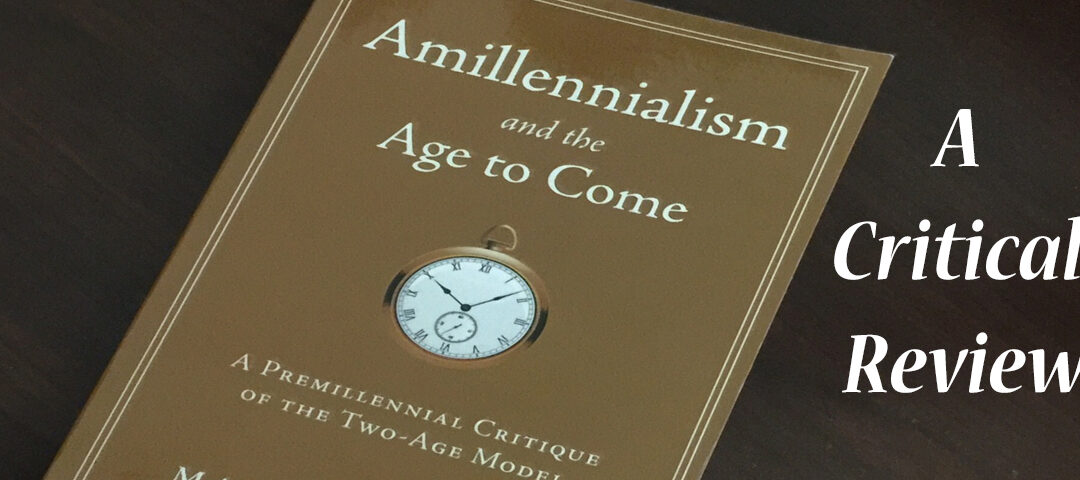
by Sam Waldron | Jul 20, 2017 | Book Reviews, Eschatology
Part 1, Part 2, Part 3, Part 4, Part 5, Part 6, Part 7, Part 8, Part 9, Part 10, Part 11, Part 12, Part 13, Part 14, Part 15
Concluding Thoughts
It is time to bring this lengthy critique of Waymeyer’s volume to a close. I want to do so by making four brief comments.
First, I will not attempt to delve into Waymeyer’s treatment of Revelation 20. It is tempting to do so, but this blog series is perhaps already too long. Fine, Amillennial treatments of this passage are, furthermore, easily available. I recommend William Hendriksen’s treatment for clarity and accessibility. I also and especially recommend G. K. Beale’s massive and impressive treatment of Revelation 20. It is 61 pages long! In it he seems to give evidence of having read almost everything ever written on the passage. He also seems to respond to every Premillennial objection to the Amillennial reading of Revelation 20:1-10.
Second, I also want to repeat my conviction that hermeneutical errors are at the root of Waymeyer’s mistakes. These involve especially the illicit introduction of the double fulfillment character of Old Testament prophecy into New Testament prophecy; his failure to recognize the highly figurative character of prophetic literature; and his failure to allow the clear teaching of Scripture, especially in the literal portions of the New Testament, to exercise a normative influence on the interpretation of the figurative and shadowy teaching of Old Testament prophecy and the highly figurative, apocalyptic language of Revelation.
Third, it must also be stressed that Waymeyer and the kind of Premillennialism he represents are guilty of (what Jay Adams someplace calls) eschatological diplopia. That is, they have a kind of prophetic double vision. What I mean is that the Bible teaches an interim kingdom to which they seem blind. It is the spiritual kingdom of the reigning Jesus during the inter-advental period. This is the true, interim kingdom. When Waymeyer insists on the necessity of a future, Jewish, millennial interim kingdom he is unnecessarily inserting a second interim kingdom after the one in which the church exists today. No such re-duplicated interim kingdom is necessary to explain biblical eschatology.
Fourth, and finally, I want to stress in conclusion that perhaps the greatest error of Waymeyer and his fellows is their failure to understand the true scope of Scripture (scopus scripturae) and biblical prophecy. That center is not the future of national Israel, but the future of Christ and His church. Ultimately, the question is really just this. Is the New Testament vision of Christ and the Church the fulfillment of the Old Testament? Or is it the Premillennial vision of a millennial kingdom centered on National Israel?
Dr. Sam Waldron is the Academic Dean of CBTS and professor of Systematic Theology. He is also one of the pastors of Grace Reformed Baptist Church in Owensboro, KY. Dr. Waldron received a B.A. from Cornerstone University, an M.Div. from Trinity Ministerial Academy, a Th.M. from Grand Rapids Theological Seminary, and a Ph.D. from Southern Baptist Theological Seminary. From 1977 to 2001 he was a pastor of the Reformed Baptist Church of Grand Rapids, MI. Dr. Waldron is the author of numerous books including A Modern Exposition of the 1689 Baptist Confession of Faith, The End Times Made Simple, Baptist Roots in America, To Be Continued?, and MacArthur’s Millennial Manifesto: A Friendly Response.
by Sam Waldron | Jul 18, 2017 | Book Reviews, Eschatology
Part 1, Part 2, Part 3, Part 4, Part 5, Part 6, Part 7, Part 8, Part 9, Part 10, Part 11, Part 12, Part 13, Part 14
Waymeyer’s Treatment of 1 Corinthians 15 Continued
Let me repeat the words with which I began my last post. “The pinnacle of the systemic confusion introduced into plain and literal New Testament passages by Waymeyer is found in his lengthy treatment of 1 Corinthians 15 on pages 147 to 171 of his book. Waymeyer’s argument consists in a number of assertions. First, there is a sequence of events at the end of Christ’s reign allowed by the use of epeita in verse 23 and eita in verse 24; and this allows for a temporal gap into which a future millennium may be inserted. Second, the reign of Christ in view in the passage is a future reign which requires a future millennial reign for its complete fulfillment. Third, “the end” in verses 24-26 includes the resurrection of unbelievers at the end of the millennium. Fourth, the assertion that death is defeated by the resurrection of believers at Christ’s Second Coming does not refer to a once-for-all defeat of death the last enemy. There are plain and, in my view, unanswerable responses to each of these assertions.” I responded to the first two of these assertions in my last post. The last two will be answered here.
“Third, ‘the end’ in verses 24-26 includes the resurrection of unbelievers at the end of the millennium.” Here it needs to be said that Waymeyer expresses some reservation about this typical premillennial interpretation of “the end” as the end of the resurrection, that is, the resurrection of unbelievers. Nevertheless, at the end of his “on the one hand, and on the other hand,” he adopts the traditional, premillennial position that this phrase is a reference, either directly or indirectly, to the resurrection of unbelievers at the end of the millennium.
In response to this little or nothing needs to be added to what I have said in the End Times Made Simple: “Against this theory the following considerations are conclusive: (1) As we have seen, the context makes no mention of the resurrection of unbelievers (vv. 18, 19). (2) The statement that all will be made alive in verse 22 is qualified by the phrase “in Christ.” Without exception this phrase has in the Apostle Paul’s writings a reference to the sphere of salvation. Unless, therefore, one is willing to adopt the heresy of universal salvation, one must limit the scope of verse 22. (3) The phrase “the end” (to telos) is never used of the last segment of the resurrection elsewhere in the New Testament.” Also conclusive against this interpretation of the end is what was noticed in my previous post. The time of “the end” is identified by the two “when’s” of verse 24. As we have seen, the second when clearly identifies the time of “the end” with the destruction of the last enemy, death, by the resurrection of believers at Christ’s Second Coming.
“Fourth, the assertion that death is defeated by the resurrection of believers at Christ’s Second Coming does not refer to a once-for-all defeat of death the last enemy.” I have already pointed to the explicit statement of Paul in 1 Corinthians 15:54-55 that at the resurrection of Christ’s people death will be abolished and defeated as one of the conclusive reasons to reject Waymeyer’s reconstruction of the meaning of verses 20-28. In response to this use of these verses, Waymeyer argues: “The most plausible way to harmonize 1 Corinthians 15:51-57 with Revelation 20 is to see the language of victory over death in this passage as applicable to each stage of resurrection set forth in Scripture.” (166) Several responses to this innovative reading of these verses may be mentioned.
In the first place, it directly contradicts verses 54-55: “But when this perishable will have put on the imperishable, and this mortal will have put on immortality, then will come about the saying that is written, ‘DEATH IS SWALLOWED UP in victory.’” Paul says “then”—not “about then.” Nor does he say “sometime after then.” He certainly does not say “over a thousand years after this.” He clearly and straightforwardly says: “then will come about the saying that is written, ‘DEATH IS SWALLOWED UP in victory.’”
In the second place, Waymeyer’s reading is made even more difficult because it is simply impossible to ignore the connection between verses 54-55 and verse 26. Granting for the sake of argument, that in another context something like Waymeyer’s reading might be possible. It is not possible in this context, because of the contextual connection between the verses 54-55 and verse 26.
In the third place, the deplorable hermeneutics driving Waymeyer’s reading must be noticed. For him the question is how to reconcile 1 Corinthians 15 with Revelation 20. Clearly, the force driving the innovative reading of 1 Corinthians 15:54-55 is the Premillennial interpretation of Revelation 20. I have pointed out in previous posts just how misguided and backwards it is to allow a highly figurative passage written in apocalyptic language to exercise a normative, hermeneutical influence over a straightforward and literal passage like 1 Corinthians 15. To introduce an alien universe of discourse into 1 Corinthians 15 from Revelation 20 is destructive of the clarity of Scripture.
Dr. Sam Waldron is the Academic Dean of CBTS and professor of Systematic Theology. He is also one of the pastors of Grace Reformed Baptist Church in Owensboro, KY. Dr. Waldron received a B.A. from Cornerstone University, an M.Div. from Trinity Ministerial Academy, a Th.M. from Grand Rapids Theological Seminary, and a Ph.D. from Southern Baptist Theological Seminary. From 1977 to 2001 he was a pastor of the Reformed Baptist Church of Grand Rapids, MI. Dr. Waldron is the author of numerous books including A Modern Exposition of the 1689 Baptist Confession of Faith, The End Times Made Simple, Baptist Roots in America, To Be Continued?, and MacArthur’s Millennial Manifesto: A Friendly Response.
by Sam Waldron | Jul 5, 2017 | Book Reviews, Eschatology
Part 1, Part 2, Part 3, Part 4, Part 5, Part 6, Part 7, Part 8, Part 9, Part 10, Part 11, Part 12
Waymeyer’s Treatment of Luke 20
Perhaps the clearest and most comprehensive, single statement of the New Testament’s “two-age” eschatology is found in Luke 20:34-36. For this reason it has become foundational to contemporary Amillennialism’s critique of Premillennialism. Waymeyer focuses on this passage on pages 102-105 of his book. Here is the passage: “Jesus said to them, “The sons of this age marry and are given in marriage, 35 but those who are considered worthy to attain to that age and the resurrection from the dead, neither marry nor are given in marriage; 36 for they cannot even die anymore, because they are like angels, and are sons of God, being sons of the resurrection.”
The Amillennialist treatment of this passage assumes that the meaning is straightforward and clear. It contrasts the two ages at four points. This age is characterized by marriage, but the age to come by no marriage. This age is characterized by death and dying, but the age to come by no death and dying. This age is characterized and inhabited by natural men, but the age to come by resurrected men. Finally, this age is characterized by righteous and wicked men co-existing, but the age to come by the fact that its inhabitants are exclusively sons of God.
Waymeyer acknowledges, as I have previously pointed out, that this passage—taken alone—naturally suggests these contrasts and the polemic against Premillennialism which may be based on them. (105) How does he seek to evade what appears to be the natural force of this passage?
He begins by noting that the context of its assertions is a debate between Jesus and the Sadducees over the reality of the resurrection (Luke 20:27f.). (103) He is, of course, correct in this. His argument is, then, that the passage is not so much about the age to come, but about the resurrection and that it is unnecessary to apply everything Jesus says about the resurrection to the age to come. (104) In a footnote he seeks to buttress the implicit distinction he makes here between the resurrection and the age to come by noting that the passage speaks of “that age and the resurrection of the dead.” (103-104) He takes the conjunction (kai) to mean that there is some distinction between the age to come and the resurrection of the dead.
What is wrong with this reading of the passage?
First, it begs the question as to why Jesus introduces the concept of the two ages and the contrast between them at all. As Waymeyer rightly points out, the context is about the resurrection. Why, then, does Jesus introduce the two ages? It seems to me that, once this question is asked, that the natural and even necessary answer to it must be that the concept of the two ages is simply Jesus’ own way of speaking of the contrast between the age of resurrection and the present age. If this is not the case, then Jesus introduces an extraneous and irrelevant distinction into this discussion which only confuses the issue. The age of resurrection is, in other words, the age to come; and the age to come is the age of resurrection. To distinguish the two is to miss Jesus’ whole point.
Second, everything about the passage and its contrast between the two ages conspires to confirm this. Everything about Waymeyer’s distinction, on the other hand, tends to confuse and corrupt the clarity of the passage.
Third, everything about the parallel passages in the New Testament tends to contradict Waymeyer’s attempted distinction. Passage after passage associates the age to come with eternal life in the eschatological and resurrected sense (Matt. 12:32; Mark 10:30; Luke 18:30; 1 Timothy 6:17-19). Passage after passage concludes the present age with the Second Coming of Christ (Matt. 13:40, 49; 24:3; Titus 2:12-13); and Christ’s coming brings the transformation of the new body to all of His people including especially all of those who survive until His return (1 Cor. 15:51, 52; 1 Thessalonians 4:15-17). Thus, the age to come is the age of resurrection for all of Christ’s people.
Fourth, what is true of the New Testament parallels in general is especially true of the closest parallel to Luke 20:34-36. Here I refer to the teaching of Jesus in the parable of the wheat and weeds explained in Matthew 13:36-43. In that passage there is the same contrast between two periods of time—the age of sowing and the age of reaping. There is the same contrast between the present mixture of good and evil men in the world and a future period in which wicked men are rooted out of Christ’s field. There is the same contrast between the natural character of the present age and the supernatural character of the future period in which the righteous shine forth as the sun in the kingdom of their Father (Matt. 13:43)—a clear reference to Daniel 12:3 and the resurrection of the righteous. All this is clearly parallel to the teaching of Jesus in Luke 20:34-36. What is devastating, however, for Waymeyer’s exegesis of Luke 20 is that it specifically contradicts his notion of a distinction between the age to come and the resurrection. At Christ’s coming all the wicked are rooted out of His field-kingdom-world; and all the righteous enter the glory of the resurrection. The coming of the future age of reaping brings the extirpation of the wicked from the world by the Second Coming and the glorification of the righteous. The passage is incapable the distinction that Premillennial reads into Luke 20:34-36.
Fifth, Waymeyer’s footnote emphasizing the kai conjunction ignores a well-known alternative use or meaning of kai known as the epexegetical or appositional use. In this construction which is common in the New Testament the kai explains or expounds the previous words. It is simply misleading and unacceptable for Waymeyer merely to assume his own understanding and not to mention or discuss the epexegetical or appositional meaning which would destroy his thesis of a distinction between the age to come and the resurrection. Everything, on the other hand, that we have seen above points to the epexegetical meaning as the right understanding of the kai.
Here in Waymeyer’s treatment of Luke 20:34-36 we see a constant feature of his exegetical work which should disturb the reader. The result of his Premillennial approach is to create confusion in passages which appear at first clear to the straightforward reader of Scripture. Distinctions are imposed on passages which are not obvious in any way in the passage itself and which actually contradict the most natural reading of the passage. We have seen this in Matthew 25. We observe it again here in Luke 20. We will see the tendency of Waymeyer’s Premillennial hermeneutic to undermine and erode the clarity of Scripture again in 1 Corinthians 15.
Dr. Sam Waldron is the Academic Dean of CBTS and professor of Systematic Theology. He is also one of the pastors of Grace Reformed Baptist Church in Owensboro, KY. Dr. Waldron received a B.A. from Cornerstone University, an M.Div. from Trinity Ministerial Academy, a Th.M. from Grand Rapids Theological Seminary, and a Ph.D. from Southern Baptist Theological Seminary. From 1977 to 2001 he was a pastor of the Reformed Baptist Church of Grand Rapids, MI. Dr. Waldron is the author of numerous books including A Modern Exposition of the 1689 Baptist Confession of Faith, The End Times Made Simple, Baptist Roots in America, To Be Continued?, and MacArthur’s Millennial Manifesto: A Friendly Response.