
by Dewey Dovel | Aug 17, 2026 | Practical Theology, Systematic Theology
*Note: This series has been developed from a manuscript that was used to preach a sermon on May 10, 2026, at Emmanuel Reformed Baptist Church (SeaTac, WA). The title of that sermon was “A Case for AM and PM Sabbath Day Worship Services,” and it can be accessed here. Click here to read each part of this series: Part 1, Part 2, Part 3, Part 4.
In my pastoral ministry experience, there have been few times when I have felt as burdened about a subject as the one that we’ll be covering in this series of articles. When we survey the landscape of American Evangelicalism—and even the landscape of confessional Christianity in our nation—we quickly discover that we live in an era where worship services are being increasingly less prioritized.
According to a 2023 article entitled Morning & Evening in the PCA, just 12.3% of PCA congregations were reported to self-advertise a Sunday morning and Sunday evening worship service.[1] At the time of that study, the Presbyterian Church in America was the largest confessionally Reformed denomination in North America, yet only 238 of its 1930 congregations offered some sort of AM and PM worship service combination on the Sabbath Day.
My intention for sharing these details is not to denigrate every church that doesn’t offer a PM service, nor is it to speak to their rationale for failing to do so. If anything, this series of articles is nothing more than my feeble attempt to make the case for a practice that fewer and fewer churches are featuring in our day, all the while recognizing that there appears to be even fewer people who’ve been willing to teach on this subject.
In my personal studies on the warrant for AM and PM Sabbath Day worship services, I’ve found very few resources that even address this topic, and I’ve found even fewer resources that seek to address this topic from a theological lens. Most of what I’ve encountered is primarily focused on the practical value—or the practical wisdom—that’s associated with AM and PM worship services, yet not so much with the biblical and theological justification for doing so.[2] It’s with an awareness of these trends that I present a positive case for AM and PM Sabbath Day worship services.
As we anticipate developing this case in subsequent articles, allow me to first define some of the key terms that we’ll be taking for granted.
“AM and PM.”
I have intentionally chosen to use this label with mindfulness for churches who have multiple worship services on the Sabbath, but do not necessarily meet anywhere near the same time. As many readers know from experience, churches will often begin their AM service anywhere between 7:00-11:30, and churches will often begin their PM service anywhere between 1:00 and 7:00. The point of this series is not to argue for the time that a local church should gather for an AM or PM worship service, but rather to simply make the case for why local churches should prayerfully consider gathering in the AM and PM for worship services. In the pastorally sensitive words of Joel Beeke and Paul Smalley:
[While] Reformed churches have traditionally held worship services in the morning and the evening—with time in between for a meal, fellowship, and rest—having a second service in the afternoon rather than the evening might be wise for a congregation with many farmers who need to care for livestock in the evening, or with people who travel long distances to attend services.[3]
The insights disclosed by Beeke and Smalley organically lead to the next key term that I want to define at the outset of this series.
“Worship Service.”
When I use the phrase “worship service,” I am specifically referring to “a public and stated gathering to worship the living God, in which every prescribed element of worship can potentially be exercised, but never exceeded.”[4] This definition of a worship service is not only broad enough to apply to every worship service that could occur within any given redemptive-historical context, but this definition is also narrow enough to account for how worship services are bound by the regulative principle. As underscored by Albert Martin:
The regulative principle of worship is the assertion that when [a group] gathers for worship, [they] are to do nothing more and nothing other than what God has revealed that He desires to receive in worship.[5]
The regulative principle of worship flows out of passages like Deuteronomy 12:1, 31-32 and 1 Timothy 3:15, which come within the immediate context of instructions that were given to regulate public and stated gatherings for worship under both the Old and New Covenants. Prior to entering the Promised Land and prior to receiving an overview of acceptable public worship in verses 2-14, the people of Israel were told “these are the statutes and judgments which you shall be careful to observe in the land which the Lord God of your fathers is giving you to possess, all the days that you live on the earth” (Deut. 12:1).[6] The chapter is then brought to a conclusion by reminding Israel to abstain from the false worship expressions of the surrounding nations: You shall not worship the Lord your God in that way; for every abomination to the Lord which He hates they have done to their gods; for they burn even their sons and daughters in the fire to their gods. Whatever I command you, be careful to observe it; you shall not add to it nor take away from it” (Deut. 12:31-32).
Moreover, on the heels of providing Timothy with particular instructions for corporate prayer (1 Tim. 2:1-4, 8), for proper male and female church member relations (1 Tim. 2:9-14), and the qualifications for church officers (1 Tim. 3:1-13), Paul says “I write so that you may know how you ought to conduct yourself in the house of God, which is the church of the living God, the pillar and ground of the truth” (1 Tim. 3:15). Just as Israel was differentiated from the pagan nations as God’s unique dwelling place (Ex. 29:45-46), so also does the Church stand apart as the unique dwelling place (i.e., house) of God. Thus, the unique identity of Israel—and the unique identity of the Church—requires a unique regulation of conduct, and especially the conduct that is displayed in formal times of worship. Hence the grounds for my proposal that we ought to define a worship service as “a public and stated gathering to worship the living God, in which every prescribed element of worship can potentially be exercised, but never exceeded.”
With an awareness of the connection between the regulative principle of worship and the worship that’s rendered to God on the Sabbath Day, the bold half of this definition enables us to differentiate Sabbath Day worship services from:
- The worship that individual Christians render to God in every facet of life (e.g., 1 Cor. 10:31).
- The worship that a group of Christians renders to God within informal or private gatherings (e.g., Matt. 6:5-6).
- The worship that a local church gathering can publicly render to God, even when gathering on occasions that are not intended to be confined to the prescribed elements of worship under the New Covenant (e.g., in Sunday School classes or a fellowship meal).
Individually and privately speaking, it’s immensely important for a Believer to worship God in their home, in their vocation, in their relationships, etc (i.e., doing all things to the glory of God). Yet as important as it is to maximize one’s stewardship of such categories of life as expressions of worship to God, they are distinct from what transpires in a worship service, and they often introduce elements that exceed what Scripture prescribes for such a context under the New Covenant. The broader consensus amongst confessionally Reformed Christians is that the prescribed elements for New Covenant worship are: the reading of Scripture (1 Timothy 4:13); the preaching of Scripture (2 Timothy 4:2); the singing of Psalms, Hymns, and Spiritual Songs (Ephesians 5:18; Colossians 3:16); the observance of the Lord’s Supper (1 Corinthians 11:17-34); prayer (1 Timothy 2:1-4, 8); baptism (Matthew 28:18-20; Acts 2:41); financial giving (1 Corinthians 16:1-2).[7]
Despite God’s ability to receive glory through our individual efforts to wash dishes, cook dinner, do laundry, and faithfully steward our vocational responsibilities, none of those activities are prescribed elements of New Covenant worship, and none of those activities would ever take place in a worship service. On the other hand, we could rightly say that from a corporate and public standpoint, it’s immensely important for Believers to attend Sunday School, to attend prayer meetings, to attend discipleship-focused gatherings, and to attend fellowship gatherings. Yet as important as those things are to do as expressions of worship to God, a distinction can still be made between those occasions and what would constitute a formal worship service. Even though the previously mentioned contexts are tremendously profitable for our souls—and may feature certain elements of what God has prescribed for New Covenant worship—they often include additional non-prescribed elements as well. A few examples of additional, non-prescribed elements that come to mind are:
- Budget analysis.
- Group discussions.
- The review of missionary reports.
- The sharing of prayer requests.
- Question-and-answer exchanges.
- Role-playing in an effort to practice sharing our faith with others, or to practice defending our faith against objections.
While all of the aforementioned activities can be edifying—and can even be necessary for satisfying the purpose of certain meetings that a church offers on a regular basis—they are not the kind of activities that should occur in a formal worship service that’s bound by the regulative principle of worship. C.R. Vaughn provides helpful commentary along these lines:
In considering the [corporate] worship of God and the surest means of benefit from it, it is necessary to recognize outward ordinances—[or prescribed elements]—as the only authorized method of our approaching [God], and the only means by which we may expect [God’s] favor in benefit to ourselves. This dictates due care to have the outward ordinances as exactly conformed to the requirements of the [Word] as it is possible to secure them… There can be no acceptable worship except in the use of those ordinances and actions in employing them which God Himself has appointed. No man, no organized body of men, has a right to invent any action for the worship of God, and to challenge His blessing on the use of it… [God’s] ordinances must be observed as nearly as possible, according to His own prescriptions.[8]
It’s with a shared concern for Vaughn’s perspective—and it’s with a desire to clarify precisely what I’m seeking to present in this series of articles—that I have set forth a narrow definition of a “worship service.” And if God would be pleased to bless the forthcoming articles, it’s my objective that readers will have examined a compelling case for the following conviction:
Local churches should feature stated gatherings in the AM and PM of the weekly Sabbath Day to worship the living God, in which every prescribed element of worship can be potentially exercised, but never exceeded.
In the articles to come, we will strive to develop this thesis through the employment of three lines of argumentation.
Stay in touch with CBTSeminary
For more information about CBTS, go to CBTSeminary.org
Consider giving to CBTSeminary to help us train the next generation of gospel ministers.
Apply to CBTS today to be sharpened for a lifetime of faithful ministry.
Follow CBTS on our socials: X | Instagram | Facebook | YouTube
Sign up for our newsletter and receive monthly updates related to the Seminary.
[1] Matthew Lee, “Morning & Evening in the PCA,” Presbyterian Polity, August 22, 2023, https://pcapolity.com/2023/08/22/morning-evening-in-the-pca/.
[2] Some helpful articles on the practical value of Sunday evening services are Paul H. Alexander, “Let’s Keep Our Sunday Evening Worship,” The Orthodox Presbyterian Church, February 1996, https://opc.org/new_horizons/evening_service.html.; Harrison Perkins, “A Rationale for Evening Services,” Modern Reformation, February 17, 2021, https://www.modernreformation.org/resources/articles/a-rationale-for-evening-services.; Kevin DeYoung, “Why I Love the Evening Service (and You Can Too),” Clearly Reformed, July 21, 2017, https://clearlyreformed.org/why-i-love-the-evening-service-and-you-can-too/.
[3] Joel R. Beeke and Paul M. Smalley, Reformed Systematic Theology: Church and Last Things, vol. 4 (Wheaton, IL: Crossway, 2024), 411.
[4] This proposed definition of a “worship service” is original to me (i.e., Dewey Dovel).
[5] Albert N. Martin, Pastoral Theology: The Man of God: His Shepherding, Evangelizing, and Counseling Labors (Montville, NJ: Trinity Pulpit Press, 2018), 276.
[6] Unless otherwise noted, all in-text citations from Scripture are derived from the New King James Version.
[7] Each of the prescribed elements of New Covenant worship are further expounded by Joel Beeke and Paul Smalley on pages 420-422 of Reformed Systematic Theology: Church and Last Things.
[8] This quote from C.R. Vaughn is extracted from Martin, Pastoral Theology: The Man of God: His Shepherding, Evangelizing, and Counseling Labors, 281-282.
Dewey Dovel is a pastor of Emmanuel Reformed Baptist Church in SeaTac, Washington. He also serves as a co-host of The Covenant Podcast, a fellow of Savoring the Savior Books, and a visiting lecturer at multiple theological institutions. Above all, Dewey is blessed to be a follower of Jesus Christ, a husband, and the father of two daughters.

by Jim Savastio | Aug 11, 2026 | Practical Theology
I recently sat under the ministry of a fellow pastor at our local fraternal. His ministry had come to an end after about five years. He began the message that day with these words, “I was not prepared for how sad ministry would make me.” That line stung me as it did many of the men gathered there that afternoon. While there are many joys and blessings uniquely attendant to gospel ministry, so too are there sorrows that few, if any, outside of ministry experience.
Of these sorrows, few are more taxing and discouraging than when people leave our church. Departures from the faith are one thing. The Bible speaks to that. But what happens when people do not leave Christ or the faith; they simply leave you and your church. They do not want you to be their pastor anymore. They do not want to be with your flock anymore.
I want to address why this matters and why it is so painful and then give some counsel in regard to how to respond. I very much want to avoid a spirit of whining or give the impression that pastoral ministry is harder or more burdensome than any other calling. Furthermore, I do not wish to cast aspersions on all of those who have left my church or your church. Sometimes that departure may be necessary for their thriving. That said, this experience is real, and it is painful.
Why this matters to us
Allow a brief biography. The Reformed Baptist Church of Louisville was constituted on September 15, 1991. 35 years ago. I have been at this church for 36 years, starting as a church planter. We constituted with 12 members, including me and my wife. In God’s kindness to us, a year later we had 24 members, and two years later we had 36 and then 48 and then 60 or more. It was seven years before we had a member resign. Yes, we had people move away, but when they did, there were tears and prayers and many tokens of love and affection. But one day, a young man who had been converted and baptized at our church called to say, “I’m not coming back.”
At that time, it was one of the hardest moments of my ministry and even of my life. That process has, in the last number of years, been repeated over 200 times. You read that right. Over 200 times. Not all of those 200 have resigned or left disgruntled; some have gotten married, taken a new job, and some have departed for glory. But a good number have said in one way or another, I don’t want to be here anymore. A number of those were people that I saw converted and baptized, loved and cared for for years, and in some cases decades. When I speak to this, I speak from painful experience.
It is rare that departure is not discouraging. It is rare that a departure is not tied in some way or another to a failure to embrace and live out the dynamics of the gospel. Some people will say I was hurt and I can’t be here anymore. Or I was disappointed with a leadership decision, and I have no alternative but to leave. I’ve grown weary here. I can’t grow here, and on and on it goes.
Departures from our fellowship bring about painful introspection (this is preferable to pride, anger, and a judgmental spirit). We ask, what is wrong with us? This disappointment not only comes to us as pastors, but it brings sorrow and confusion to the church as well.
The departure feels like (and may well actually be) a judgment on you. You have failed us. If you were a better pastor or a better preacher or a better church with better this or that, they’d still be here.
One of the most painful aspects of this is seeing the willingness of the departing member to embrace a new church with all its humanity and weakness, and yet they are not willing to grant you the same kindness. Every church that the departed member goes to has people in it. No church on earth is perfectly sanctified, but the new church gets a pass while the old church does not. This is especially painful when they start to gush to others about how great their new church is, perhaps even posting about it online.
When a departure is announced, it can breed uncertainty. What’s wrong with the leaders? Or it breeds imitation: if they leave, maybe I should leave too! It brings about anxiety about the future of the church and plans that the church has made. It brings about questions of finances. Questions about who will fill in for them since they had a part in one ministry or another. It may bring about questions concerning God’s disapproval or asking, is he chastening us?
But there are greater reasons why this hurts. We loved them. We were committed to them in a way they may never understand.
We grieve because we have a high ecclesiology. We believe the church is a body, a family, and a flock. We may grieve because we feel that we have failed them.
Some of this is a reality of the church in a fallen age. It’s also born of the reality that there are many other faithful churches that someone can go to. When Paul urged Euodia and Syntyche to get along, they did not have another church in Philippi to go to. They had to deal with the issues.
Some concluding counsel
Take care of how you remember the departed member and how you speak of them. If they have done good to your congregation over the years, that should be acknowledged and commended. If possible, remain relational. Deal with them in such a way as to make it easy for them to come back to your church.
Be inquisitive. What was behind this decision? Where will you go? Be humble, be teachable. Remember for some that this is as painful for them as it is for you.
Remember our ultimate goal is for them to thrive. If the departing member is thriving in a new location in a way they did not or could not under your ministry, rejoice.
Finally, remember the world to come. Perfect love and friendship will reign through all eternity.
Be still, my soul: when dearest friends depart,
And all is darkened in the vale of tears,
Then shalt thou better know His love, His heart,
Who comes to soothe thy sorrow and thy fears.
Be still, my soul: thy Jesus can repay
From His own fullness all He takes away.
Stay in touch with CBTSeminary
For more information about CBTS, go to CBTSeminary.org
Consider giving to CBTSeminary to help us train the next generation of gospel ministers.
Apply to CBTS today to be sharpened for a lifetime of faithful ministry.
Follow CBTS on our socials: X | Instagram | Facebook | YouTube
Sign up for our newsletter and receive monthly updates related to the Seminary.
Jim has been with RBC since 1990. He was set aside by the church for full time ministry in November of 1991. Jim was brought to faith as a teenager and soon began to experience a desire to preach God’s Word. He trained for the ministry at Columbia Bible College in Columbia, SC (now Columbia International University) and at the Trinity Ministerial Academy in Montville, NJ. He married his wife, Becky in 1989 and they have been blessed with three daughters and one son.

by Justin Miller | Aug 10, 2026 | Practical Theology
*The following is an excerpt from A Life of Joy: Learning Christian Contentment, published by Free Grace Press, 2026. Pick up your copy here: https://freegracepress.com/products/a-life-of-joy
God is the One who ultimately assesses the quality of our lives. You see, the fear of man, the love of this world, and a wrong perspective on success hinder us from seeing trials rightly and from joyfully submitting to God in all of life.
For example, Paul writes of “assessing preachers,” like Apollos and himself:
According to the grace of God given to me, like a skilled master builder I laid a foundation, and someone else is building upon it. Let each one take care how he builds upon it. For no one can lay a foundation other than that which is laid, which is Jesus Christ. Now if anyone builds on the foundation with gold, silver, precious stones, wood, hay, straw—each one’s work will become manifest, for the Day will disclose it, because it will be revealed by fire, and the fire will test what sort of work each one has done. If the work that anyone has built on the foundation survives, he will receive a reward. If anyone’s work is burned up, he will suffer loss, though he himself will be saved, but only as through fire (1 Corinthians 3:10-15).
Paul makes it clear that a preacher’s work and, by implication, all Christians’ work will be made clear on that great day. We are not to prematurely assess the quality of a man or woman’s life. Many have died in seeming failure, yet God used what they wrote and did, to affect generations after them. They were faithful, and God hid much of the fruit of their lives from them. Yet their fruit goes forth.
Paul goes on to emphasize this concept in 1 Corinthians 4:1-5 concerning stewardship:
This is how one should regard us, as servants of Christ and stewards of the mysteries of God. Moreover, it is required of stewards that they be found faithful. But with me it is a very small thing that I should be judged by you or by any human court. In fact, I do not even judge myself. For I am not aware of anything against myself, but I am not thereby acquitted. It is the Lord who judges me. Therefore do not pronounce judgment before the time, before the Lord comes, who will bring to light the things now hidden in darkness and will disclose the purposes of the heart. Then each one will receive his commendation from God.
Paul expounds here that he and other pastors are mere stewards of the mysteries of God. They are to be faithful. Yet he does not judge himself, and it’s a very insignificant thing for him to be judged by human courts. He knows that what matters is what God says about his ministry and labor, and what God does with it. He writes that motives will be disclosed at the judgment.
As we read in 2 Timothy 4, Paul died with many abandoning and forsaking him, seemingly feeling alone and discarded. Yet there is a note of triumphant jubilation in Paul’s tone. We read in 2 Timothy 4:16-18:
At my first defense no one came to stand by me, but all deserted me. May it not be charged against them! But the Lord stood by me and strengthened me, so that through me the message might be fully proclaimed and all the Gentiles might hear it. So I was rescued from the lion’s mouth. The Lord will rescue me from every evil deed and bring me safely into his heavenly kingdom. To him be the glory forever and ever. Amen.
Paul declared that the Lord stood with him and strengthened him and would deliver him from every evil deed, bringing him safely into His heavenly kingdom. He proclaims: to the Lord be the glory! What a statement. Paul entrusted himself to the Lord, who knows all and is faithful.
Fear God, Not Man
One of the greatest hindrances to our joyful submission to God in every part of life is our tendency toward avoidance of hardships and difficulties because we fear people. The reality is that we cannot serve God faithfully if we seek to avoid difficulty by compromising in order to please people or protect our reputation. Galatians 1:10 is clear, “For am I now seeking the approval of man, or of God? Or am I trying to please man? If I were still trying to please man, I would not be a servant of Christ.” We cannot serve Christ and serve people. We must be willing to be faithful to Christ, knowing it will lead us into and through hardships. Spurgeon once warned his readers of the danger of platform protection. He wrote to an assembly of pastors in April of 1888, “I care for no man and for no newspaper, but only for God.”[1] Later that year, he wrote in The Sword and the Trowel:
Failure at a crucial moment may mar the entire outcome of a life. A man who has enjoyed special light is made bold to follow in the way of the Lord, and is anointed to guide others therein. He rises into a place of love and esteem among the godly, and this promotes his advancement among men. What then? The temptation comes to be careful of the position he has gained, and to do nothing to endanger it. The man, so lately a faithful man of God, compromises with worldlings, and to quiet his own conscience invents a theory by which such compromises are justified and even commended. He receives the praise of “the judicious”; he has, in truth, gone over to the enemy. The whole force of his former life now tells upon the wrong side…To avoid such an end it becomes us to ever stand fast.[2]
Spurgeon lamented how many compromised to avoid hardship and loss of people’s praise. The only cure for the fear of man is to fear the LORD.
The fear of the LORD is tied to a wise life in the Scriptures. Wisdom is truth righteously and skillfully applied. Solomon writes in Proverbs 9:10: “The fear of the Lord is the beginning of wisdom, and the knowledge of the Holy One is insight.” To see God as awesome and worthy of our adoration in all of our circumstances in this life will move us to rightly apply the truth to our lives and live for His praise even if it should garnish man’s frown. Faithfulness born of a true faith in Christ leads us to and through hardship and brings us out more joyfully submitted to God in all things. John Gill captures the heart of a truly content Christian in his commentary on Philippians 4:11. He writes:
They are thankful for everything they have, be it little or more, and in every state, whether of adversity or prosperity; and quietly and patiently submit to the will of God, and cheerfully take and bear whatever is assigned them as their portion.[3]
The fuel of contentment drives us to thankfully and joyfully submit to the will of God, bearing whatever we are assigned by His gracious hand, for we trust His unconditional love for us, His people.
Stay in touch with CBTSeminary
For more information about CBTS, go to CBTSeminary.org
Consider giving to CBTSeminary to help us train the next generation of gospel ministers.
Apply to CBTS today to be sharpened for a lifetime of faithful ministry.
Follow CBTS on our socials: X | Instagram | Facebook | YouTube
Sign up for our newsletter and receive monthly updates related to the Seminary.
[1] Iain Murray, The Forgotten Spurgeon (Edinburgh: Banner of Truth Trust, 1973), 160-162. Quote is Spurgeon’s, as recorded by Murray.
[2] Murray, The Forgotten Spurgeon, 160-162. Quote is Spurgeon’s, as recorded by Murray.
[3] John Gill, Philippians, Exposition of the Old and New Testaments, Vol. 9 (Paris, AR: Baptist Standard Bearer, 2016), 159.

by Justin Miller | Aug 10, 2026 | Practical Theology
*The following is an excerpt from A Life of Joy: Learning Christian Contentment, published by Free Grace Press, 2026. Pick up your copy here: https://freegracepress.com/products/a-life-of-joy
Christian Contentment Is Ultimately Centered On a Life of Joy
Jesus used the word “joy” in John 15:11 to describe His state of obeying God the Father and submitting to Him in all of life. He said, “These things I have spoken to you, that my joy may be in you, and that your joy may be full.” The word translated “joy” there is the Greek word chará, and it means, “gladness, state of rejoicing, happiness.”[1] The idea conveyed is a state of gladness, rooted in a relationship to God. We are in a state of always rejoicing in God; Paul, in his first epistle to the Thessalonians, states this explicitly when he writes, “Rejoice always” (1 Thessalonians 5:16). Paul uses this word frequently in relation to the Christian life. One theological dictionary outlines it like this:
For Paul chará is the joy of faith (Phil. 1:25) and a fruit of the Spirit (Gal. 5:22). God’s kingdom is joy (Rom. 14:17). Joy and hope are related (Rom. 12:12). Its opposite is affliction (cf. Rom. 5:1 ff.). Joy actualizes freedom and takes shape in fellowship (12:15). Paul wants to come with joy (15:32). Joy is reciprocal (Phil. 2:28–29). Joy is in God (1 Th. 3:9) or in the Lord (Phil. 3:1). In the relation between Paul and the church, joy is eschatological; the church will be his joy (1 Th. 2:19). The mood of Philippians is one of joy (1:4). This is joy at the preaching of Christ (1:18). It is future joy experienced as joy in the present. As the joy of faith it includes a readiness for martyrdom (1:25). This joy maintains itself in face of affliction (2 Cor. 7:4ff.). Paul himself, like the Lord, is an example in this regard (1 Th. 1:6). Paul’s apostolic authority works for the joy of the church (2 Cor. 1:24). He rejoices in his own weakness when it means the church’s strength (13:9).[2]
Gladness, as depicted by Jesus and Paul in the New Testament, is found in our God, and specifically as we live our lives by His Word, submitted to Christ in all manner of life. This is what brings us gladness as a Christian, even in hardships and difficulties. Yet this joyful submission to God in all of life only comes forth from a certain type of heart. Said another way, the plant of contentment grows only in a certain type of soil: the soil of humility.
Humility Is the Soil for the Plant of Contentment
Paul outlines in Philippians 2:3-11 what humility is and then shows how it was exemplified in the life and death of the Lord Jesus. He writes:
Do nothing from selfish ambition or conceit, but in humility count others more significant than yourselves. Let each of you look not only to his own interests, but also to the interests of others. Have this mind among yourselves, which is yours in Christ Jesus, who, though he was in the form of God, did not count equality with God as thing to be grasped, but emptied himself, by taking the form of a servant, being born in the likeness of men. And being found in human form, he humbled himself by becoming obedient to the point of death, even death on a cross. Therefore God has highly exalted him and bestowed on him the name that is above every name, so that at the name of Jesus every knee should bow, in heaven and on earth and under the earth, and every tongue confess that Jesus Christ is Lord to the glory of God the Father (Philippians 2:3-11).
Notice here that humility is not self-degradation. It is self-forgetfulness. It is the mind, will, and affections being absorbed in the glory of God, seeking to do good to those made in God’s image. It is looking to others’ interests, with Christ as our example. He did not count equality with God the Father a thing to be grasped, yet emptied Himself of His glory (not His deity) and sought to save the people of God. He lived for the glory of His Father, upholding His righteousness, serving to save sinners like you and me. He lived for the glory of God and our good.
Humility is an internal posture that is focused on God’s glory and others’ good. It is a selfless, not a selfish, posture. Such a posture is vital in order for true contentment to grow in a Christian. If all we ever think about is ourselves, how things in our lives are going, and we don’t think about knowing God, serving God, and serving others (particularly the church), then we will miss out on treasuring God and giving our lives in joyful submission to Him as we serve.
Humility is the rich soil in which the plant of contentment grows well. Augustine is attributed as saying, “Should you ask me what is the first thing in religion; I should reply that the first, second, and third thing therein is humility.” Augustine recognizes that humility is the soil in which the good works of the Christian faith grows well, one of those fruits being the joyful submission to God in all things. Richard Baxter writes:
The very design of the gospel is to abase us, and the work of grace is begun and carried on in humiliation. Humility is not a mere ornament of a Christian, but an essential part of the new creature. It is a contradiction in terms—to be a Christian, and not humble. All who will be Christians must be Christ’s disciples, and “come to him to learn”; and the lesson which he teaches then, is, to “be meek and lowly.”[3]
A life captured by the gospel of grace will produce humility, which will in turn help us to joyfully submit to God whom we love and focus on in all of life. Humility and contentment are irrevocably connected and flow out of a life that has been the recipient of God’s work of grace in the gospel of Jesus Christ.
We will look at humility more in the chapter on hindrances, as it is the antithesis of pride which is one of the greatest hindrances to contentment. For the Christian, contentment must be learned and nurtured. Paul grew in this area, continually getting better at submitting to God and delighting in Him. His zeal to enjoy Christ grew rather than waned, and Paul’s example serves as an exhortation for you and me.
There is something connected to being able to joyfully submit to God in all of life, a posture of the heart that a Christian must have increasingly—something seen so beautifully in the Lord Jesus. That posture is humility. Now, how exactly can we grow in Christian contentment? The next chapter will tackle how we can grow in these things.
[1] James Swanson, in Dictionary of Biblical Languages with Semantic Domains: Greek (New Testament), electronic ed. (Oak Harbor, WA: Logos Research Systems, 1997).
[2] G. Kittel, G. Friedrich, and G. W. Bromiley, in Theological Dictionary of the New Testament, Abridged in One Volume (Grand Rapids: Eerdmans, 1985), 1300.
[3] Richard Baxter, “Ministerial Pride – by Richard Baxter (1615-1691),” A Puritan’s Mind: https://www.apuritansmind.com/pastors-study/ministerial-pride-by-richard-baxter-1615-1691/ (March 11, 2026).
Stay in touch with CBTSeminary
For more information about CBTS, go to CBTSeminary.org
Consider giving to CBTSeminary to help us train the next generation of gospel ministers.
Apply to CBTS today to be sharpened for a lifetime of faithful ministry.
Follow CBTS on our socials: X | Instagram | Facebook | YouTube
Sign up for our newsletter and receive monthly updates related to the Seminary.
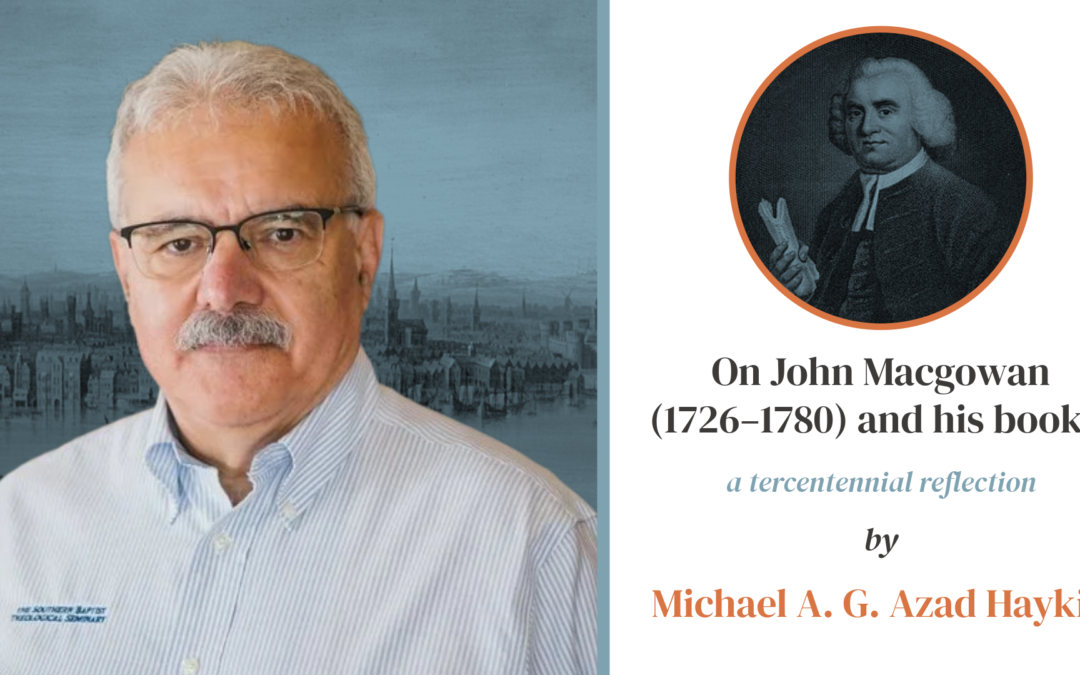
by Michael Haykin | Aug 10, 2026 | Church History
Although the name of John Macgowan, a Baptist author of the long eighteenth century, is all but unknown today, many of his books went through numerous editions during his lifetime and in the decades immediately after his death that bespoke a wide popularity amongst a certain class of readers on both sides of the Atlantic. With titles such as Death: A Vision (1766), Priestcraft Defended (1768)—a satirical attack on the University of Oxford for expelling six evangelical students—Infernal Conference: or, Dialogues of Devils (1772)—a definite forerunner of C. S. Lewis’ The Screwtape Letters—and Socinianism Brought to the Test: or Jesus Christ Proved to be either the Adorable God, or A Notorious Impostor (1773), Macgowan was well-known for his hard-hitting and, at times caustic, defence of orthodox Christianity.
Early years
He had been born in Edinburgh in October of 1726 and was apprenticed to be a weaver. In 1745‒46, though, he joined the ill-fated army of Charles Edward Stuart in the latter’s attempt to seize the throne of England. He fought at Culloden in April of 1746 and was one of the few Sottish soldiers to survive, fleeing for safety to Durham. It was there in the north of England that he was converted after hearing a Methodist preacher, John Unthank, and for a time he was a lay-preacher with the Methodists. Soon, however, he came to embrace Calvinistic convictions, which led him initially to become a Congregationalist and eventually to join himself to the Calvinistic Baptists. From 1751 to 1757 he pastored Hill Cliff Baptist Church in Warrington, where he also married Esther Rigby, his first wife. She died in 1762 after giving birth to their fourth child.
At the time of Esther’s death, Macgowan was pastoring in the market town of Bridgnorth in Shropshire. He married again in 1766, the same year that he accepted a call to pastor Devonshire Square Baptist Church in London—founded in the early 1640s with the justly-famous William Kiffen for its pastor, it was one of the oldest Baptist congregations in the land. He and his second wife, Mary Harper, were married in Bridgnorth’s parish church of St. Mary Magdalene since only Anglican ministers could perform a legal marriage.
A move to London
Macgowan’s ministry at Bridgnorth had been somewhat disappointing, which may have been an inducement to accept an invitation in September of 1766 to become the pastor of the congregation in London. In their call to him, the Devonshire Square congregation had stressed that while they were not a “fashionable people,” they were “tenacious of church order” and loved “to hear the doctrines of the gospel delivered experientially.”
His fourteen-year ministry at Devonshire Square was, it appears, quite a successful one; between 1769 and 1775, there were close to hundred baptisms. And by the 1770s, the church had grown to 150 members, nearly all of whom were tradesmen, artisans, and labourers. And it was in London that Macgowan especially made his mark as a voluminous and best-selling author. A two-volume set of his works, published posthumously in 1825, contains most of these writings.
On the Trinity
One that it does not contain is one of his earliest ventures into the world of print media, a lengthy letter that was published in 1762 as a postscript to a curious defence of the Trinity by John Allen, a prickly Baptist controversialist who ended up in America in the early 1770s where he helped to foment the rising tide of revolution. According to Walter Wilson (c.1781‒1847), the author of a four-volume history of the London Nonconformity, while Macgowan largely adhered to an orthodox view of the Triune God, he did not conceive of the title “the Son of God” to be an appropriate one for the second person of the Godhead in the immanent Trinity. In other words, Wilson maintained that Macgowan did not approve of differentiating between the Father and the Son in terms of the traditional phrase “the eternal generation of the Son”. In his letter on the Trinity, which he wrote in the Spring of 1761, though it was not published till the following year, Macgowan’s reflections on the Trinity described the persons as “first, second, and third” or “Father, Word and Spirit.” Nonetheless, he stressed, “I look on all the three personal subsistences to be absolutely essential to the deity,” co-equal in eminence, and together “one undivided essence.”[1]
However, a close reading of some of Macgowan’s other works does reveal his use of the term “Son” for the second person of the Godhead. In his funeral sermon for his fellow London Baptist minister, Benjamin Messer (d.1772), for example, Macgowan referred to “the Son and Holy Ghost, as distinct persons or subsistencies in the divine essence.”[2] And in his Socinianism Brought to the Test, published the year following his funeral sermon for Messer, Macgowan asserted that orthodox Christians worship the “Father, Son, and Holy Ghost,” believing that the Son is “the same in essence with the Father.”[3] In other words, it appears that Wilson’s remark about Macgowan’s understanding of the immanent Trinity, which he claims to have received on the basis of “private information” is simply wrong.
The eighteenth century, with the onset of the so-called Age of Reason, was witness to massive debates about the Trinity and how to properly speak about God. In many ways, the great theological battle of that era was over the received doctrine of there being three co-eternal and co-equal persons in the one Godhead. Macgowan was not ashamed to defend this traditional understanding of God.
His funeral in 1780 was taken by two of the most eminent Baptist leaders in the city, Benjamin Wallin and Samuel Stennett. He was buried in Bunhill Fields, that holy resting place for thousands of Nonconformists.
[1] John Macgowan, “Postscript” to John Allen, A compendious Descant of the Autogeneal, and Theanthropos Glories of Christ: or, The Crown of Crowns Set upon the Head of King Jesus (London: M. Lewis, 1773), 65‒66. Macgowan’s postscript is sometimes called A Letter to an Arian.
[2] John Macgowan, The Sure Foundation (London: G. Keith and J. Johnson, 1772), 7.
[3] John Macgowan, Socinianism Brought to the Test: or Jesus Christ Proved to be either the Adorable God, or A Notorious Impostor (London: G. Keith, J. Johnson, A. Bell, and J. Matthews, 1773), 22.
Stay in touch with CBTSeminary
For more information about CBTS, go to CBTSeminary.org
Consider giving to CBTSeminary to help us train the next generation of gospel ministers.
Apply to CBTS today to be sharpened for a lifetime of faithful ministry.
Follow CBTS on our socials: X | Instagram | Facebook | YouTube
Sign up for our newsletter and receive monthly updates related to the Seminary.

Born in England of Irish and Kurdish parents, Michael A.G. Haykin serves as professor of church history & biblical spirituality. Haykin has a B.A. in Philosophy from the University of Toronto (1974), a Master of Religion from Wycliffe College, the University of Toronto (1977), and a Th.D. in Church History from Wycliffe College and the University of Toronto (1982). Haykin and his wife, Alison, have two grown children: Victoria and Nigel.
He is the author of a number of books, including The Spirit of God: The Exegesis of 1 and 2 Corinthians in the Pneumatomachian Controversy of the Fourth Century (E. J. Brill, 1994); One heart and one soul: John Sutcliff of Olney, his friends, and his times (Evangelical Press, 1994); Kiffin, Knollys and Keach: Rediscovering Our English Baptist Heritage (Reformation Today Trust, 1996); ‘At the Pure Fountain of Thy Word’: Andrew Fuller as an Apologist (Paternoster Press, 2004); Jonathan Edwards: The Holy Spirit in Revival (Evangelical Press, 2005); The God who draws near: An introduction to biblical spirituality (Evangelical Press, 2007).
Course taught for CBTS: Biblical Spirituality.