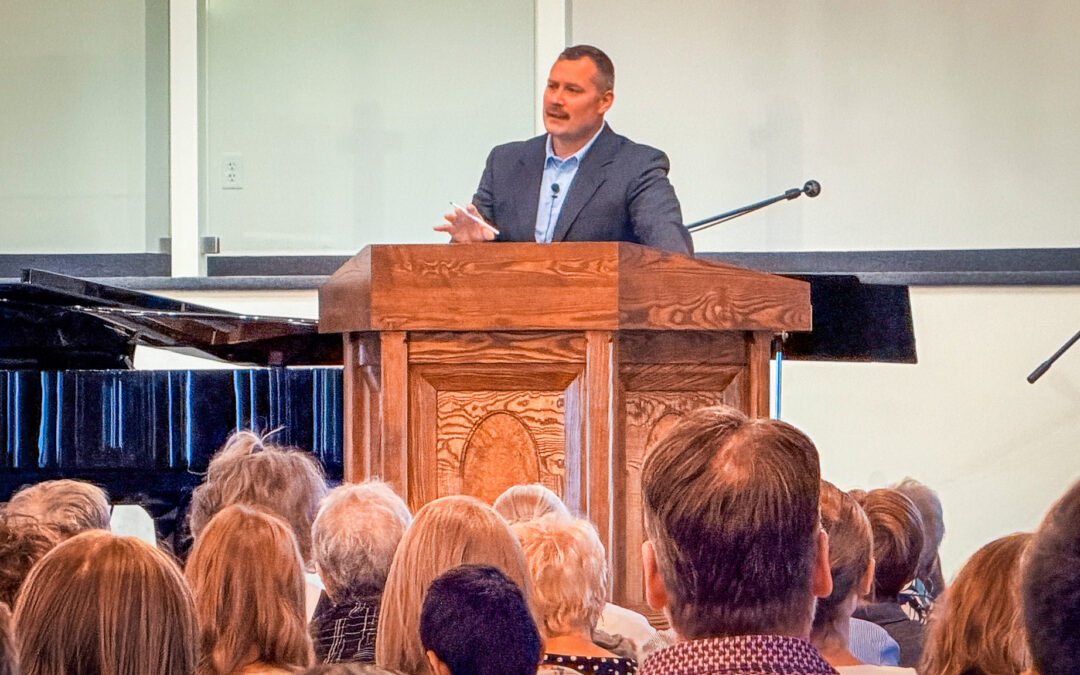
*The following is a portion of Austin McCormick’s sermon, “There is a Fountain,“ preached on June 28th at Covenant Baptist Church in Clarksville, TN.
Introduction
In the 18th century, there was a man who struggled with intense bouts of depression. When he was just six years old, he lost his mother. In his early adulthood, his relationship with the woman he loved ended. Shortly thereafter, His best friend unexpectedly died by drowning. And for several years, he despaired under the weight of his sin. But by the kind providence of God, he was eventually brought to an asylum where he could read the Bible. And upon reading these words from Romans 3:25, “Whom God hath set forth to be a propitiation through faith in his blood…” this man was converted to Christ!
This man’s name was William Cowper, the author of several songs we sing in public worship, such as God Moves in a Mysterious Way, and more. But from the opening words of our text, Cowper authored his most well-known hymn: There is a Fountain Filled with Blood. As a believer, Cowper would continue to struggle with depression and his remaining sin. But Zechariah 13 brought him comfort because it pointed him back to that fountain where sinners lose their guilty stains.
As we consider Zechariah 13 in this blog, I hope you will experientially know something of this comfort that Cowper received under the gospel fountain. I further hope this gospel fountain will lead you to evangelical obedience towards Christ and deepen your dependence upon Him.
A Fountain for Cleansing: Zech. 13:1
A. This Fountain Flows from Him Whom They Have Pierced. Zech. 12:10
The words On that day at the beginning of this versepoint us to the day Christ died to save sinners. We know this because this text is directly related to its preceding text, Zechariah 12:10. On that day, God said He would pour out His Spirit of Grace, causing sinners to look upon the pierced Messiah and mourn on account of their sins committed against Him. And our text is still referring to that same day.
The same audience is mentioned in both texts: the house of David and the inhabitants of Jerusalem, which is simply Old Testament language for “believers.” The same problem is addressed in both texts, namely, sin committed against God. But the comforting connection between these verses is this: Those who look upon the Pierced One by faith and mourn with repentance—these people are not left without hope! Although crucifying the Lord of glory was a heinous crime, in God’s plan of redemption, this act has also resulted in the greatest news of all time! When Christ was killed on the cross, a fountain of mercy came flowing forth from Him who they have pierced. So, Cowper is right to note that this is no ordinary fountain. This is a fountain filled with blood, drawn from Immanuel’s veins.
B. Purpose of this gospel fountain.
And consider now the purpose of this fountain.The main emphasis of this fountain is not to quench thirst, but to provide cleansing. When people get themselves dirty, fountain water is needed to help them to wash and be cleansed. We can illustrate this purpose by considering children who play outside in the mud. When they’re done playing in the mud, and they want to come inside, what must they do before their mother lets them come in? They must rinse their bodies with the garden hose and cleanse themselves, so they don’t track mud all over the house. The hose, or the fountain, is used for the purpose of cleansing.And in this illustration, the fifth mud points us to how sin makes us unclean. But the fountain points us to how we can have our sins removed! Similarly to how a fountain cleanses our dirty bodies, the gospel fountain cleanses our sins!
And this is only possible because of the shed blood of Jesus Christ on behalf of sinners. We cannot remove our sins by our attempts at obedience. That is like rolling around in the mud for cleansing… But Jesus offered Himself up to God without blemish to take away our sins. (Jn. 1:29). Jesus shed His blood so that God would forgive us of our sins and cleanse us of all unrighteousness. (1 Jn. 1:9). So, when we trust in Him alone for our salvation, we discover the good news that John writes about in His first letter: the blood of Jesus His Son cleanses us from all sin. (1 Jn. 1:7). Though our sin makes us dirty, Jesus’ blood washes us and makes us whiter than snow. (Ps. 51:7; Is. 1:18).
C. Continually Existing in the Status of Being Open. מָקֹ֣ור נִפְתָּ֔ח
And the good news this morning is that this fountain is open right now! This is not a fountain that was once opened but is now sealed or closed. If we were being overly literal with our translation of the original, we could translate verse 1: “On that day there will be a fountain opened that will continue to exist in the status of being open!” This fountain wasn’t just for the post-exilic Jews or the first-century disciples. This fountain continues to be open, even now, for sinners like us. Which leads us to our first application for unbelievers.
Unbelievers: You must come under this fountain for salvation.
By nature, you are unclean and unacceptable in the eyes of God. And you have committed filthy acts which make you unworthy of salvation or heaven. Your sins deserve hell, and you cannot clean yourselves up by your own goodness. So, you must come to the fountain of Christ by faith for cleansing. Only His blood can take away your sins.
Obj. #1. But perhaps you have some objections to why you won’t come to Christ to receive this cleansing. Perhaps you’re thinking: “I’m not ready to come to Christ yet, because I don’t have my life in order. I need to be a better person, and then I’ll become a Christian.” Or maybe you’re thinking: “I need to feel a deeper hatred of my sins; I need to sense some preparatory work of God moving in my soul, before I have some merit to go to Christ.” Friend, if this is how you are thinking, then you are reading this text backwards! We don’t clean ourselves up to come to Christ! No, we come to Christ with our sins! We come to Him confessing that we are defiled and that we cannot clean ourselves! So, don’t wait until you think you’re better to come to Christ.Come, ye weary, heavy laden, lost and ruined by the fall! If you tarry till you’re better, you will never come at all.Come to Christ with your sin, and He will cleanse you.
Obj. #2. Perhaps your mental objection to resisting the gospel is something like this: This passage says that this cleansing is for the house of David and the inhabitants of Jerusalem—and I don’t know if that is me. I don’t know if I’m numbered among the elect. I don’t know if this promise belongs to me. Friend, if this is your objection, then you must look to the cross before you would find any evidence of your election. You don’t try to find out if you’re elect before you close with Christ. No amount of introspection will reveal whether you are elect or not. You come to Christ first for cleansing and discover that whoever comes to Him, he will never cast out. (Jn. 6:37).Then, and only then, do you learn that those who come to the Son were those given to Him by the Father in eternity. (Jn. 6:37). So don’t gaze at your navel to discover if you’re elect before coming to Jesus. Come to the fountain of Christ first, and then the rest of His gospel promises will become precious to you. A second application for believers is this:
Believers: You must continually live under this fountain opened by Christ.
You must remain under this fountain because you still have remaining sin.Martin Luther rightly taught us that the entire life of believers should be one of repentance.You don’t just repent when you first come to Christ. You must continue to confess your remaining sins to God. And when you do, you can trust that this fountain is still open for your remaining corruptions.
You must also remain under this fountain to avoid despair. As a Christian, you have been justified through the blood of Christ. (Rom. 5:9). God objectively approves of you and considers you no longer guilty. And Jesus shed His blood to remove your guilt from you. Indeed, His blood has been sprinkled on your conscience to purify your conscience, so that when you trust in Him, you don’t have to live in despair for what you’ve previously done. Similarly to how the goat was sent into the wilderness on the day of atonement, Christ shed His blood to make expiation on your behalf, so you could “lose all your guilty stains.” (Cowper).
You must further stay under this fountain for the enjoyment of your assurance. Our confession rightly teaches that our assurance is founded on the blood and righteousness of Christ. (2LCF 18:2).Yes, good works improve our assurance. And yes, the testimony of the Holy Spirit grows our assurance. But if you try to look at these alone, completely detached from Christ’s shed blood, you will struggle with assurance—because these three grounds are like a three-legged chair. If you lose one of them, your assurance will fall over and diminish… The objective reason that God approves of you is that Christ shed His blood for you. The only reason you can see fruit in your life as a believer is because Christ shed His blood to change you. And the Holy Spirit takes His Word, and bears witness with your spirit that Christ’s blood was shed for you. There is no assurance without the precious blood of Christ. So, look to Christ.
And then lastly, you must stay under this fountain for strength to live the Christian life. The relief of sins forgiven motivates us to work by love in obedience to God. As the Scottish Preacher Ralph Erskine wrote: The gospel gives us wings to actually live for God’s glory. So, don’t take Jesus’ shed blood as your license to sin. Receive the blessing of spiritual cleansing and walk in the purity that Christ’s blood purchased.
Conclusion
Has your soul rejoiced that Christ’s blood has washed away your sins? Has God transformed you into someone who is zealous for His worship? Can you sing with William Cowper: E’er since by faith I saw the stream thy flowing wounds supply, redeeming love has been my theme, and shall be till I die?
If you cannot answer yes to any of these questions, if your soul is still miserable in the estate of sin, then I invite you once more to come under the fountain of Christ. Believe in Him today—and His redeeming love will be your theme until you die.
Austin has been one of the pastors of Covenant Baptist Church since February 2024. He holds a B.A. in Biblical Studies from Spurgeon College and an M.Div from Covenant Baptist Theological Seminary.
By God’s free and sovereign grace, Austin was saved early in his adulthood. He is married to Rachel, and together they have three children: Geneva, Benjamin, and Bristol.
The world of higher education is in a lot of flux right now. Traditional brick-and-mortar schools are having to adapt to changes in technology and consumer demand. Once repositories of knowledge, schools are now wrestling with their place of service in a world where knowledge is ubiquitous and instantly available via a pocket-sized device.
So in a changing landscape like this, what use is a seminary at all? Why can’t I just use Google? Or, to run the other direction, if ministry is inevitably personal and relational, how can seminary education even be done remotely? These are great questions that I would like to briefly address by delineating some blessings and dangers of remote seminary education. Perks and Pitfalls, we might call them.
First, the Perks. A major benefit of remote theological education is the ability for someone to get further education while remaining in his or her place of ministry service. Formal theological education once required physical relocation for several years, often meaning that unless you lived and worked at a church near a seminary, you had to leave your current place of service to get an education. That isn’t the case now. Technology allows pastors, deacons, and other aspiring church leaders the ability to remain in their own local church while pursuing further theological training. Staying in one’s own church also allows for the integration of classroom study immediately into real-life ministry. Plus, students can be mentored by their own pastors, which is a dynamic that traditional seminaries often struggle to provide, simply because of the sheer number of students. Staying in one’s own church can have real benefits.
Second, and very much related, is the blessing that remote theological education provides for both missionaries on the field and for international students. These students are able to receive a quality education without having to leave the mission field or having to travel great distances. Remote education opens the door for many students for whom formal theological education would otherwise be practically impossible.
Third, remote theological education is usually accompanied by efficiencies that traditional brick-and-mortar schools struggle to provide in the same way. Or, to put it simply, remote seminaries can be more financially feasible for more students because of the reduction in operational costs. CBTS doesn’t have a massive campus with student housing, library buildings, or cafeterias, and that enables tuition to remain drastically lower than traditional higher education options. Lower tuition and fees mean that more people are able to consider theological education, and are able to consider it with less dependence upon student loan debt.
But lest we think that distance education is the solution for everyone, we would be wise to investigate the drawbacks of remote learning. Remote learning isn’t for everyone, and shouldn’t be undertaken without the proper consideration and counsel.
A first potential pitfall of remote theological education is the danger of isolation. Self-paced coursework can be a real blessing for those who need it, but it can also be a real struggle, especially for highly relational students. Without regular interaction and encouragement, some students can feel alone in their studies. That’s why at CBTS, we encourage students to take as many live remote classes as possible during their studies with us. Further, all of our pastoral-track degrees require regular meetings between the student and their pastoral mentor. These options, combined with additional fellowship opportunities (e.g., online groups, social media interactions, annual Covenant Conference meet-ups), can help students battle against loneliness during their remote education.
Second, a related danger of remote education is filling one’s head without watching one’s heart. Students can be puffed up with head knowledge while neglecting the care of their own souls. While that danger is not unique to remote theological education, the danger is certainly compounded by the opportunity for isolation. Thus again, CBTS makes a priority the local church and a student’s own pastoral relationships. Further, CBTS students meet twice a year with the Dean of Students, Rex Semrad, for academic guidance and encouragement. CBTS works hard to provide opportunities for growth in personal piety that accompanies growth in doctrinal knowledge.
Third, a final pitfall that can surround remote education is the flip side of one of the benefits: flexibility. The same flexibility that often draws students to remote, asynchronous learning can also serve as a real stumbling block for some students. On-demand coursework, flexible deadlines, low-cost tuition, and other real blessings can easily turn into a trap if the student is not disciplined. Students should know themselves and their weaknesses and put in place measures to ensure that they won’t get too far behind. We all need accountability to help us perform at our best, and seminarians are no different. That’s why regular meetings with local church mentors and with the Dean of Students at CBTS can be so helpful. We each need encouragement to run our race well, and CBTS students can do that if they are wise and make a plan.
In sum, remote theological education is a blessing afforded by technology that previous generations could only dream about. But, just like any technological innovation, it must be stewarded wisely. It can be a real blessing, but it also has real pitfalls if one is not careful. If you would like to learn more about the blessings afforded by remote theological education at CBTS, or if you are struggling with any of these pitfalls yourself, please feel free to reach out to the staff at CBTS. We’d love to share with you and see if CBTS might be a good fit for your theological training.
Jon English serves as Academic Dean and Professor of Systematic and Historical Theology at Covenant Baptist Theological Seminary. Previously he served as Pastor of Discipleship for Morningview Baptist Church in Montgomery, Alabama. He has earned a Bachelor’s degree from Auburn University Montgomery, a Masters of Divinity from The Southern Baptist Theological Seminary, and a PhD in Systematic and Historical Theology from SBTS. Jon English is a member of the Evangelical Theological Society and an Ecclesial fellow for the Center for Pastor Theologians.
Course taught at CBTS: The Decalogue & the Sabbath in Redemptive History
Every week, Pastor Seth Beyersdorf stands before the congregation of Oakridge Community Church in Stillwater, Minnesota, with the responsibility of preaching God’s Word and shepherding Christ’s flock.
It is a calling he has embraced for many years. Seth and his family have been members of Oakridge since 2013. He was called by the church to pastoral ministry in 2016 and became the church’s primary preaching and teaching pastor in 2019. Through seasons of growth and challenge, he has sought to faithfully minister God’s Word to the people entrusted to him.
To help him develop in these pastoral responsibilities, Seth pursued a Master of Divinity through Covenant Baptist Theological Seminary. Rather than pulling him away from ministry, his theological studies became an important tool in strengthening it.
“CBTS has been a vital part of training and preparing me to minister God’s Word to His people,” Seth explains. “My time at CBTS has helped me not only learn to handle God’s Word with carefulness and reverence, but also with pastoral concern.”
The phrase pastoral concern captures much of what Seth gained during his years of study. Theological education is often associated with gaining knowledge, but for Seth, the goal was never simply to know more. The aim was to become a better shepherd of Christ’s people. As he studied Scripture, theology, church history, and the biblical languages, he found those lessons shaping the way he preached, counseled, and cared for members of his congregation.
For Seth, seminary was never disconnected from real ministry. All that he was learning could be carried immediately into the life of the church he serves. Whether standing behind the pulpit on Sunday morning or sitting across from a church member in need of encouragement, he was learning how to apply God’s Word with greater wisdom and care. His professors deepened his understanding of Scripture and strengthened his ability to communicate its truths to others.
What Seth appreciates most about his education at CBTS is how well it serves men who are already engaged in ministry.
“I wholeheartedly recommend CBTS to anyone thinking about entering seminary studies, especially those who are already engaged in ministry in the local church,” he says. “The study format allows for your classes to be integrated into your current schedule.”
As he reflects on completing his Master of Divinity, Seth is deeply grateful—not only for what he learned, but also for those who made the opportunity possible.
“As a pastor with a younger family, finances are always tight,” he says. “I am filled with thankfulness to the Lord for stirring up the hearts of His people to help provide such rich theological education at an affordable cost.”
Seth’s experience reflects a reality shared by many CBTS students. They bring local church involvement, ministry, and family responsibilities with them as they pursue theological education. They are faithfully serving while seeking to grow in their ability to preach, teach, counsel, and shepherd God’s people. For many, affordable tuition makes that pursuit possible.
The generosity of ministry partners helps remove financial barriers for men who are already laboring in Christ’s kingdom. As Seth’s story demonstrates, the impact of their support extends far beyond a classroom. It reaches local congregations, families, and communities that benefit from better-equipped pastors and church leaders.
Today, Seth continues serving Oakridge Community Church with a deeper understanding of God’s Word and a renewed commitment to shepherding Christ’s people faithfully. His story is one example of how theological education, supported by God’s people, can strengthen local churches for generations to come.
If you would like to help make stories like Seth’s possible, we invite you to learn more about supporting the training of future pastors and church leaders through CBTS.
Support CBTS by becoming a monthly ministry partner
As an example of poetic biblical meditation, I have chosen three separate expositions and poetic expressions to share. Our congregation has sang each of these poems at one point or another in the last four years (corporately or in small groups). No surprise, some are better read than sung. However, for the sake of emphasizing the usefulness and importance of artistic expression through Reformed, Biblical, Experiential Spirituality, let us share a devotion from Scripture and then consider the English poetic expression.
The Glory of God’s Wrath
Few pastors preach through Nahum; it only takes the first chapter to understand why. When we come to read Nahum 1:1–8, relating to God’s wrath, we have two worthy ways of rendering the text. First, we look to the joy of our salvation. Second, we trust God’s judgment and turn to repent and grow sorrowful over the evils and wickedness that demand justice and reprisal. Yet Nahum teaches more than flat, cold judgment. Nahum teaches that the Lord’s wrath is good. Nahum calls God’s people to worship when the wrath arrives.
Nahum 1:7
Nahum receives a “burden” from the Lord (Nahum 1:1). Three times Nahum refers to God as the avenger who will come to deliver what is spelled out in the burden. Yet this is not a letter about Israel, but rather about the glory of God. The Almighty desires for His name to be honored and revered. Nineveh has traduced the Lord. Even as the wrath due is expounded, God has control and discernment in His anger concerning them, such that He will send the most chaotic of instruments to judge and purify the land. In His wrath, the sea is dried up, the clouds are stirred as in a storm, the mountains tremble and melt, and the flowers wither before Him. The earth and all its flora and fauna flee but cannot escape witnessing the judgments here outpoured. There is no acquittal—righteousness must be found in purity. Yet, God alone is righteousness; He is good, a stronghold on this great day of judgment and vengeance for His holy name. Those unrighteous will suffer the darkness of wrath. But who is kept in the stronghold of God (Nahum 1:7)?
No one can stand before God’s indignation. Only the pure righteousness of the divine nature can control such might and power. When the Lord speaks of being “slow to anger,” He is here articulating the control and operation of His power—He is not led my passions as we are. God executes His sovereign purposes with exactness, precision, and perfection. But who has need of a stronghold? Who will receive the blessedness of His goodness as He exacts His judgment in accordance with righteousness?
Nahum abruptly speaks the evangelical call to faith and repentance that will take further shape in the following verses (Nahum 1:7, 15). Those who trust in Him are kept, held fast, preserved. Jesus Christ—the object of faith through all of Scripture—He alone preserves through the divine act of receiving the wrath and vengeance herein described. God’s covenant people experience the exclusivity of redemption, miraculous acquittal, and the enormity of mercy’s inheritance. Do you experience this preservation today? For those in Christ, the trials and troubles you face may appear heavy, but they are nothing compared to the actual wrath of God that consumes utterly and eternally. Your Savior covered you and preserved you from such wrath—what you face may be challenging, but more than preservation, Jesus is shepherding you and purposing your trials through His shield of goodness.
We celebrate His glorious name in its preservation and demonstration. This does not mean we grow cold or that we wickedly celebrate destruction for destruction’s sake—we celebrate for our Savior.
Praise Him, All-conquering Savior
Whose faithful fortress does defend
His wrath consumes all the wicked
Their reign a tumult swift to end
All evil shall He crush; believe!
Glorious One, this praise receive!
When earth and heaven shall tremble
Yes, earth, all its mountains to quake
His voice a salve for His people
Unto the sinful with torment shake
All comfort shall He give; believe!
Glorious One, this praise receive!
Won’drous Your grace is transforming
So too, Your anger satisfied
In justice sate the sword of bloodguilt
And on Your righteous steed do ride
All cleansing is His hand; believe!
Glorious One, this praise receive!
Chastise in me straying corruption
Starve Satan’s hateful maw
Stand now upon the neck of my will
Till in Your mercy I may awe
All strength unto the end; believe!
Glorious One, this praise receive!
Come swift, Lord, and tend the battle
Then we will see the wine vat spill
Fury, unto Your hell deliver
Shall we with mercy drink our fill
All heaven then will sing; believe!
Glorious One, this praise receive!
Lead me Oh Lord my sin to hate
And take joy—in Your child—to spare
May I love Your wrath as glory
To bring all justice thus to bear
All watchful eyes will see; believe!
Glorious One, this praise receive!
About the Author
Christopher Ellis Osterbrock (DEdMin. in Biblical Spirituality, The Southern Baptist Theological Seminary; PhD Student in Historical Theology, Puritan Reformed Theological Seminary) is senior pastor of First Baptist Church of Wellsboro, PA. He is the author of What is Saving Faith? (March, 2022), as well as editor of several reprints
When leading a college-level course on Spiritual Formation, I’ve heard the response a few times: “Why write poetry you know no one will read?” I’m sure we can understand the sentiment—not many of us will be remembered for our journals like Jonathan Edwards or Anne Dutton. However, we are encouraged by their writing style, perplexed by some of their narratives, and even left wondering why they wrote when they didn’t know anyone might read beyond their first audiences. The means of reflective, biblical meditation, such as these former saints engaged in, may not be our experience, but the discipline of biblical meditation jumps straight at us from Scripture.
Even for those who do not enjoy reading or writing poetry, the process remains pregnant with spiritual benefits. The work of applying Scripture, organizing the mind, resting in a prayerful engagement with your heart before the Lord—how could these not develop spiritual fruit? The following advice is intended for your own spiritual edification in learning a new means for biblical meditation. Likewise, for those in preaching and teaching ministries, the following has served me as one small part of my regular sermon preparation.
Let’s look at three components of poetic biblical meditation.
Remembrance
When writing poetry in contemplation of a Bible passage, we operate two kinds of remembrance. First, the action of remembering the scope of the account and its context. Second, the personal act of recalling events in our own lives, even previous engagements with that Scripture. As should be easily deduced, the biblical account must come first. The Bible speaks of remembering as a discipline, both in forms of command and of spiritual endeavor. God causes His name to be remembered (Exodus 20:24). The Spirit used prophets to remind men and women of their obstinance and wickedness (1 Kings 17:18; Hosea 8:13). The Spirit enlightens the mind to remember for purifying doctrine and serves to lead recall in the prayers of the saints (John 12:16; 13:7; 14:26; 2 Timothy 1:3–4). Likewise, expositors like John Calvin intimate a necessity of remembrance for a multiplicity of uses, such as benefiting our growth by seeing how God has intervened, preserving our strength and stamina by assuring us of His promises, and correcting us by revealing our sins and the wickedness of others.[1]
By working our minds through the territory of imagination, guarded by our orthodox doctrines, we can engage the Scripture prayerfully, seeking to apply what we know of the context and how we interact therein. Rewording and organizing the themes and artistry of the passage in its context draws us to see ourselves in consideration of the truths God brings to us and from His Spirit within us.
Digestion
As we make notes and begin ordering the passage as a meditation, we digest the Scripture in a way that we perhaps wouldn’t preach or teach. Yet this process allows us to digest the truths and applications from a different part of the brain. We draw out, ruminate, cogitate on the doctrinal truths until we can develop them in our own words, and then beautify those expressions. The deep analysis of exposition finds a partner here in expressing truths we would otherwise preach, into truths we force ourselves to rephrase and experience in a sensory exercise (touching, tasting, hearing, seeing, remembering). Keeping the Word primary, we are called to be taught, edified, corrected, and encouraged by the doctrines and truths expounded in the Word. By exercising the artistic components, we engage our whole selves without falling into occultism, eastern mysticism, or the cloud of unknowing—biblical meditation has a longer tenure than any of those demonic rituals. Reformed Baptists are grounded in solid doctrine, but this does not mean we can’t digest a text poetically once in a while.
Through the art and practice of reworking, drawing out theological nuance, and exploration of our sensory faculties, we experience personal edification. The process of meditation from David or Moses demonstrates the God-given capacity to ruminate upon the world while turning those experiences and language into a means for profiting the church, ultimately glorifying God according to the deep truths of His attributes so far explored. With these former saints, we look to the stars and wonder at God’s care (Psalm 8), we consider the ant and learn God’s provision (Proverbs 6:6–11), we cogitate on the sparrows and see the providence of our Creator and the neglect we foster in our fretfulness (Luke 12:6–7), and we hear one crushing grapes and discover the Triumphant Savior valiant in blood (Revelation 14:19–20). Digestion in poetic biblical meditation leads to intimate expressions of the text as it requires sufficient time to spend calculating the words, exhausting the memory banks, and taking seriously the act of thinking of that which is praiseworthy, true, beautiful and excellent according to the words God has given.
Adoration
As this process takes a personal shape, our meditative work infills our minds to reprocess even our own mental, emotional, and spiritual state according to God’s Word. Meditation is purgative in the sense that we forsake worldly understanding and the words and topics that would hinder our praise. Meditation is formative in the sense that we draw near to Christ by faith, establish words, word-pictures, and the mental acuity to rightly speak of Him and share His work within us and without us. Biblical meditation serves as personal praise to God both in the primary work of seeking to draw out and prepare the poetic material, as well as the application of the work in worship and as worshipful.
God deserves to be worshipped through His Word; the poet thus anticipates that the text will teach and appeal to the senses and intellect, heart and faith of the reader—even if it is just that single pilgrim drawing upon the text. The adoration which flows out of meditation ought to leave a mark upon our prayers, sermons, or witness in general. As a pastor, I often force myself into the questions: How am I using the text not only to preach but to adore? How will the Spirit use the text not only to edify my walk of obedience but to stir my affections in every faculty of my personhood?
Concluding remarks
Poetic biblical meditation draws us to make a recreation of our words and expressions. Through this discipline, we are put into a place where we seek wordsmith precision. We are forced to capitalize on tact and correct vocabulary, tempo and cadence, grammar, and emphases. Does such work hinder our pulpit presence? Our goal is spiritual vitality, adoration of the Triune God, and usefulness in offering our words back to God’s people. Even if you fail miserably at writing poetry, others in your congregation likely live in an artistic world that must and ought to be used to serve and glorify Jesus Christ—only in Him will such desires be satisfied.
About the Author
Christopher Ellis Osterbrock (DEdMin. in Biblical Spirituality, The Southern Baptist Theological Seminary; PhD Student in Historical Theology, Puritan Reformed Theological Seminary) is senior pastor of First Baptist Church of Wellsboro, PA. He is the author of What is Saving Faith? (March, 2022), as well as editor of several reprints
Sign up for our newsletter and receive monthly updates related to the Seminary.
[1] I recently wrote an in-depth analysis of Calvin’s use of remembrance drawn from his Institution (1550). See Christopher Ellis Osterbrock, “‘To Recall Godly Minds from Despair’: The Utility of Memory as a Spiritual Discipline in John Calvin’s Institutio,” in Puritan Reformed Journal 18.1 (January 2026).
We use cookies on our website to give you the most relevant experience by remembering your preferences and repeat visits.
By clicking “Accept”, you consent to the use of ALL the cookies. Do not sell my personal information.
This website uses cookies to improve your experience while you navigate through the website. Out of these, the cookies that are categorized as necessary are stored on your browser as they are essential for the working of basic functionalities of the website. We also use third-party cookies that help us analyze and understand how you use this website. These cookies will be stored in your browser only with your consent. You also have the option to opt-out of these cookies. But opting out of some of these cookies may affect your browsing experience.
Necessary cookies are absolutely essential for the website to function properly. These cookies ensure basic functionalities and security features of the website, anonymously.
Cookie
Duration
Description
cookielawinfo-checkbox-analytics
11 months
This cookie is set by GDPR Cookie Consent plugin. The cookie is used to store the user consent for the cookies in the category "Analytics".
cookielawinfo-checkbox-functional
11 months
The cookie is set by GDPR cookie consent to record the user consent for the cookies in the category "Functional".
cookielawinfo-checkbox-necessary
11 months
This cookie is set by GDPR Cookie Consent plugin. The cookies is used to store the user consent for the cookies in the category "Necessary".
cookielawinfo-checkbox-others
11 months
This cookie is set by GDPR Cookie Consent plugin. The cookie is used to store the user consent for the cookies in the category "Other.
cookielawinfo-checkbox-performance
11 months
This cookie is set by GDPR Cookie Consent plugin. The cookie is used to store the user consent for the cookies in the category "Performance".
viewed_cookie_policy
11 months
The cookie is set by the GDPR Cookie Consent plugin and is used to store whether or not user has consented to the use of cookies. It does not store any personal data.
Functional cookies help to perform certain functionalities like sharing the content of the website on social media platforms, collect feedbacks, and other third-party features.
Performance cookies are used to understand and analyze the key performance indexes of the website which helps in delivering a better user experience for the visitors.
Analytical cookies are used to understand how visitors interact with the website. These cookies help provide information on metrics the number of visitors, bounce rate, traffic source, etc.
Advertisement cookies are used to provide visitors with relevant ads and marketing campaigns. These cookies track visitors across websites and collect information to provide customized ads.