by CBTS Student | Apr 13, 2026 | Worship
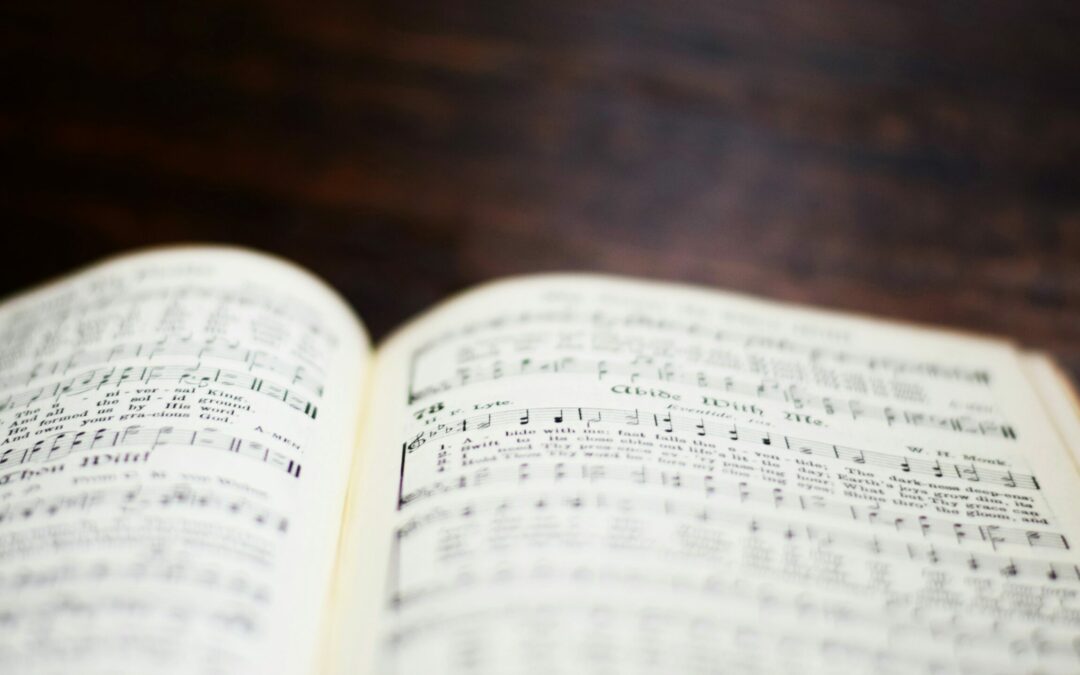
Songs are not merely words or music; by the wise design of our Creator, they are crafted to dwell within us. In Colossians 3:16 (and its parallel passage, Ephesians 5:18-19), we find the primary directives for congregational singing—an instruction that shapes how the word of Christ takes root in the public worship of His Church.
Let the word of Christ dwell in you richly, with all wisdom teaching and admonishing one another with psalms and hymns and spiritual songs, singing with gratefulness in your hearts to God. —Colossians 3:16 (LSB)
I. What We Sing: The Biblical Content
So, what should we sing? God commands the content plainly: psalms, hymns, and spiritual songs. It is well beyond the scope of this article to discuss the topic of exclusive psalmody, but the reader is encouraged to read the following helpful series of articles from Dr. Waldron. While we may be permitted to sing more than psalms exclusively, we must not exclude psalmody in our Lord’s Day worship. This is the common error in our day, and there is much work to be done in the church concerning psalm singing. Psalms are obviously didactic as a divinely authorized method of teaching in both the Old and New Testaments. Furthermore, today, not all songs called ‘hymns’ or ‘spiritual’ are didactic in nature, but the ones we sing in worship must teach us something revealed in Holy Scripture.
Equally important is what we are not to sing in worship:
- Songs void of the word of Christ and lacking any biblical teaching at all.
- Songs that are not arranged for congregational singing (e.g., songs tonally designed for a solo pop vocalist, songs that profit heretical groups regardless of content, etc.).
While there are certainly some modern hymns that are doctrinally sound and stylistically appropriate for congregational singing in worship, the vast and ecumenical history of Christian hymnody is far too rich to exclusively cater to present musical trends.
II. How We Sing: The Proper Posture
After all, the directive of Colossians 3:16 and Ephesians 5:18-19 has in view not only the content of what is being sung, but the posture as well. When applying biblical wisdom to our singing, we must be diligent in not allowing the form to overshadow the content of the teaching. Of course, this prohibits certain styles of music from ever being used to accommodate the singing in corporate worship.
Too many (otherwise biblically faithful) churches allow for performers to ‘lead’ a congregation. Expository preaching and the lack of an altar call alone do not constitute biblical worship. An expository, gospel-saturated sermon amidst performative emotionalism in the element of singing is nonetheless a trampling of God’s courts (Isaiah 1:12).
We must critically evaluate how we ought to sing in worship: with wisdom and not with a posture of performance. Even songs with solid doctrine become problematic when arranged in a performative, emotionalistic manner where the form overshadows the content. And as congregational singing is a form of teaching in a formal meeting of the church, the eldership should be diligent to oversee which songs are being selected each week and approve any hymnals used.
The unified voice of the congregation is the lead instrument in public worship. Any musical instrument that overpowers the singing inherently violates the biblical principle. At this point, church leaders must ask themselves hard questions:
- How many amplified voices and instruments does it take to lead the singing?
- Will this overpower the congregational voices (the primary instrument)?
- Is it wise to have a woman lead the singing (even if the choice of songs is under the oversight of the eldership)?
- Since singing is teaching, is it permissible for a woman to teach in this capacity?
- Is it wise to establish a ‘praise team’ or band that assumes a posture of performance and dynamically overpowers the voices of the congregation?
I fear that many in the church have compromised on biblical principles for the sensual enhancement of the musical experience. There’s nothing wrong with a good concert, but that’s not what the singing element in the Lord’s Day worship should seek to emulate.
On the other end, many do not sing at all, or if they do, in a half-hearted lip-sync. Raise the voice God gave you for the reason He gave it to you. Not singing along with the congregation is like plugging your ears during the sermon.
III. Why We Sing: The Primary Purpose
Why do we spend anywhere from a quarter to a third of our time in corporate worship singing every Lord’s Day? Because singing is didactic, that is, a primary form of teaching. We must sing with all wisdom, as songs are tools of teaching and admonishing. Wisdom must be applied to this teaching and admonishment through the congregational singing of God’s people in corporate worship. This is how the word, or message, of Christ dwells richly in us.
The Triune God loves music, and He loves songs. His Word makes this clear. A substantial portion of the Bible is essentially song lyrics. Christianity is a uniquely musical religion because singing songs is commanded in our worship. Moreover, it is an ordinary means of grace—a faith-increaser. Just as through preaching, prayer, giving, baptism, and the Lord’s Supper, singing is a way that God communicates His grace to us. He graciously gave us the ability to memorize words and songs about Him. When a tune is paired with a text, the melody helps us memorize and internalize the words, embedding them deeply in our affections.
There are plenty of Christians who, while being filled with the Holy Spirit, at the same time refuse to let the word of Christ dwell richly in them by forsaking this vital means of grace. Why don’t you sing with gratefulness in your heart to God? How grateful for your salvation are you then? Have you let something else dwell in you richly? What about the word of Christ!?
Pastors and Song Leaders, are all the songs sung in worship in your church teaching from Scripture? If so, is this teaching and admonishment through song being done with all wisdom? In your church, is singing acknowledged as a means of grace with the primary purpose of richly instilling the message of Christ?
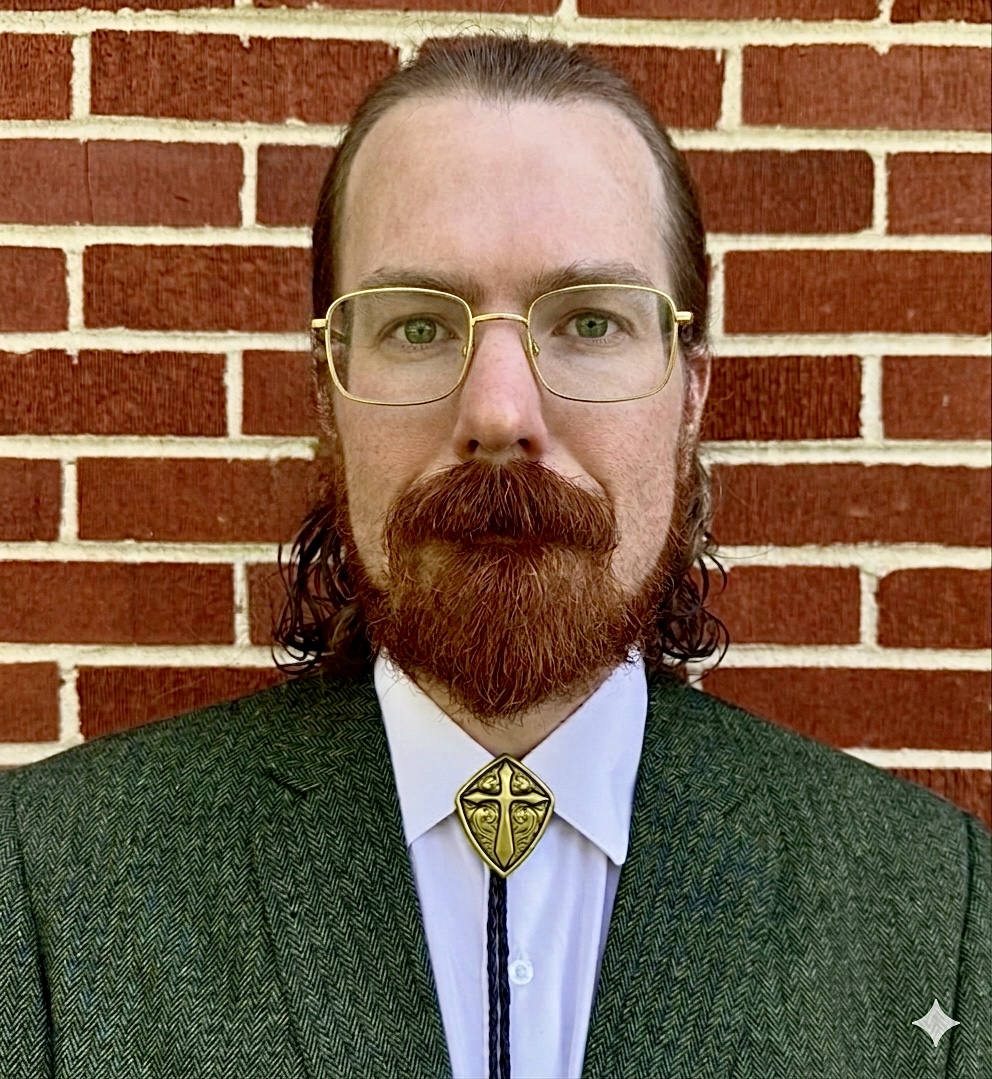
About the Author: Michael Mullin
Michael Mullin is a student at CBTS aiming to graduate with a Master’s of Divinity in 2027. He has led the congregational singing in worship for the past 5 years, and has served in various music ministry roles for much longer. Before being called into ministry, he worked in the Nashville music industry. Michael, his wife, and daughter live in Hendersonville, TN.
This blog post is authored by a student of Covenant Baptist Theological Seminary.
by Sam Waldron | Apr 10, 2026 | Practical Theology
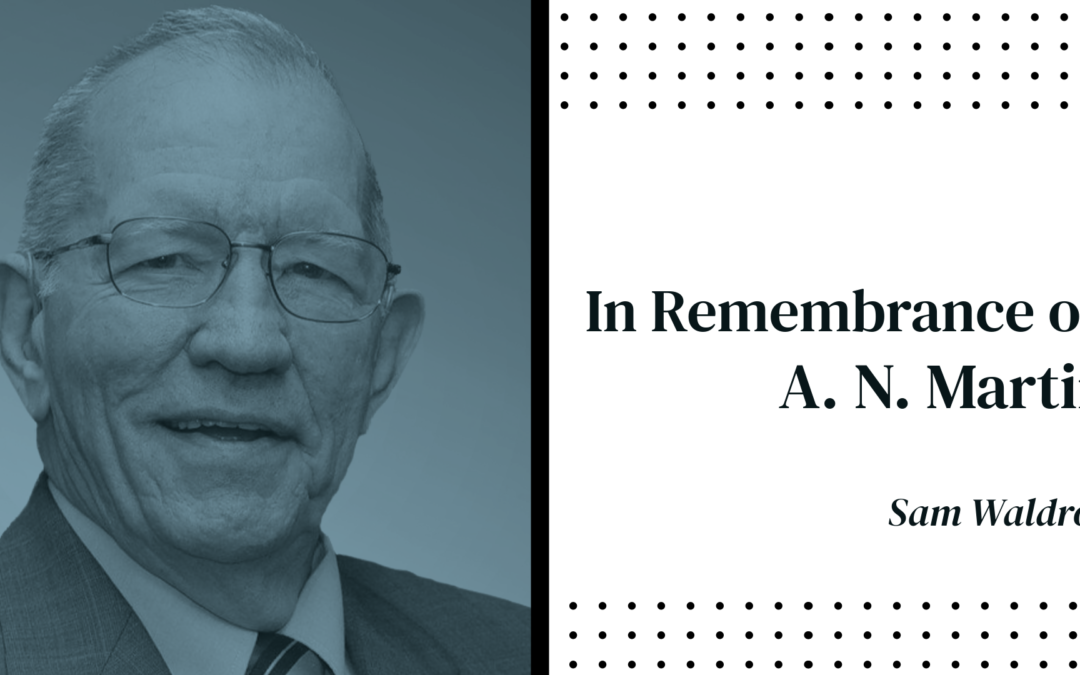
I have seen a number of appreciative mentions of A. N. Martin online since his passing several days ago. I can only view them with great appreciation for the positive remembrance of this godly and useful man’s life.
As one of his students, I remember him often quoting the old proverb which goes, The best of men are but men at best. He certainly would have applied that to himself. But those of us who were deeply molded by his teaching and example cannot be silent about the enormous and blessed influence he had on lives and ministries. Remembering that blessed influence and writing about it is not something, however, that I was able to do without a day or two of reflection. That is because of how deep and pervasive that influence was for some of us.
As well as I can recall, that influence for me dates back to the early 1970’s when Pastor Martin was invited to speak at a couple of conferences in Michigan. I was profoundly affected by his ministries in them on The New Creation and The Doctrine of Repentance. I think it was from him in those ministries that I first heard of “the tree of repentance,” upon which I still expand in my Doctrine of Salvation lectures.
With this influence leading me, I later wrote Pastor Martin to seek counsel regarding an issue that was bothering me. I remember the helpful, balanced, and gracious response I promptly received.
When my wife and I joined the Reformed Baptist Church of Grand Rapids in 1975 (shortly after we were married), Pastor Martin’s influence continued. This very youthful church (our old members were in their early 40’s at most, and our pastors were not yet 30) was greatly helped by the example of Trinity Baptist Church, which at that time was in Essex Fells, NJ. Cassette tapes of his preaching were frequently in circulation among us—as they were across our nation.
But the greatest period of Pastor Martin’s influence on me began in 1979 when our church in Grand Rapids sent me to study at Trinity Ministerial Academy in New Jersey. I think I was a part of the third class to matriculate. Pastor Martin’s pastoral theology is now embodied in three wonderful volumes. Recently, we at CBTS invited Pastor Dave Chanski—the final editor of those volumes—to give several lectures in a seminar for our students and friends at CBTS. But it is with profound thankfulness that I can say that in my three years as a part of TMA, I heard all of those lectures (at least in an early form) in the Friday morning lectures, which all the students attended. I was profoundly helped and shaped by those fine lectures in ways that I still remember. I am also sure that I was blessed in many ways that I do not specifically recall.
During those three years at TMA, I was also blessed to be a part of Trinity Baptist Church and hear almost every Lord’s Day the preaching of Pastor Martin. I know that I was influenced by his preaching and learned much about preaching. What did I learn from his example? I learned that good preaching should be organized and orderly. This has made me careful about form and structure in my own preaching. I also learned, of course, that preaching should be passionate. Finally, I was encouraged to be graphic in my preaching by using illustrations that would stick with my hearers. Pastor Martin was known for this. Some might even smile at how graphic some of his illustrations were. I think I remember Pastor Martin saying that a good illustration would grow talons, grip, and penetrate the spiritual skin of the hearers. I certainly am not the preacher that Pastor Martin was, but I am a better and more useful preacher because of him.
The death of those who have blessed, guided, and helped us through this life should not be allowed to pass without notice and gratitude. I do thank God for the life and ministry of A. N. Martiin. I cannot allow his homegoing to pass without expressing deep thanksgiving for God giving him to us.
The Lord Reigns,
Dr. Sam Waldron
Dr. Sam Waldron is the Academic Dean of CBTS and professor of Systematic Theology. He is also one of the pastors of Grace Reformed Baptist Church in Owensboro, KY. Dr. Waldron received a B.A. from Cornerstone University, an M.Div. from Trinity Ministerial Academy, a Th.M. from Grand Rapids Theological Seminary, and a Ph.D. from Southern Baptist Theological Seminary. From 1977 to 2001 he was a pastor of the Reformed Baptist Church of Grand Rapids, MI. Dr. Waldron is the author of numerous books including A Modern Exposition of the 1689 Baptist Confession of Faith, The End Times Made Simple, Baptist Roots in America, To Be Continued?, and MacArthur’s Millennial Manifesto: A Friendly Response.

by Sam Waldron | Apr 7, 2026 | Systematic Theology
“Elect infants dying in infancy are regenerated and saved by Christ through the Spirit; who worketh when, and where, and how he pleases; so also are all elect persons, who are incapable of being outwardly called by the ministry of the Word.”
1689 LBCF 10:3.
There is a straightforward implication of this statement. It is that for the Confession there is an important qualification here to exclusivism—the doctrine that men may only be saved by believing in Christ. This great truth—and it is a crucial gospel teaching—does not apply to infants and the mentally incompetent.
This implication is important, but it is also delicate. I mean that the Confession does not want to “crack the door” to other theories which further impinge upon and even deny the foundational truth tht men may only be saved by believing the gospel. What about those theories which say that if men live up to the light they have, or conduct themselves according to the law of nature, then even without the gospel they may be saved.
Paragraph 4 of the Confession directly rejects such theories:
“Others not elected, although they may be called by the ministry of the Word, and may have some common operations of the Spirit, yet not being effectually drawn by the Father, they neither will nor can truly come to Christ, and therefore cannot be saved: much less can men that receive not the Christian religion be saved; be they never so diligent to frame their lives according to the light of nature and the law of that religion they do profess.”
1689 LBCF 10:4.
There is none righteous, no not one. No one without special revelation lives up to general revelation or the light of nature. Only the gospel is the instrument of transforming the hearts of men so that they do not always go astray from God.
But in the history of even Reformed theology other false ideas have been based on the fact that infants and the mentally incompetent may be saved. Some draw bad and unnecessary deductions from infant salvation. They argue for the doctrine of “immediate regeneration.” This is the doctrine that regeneration is without (or unmediated by) the Word. Here is how they argue. ‘Since infants are immediately regenerated, the Word is not necessary to regeneration, so the regeneration of adults is also immediate.’
Of course, this contradicts the multitude of passages that we looked at previously. These explicitly teach that effectual calling and regeneration are accomplished by the Spirit powerfully applying the Word to the hearts of men.
The doctrine of regeneration without the Word leads to other serious errors. “Some are saved years before hearing the gospel.” “Some are regenerated who yet live in sin.” “There may be a gap between regeneration and faith.”
All of this warns us against speculating about the mysterious doctrine that “elect infants dying in infancy” are saved.
The problems with such reasoning are many. The Bible is not clear infants about how infants are regenerated. Perhaps in some miraculous fashion the Word is the means of their salvation. Even if infants are regenerated without the Word, it does not follow that adults are or may be. In fact, this contradicts the Confession at 10:4. Deductions from and speculations about infant regeneration must be resisted.
Welcome to Confessing the Faith, a theological and devotional walk through the 1689 Baptist Confession of Faith. I am your host, Sam Waldron, pastor of Grace Reformed Baptist Church in Owensboro, KY and President of Covenant Baptist Theological Seminary.
Paragraph 3 of Chapter 10 raises the mysterious and controversial issues of “elect infants dying infancy.” So far I have not commented on the biblical basis for this doctrine. For me, the question of its biblical basis is difficult.
For myself I am not convinced by many of the passages which are sometimes cited to prove the salvation of infants dying in infancy. Such passages do not seem clear enough to me to ground this doctrine. They certainly are not clear enough to prove the doctrine of the universal salvation of infants dying in infancy.
I think if you consider the matter seriously you may come to the same conclusion as myself. In my view there are good reasons why God may have left this issue shrouded in some mystery for the wicked sons of Adam.
But a practical question remains. What shall we say to those who mourn the death of an infant? The Scriptures may not be explicit, but there is much by way of implication that may be of comfort to grieving parents. Several truths may guide and comfort them.
1st Truth: The sinful guilt of infants must not be denied or undermined. This guilt is real (Psa 51:4, 5; 58:3; Prov 22:15; Eph 2:1-3). There is no so-called age of accountability taught in the Bible before which children are not sinful or accountable for their sins. Neither are the children of believers are less depraved or regenerate. It is certainly true, however, that their guilt is greatly limited as compared to adults (Luke 12:47,48; James 4:17; 2 Cor 5:10, 11).
2nd Truth: The character of God—His mercy, justice, goodness, power and sovereignty—should comfort the grieving parent. God will be and do what is good and just. He is good and He does good. [Gen 18:25: Shall not the Judge of all the earth deal justly?] Nothing can prevent Him from saving them. [John 3:8: The wind blows where it wishes … so is everyone who is born of the Spirit.]
3rd Truth: God’s Purposes of Mercy to Us, His children provide comforting considerations. God’s purposes of mercy toward His children generally include benefits for their children. [Exod 20:5-6 I, the LORD your God, am a jealous God, punishing the children for the sin of the fathers to the third and fourth generation of those who hate me, but showing love to a thousand generations of those who love me…] God’s purposes of mercy toward His children generally include benefits for their children. [Prov 20:7 A righteous man who walks in his integrity– How blessed are his sons after him.] [Psalm 112:1-2 How blessed is the man who fears the LORD, Who greatly delights in His commands. His descendants will be mighty on earth; The generation of the upright will be blessed.] God does so love His children as to frequently embrace their children in his saving purposes.
Such considerations do not satisfy carnal curiosity or rebellious grief. Yet they may serve to calm the aching heart of the submissive, child of God.
Let the grieving mother and father take refuge in their God and in these truths.
Dr. Sam Waldron is the Academic Dean of CBTS and professor of Systematic Theology. He is also one of the pastors of Grace Reformed Baptist Church in Owensboro, KY. Dr. Waldron received a B.A. from Cornerstone University, an M.Div. from Trinity Ministerial Academy, a Th.M. from Grand Rapids Theological Seminary, and a Ph.D. from Southern Baptist Theological Seminary. From 1977 to 2001 he was a pastor of the Reformed Baptist Church of Grand Rapids, MI. Dr. Waldron is the author of numerous books including A Modern Exposition of the 1689 Baptist Confession of Faith, The End Times Made Simple, Baptist Roots in America, To Be Continued?, and MacArthur’s Millennial Manifesto: A Friendly Response.