by CBTS Student | Apr 28, 2026 | Historical Theology, Systematic Theology
Will you not revive us again, that your people may rejoice in you? Show us your steadfast love, O Lord, and grant us your salvation. Let me hear what God the Lord will speak, for he will speak peace to his people, to his saints; but let them not turn back to folly. Surely his salvation is near to those who fear him, that glory may dwell in our land. – Psalm 85:6-9 ESV
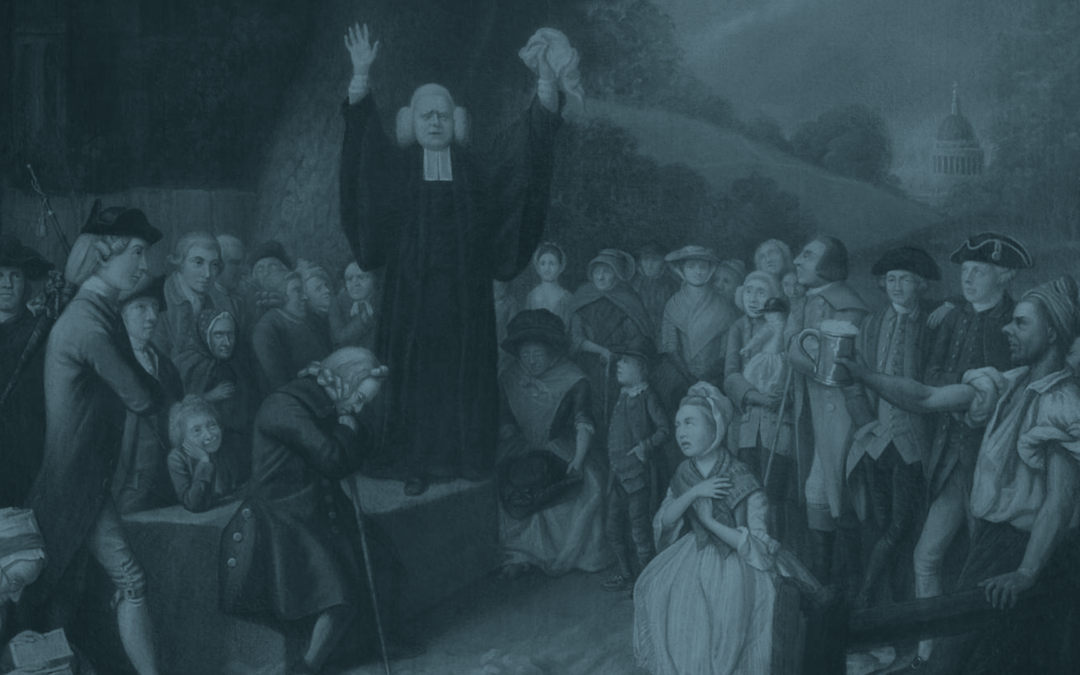
Recently, Jeannie and I went to see the movie, “A Great Awakening.” It was produced by Sight and Sound Theater, the same organization that puts together the elaborate Biblical stage presentations in Lancaster, PA. We’d heard many good comments about it, so we decided to see it for ourselves on the big screen. A prominent theme is the friendship between Benjamin Franklin and George Whitefield. Many people may have a few questions about it, so I’ll provide some answers here.
What is a “great awakening”? An awakening is when God’s Spirit moves powerfully among a nation, with the result that many people make professions of faith in Christ. Weeping over sin and repentance, transformed lives, and strengthened churches are characteristic of it. Other terms for an awakening are a “revival” or “renewal.” There have been two great awakenings in American history, with the obvious names “the first great awakening” and “the second great awakening.” They were quite different in their nature and their impact on the nation, but they both were marked by intense religious activity. The recent movie refers to the First Great Awakening, spanning 1730 to 1760. This revival movement stressed the truth that human freedom comes not from a government, but from God. It was instrumental in the American independence that soon followed.
Who is George Whitefield? George Whitefield was one of two fiery Calvinistic ministers of the First Great Awakening. Jonathan Edwards was the other. Whitefield was also a contemporary of John Wesley. Initially, they worked closely together as friends, laying the foundation of the Methodist denomination. Soon, however, Wesley publicly attacked Whitefield’s Calvinistic theology. Wesley parted company, with Whitefield continuing to seek reconciliation. Many years later, the relationship began to warm again, culminating with a request by an ailing Whitefield that Wesley preach at his funeral. Whitefield was a powerfully gifted speaker whose voice could be heard by a gathering of many thousands with no amplification. His spirited message was one of an uncompromised Biblical gospel. His frequent Scriptural plea was “You must be born again!” Thousands turned to Christ in response. He enjoyed a decades-long, cordial relationship with Benjamin Franklin. Though Franklin was a hardened deist, he respected and appreciated the effect Whitefield had upon the American colonies.
Can another Great Awakening occur today? Absolutely! It’s critical to understand, however, that a great awakening is not something we work up, but something God sends down. Great awakenings, or true national revivals, are marked by conviction and confession of sin, repentance from sin, and turning to Christ in life transformation. God initiates them, often through the prayers of Christians who are longing for greater evangelism and holiness. Awakenings on a smaller scale can and do happen more often in families, in churches, and in communities.
Will you pray for a great awakening in your own life, the life of your family, and the life of your church? James 4:7-10 says, “Submit yourselves therefore to God. Resist the devil, and he will flee from you. Draw near to God, and he will draw near to you. Cleanse your hands, you sinners, and purify your hearts, you double-minded. Be wretched and mourn and weep. Let your laughter be turned to mourning and your joy to gloom. Humble yourselves before the Lord, and he will exalt you.”
With a shepherd’s heart,
Pastor David Bess
About the Author
David Bess is pastor of the First Baptist Church, in Waynesburg, PA. He has pastored Baptist churches for over 40 years in Indiana, West Virginia, and now Pennsylvania. He resides in Washington, PA with his wife, Jeannie. Their son, daughter-in-law, and two grandchildren live in nearby Canonsburg, PA. He has MDiv and DMin degrees from the Southern Baptist Theological Seminary in Louisville. He is currently pursuing a MARBS degree from CBTS.

Stay in touch with CBTSeminary
For more information about CBTS, go to CBTSeminary.org
Consider giving to CBTSeminary to help us train the next generation of gospel ministers.
Apply to CBTS today to be sharpened for a lifetime of faithful ministry.
Follow CBTS on our socials: X | Instagram | Facebook | YouTube
Sign up for our newsletter and receive monthly updates related to the Seminary.
This blog post is authored by a student of Covenant Baptist Theological Seminary.

by Ben Habegger | Apr 28, 2026 | Systematic Theology
*Editor’s Note: The views expressed in this series are not intended as an official statement of CBTS or a uniform position of its faculty. This material is offered in the spirit of faith seeking understanding and to encourage further theological reflection. To read more installments in this series, click here: 1, 2, 3, 4, 5, 6, 7, 8, 9, and 10.
Those who, like a good number in church history, believe that Christ’s disembodied soul descended to the netherworld at his death, have various proof texts for their position. We have already encountered such texts in earlier blog posts, so we’ll move through these rather quickly.
38 Then some of the scribes and Pharisees answered him, saying, “Teacher, we wish to see a sign from you.” 39 But he answered them, “An evil and adulterous generation seeks for a sign, but no sign will be given to it except the sign of the prophet Jonah. 40 For just as Jonah was three days and three nights in the belly of the great fish, so will the Son of Man be three days and three nights in the heart of the earth. 41 The men of Nineveh will rise up at the judgment with this generation and condemn it, for they repented at the preaching of Jonah, and behold, something greater than Jonah is here.
(Matthew 12:38–41)
Here is Jesus’ actual point in the context of Matthew 12? The Lord’s disobedient servant Jonah spent three days in the stomach of the great fish, virtually swallowed by death, only to have his inevitable death spit him out again (in response to his prayer from fish’s belly) so that he would preach judgment to the far-off Gentiles. Jesus, the obedient servant of the Lord, would be truly swallowed by death. Though he prayed to his Father from the cross, he would yield up his spirit without any last-minute deliverance. His body would be placed in the grave (often viewed in the Old Testament as the bowels of the earth), only to burst forth in bodily resurrection on the third day. He would rise, ascend to heaven, and pour out the Holy Spirit for the salvation of all nations. And still, his own people would close their eyes to such a miraculous and well-attested sign as his resurrection. As for the Son of Man’s “three days and three nights in the heart of the earth,” Francis Turretin explains:
The “heart of the earth” in the style of the Hebrews means nothing else than what is within the earth…. Thus “to be in the heart of the earth” (Mt. 12:40) means nothing else than to be within the earth whether that be nearer or more remote from its surface. In this way is intimated the state of Christ’s body in the sepulcher (which was in the earth, in which it rested until the third day).[1]
Indeed, this text is not a strong proof text for a descent to the netherworld.
24 God raised him up, loosing the pangs of death, because it was not possible for him to be held by it. 25 For David says concerning him,
“‘I saw the Lord always before me,
for he is at my right hand that I may not be shaken;
26 therefore my heart was glad, and my tongue rejoiced;
my flesh also will dwell in hope.
27 For you will not abandon my soul to Hades,
or let your Holy One see corruption.
28 You have made known to me the paths of life;
you will make me full of gladness with your presence.’
29 “Brothers, I may say to you with confidence about the patriarch David that he both died and was buried, and his tomb is with us to this day. 30 Being therefore a prophet, and knowing that God had sworn with an oath to him that he would set one of his descendants on his throne, 31 he foresaw and spoke about the resurrection of the Christ, that he was not abandoned to Hades, nor did his flesh see corruption. 32 This Jesus God raised up, and of that we all are witnesses.
(Acts 2:24–32)
Though Sheol in Hebrew (translated by Hades in Greek) may sometimes refer to the place of torment for the departed spirits of the wicked, it often refers more generally to death and the grave. God had promised not to leave Jesus in Hades—that is, not to leave his human nature in the state of physical death, and thus not to leave his flesh to decay. Again, we have already dealt with Acts 2:27 and 31, along with its quotation of Psalm 16:9–10, in earlier blog posts.
6 But the righteousness based on faith says, “Do not say in your heart, ‘Who will ascend into heaven?’” (that is, to bring Christ down) 7 “or ‘Who will descend into the abyss?’” (that is, to bring Christ up from the dead).
(Romans 10:6–7)
Paul’s word choice here reflects the Old Testament, which often uses the imagery of the pit/the deep/the abyss for the fate of the dead. Somewhat like the Hebrew word sheol, this wording often refers to death and the grave in general rather than to a holding place for departed spirits.
7 But grace was given to each one of us according to the measure of Christ’s gift. 8 Therefore it says,
“When he ascended on high he led a host of captives,
and he gave gifts to men.”
9 (In saying, “He ascended,” what does it mean but that he had also descended into the lower regions, the earth [NASB: “the lower parts of the earth”]? 10 He who descended is the one who also ascended far above all the heavens, that he might fill all things.)
(Ephesians 4:7–10)
Commentator S. M. Baugh is helpful here.
The meaning of (“the nether regions of the earth”; cf. esp. Psa 63:9; Isa 44:23; John 3:13; 6:41, 51, 58) has drawn significant discussion over the centuries, with three prominent understandings of its meaning. It refers to: (1) Christ’s descent into hell; (2) the earth itself; or (3) Christ’s death. The first view was popular in the early church in conjunction with their view of 1 Pet 3:19 (“he went and proclaimed to the spirits in prison”), but it is hard to defend this interpretation today (see Barth, 433; Hoehner, 533–35).”[2]
The advantage of the third view is that “the nether regions of the earth,” namely the grave (Sheol), expresses the purpose of the Son of God’s descent and includes the idea of the cross and the death of Christ that has concerned Paul as paving the way for his exaltation to the highest place over all creation by freeing his people from sin (e.g., 1:7, 20–22; 2:1–7, 16; 5:2). So, “by ‘the lower parts of the earth’ he means ‘death’” (Chrysostom, 195).[3]
This phrase “the lower parts of the earth” and its meaning are roughly equivalent to Jesus’ wording and meaning in Matthew 12:40 when he mentions “the heart of the earth.”
18 For Christ also suffered once for sins, the righteous for the unrighteous, that he might bring us to God, being put to death in the flesh but made alive in the spirit, 19 in which he went and proclaimed to the spirits in prison, 20 because they formerly did not obey, when God’s patience waited in the days of Noah, while the ark was being prepared, in which a few, that is, eight persons, were brought safely through water. 21 Baptism, which corresponds to this, now saves you, not as a removal of dirt from the body but as an appeal to God for a good conscience, through the resurrection of Jesus Christ, 22 who has gone into heaven and is at the right hand of God, with angels, authorities, and powers having been subjected to him.
(1 Peter 3:18–22)
What is Peter saying? Christ’s suffering in the flesh led to resurrection in the Holy Spirit. This same Spirit of Christ preached to the disobedient in Noah’s day. Peter has already spoken of the Holy Spirit speaking through the Old Testament prophets, calling him the Spirit of Christ (1 Peter 1:11). Here Peter says that Christ in the person of his Holy Spirit preached to those who are now imprisoned spirits. By calling them “the spirits in prison,” Peter is referring to their current condition. This foreshadows a theme he’ll touch on again in chapter 4 of the dead being kept for judgment. Who are these spirits, and why were they imprisoned? Their identity and the reason for their imprisonment is clarified by saying that they were once disobedient when God’s patience waited in the days of Noah. In 2 Peter 2:5, Peter himself calls Noah “a herald (κήρυκα, ‘preacher’) of righteousness.” 1 Peter 3:19–20 is referring to those who did not obey the Spirit as he preached through Noah. Indeed, the patience of God’s Spirit only waited for one hundred and twenty years (cf. Genesis 6:3). Those who listened to Christ’s Spirit in the days of Noah were saved through the waters of divine judgment within the ark. Peter will present a similar contrast at the beginning of Chapter 4 between those who have believed the gospel and those who do not, and the salvation or judgment of each group.
In the next (and final) post, I will present biblical arguments against a descent of Christ into the netherworld.
Stay in touch with CBTSeminary
For more information about CBTS, go to CBTSeminary.org
Consider giving to CBTSeminary to help us train the next generation of gospel ministers.
Apply to CBTS today to be sharpened for a lifetime of faithful ministry.
Follow CBTS on our socials: X | Instagram | Facebook | YouTube
Sign up for our newsletter and receive monthly updates related to the Seminary.
[1] Francis Turretin, Institutes of Elenctic Theology, Volume 2, translated by George Musgrave Giger, edited by James T. Dennison, Jr. (Phillipsburg, NJ: P&R Publishing, 1994), 359.
[2] S. M. Baugh, Ephesians, Evangelical Exegetical Commentary (Bellingham, WA: Lexham Academic, 2016), 327.
[3] Ibid., 328.
Ben Habegger first served in full-time pastoral ministry near Detroit, Michigan from 2013-2017 and has now been vocational pastor at Hope Reformed Baptist Church of Aloha, Oregon (formerly Glencullen Baptist Church of Portland, Oregon) since January of 2020. He has a Master of Divinity degree from Detroit Baptist Theological Seminary and a Master of Arts in Reformed Baptist Studies from Covenant Baptist Theological Seminary. Ben and his wife Theresa have four children.
by Ben Habegger | Apr 28, 2026 | Historical Theology, Systematic Theology
*Editor’s Note: The views expressed in this series are not intended as an official statement of CBTS or a uniform position of its faculty. This material is offered in the spirit of faith seeking understanding and to encourage further theological reflection. To read more installments in this series, click here: 1, 2, 3, 4, 5, 6, 7, 8, 9, and 10.
A Debated Clause in the Apostles’ Creed
To discuss the idea of Christ’s “descent into hell,” we should begin with some facts about the creedal origin of this phrase. In a book on the early church, Henry Chadwick briefly explains the origin of what is traditionally called “The Apostles’ Creed”: “The Creed properly belonged to baptism and made a late appearance in the eucharistic liturgy. In any event the Western baptismal creed was the so-called ‘Apostles’ Creed’, while the Greek East used for baptism the Nicene creed of 325.”[1] The Apostles’ Creed became a commonly used creed in the Latin-speaking (Western) regions of the Roman Empire. This creed was not something commonly used in the Greek-speaking areas east of Rome, and the Nicene Creed does not include anything like the statement in question: “he descended into hell.” The so-called “Athanasian Creed” (or Quicunque Vult), which also mentions the descent into hell, could understandably be assumed by some to provide an eastern witness to this doctrine as part of early Nicene orthodoxy; but the “Athanasian Creed” was not produced by Athanasius in the East. It was rather a later Western creed from the fifth or sixth century. In any case, the Apostles’ Creed is a good place to start when examining the teaching that Christ at his death “descended into hell.”
The Apostles’ Creed
I believe in God,
the Father almighty,
Creator of heaven and earth,
and in Jesus Christ, his only Son, our Lord,
who was conceived by the Holy Spirit,
born of the Virgin Mary,
suffered under Pontius Pilate,
was crucified, died and was buried;
he descended into hell;
on the third day he rose again from the dead;
he ascended into heaven,
and is seated at the right hand of God the Father almighty;
from there he will come to judge the living and the dead.
I believe in the Holy Spirit,
the holy catholic Church,
the communion of saints,
the forgiveness of sins,
the resurrection of the body,
and life everlasting. Amen.
In the context of recent “theological retrieval,” which usually includes a robust return to the ancient creeds, challenges to the historicity of the now-familiar text of the Apostles’ Creed are sometimes too easily dismissed. Here is an example of such dismissal:
Some scholars have argued that the phrase [“he descended into hell”] is absent from the early versions of the creed, and therefore conclude that it doesn’t belong. Others, however, have been able to identify the clause in early literature, thus strengthening the case for its authenticity.[2]
Notice carefully what is actually said here. The clause is identified “in early literature,” which is then implied to support its originality in the earliest versions of the Apostles’ Creed. The earliest available versions of the creed itself are not then treated as the standard for the earliest text of that creed. Rather, the fact that a phrase found in later versions is also found in other “early literature” then somehow shows that the phrase might have been in the earliest versions after all. Frankly, it is just as likely, indeed more likely in view of the available evidence, that the idea and phrase “he descended into hell” became increasingly popular over time and then found its way into later copies of the creed.
If you visit different churches and recite the Creed with them, you will note that most of them—Catholic, Anglican, Lutheran, Reformed—include the statement that “he descended to the dead” or “he descended into hell,” while some, particularly those of the Wesleyan tradition, do not. The reason for this discrepancy is not really a theological difference or disagreement; it is only a disagreement as to what version of the Creed to employ. John Wesley, being a patristic scholar, knew that it was not included in most creeds until a relatively late date—the fourth century in one particular case, but generally the sixth to the eighth centuries. By the beginning of the ninth it was included in the official version of the Apostles’ Creed.[3]
This conclusion—that the descent into hell was a late addition to the Apostles’ Creed—is not a recent invention of contemporary scholarship. No less orthodox Protestant scholastics than Francis Turretin and Petrus van Mastricht held the same conclusion in the seventeenth century.[4]
There is often an urge now to affirm every phrase which commonly occurs in the Apostles’ Creed, and also to affirm every idea it was originally intended to teach. Why? Because the Apostles’ Creed has been chosen as an early, practically inerrant definition of the apostolic Christian faith. Ironically, this is a rather arbitrary choice, especially when placed alongside the renewed emphasis on the “ecumenical creeds,” which were the product of ecumenical church councils in the early centuries of the church. The Apostles’ Creed was not the product of an ecumenical council (and neither was the so-called Athanasian Creed, for that matter). Nevertheless, the Apostles’ Creed is ancient from our standpoint, and eventually came into common use in the Western church tradition. Thus there is significant pressure from some quarters to affirm the clause “he descended into hell” in the Apostles’ Creed (a clause which I personally do not affirm) and then to interpret scripture in light of this early idea in the ancient church. Take for example Samuel Renihan:
The Apostles’ Creed is one of the oldest statements of collective Christian beliefs, which many churches continue to confess today. The phrase “He descended to hell” or “He descended to the dead” has made some reluctant to embrace this creed. Others, as will be presented in the second part of this book, redefine this article into something entirely contrary to its intended meaning. This book has attempted to teach the Bible’s doctrine of the descent, so that we can unite our voices with Christians of all ages in the Apostles’ Creed and confess confidently that “He descended to the dead.”[5]
Let me remind you that, though a creed may happen in God’s providence to be without error in its interpretation of scripture, it is not infallible—incapable of error—by its very nature. A creed is not breathed out by God’s Spirit. It is merely a human document, though perhaps a weighty human testimony to the truth of scripture. Only scripture is infallible and thus without error, for its infallibility is due to its divine author. Therefore, if there is a questionable phrase in an otherwise biblical creed, Christians are under no obligation to believe the questionable phrase simply because it is found in a basically correct creed. Indeed, we should beware an overweening desire to find in scripture that which conforms to an attractive tradition. Rather, we should accept creedal tradition to the degree that it conforms to truly apostolic doctrine, which can be found infallibly in scripture alone. Creeds can helpfully instruct us in scripture, but they must never be believed simply because of their antiquity or wide acceptance.
Orthodox Interpretations of the “Descent” Clause
Given its long pedigree of common use in the Western church, those in the Reformation stream of theology understandably valued the Apostles’ Creed. At the same time, Reformed theology (with its insistence upon scriptural authority) inevitably clashed with the idea of a limbus patrum and with Christ’s descent there. Some heirs of the Reformation retained such doctrines, but many others did not. Those who did not retain the doctrine, however, often desired to retain the relevant phrase in the Apostles’ Creed. For that reason, the phrase has been interpreted in various ways, especially since the Reformation. We will briefly touch on these interpretations.
Interpretation 1: Christ’s Subjection to the Father’s Wrath on the Cross
In John Calvin’s Institutes (Book II, Chapter XVI, sections 10–11), Calvin argued that the Creed did not teach that Christ descended to hell locally, but that he suffered the agonies and punishments of hell due to man. Christ did this all his life, but especially in the Garden of Gethsemane and on the cross, thus making satisfaction for sins by his suffering.
[Quoting Calvin:] And truly there can be imagined no more dreadful bottomless depth, than for a man to feel himself forsaken and estranged from God, and not to be heard when he calls upon him, even as if God himself had conspired to his destruction.[6]
The Heidelberg Catechism itself takes pains to explain and apply the Apostles’ Creed, including the phrase, “He descended into hell”:
Question 44: Why is there added, “he descended into hell”?
Answer: That in my greatest temptations, I may be assured and wholly comfort myself in this, that my Lord Jesus Christ, by his inexpressible anguish, pains, terrors, and hellish agonies, in which he was plunged during all his sufferings, but especially on the cross, hath delivered me from the anguish and torments of hell.[7]
Interpretation 2: Christ’s Subjection to Death in His Human Nature
In 1680 Hercules Collins (c.1646–1702), a Particular Baptist pastor, published an edited version of the Heidelberg Catechism. The catechism, as mentioned above, works through the articles of the Apostles’ Creed. Arriving at the descent, Collins added a marginal note, quoting Ussher and referring the reader to Perkins. The note reads,
“Not that he (to wit, Christ) went into the place of the damned, but that he went absolutely into the state of the dead. See Dr. Ussher in his Body of Divinity, page 174 and Mr. Perkins on the Creed.”
In this brief example, the influences of Ursinus, Olevianus, Perkins, and Ussher combine to shape Hercules Collins’ view of the descent.[8]
Though their historical ties to the original intent of the clause seem tenuous at best, both these first two interpretations are at least in harmony with scripture.
Interpretation 3: Christ’s Descent to the Netherworld after His Death
The most ancient reason for the relevant phrase in the Apostles’ Creed seems indeed to be the belief that Jesus went down to Sheol/Hades, a netherworld of departed spirits, between his death and resurrection. Three basic reasons have been given for such a descent in orthodox versions of this teaching. Sam Renihan’s book on the topic proposes all three reasons, and his words represent these reasons well.
First, it is said that Christ descended to the netherworld to release pre-Christian saints confined there.
Saints before the resurrection may have been at rest, but they had not yet arrived at that heavenly country, which Hebrews says was reserved until a time when both they and ourselves would have access to it…. Satan had no power to torment these saints, but they were contained in Sheol. So, Jesus broke the bars and gates of Sheol and led a host of captive souls out while the strong man could do nothing but watch. Jesus descended to Abraham’s Bosom without humiliation or defeat, but as a conqueror. He did not descend to languish but to liberate.[9]
Here it is important to remember some historical context of the ancient church. As mentioned in the blog posts on Sheol, there were many in the ancient church who believed that only a select few Christians, such as martyrs, go directly to heaven at death, and that most believers still go to a subterranean place of departed spirits. In other words, as a rule, both the righteous and the unrighteous dead have always gone and still go to Hades under the earth (though perhaps to different compartments). This was in line with both Jewish and pagan ideas of the time, and it seems to have been a belief of many Christians as well. Thus Christ’s release of Old Testament saints to go to heaven did not necessarily mean that the righteous now go straight to heaven at death. In fact, the developing doctrine of purgatory continued this theme in the Middle Ages, teaching that most Christians are restricted at death from the heavenly glory of God. It was the Protestant Reformation that bore renewed testimony to the simple Biblical truth that all Christian believers enter heaven at death.
Second, it is said by some that Christ descended to the netherworld to proclaim victory over wicked angels or demonic spirits.
Jesus Christ, as a soul… made a proclamation to imprisoned angels, the wicked and rebellious angels imprisoned in Tartarus, the lowest tier of Sheol. By appearing in Tartarus, or the abyss, and declaring his victory, Jesus caused every demon to know that their efforts were all in vain.[10]
Third, it is said that Christ descended to the netherworld to proclaim condemnation to the wicked dead.
Jesus also caused everyone who died in unbelief to know that the one whose name they had refused to name, the one upon whom they had refused to call, was precisely who the Scriptures said he was, precisely who he said he was. They know that their condemnation is just.[11]
Finally, it is worth mentioning that there have also been more heterodox versions of such ideas.
The common view during the Middle Ages was that when Jesus descended into hell he preached to all who had lived before him, thus giving them an opportunity for salvation. According to tradition, the apostles had preached to every nation, so that those living after Jesus who did not believe had been given an opportunity and failed to make use of it. Thus, by descending into hell and there preaching to those who had lived before him, Jesus gave them a fair opportunity for salvation.[12]
The next blog post will move to briefly address some proof texts for a descent of Jesus’ soul into the netherworld.
Stay in touch with CBTSeminary
For more information about CBTS, go to CBTSeminary.org
Consider giving to CBTSeminary to help us train the next generation of gospel ministers.
Apply to CBTS today to be sharpened for a lifetime of faithful ministry.
Follow CBTS on our socials: X | Instagram | Facebook | YouTube
Sign up for our newsletter and receive monthly updates related to the Seminary.
[1] Henry Chadwick, The Early Church, Revised Edition, The Penguin History of the Church (London: Penguin Books, 1993), 270.
[2] Nate Pickowicz, Christ and Creed: The Early Church Creeds and Their Value for Today (Ross-shire, Great Britain: Christian Focus, 2023), 25.
[3] Justo L. Gonzalez, The Apostles’ Creed for Today (Louisville: Westminster John Knox, 2007), 48.
[4] Francis Turretin, Institutes of Elenctic Theology, Volume 2, translated by George Musgrave Giger, edited by James T. Dennison, Jr. (Phillipsburg, NJ: P&R Publishing, 1994), 362; Petrus van Mastricht, Theoretical-Practical Theology, Volume 4: Redemption in Christ, translated by Todd M. Rester, edited by Joel R. Beeke (Grand Rapids: Reformation Heritage Books, 2023), 456–457.
[5] Samuel D. Renihan, Crux, Mors, Inferi: A Primer and Reader on the Descent of Christ (Independently Published, 2021), 95.
[6] Ibid., 107–108.
[7] The Commentary of Dr. Zacharias Ursinus on the Heidelberg Catechism, translated by George W. Willard (Jenison, MI: Reformed Free Publishing Association, 2025), 226.
[8] Renihan, Crux, Mors, Inferi, 119.
[9] Ibid., 68.
[10] Ibid., 72.
[11] Ibid., 72.
[12] Gonzalez, The Apostles’ Creed for Today, 48.
Ben Habegger first served in full-time pastoral ministry near Detroit, Michigan from 2013-2017 and has now been vocational pastor at Hope Reformed Baptist Church of Aloha, Oregon (formerly Glencullen Baptist Church of Portland, Oregon) since January of 2020. He has a Master of Divinity degree from Detroit Baptist Theological Seminary and a Master of Arts in Reformed Baptist Studies from Covenant Baptist Theological Seminary. Ben and his wife Theresa have four children.
by Ben Habegger | Apr 28, 2026 | New Testament, Old Testament
*Editor’s Note: The views expressed in this series are not intended as an official statement of CBTS or a uniform position of its faculty. This material is offered in the spirit of faith seeking understanding and to encourage further theological reflection. To read more installments in this series, click here: 1, 2, 3, 4, 5, 6, 7, 8, 9, and 10.
Before our blog series concludes by discussing Christ’s “descent into hell,” this blog post will briefly address one more word which designates a hellish prison for wicked spirits. In fact, this participle tends to include the word “hell” in its English translations. The Greek word occurs only once in the New Testament. The Apostle Peter uses this word in 2 Peter 2:4 to describe a divine punishment in the past (with continuing effects). The word is ταρταρώσας (tartarosas, from ταρταρόω), which can be translated into English as “cast… into hell.”
4 For if God did not spare angels when they sinned, but cast them into hell and committed them to chains [ESV margin: “Some manuscripts pits”] of gloomy darkness to be kept until the judgment; 5 if he did not spare the ancient world, but preserved Noah, a herald of righteousness, with seven others, when he brought a flood upon the world of the ungodly; 6 if by turning the cities of Sodom and Gomorrah to ashes he condemned them to extinction, making them an example of what is going to happen to the ungodly; 7 and if he rescued righteous Lot, greatly distressed by the sensual conduct of the wicked 8 (for as that righteous man lived among them day after day, he was tormenting his righteous soul over their lawless deeds that he saw and heard); 9 then the Lord knows how to rescue the godly from trials, and to keep the unrighteous under punishment until the day of judgment, 10 and especially those who indulge in the lust of defiling passion and despise authority.
(2 Peter 2:4–10a)
Gene Green reflects scholarly consensus when he says this about the word translated “cast… into hell” in verse 4: “This verb, found only here in the NT, refers to being sent to Tartarus, the ‘deepest region of the underworld, lower even than Hades’ (OCD 1476).”[1]
Alongside other spectacular instances of divine punishments from the Book of Genesis, Peter mentions an example of God punishing angels who had sinned. He apparently assumes his readers’ knowledge of this event, much as they would know of the great flood of Noah’s day, as well as the destruction of Sodom and Gomorrah in Lot’s day.
Some in the Reformed camp have attempted to apply the divine punishment here mentioned to all fallen angels, but in a metaphorical manner. Here is one example from Louis Berkhof’s Systematic Theology: “They [all fallen angels] are even now chained to hell and pits of darkness, and though not yet limited to one place, yet, as Calvin says, drag their chains with them wherever they go, II Pet. 2:4; Jude 6.”[2] Notice, however, that such an interpretation actually blunts the contextual point stated in verses 9 and 10—God’s awesome and climactic punishments upon lustful rebellion (which, at least, in Peter’s other two examples, occur during the history recorded in Genesis). These inescapable punishments are described as temporal foretastes of inescapable judgment on the last day. I submit that this cannot simply describe the fallen condition of all evil angels (a fall which is assumed rather than described in scripture). It describes a particular punishment of imprisonment, a punishment which is tied to a particular event recorded in scripture. Judging from the sequence of Peter’s three examples, this punishment seems to have happened either before or at the same time as Noah’s flood, an event which itself occurred before Sodom’s destruction.
Under the infallible inspiration of the Holy Spirit, Peter apparently agreed with an interpretation of Genesis 6:1–4 which is well-attested both before and during his era (though we may not thereby conclude that the apostles would have agreed with further, fanciful developments and uses of such an interpretation). Here is the first portion of Genesis 6:
1 When man began to multiply on the face of the land and daughters were born to them, 2 the sons of God saw that the daughters of man were attractive. And they took as their wives any they chose. 3 Then the Lord said, “My Spirit shall not abide in man forever, for he is flesh: his days shall be 120 years.” 4 The Nephilim were on the earth in those days, and also afterward, when the sons of God came in to the daughters of man and they bore children to them. These were the mighty men who were of old, the men of renown. 5 The Lord saw that the wickedness of man was great in the earth, and that every intention of the thoughts of his heart was only evil continually. 6 And the Lord regretted that he had made man on the earth, and it grieved him to his heart. 7 So the Lord said, “I will blot out man whom I have created from the face of the land, man and animals and creeping things and birds of the heavens, for I am sorry that I have made them.” 8 But Noah found favor in the eyes of the Lord.
(Genesis 6:1–8)
We have various extrabiblical writings from the centuries immediately before and after Christ, demonstrating a common understanding in which Genesis 6 describes both angelic and human sin. The “sons of God” are not regenerate men or descendants of Seth or human rulers; they are heavenly beings (just as they are in the Book of Job, for instance) who somehow engaged in perverse unions with “the daughters of men” (human women). Though realizing that many of my Evangelical and Reformed brothers strongly disagree, I myself see this understanding to be the plain and uncontrived (albeit mysterious) meaning of Genesis 6.
As to the insistence of various Reformed brethren (such as John Murray) that the “sons of God” in Genesis 6 were godly descendants of Seth (as described in Genesis 5), I wish to make one observation. We must be careful not to label Seth’s line as “the godly line” and Cain’s line as “the ungodly line”. The scriptures never tell us that everyone (or even most) descended from Seth came to faith or that everyone (or even most) in Cain’s line remained in rebellion against God. Actually, such an idea must gloss over the rest of Adam’s descendants (through his many other sons and daughters) or assume that they all sided with one of two families: the Sethites or the Cainites. Such an assumption is foreign to the text. Furthermore, Seth’s line is neither said nor implied to be a holy, covenant nation like Israel would later be, with its people in a national covenant with God (and thus forbidden to intermarry with other nations). These sorts of ideas may seem to fit paedobaptist assumptions that God’s covenant of grace is always given to both believers and their children in some sense, but we shouldn’t read that into the early chapters of Genesis. What we can say is that Genesis highlights a few people from Seth’s line who were definitely regenerate, righteous people, as well as one descendant of Cain (named Lamech) who stood out as a wicked man. This continues the theme of the seed of the woman and the seed of the serpent, but it doesn’t imply that these spiritual seed lines were neatly divided according to two biological family lines. In any case, by the time of the flood, only Noah and some of his immediate family were righteous, and the text does not say that the rest of the Sethites were turned away from God by bad marriages. Still, there is something significant about Seth’s line. Though their family tree included both righteous and wicked people, nevertheless Noah, Abraham, Isaac, and Jacob were descended directly from Seth. That is what Genesis emphasizes. Thus King David and his offspring Jesus Christ, the promised Seed of the Woman, are the seed of Seth. The special thing about Seth’s bloodline is that it leads to the coming Redeemer.
Regarding the sin of heavenly beings in Genesis 6, it was further understood in the centuries surrounding Peter that God sent these particular angels to Tartarus, “thought of by the Greeks as a subterranean place lower than Hades where divine punishment was meted out, and so regarded in Israelite apocalyptic as well.”[3] If Peter had meant to avoid such an interpretation, surely he could have avoided the verb form of the name Tartarus when mentioning the fate of sinning angels. Again, this is not to suggest that Peter endorsed either the pagan Greek mythology which spoke of Tartarus or the fanciful and presumptuous speculation which was often attached to Genesis 6. Nevertheless, Peter affirms that God punished a certain group of angels for a certain sin (apparently their lustful rebellion against created boundaries as recorded in Genesis 6) with hellish imprisonment until the final day of judgment. They are being kept “under punishment until the day of judgment” (verse 9) because they “indulge(d) in the lust of defiling passion and despise(d) authority” (verse 10).
Notice how Jude speaks so similarly to Peter as he himself describes the imprisonment of certain angels “until the judgment of the great day”:
6 And the angels who did not stay within their own position of authority, but left their proper dwelling, he has kept in eternal chains under gloomy darkness until the judgment of the great day— 7 just as Sodom and Gomorrah and the surrounding cities, which likewise indulged in sexual immorality and pursued unnatural desire [“different/strange flesh”], serve as an example by undergoing a punishment of eternal fire.
(Jude 6–7)
Notice also that Jude very specifically compares (“just as” [ὡς] in verse 7) the sin of these angels who left their created role and boundaries to the sin of Sodom and the other cities of the plain, “which likewise [τὸν ὅμοιον τρόπον τούτοις] indulged in sexual immorality and pursued unnatural desire (more literally, ‘pursued different/strange flesh’).” According to verse 4, Jude is reminding his readers of such sins because of “ungodly people, who pervert the grace of our God into sensuality and deny our only Master and Lord, Jesus Christ.” Again in verse 8, Jude emphasizes how the libertines in the church “in like manner” to the Israelites in the wilderness, the angels who sinned, and the Sodomites, now “defile the flesh, reject authority, and blaspheme the glorious ones.”
Let me note here that, though many connect an angelic interpretation of Genesis 6 to a particular interpretation of 1 Peter 3:19–20 which would teach a postmortem descent of Christ, this is not a necessary connection. The meaning of Christ making proclamation “to the spirits in prison” should be a separate discussion, not a foregone conclusion based on texts like Genesis 6. For myself, I understand 1 Peter 3 to teach that Christ “in the Spirit” (the Holy Spirit of God) preached (ἐκήρυξεν) to human sinners in the days of Noah, sinners who are now deceased spirits in prison. This is consistent both with Peter’s earlier use of “the Spirit of Christ” in 1 Peter 1:10–12 (the Spirit by whom the gospel is preached) and with the repeated contrast between the flesh and the Spirit in both 1 Peter 3:18 and 1 Peter 4:6. It also fits with what Peter himself calls Noah in 2 Peter 2:5, “a herald (κήρυκα, ‘preacher’) of righteousness.”
Conclusion
To conclude the two most recent blog posts, we can say that the New Testament’s use of words like “Abyss,” “Pit of the Abyss,” and “Tartarus” seem to collectively describe realms within the present Hell (Hades), places of imprisonment for evil angels or demons. Not all fallen angels are currently confined in Hell; apparently God can and does bind certain evil spirits in Hell. This occasional imprisonment is due to specific angelic sins. In view of the Old Testament concepts of Sheol and “the pit”, the present prison for evil angels seems to be roughly the same place, or another part of the same place, where the deceased spirits of unrighteous humanity are confined. One particular Old Testament text might especially imply this:
21 On that day the Lord will punish
the host of heaven, in heaven,
and the kings of the earth, on the earth.
22 They will be gathered together
as prisoners in a pit;
they will be shut up in a prison,
and after many days they will be punished.
23 Then the moon will be confounded
and the sun ashamed,
for the Lord of hosts reigns
on Mount Zion and in Jerusalem,
and his glory will be before his elders.
(Isaiah 24:21–23)
Perhaps Isaiah 24 here portrays the imprisonment of both angelic and human sinners in the abyss until their ultimate punishment.
There is much here which we must approach with humility, sensing our own ignorance. But we can conclude with some biblical certainties. What will happen to wicked angels at the end of history? They, like their fellow human prisoners, will be cast into Gehenna, the lake of fire, which is eternal Hell.
31 “When the Son of Man comes in his glory, and all the angels with him, then he will sit on his glorious throne. 32 Before him will be gathered all the nations, and he will separate people one from another as a shepherd separates the sheep from the goats. 33 And he will place the sheep on his right, but the goats on the left.
41 “Then he will say to those on his left, ‘Depart from me, you cursed, into the eternal fire prepared for the devil and his angels.
46 And these will go away into eternal punishment, but the righteous into eternal life.
(Matthew 25:31–33, 41, 46)
10 And the devil who had deceived them was thrown into the lake of fire and sulfur where the beast and the false prophet were, and they will be tormented day and night forever and ever.
13 And the sea gave up the dead who were in it, Death and Hades gave up the dead who were in them, and they were judged, each one of them, according to what they had done. 14 Then Death and Hades were thrown into the lake of fire. This is the second death, the lake of fire. 15 And if anyone’s name was not found written in the book of life, he was thrown into the lake of fire.
(Revelation 20:10, 13–15)
In the next blog posts, we will finally address the concept of Christ’s “descent into hell” directly.
Stay in touch with CBTSeminary
For more information about CBTS, go to CBTSeminary.org
Consider giving to CBTSeminary to help us train the next generation of gospel ministers.
Apply to CBTS today to be sharpened for a lifetime of faithful ministry.
Follow CBTS on our socials: X | Instagram | Facebook | YouTube
Sign up for our newsletter and receive monthly updates related to the Seminary.
[1] Gene L. Green, Jude and 2 Peter, Baker Exegetical Commentary on the New Testament (Grand Rapids: Baker Academic, 2008), 250.
[2] Louis Berkhof, Systematic Theology, Revised and Enlarged Edition (Grand Rapids: Eerdmans, 1941), 149.
[3] A Greek-English Lexicon of the New Testament and Other Early Christian Literature, Third Edition (BDAG), revised and edited by Frederick William Danker (Chicago: The University of Chicago Press, 2000), 991.
Ben Habegger first served in full-time pastoral ministry near Detroit, Michigan from 2013-2017 and has now been vocational pastor at Hope Reformed Baptist Church of Aloha, Oregon (formerly Glencullen Baptist Church of Portland, Oregon) since January of 2020. He has a Master of Divinity degree from Detroit Baptist Theological Seminary and a Master of Arts in Reformed Baptist Studies from Covenant Baptist Theological Seminary. Ben and his wife Theresa have four children.

by CBTS Student | Apr 13, 2026 | New Testament, Old Testament, Practical Theology
According to a Gallup poll titled, Trends in U.S. Adults’ Acceptance of Moral and Values Behaviors, the approval rating for polygamy in the United States was at 7% in 2003 and has risen to a level around 21% as of 2025 (Newport 2025).[1] It is clear that polygamy is slowly becoming an accepted practice. Polygamy is defined as a man having multiple wives or a woman having multiple husbands. Now, a 21% approval rating does not seem like a significant figure. After all, that would mean 79% of people in the United States disapprove of polygamy. So why give it any attention at all? We give these matters attention because people are constantly led astray by false teachings.
The apostle Paul says that there will be a time where, “people will not endure sound doctrine; but wanting to have their ears tickled, they will accumulate for themselves teachers in accordance to their own desires, and will turn away their ears from the truth (emphasis added) and will turn aside to myths” (2 Timothy 4:3-4). Likewise, Peter echoes the same concern, stating, “false prophets also arose among the people, just as there will also be false teachers among you, who will secretly introduce destructive heresies, even denying the Master who bought them, bringing swift destruction upon themselves. Many will follow their sensuality (emphasis added), and because of them the way of the truth will be maligned; and in their greed they will exploit you with false words; their judgment from long ago is not idle, and their destruction is not asleep” (2 Peter 2:1-3). The Scriptures are clear. False teachers will rise up and lead people astray. We are seeing these very things in today’s world.
There are people who have been advocating for a type of polygamy called “biblical polygyny”. Polygyny is a subset of polygamy where a man can marry multiple wives. But a woman cannot have multiple husbands. Proponents of “biblical polygyny” include a former professor of Bible and Theology at Moody Bible Institute, William F. Luck; pastor of Ormond Church, Rich Tidwell; and author and social media influencer, Rob Kowalski. Social media has allowed many of these voices to be amplified and reach the vulnerable: those who may not have a strong scriptural foundation or men who have been disenfranchised by a culture that deems biblical masculinity as “toxic”. While polygamy and its subsets are not the majority, it is clear that there is a push for it in Christian circles. Therefore, we must give this urgent matter attention.
The call of every Christian is to “contend earnestly for the faith which was once for all handed down to the saints” (Jude 3). This is even more pertinent for pastors who are called, “[to hold] fast the faithful word which is in accordance with the teaching, so that he will be able both to exhort in sound doctrine and to refute those who contradict (emphasis added)” (Titus 1:9). Given this responsibility, three points will be examined to demonstrate why polygamy and its various subsets are unbiblical.
First, the bible defines marriage as a covenant between one man and one woman. The definition of marriage is found in Genesis 2:24-25, “For this reason a man shall leave his father and his mother, and be joined to his wife; and they shall become one flesh. And the man and his wife were both naked and were not ashamed.” The book of Genesis is the first book of the bible, and rightly so, “the book is about beginnings: the beginning of the universe; the beginning of time, matter, and space; the beginning of humanity.”[2] Inseparable with the beginning of humanity is the beginning of marriage. As the creator of marriage, God gets to define what marriage is and what it is not. Marriage is strictly between a single man and a single woman. Notice the use of the singular throughout these verses, “For this reason a man (emphasis added) shall leave his father and his mother, and be joined to his wife (emphasis added); and they shall become one flesh” (Gen. 2:24). The essence of marriage lies in the fact that it is two people, and only two people, coming together in this union of marriage. This creational pattern for marriage is reinforced by Jesus in Matthew 19. In the beginning of this chapter, Jesus was asked by the Pharisees whether it was lawful for a man to divorce his wife for any reason. Jesus responds by quoting the definition of marriage, “‘Have you not read that He who created them from the beginning MADE THEM MALE AND FEMALE, and said, ‘FOR THIS REASON A MAN SHALL LEAVE HIS FATHER AND MOTHER AND BE JOINED TO HIS WIFE, AND THE TWO SHALL BECOME ONE FLESH’? ‘So they are no longer two, but one flesh. What therefore God has joined together, let no man separate” (Matt. 19:4-6). In answering the question on divorce, Jesus quotes Genesis 2:24. He goes back to the essence of marriage that was defined at the beginning of creation: a one man and one woman relationship. Furthermore, notice how it is the “two” that become “one” flesh. If a man could have multiple wives, it would no longer be the “two” becoming one flesh, but three, four, five, six, etc. Furthermore, if a man were to have multiple wives, he would not be clinging to “his wife”, but to “his wives,” which would completely redefine God’s definition of marriage. It is obvious from the plain reading of the text that the creational and biblical definition of marriage is between one man and one woman.
Second, the Bible records God punishing someone as a result of their polygamy, but never once records Him punishing someone for their monogamy. In 1 Kings 11:1-13, we get an explanation from God on why Solomon turned away from Him. The answer is found in verses 3-4, “He had seven hundred wives, princesses, and three hundred concubines, and his wives turned his heart away. For when Solomon was old, his wives turned his heart away after other gods; and his heart was not wholly devoted to the LORD his God” (1 Kg. 11:3-4). There is a direct connection between Solomon having multiple wives (polygamy) and Solomon going after other gods (idolatry). As a result, God punishes Solomon in 1 Kg. 11:11 by stripping away the kingdom from Solomon after his death. Now, some may be tempted to read this and say the only sin that Solomon committed was idolatry. However, this is not the case. In Hebrews 13:4 we read, “Marriage is to be held in honor among all, and the marriage bed is to be undefiled; for fornicators and adulterers God will judge”. With the definition of marriage already established in Genesis 2, it is clear that any “marriage” that deviates from the one man and one woman pattern will be judged by God as sexual immorality. This is exactly what happened to Solomon in 1 Kings. Yes, God judged Solomon for his idolatry. But as Hebrews 13 has shown, God also judged Solomon for his polygamy. If polygamy were truly a biblical position, God would not have punished Solomon for it. Additionally, there is not a single recorded instance in the entirety of Scripture that shows God punishing someone for their monogamy. Lastly, the only marriage relationship ever prescribed in the entirety of Scripture is monogamy. When you survey the passages that talk prescriptively about the essence of marriage, it is always between one man and one woman. The reason is that monogamy is God’s design for marriage.
Third, the Bible describes instances of polygamy but never prescribes it. Taking the previous example of 1 Kings 11, the Bible records Solomon’s polygamy. However, it does not prescribe it as a norm for people to follow. One of the most common hermeneutical errors is failing to distinguish when the bible describes something and when the bible prescribes something. 1 Kings 11 describes Solomon’s polygamy. There is no positive command for someone to take multiple wives. Now, some polygamists like to point to 2 Samuel 12:8 as an example of God ordaining and prescribing polygamy, “‘I also gave you your master’s house and your master’s wives into your care, and I gave you the house of Israel and Judah; and if that had been too little, I would have added to you many more things like these!”. Polygamists argue that God gave David multiple wives and will conclude that polygamy is biblical. However, this is a complete misunderstanding of the phraseology. The phraseology means nothing more than that God in His providence had given David, as king of Israel, everything that was Saul’s. The history furnishes conclusive evidence that he [David], never actually married any of the wives of Saul. But the harem of the preceding king belongs, according to Oriental notions, as a part of the regalia to his successor.”[3] When we take the time to understand the text as the authors intended, we can see that the biblical pattern for marriage is upheld.
After surveying the biblical data, it is clear that polygamy is unbiblical and should resoundingly be rejected. We cannot remain silent or indifferent to the issue of polygamy. We live in a society that actively seeks to undermine the biblical definition of marriage. Therefore, having an apologetic for biblical marriage is more important now than ever.
About the Author: Spencer Choate
Spencer Choate is an MDiv student at Covenant Baptist Theological Seminary. He holds a Masters in Communication Studies and teaches Public Speaking at Jessup University. He has been married to his wife, Brenna, for almost three years.

Bibliography
Newport, Frank. “Trends in U.S. Adults’ Acceptance of Moral and Values Behaviors.” Gallup. 2025. https://news.gallup.com/opinion/polling-matters/694550/trends-adults-acceptance-moral-values-behaviors.aspx.
Robert Jamieson, A. R. Fausset, and David Brown. A Commentary, Critical, Practical, and Explanatory on the Old and New Testaments. Edinburgh: T. & T. Clark, 1882.
Van Pelt, Miles V. Editor. A Biblical-Theological Introduction to the Old Testament: The Gospel Promised. Wheaton, IL: Crossway, 2016.
[1] Frank Newport, “Trends in U.S. Adults’ Acceptance of Moral and Values Behaviors,” Gallup, 2025, https://news.gallup.com/opinion/polling-matters/694550/trends-adults-acceptance-moral-values-behaviors.aspx.
[2] Van Pelt, Miles V. Editor, A Biblical-Theological Introduction to the Old Testament: The Gospel Promised, Wheaton, IL: Crossway, 2016, 43.
[3] Robert Jamieson et. al., A Commentary, Critical, Practical, and Explanatory on the Old and New Testaments (Edinburgh: T. & T. Clark, 1882).
This blog post is authored by a student of Covenant Baptist Theological Seminary.