by Austin McCormick | Dec 30, 2025 | Historical Theology, Systematic Theology
Introduction
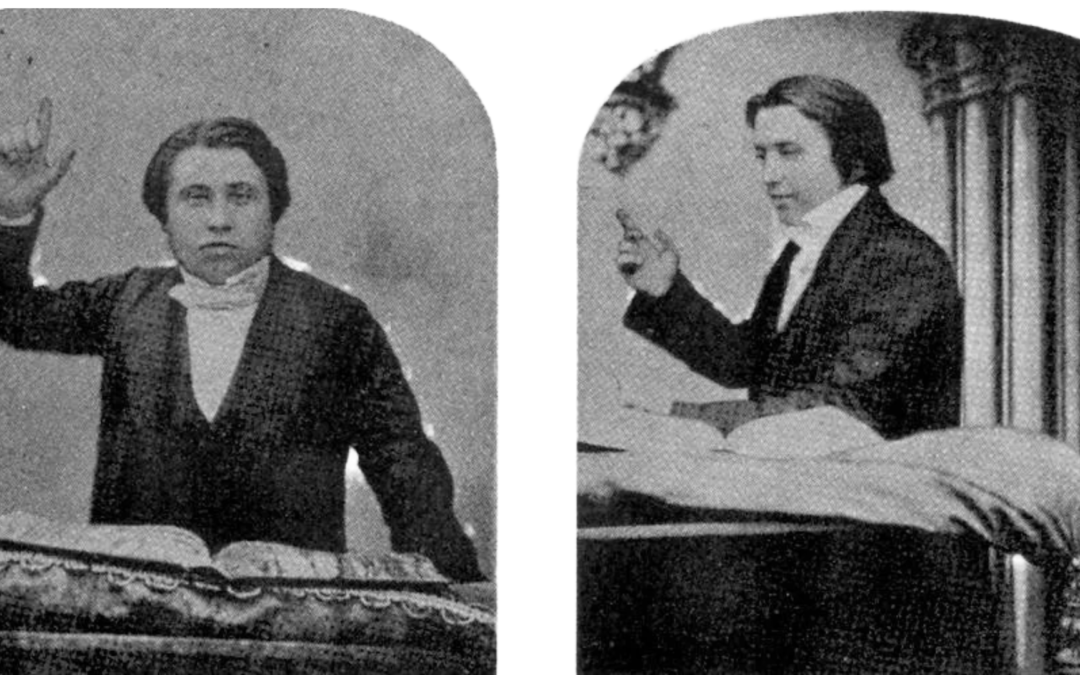
On January 7th of 1855, the Prince of Preachers, C.H. Spurgeon, delivered a sermon at New Park Street Chapel titled: “The Immutability of God”. At this time, Spurgeon was a mere 20 years old. His youth and limited experience did not hinder him from delivering this God-centered homily, though. The text which Spurgeon preached from was Malachi 3:6, which reads as follows in the King James Version: “I am the Lord, I change not; therefore, ye sons of Jacob are not consumed.” The doctrine emphasized from this text was God’s immutability, which is God’s freedom from change. The headings below are the headings Spurgeon used in this sermon to explain this doctrine.
He Changes Not in His Essence
But God is perpetually the same. He is not composed of any substance or material, but is spirit—pure, essential, and etherial spirit—and therefore he is immutable. He remains everlastingly the same.
If God were able to change His essence, He would not be God. He cannot change His simple essence—for if He were able to change to a better (or worse) essence, He would have the ability to improve (or worsen). If God were able to change, there would be a time when God would cease to be perfect. We know this is false. God has never changed. He is pure act or pure being; he is not in the process of becoming. His essence cannot gain or lose. He is who He is. Or as Spurgeon says, “He remains everlastingly the same.”
He Changes Not in His Attributes
Take any one attribute of God, and I will write semper idem on it (always the same.) Take any one thing you can say of God now, and it may be said not only in the dark past, but in the bright future it shall always remain the same.
A few attributes that Spurgeon mentions under this subpoint include: God’s power, wisdom, justice, truth, goodness, and love. Just as God cannot grow (or worsen) in His being, His attributes do not change. This is because in God, His attributes are the same as His simple essence.
Humans consistently undergo changes. Humans change whenever they learn something; they change whenever they physically grow; they change as their love for someone, or something, improves or worsens. But God’s wisdom and knowledge remain unchanged. He knows as much now as ever; neither more nor less. His justice remains the same. Just and holy was He in the past; Just and holy is He now. Not a single attribute of God changes in God, or ever will.
He Changes Not in His Plans
God is a mastermind; he arranged everything in his gigantic intellect long before he did it; and once having settled it, mark you, he never alters it. “This shall be done,” saith he, and the iron hand of destiny marks it down, and it is brought to pass. “This is my purpose,” and it stands, nor can earth or hell alter it.
God has never failed in His purpose that he predetermined before the foundation of the world. God has never begun to build something, then fail in His “project”—nor did He have to change His “project”. “God hath decreed in himself, from all eternity, by the most wise and holy counsel of His own will, freely and unchangeably, all things whatsoever come to pass.” (2LCF 3:1).
He Changes Not in His Promises
Believer! there was a delightful promise which you had yesterday; and this morning when you turned to the Bible the promise was not sweet. Do you know why? Do you think the promise had changed? Ah, no! You changed; that is where the matter lies.
If God’s promises could change, they would no longer be promises. A changing promise would be comparable to wishful thinking that the believer subjectively pants after. Changing promises of salvation would lead to no assurance of salvation. Changing promises concerning God’s provision would lead to constant fear, doubt, and worries. But God doesn’t change; therefore, we are not consumed. Spurgeon writes: “Remember, every promise is a rock, an unchanging thing.”
He Changes Not in His Threatenings
You must believe or be damned, saith the Bible; and mark, that threat of God is as unchangeable as God himself.
If God’s promises of salvation are certain and unchanging, so then are His threatenings of damnation and punishment. Spurgeon gives the following description of the unchanging threat that God will execute towards unbelievers:
When a thousand years of hell’s torments shall have passed away, you shall look on high, and see written in burning letters of fire, “He that believeth not shall be damned.” “But, Lord, I am damned.” Nevertheless, it says “shall be” still. And when a million ages have rolled away, and you are exhausted by your pains and agonies, you shall turn up your eye and still read “SHALL BE DAMNED,” unchanged, unaltered. And when you shall have thought that eternity must have spun out its last thread—that every particle of that which we call eternity, must have run out, you shall still see it written up there, “SHALL BE DAMNED” O terrific thought.
He Changes Not the Objects of His Love
The objects of everlasting love never change. Those whom God hath called, he will justify; whom he has justified, he will sanctify; and whom he sanctifies, he will glorify.
You more than likely recognize this similar phrase, modeled after the Apostle Paul’s writing in Romans 8:28-30. Those whom God has loved with an electing love of delight in eternity past, He will continue to love in eternity future. God demonstrates—or exercises—this love of delight in His people by effectually calling them, justifying them in time, sanctifying them, and glorifying them.
Conclusion
From the beginning of Spurgeon’s young pastorate, his doctrine of God—or theology proper— would shape his pulpit ministry. Serving an unchanging God spurred him to faithfully preach God’s holy word. For Spurgeon, it seemed impossible to serve—or to even conceive the idea of a changing God.
I imagine it is impossible to conceive of a changing God; it is so to me. Others may be capable of such an idea, but I could not entertain it. I could no more think of a changing God, than I could of a round square, or any other absurdity.
May we affirm the Immutability of God as we cling to these words: “I am the Lord, I change not; therefore, ye sons of Jacob are not consumed.”—Malachi. 3:6.
Bibliography
C. H. Spurgeon, “The Immutability of God,” in The New Park Street Pulpit Sermons, vol. 1 (London: Passmore & Alabaster, 1855).
Austin McCormick is a Pastor of Covenant Baptist Church (Clarksville, TN). He holds a B.A. in Biblical Studies from Spurgeon College, a M.A. in Pastoral Studies and a M.Div from Covenant Baptist Theological Seminary. By God’s free and sovereign grace, Austin was saved early in his adulthood. He is married to Rachel, and together they have three children: Geneva, Benjamin, and Bristol.
by CBTS | Dec 13, 2025 | Book
*The following lists are the top five books read in 2025 by CBTS faculty, board members, and administrators.
Ron Miller
- The Psalms: A Christ-Centered Commentary by Christopher Ash. The best overall commentary I’ve ever read for personal worship, meditation, and preaching preparation.
- A Sober Discourse of Right to Church-Communion by William Kiffin. This is the second time through, but this read was immensely rewarding. One of my favorite books of the 17th century Particular Baptists.
- London Calvinistic Baptists 1689-1727: Tensions with a Dissenting Community under Toleration by Murdina D. MacDonald. One of the more quoted PhD dissertations related to the Particular Baptists from 40 years ago. Finally published and is a must-read for those interested in the subject area.
- Religion and Society in a Cotswold Vale by Albion Urdank. Historical, economic, and societal study of dissenting communities in one western valley town. Superb detail on the vibrant Shortwood Baptist church. For those who like to drown themselves in Baptist history, you’ll want to jump into this river.
- Introduction to the Theology and Apologetics of Cornelius Van Til by Lane Tipton. Excellent summary marked by clarity from a man who actually rightly understands and interprets Van Til.
Honorable mentions:
- Going to Church in Medieval England by Nicholas Orme. This detailed description of worship and religion (almost 500 pages) is enlightening in that it shows what a tremendously freeing impact the Reformation had on the English church. But the legalism and superstition that overwhelmed people’s lives almost did the same to my soul. What a grief that people had to live under this for centuries. Post tenebras lux!
- Every Man’s Conscience: Early English Baptists and the Fight for Religious Liberty by Ryan Burton King. Not perfect, but a solid introduction to the Baptist distinctive of freedom of religion.
Justin Miller
- Godly Man’s Portrait by Thomas Watson
- JC Ryle: Prepared to Stand Alone by Iain Murray
- Daniel Rowland by Eifon Evans
- What is a Reformed Baptist? by Tom Hicks
- Christian Doctrine by Lloyd Jones
Timothy Decker
- Baptism in the Early Church by H. F. Stander. Why am I just now getting to this book!?
- The Blessed and Boundless God by George Swinnock. Theology Proper 101 that is warm and experiential.
- The Doctrine of Last Things by Sam Waldron. Nothing helps you look forward to the eternal state than reading eschatology from a hospital bed! This was a well-organized and systematic presentation on a difficult subject.
- The Fading of the Flesh and the Flourishing of Faith by George Swinnock. Before Piper, before Edwards, Swinnock paved the way of enjoying God by saying, “According to the degree of our enjoyment of Him, such is the degree of our happiness.”
- Scribes and Scripture: The Amazing Story of How We Got Our Bible by John Meade & Peter Gurry. Excellent introduction for the novice.
Jon English Lee
- Non-Things by Byung-Chul Han. This is a philosopher’s look at the nature of digitalization in modern society. He provides a fascinating and compelling look at how the proliferation of “non-things” (e.g., information, disembodied digital voices) obscures “things” (e.g., the common, the ordinary) and drains them of color.
- Hot Protestants: A History of Puritanism in England and America by Michael Winship. This is a well-written introduction to the history of the Puritan movement. It even has a few pictures, which is always a plus.
- Medieval Christianity: A New History by Kevin Madigan. I read this in preparation for teaching Historical Theology 2, and it was a pleasant surprise. Well written and researched, it was a joy to read.
- Rest: A Theological Account by Euntaek David Shin. Rest and sabbath have been an interest of mine since seminary, and Shin’s book was a joy to read. He raises many questions (e.g., how does our heavenly “rest” relate to perpetual “progress” in glory?) and draws together answers from the breadth of church history. I loved it.
- Digital Liturgies by Samuel James. Sam is a friend of mine from Seminary and his work on the nature and effects of digital technologies is sobering and helpful. I will probably have my children read these as they enter the teenage years.
Austin McCormick
- Spiritual Depression by D. Martyn Lloyd-Jones. Supremely useful to help endure discouragements. Plus, this book has been immediately applicable in counseling church members.
- Knowing and Growing in Assurance of Faith by Joel Beeke. Grew me in understanding the role of inward evidences of grace and the meaning of the testimony of the Holy Spirit in our assurance.
- The Life and Thought of John Gill: A Tercentennial Appreciation. Edited by Michael A.G. Haykin. The entry by Richard Muller is worth the entire book. Muller argues that Gill, as a Baptist, is clearly within the Reformed Theological Tradition.
- Haggai, Zechariah, and Malachi by Anthony Petterson. Most helpful commentary to understand Zechariah’s night visions. Petterson keeps the main point clear while also pointing to Christ with a biblical-theological hermeneutic.
- A Complete Body of Doctrinal and Practical Divinity by John Gill. Read five pages per morning this year to continue progressing through Gill’s writings. His writings on the Trinity were particularly satisfying and led to doxology.
Honorable mentions:
- Theonomy Old and New by Sam Waldron and Tom Hicks
- Glory in our Midst by Meredith Kline.
- The Fellowship of the Ring by J.R.R. Tolkien.
- John Gill and the Cause of God and Truth by George Ella.
- Amusing Ourselves to Death by Neil Postman.
- Digital Minimalism by Cal Newport.
Dewey Dovel
- The Christian Ministry: With an Inquiry Into the Causes of Its Inefficiency by Charles Bridges. After my installation into the pastorate of Emmanuel Reformed Baptist Church (SeaTac, WA) in June 2024, a dear church member gifted me with this classic volume on pastoral theology. As I’ve worked through this book in my personal devotionals over the past year, my only regret is that I haven’t read Bridges’ work sooner. This resource is a must read for pastors young and old, in addition to every man that aspires to serve the Lord Jesus Christ in ministry.
- Thoughts on Public Prayer by Samuel Miller. Despite prayer meetings becoming less and less prevalent throughout the broader American Evangelical world, previous generations bear witness to the edification and enrichment that comes when God’s people assemble to pray. This recent Banner of Truth republication will equip pastors to more effectively lead their congregations in prayer, and perhaps even motivate Christians to pursue more opportunities to gather with their local church before the Throne of Grace (Heb. 4:16).
- Daily Doctrine: A One-Year Guide to Systematic Theology by Kevin DeYoung. In the midst of the recent proliferation of systematic theology textbooks, Kevin DeYoung has produced a timeless gift for confessionally Reformed Christians. Written as a devotional resource for serious-minded laypeople and pastors/theologians, DeYoung faithfully addresses the vast majority of Christian doctrines in digestible chunks (~500 words per chapter). My household has profited greatly from working through this book over the past year in our family worship, and I anticipate regularly returning to it for aid with future teaching/writing assignments.
- (and 5) Christian Apologetics Past & Present in 2 Volumes by William Edgar and K. Scott Oliphint, eds. When debate swirls around the subject of apologetics, it’s far too common to hear what scholars *have said about* prominent apologists of the past, versus what those prominent figures *actually said* in their respective context. By collating noteworthy literature from some of the most significant defenders of our faith, William Edgar and K. Scott Oliphint have sought to ensure that contemporary apologetic discussions return to the sources. This two-volume anthology is a masterful array of original source material, and will be immensely useful in helping Christians give an answer for the hope within them (1 Pet. 3:15).
Isaac Best
- Yours, Till Heaven: The Untold Love Story of Charles and Susie Spurgeon by Ray Rhodes Jr. Not a straight, chronological telling of their love story, but more of a systematic approach, Rhodes explores the deep and warmly Christian love the Spurgeons had for each other.
- The Letter and Spirit of Biblical Interpretation: From the Early Church to Modern Practice by Kieth Stanglin. A survey and evaluation of the hermeneutical practices of the Church from the early Church to the present. Stanglin shows the broad continuity of hermeneutical thought until the modern era and argues for a recovery of the best of the Church’s former hermeneutic. Not without its weaknesses, the book is an accessible and balanced attack on the reductionistic modern approach to interpreting Scripture.
- A Reformed Baptist Manifesto: The New Covenant Constitution of the Church by Samuel Waldron with Richard Barcellos. Waldron gives a straighforward defense of the New Covenant’s position as the constitution of the Church and shows how that constitution rules out Dispensationalism, Antinomiansim, Arminianism, and Paedobaptism. An appendix by Barcellos evaluates a (now dated) defense of New Covenant Theology; he shows (in part) how NCT fails to properly understand the law of the New Covenant.
- Before the Foundation of the World: Doctrines of God’s Free Grace by Jeffrey T Riddle. A short, simple, and powerful defense of the Doctrines of Grace.
- Brother Cadfael’s Penance by Ellis Peters. The final book in the Brother Cadfael Chronicles, this is a fun, fictional murder mystery in which Cadfael, a Benedictine monk, attempts to rescue two others who are dear to him. Besides making for enjoyable reading, it also subtly (though unintentionally) displays the ultimately unsatisfactory nature of the Popish understanding of forgiveness of sins.

by Timothy Decker | Dec 8, 2025 | Apologetics, New Testament
Not growing up believing in Santa Clause, I can honestly say that I do not understand the tradition behind it. I cannot fathom why kids would be so devastated when the Santa Clause myth is ruined. But I did grow up with nativity scenes and other Christmas traditions that are indelibly cemented in most of the cultural minds of Western Christianity. But many of these legends are just that. They have no basis in the Bible, but they are now commonly accepted views surrounding Christ’s birth. Ask anyone, and they’ll tell you that Marry rode a donkey from Nazareth to Bethlehem. It’s in all the movies, Christmas plays, and nativity scenes. But is it from the Bible?
If what I’m about to write is true, it could be a devastating blow to some who are so reliant on tradition. But I prefer to be biblical as much as possible. And as one who teaches the NT ecclesiastically and academically, I want Christians to be informed by Scripture first rather than tradition. Indeed, we want our traditions to be informed by Scripture!
 If you have ever seen the movie The Nativity Story, then you will recognize many of these Christmas legends. Or you may have grown up with those nativities that display a wooden, barn-like scene as a Christmas decoration. They are likely built around traditions that are greatly lacking Scripture. In this article, we will consider many assumptions and even overthrow scenes of Jesus’ birth that are widely held, dearly cherished, yet almost certainly false. Perhaps you will know some of these myths (like the “3 kings”). But others may be new to you.
Legend #1: Mary rode on a donkey to get to Bethlehem
While donkeys are a prominent animal in the Scriptures, one place they are absent in the narrative of Scripture is at the birth of our Lord. The only two biblical accounts of his birth, Matthew 1–2 and Luke 1–2, make no mention of a donkey. The assumption is that certainly Joseph would not make Mary walk the entire way to Bethlehem. Well, maybe she did walk it. We just don’t know. No doubt, Joseph was a righteous man. Chivalrous even? But the Scriptures are silent while this legend is ubiquitous. This tradition corresponds with the next one, that Mary was near delivery at the time of the journey and would have had to ride a donkey. But let’s not assume that for now. The typical way for commoners to travel was by foot. Even pregnant women midway through the pregnancy would be able to slowly hike the trek from Nazareth to Bethlehem (around 70 miles). This myth is unconfirmed at best and unlikely at worst.
Legend #2: Mary was near her delivery date when they traveled to Bethlehem
This myth likely comes from Luke 2:5 in the KJV which says that Mary was “great with child.” We hear that as near her delivery date. However, Luke simply used the word for “pregnant” in Greek. It is only used here in the NT, but in the Greek OT and non-biblical Greek sources, it always refers to pregnancy in general. Most modern translations use the expression “with child” whereas the CSB is more direct: “Mary, who was engaged to him and was pregnant.”
Going one step further, Luke 2:6 says they were there in Bethlehem already when her days were completed to give birth. How long had they been in Bethlehem, we are not told. The Greek text uses a form to indicate a duration of time had elapsed (ἐν τῷ εἶναι αὐτοὺς ἐκεῖ). But I believe we can say that Joseph was not a dunder head. He would not have travelled in such a way that would put Marry in a difficult situation for travel. That would also increase his own difficulties. This legend makes for great cinema, but it lacks any roots from Scripture.
Legend #3: Born in a stable or cave
This is where we can be a bit more objective and rule out the legend completely. Since Jesus was placed in a manger after his birth, the assumption is that he was delivered in a place surrounded by animals. Luke anticipates the curiosity of the readers in Luke 2:7 after the mention of a manger, an animal feeding trough. Why a manger and with the animals? Because, as the tradition goes and translations have supported, “there was no room for him in the inn” (see Legend #4).
The “stable” theory is mostly an anachronism. Most Jews had no such thing, for how would they protect their animals from theft during the night? The same is true with storing animals in a cave overnight. It’s just not practical. These two nativity scene scenarios lack historical probability. What is more, the text says nothing about stables or caves. There is only the assumption that Jesus must have been born around animals because a manger is mentioned. True enough, that seems possible. But are animals housed anywhere else in 1st century Bethlehem? The real question is: where were mangers in 1st century towns like Bethlehem? For that answer, we come to Legend #4.
Legend #4: “No room in the inn”
Again, this is another tradition caused by the translations like the KJV, NKJV, ESV, and NASB which read in Luke 2:7: “[she] laid him in a manger; because there was no room for them in the inn.” However, the word translated “inn” at v. 7 is kataluma; κατάλυμα. This word is used one other time at Luke 22:11 KJV: “The Master saith unto thee, Where is the guestchamber [kataluma], where I shall eat the passover with my disciples?” Lexicons will confirm that the word in question is better understood as a “guestroom” for special lodging purposes—a fitting scenario for Joseph making a family visit to his ancestral hometown for the Roman census.
Added to that, there is a more specific Greek word for “inn” (pandocheion; πανδοχεῖον) used at Luke 10:34 speaking of the good Samaritan: “[he] set him on his own beast, and brought him to an inn [pandocheion], and took care of him.” Luke clearly distinguishes between an inn and a guestroom. Translations like the NIV and CSB do a better job of conveying this: CSB “[she] placed him in a manger, because there was no guest room [kataluma] available for them.”
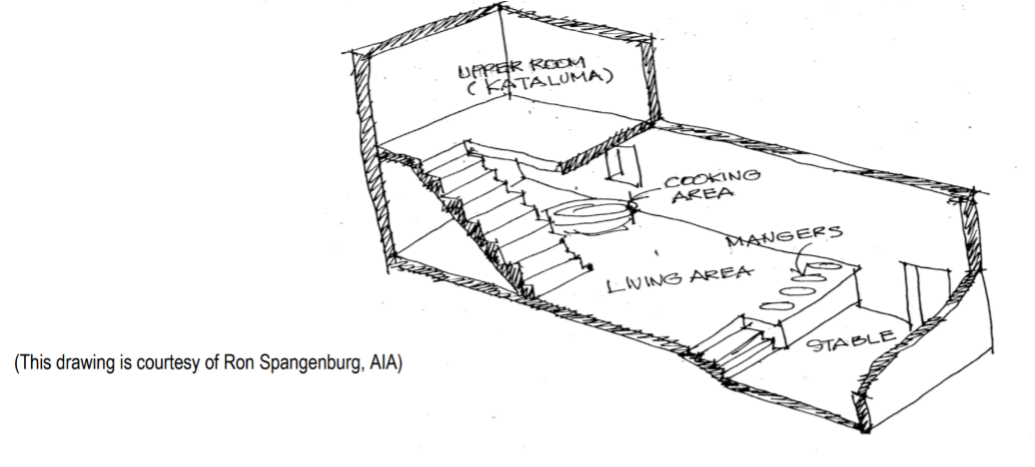 Now legends 3 and 4 are further debunked by the way a 1st century Jewish residence was designed. It explains both the “guest room” as well as the location of the manger. Most homes included a walled courtyard for the animals just below the residence. This would keep the animals protected from theft at night but separate from the family dining/sleeping area. To feed the creatures, there were mangers set up in the courtyard. One of the first chores at sun-up would be to take the animals outside for their grazing and to allow the courtyard to be cleaned. Most homes also included a storage room that would double as a guest room. This is the kataluma mentioned in Luke 2:7 and 22:11. Many times, it was set off or even higher than the family living area—an “upper room.”
The most likely scenario is that Joseph and Mary arrived at a busy time in Bethlehem considering the census. And as family would likely house family, Joseph came to a relative’s home that almost certainly was already occupying other family visitors. Therefore, there was no room for them in the guestroom. And so Mary and Joseph either squeezed in with main family in the daily living area, or they had to make do with the animals, a much safer prospect than sleeping outside the walls of the home. When it came time for delivery, wherever Mary was (probably in the family living area?), the three of them (Joseph, Mary, and now Jesus) returned to their spot while putting the newborn in the manger between the living area and courtyard. In other words, there was no inn. Nor was there a mean innkeeper. There was no cave or stable. There was just a crowded home filled with Joseph’s relatives traveling to the city of David for the census. This may even be confirmed when the Magi later visit Jesus in Matt 2:11 NKJV, “And when they had come into the house, they saw the young Child with Mary His mother, and fell down and worshiped Him.” They visited him in a house, as we would expect.
To summarize both the flaws of Legends 3 and 4, hear NT scholar Kenneth Bailey:
It is not “a room” but rather “the guest room,” more specifically, “the guest room” of a home, naturally. This translation gives new understanding to the story of Jesus’ birth. Joseph and Mary arrive in Bethlehem. They find shelter with a family whose separate guest room is full, and are accommodated among the family in acceptable village style. The birth takes place there on the raised terrace of the family home, and the baby is laid in a manger… If we assume the perspective of a Palestinian reader, the present form of the verse makes good sense. The author records, “And she gave birth to her first-born son and wrapped him in swaddling cloths, and laid him in a manger.” The (Palestinian) reader instinctively thinks, “Manger—oh—they are in the main family room. Why not the guest room?” The author instinctively replies, “Because there was no place for them in the guest room.” The reader concludes, “Ah, yes—well, the family room is more appropriate anyway.” Thus, with the translation “guest room,” all of the cultural, historical and linguistic pieces fall into place. … The raised terrace on which the family ate, slept and lived was unsoiled by the animals, which were taken out each day and during which time the lower level was cleaned.
Legend #5: “We three kings”
It is a widely held tradition that Jesus was visited on the night of his birth. Luke 2 records shepherds and tradition include three kings named Caspar, Melchior, and Balthazar. However, they were not kings but magi (μάγοι) or wisemen from the east. Almost certainly, there was more than three. That number likely derives from the three gifts presented to Jesus (Matt 2:11). Indeed, it is quite improbable that such a group of scholars and students of stars would travel in such a small pack. Journeys from the east (associations with Babylon most likely) often entail large caravans, if for no other reason than safety. Indeed, their presence would hardly gain the attention of Herod if only three men rode into Jerusalem. But if a large caravan from the east traveled a great distance, that would catch the eyes of almost everyone in Jerusalem.
Legend # 6: The magi were present at the birth
This legend appears in almost every nativity scene and movie. Whoever the magi were, and however many there were, one thing we can be certain of: they were not present at the birth of Christ. Matt 2:1 indicates that it was after Jesus was born that they arrived in Jerusalem to seek Herod’s assistance. Though we are not told exactly, perhaps the star appeared the same night of Jesus’ birth. This is the implication of Herod’s questioning about the star’s timing in Matt 2:7. Therefore, if the star appeared around or at the birth of our Lord, and the magi had to travel a great distance to Jerusalem, then it would be impossible for them to be present at the birth.
Indeed, the journey from the area of Babylon (the likely location of the Magi) to Jerusalem is roughly a four-month trek. For Ezra the scribe and his caravan, it was reported that his journey to Jerusalem took four months (Ezra 7:8–9). It is very probable that the speed of the journey for the Magi had not changed since Ezra’s time. Therefore, it is safe to conclude that the Magi arrived many months after the birth.
Further evidence indicates that it could have been more than a year before the Magi arrived in Jerusalem. This is suggested by the fact that Herod sought to kill all the male children two years old and under. Certainly, most could tell the difference between a six-month-old and an eighteen-month-old. But if Herod was not alerted about the birth of the Messiah for six to twelve months, then he was likely hedging his bets and covering possible scenarios. If the Magi had reported to Herod about a newborn King not even weeks old, then there would have been no reason for Herod to kill so widely or indiscriminately. Therefore, the Magi were probably appearing before Herod several months after the birth of Jesus.
Conclusion & Reflection
I no longer take pleasure in bursting the bubbles of tradition that I once enjoyed. I would rather encourage people’s faith than erode it. However, as believers in Christ and his word, we must train ourselves to be governed by Scripture first and foremost and not tradition, no matter how wholesome or deeply rooted these traditions go. Therefore, all of our traditions need to be calibrated and formed around Scripture. And if by “testing the spirits” we can include testing our traditions, and in doing so makes you feel uncomfortable, then perhaps you need to reevaluate yourself in light of the spirit of this tradition.
On the inverse side, having a more historically situated and biblically oriented understanding of the birth of our Lord makes for better Scripture reading, learning, and preaching. Truth will always uplift over tradition, especially when those legends of tradition are in error.
Dr. Timothy Decker is one of the pastors of Trinity Reformed Baptist Church of Roanoke, VA, having joined them in 2018. He holds a B.A. and M.A. biblical studies from Carolina University (formerly Piedmont International University), a Th.M. in New Testament from Southeastern Baptist Theological Seminary, and a Ph.D. in biblical studies from Capital Seminary and Graduate School. In his dissertation research, he examined the style of biblical Hebrew poetry in the New Testament. He has presented various papers at academic society meetings and authored numerous articles in several different scholarly journals. He is a member of ETS and IBR. When he is not reading or researching, he enjoys spending time with his wife and four children.
Courses taught at CBTSeminary: Elementary Greek I, Elementary Greek II

by Sam Waldron | Dec 2, 2025 | Systematic Theology
Chapter 9 of the Confession teaches the important biblical doctrine of the total inability of fallen man to do anything spiritually good. Still, this teaching has been widely denied. In this blog, I want to address those objections.
1st Denial: It is inconsistent with the commands of the Bible.
The premise underlying this objection is that if God commands men to repent, believe, or come to Christ, they must be able to. In other words, responsibility assumes ability. Several conclusive responses may be given to this denial of total inability.
1) This premise is contradicted by the clear teaching of Scripture.
God commands men to believe, but the Bible teaches that they cannot (Acts 16:31 with John 6:37, 40, 44, 65).
God commands men to repent, but the Bible teaches that they cannot (Acts 2:38 with 2 Tim. 2:25, 26).
God commands men to make a new heart, but the Bible teaches that they cannot (Ezek. 18:31 with Ezek. 11:19).
2) This premise, if correct, would imply complete human ability to give perfect, perpetual obedience to the law of God.
God commands us to be perfect perpetually.
On this premise we must, then, have this moral ability.
3) This premise confuses natural or physical ability and moral or spiritual ability.
The Confession distinguishes natural liberty (par. 1) from moral freedom (par 3 and 4). Man is not lacking a will, or mind, or a heart or the emotions of love, trust, or sorrow. It would be wrong to command a child to jump over a wall 50 feet high, but total inability is a moral issue. It is like asking someone who hates you for a favor. The example of the drunken driver is pertinent. He is responsible to stay on his sider of the road, but he lacks the ability.
4) Its premise misunderstands the implications of the commands and conditions of the Bible.
The commands of the law cannot be changed. The conditions of salvation must be kept. These necessities, however, do not assume our moral ability, but God’s saving grace
2nd Denial: It is inconsistent with the realities of human life.
Total inability appears to be an unrealistically harsh view of fallen humanity. Aren’t some unconverted men better than others? Don’t they do righteous things?
Yes, but we must distinguish between civil and spiritual righteousness, between common and saving grace. In the sense of civil righteousness good is attributed to unsaved men (2 Kings 10:29, 30; 2 Kings 12:2; Rom. 2:14). A distinction is necessary because the Scriptures also teach that the unregenerate cannot and do not please God (Rom. 3:10-12; 8:7, 8; Heb. 11:6; 2 Thess. 3:2).
Total inability does not mean that men are as bad as they can be, but that they are as bad off as they can be. Distinguish between absolute and total depravity!
3rd Denial: It is inconsistent with the practical needs of the sinner and produces despair.
Some have abused the doctrine, but properly understood, this doctrine does not tend to despair.
Hopelessness and despair presuppose some willingness to be saved.
But this doctrine is not that men are willing, but unable.
Total inability means that no one is willing until God works.
Despair of human resources is the necessary preparation for the gospel.
Human sufficiency is the true hindrance.
The man in the burning house with locked doors is the man who will cry for help.
4the Denial: It is inconsistent with the sincerity of God.
How can God sincerely offer mercy to men when He knows that unless he draws them they will never come? How can He do this even if He merely foreknows they will not come?
There is a real difficulty. The Bible clearly teaches that God offers mercy to wicked men, but the Bible teaches that men cannot come. This problem is caused by the Bible—not a system of theology.
This problem reduces to the fundamental tension between the decretive and preceptive will of God. The presence of such a mystery does not disprove either side of the tension, but calls for humble submission.
Dr. Sam Waldron is the Academic Dean of CBTS and professor of Systematic Theology. He is also one of the pastors of Grace Reformed Baptist Church in Owensboro, KY. Dr. Waldron received a B.A. from Cornerstone University, an M.Div. from Trinity Ministerial Academy, a Th.M. from Grand Rapids Theological Seminary, and a Ph.D. from Southern Baptist Theological Seminary. From 1977 to 2001 he was a pastor of the Reformed Baptist Church of Grand Rapids, MI. Dr. Waldron is the author of numerous books including A Modern Exposition of the 1689 Baptist Confession of Faith, The End Times Made Simple, Baptist Roots in America, To Be Continued?, and MacArthur’s Millennial Manifesto: A Friendly Response.

by Sam Waldron | Dec 2, 2025 | Systematic Theology
Par 3 teaches the doctrine of total inability:
“Man, by his fall into a state of sin, hath wholly lost all ability of will to any spiritual good accompanying salvation; so as a natural man, being altogether averse from that good, and dead in sin, is not able by his own strength to convert himself, or to prepare himself thereunto.”
Though the Confession affirms free will, it affirms the kind of free will that is compatible with the idea that this free will is incapable of any spiritual good. Perhaps this seems paradoxical to you, but it is clearly the case.
I. Its Definition
Total inability must be defined and distinguished from total depravity.
Total Depravity is the corruption of every faculty or ability of man.
Confession (6:2) “wholly defiled in all the faculties and parts of soul and body.”
Total Inability is the inability to will anything spiritually good.
Confession (6:4) “we are utterly indisposed, disabled, and made opposite to all good, and wholly inclined to all evil.”
Confession (9:3) “Man…hath wholly lost all ability of will to any spiritual good accompanying salvation … And … is not able by his own strength to convert himself or to prepare himself thereunto.”
II. Its Defense
1st Scriptural Proof: The Scripture asserts that men in their natural condition are enslaved, dead, and blind.
Romans 6:16 … you are slaves of the one whom you obey, either of sin resulting in death, or of obedience resulting in righteousness? …. 20 For when you were slaves of sin, you were free in regard to righteousness.
John 8:32 … the truth will make you free.” …. 34 … everyone who commits sin is the slave of sin.
Ephesians 2:1 And you were dead in your trespasses and sins …
2 Corinthians 4:4 … the god of this world has blinded the minds of the unbelieving so that they might not see …
John 3:3 … unless one is born again, he cannot see the kingdom of God.”
2nd Scriptural Proof: The Scripture asserts plainly and explicitly that man has lost the ability to please God, to do God’s will, or perceive and receive the things of God.
Romans 7:18 For I know that nothing good dwells in me, that is, in my flesh …
Romans 8:7 because the mind set on the flesh is hostile toward God; for it does not subject itself to the law of God, for it is not even able to do so,
1 Corinthians 2:14 But a natural man does not accept the things of the Spirit of God, for they are foolishness to him; and he cannot understand them.
3rd Scriptural Proof: No man ever wills to receive Christ or come to God apart from God’s drawing.
John 5:40 and you are unwilling to come to Me so that you may have life.
John 6:37 “All that the Father gives Me will come to Me .… 39 “This is the will of Him who sent Me, that of all that He has given Me I lose nothing, but raise it up on the last day.
John 6:44 “No one can come to Me unless the Father who sent Me draws him; and I will raise him up on the last day.
John 6:65 And He was saying, “For this reason I have said to you, that no one can come to Me unless it has been granted him from the Father.”
4th Scriptural Proof: The will of man is not the source or determining factor in the application of salvation.
James 1:18 In the exercise of His will He brought us forth by the word of truth, so that we would be a kind of first fruits among His creatures.
Romans 9:16 So then it does not depend on the man who wills or the man who runs, but on God who has mercy….18 So then He has mercy on whom He desires, and He hardens whom He desires.
John 1:12 But as many as received Him, to them He gave the right to become children of God, even to those who believe in His name, 13 who were born, not of blood nor of the will of the flesh nor of the will of man, but of God.
5th Scriptural Proof: Repentance and faith, those crucial duties laid on the sinner in the gospel, are the gift of God.
Acts 5:31 … a Prince and a Savior, to grant repentance to Israel, and forgiveness of sins.
Acts 11:18 … “Well then, God has granted to the Gentiles also the repentance that leads to life.”
2 Timothy 2:25 … if perhaps God may grant them repentance … 26 and they may come to their senses and escape from the snare of the devil, having been held captive by him to do his will.
Philippians 1:29 For to you it has been granted for Christ’s sake … to believe in Him …
Eph. 2:8-9 For by grace you have been saved through faith; and that not of yourselves, it is the gift of God; not as a result of works, so that no one may boast.
The Scripture proof for the doctrine of total inability is indisputable.
Dr. Sam Waldron is the Academic Dean of CBTS and professor of Systematic Theology. He is also one of the pastors of Grace Reformed Baptist Church in Owensboro, KY. Dr. Waldron received a B.A. from Cornerstone University, an M.Div. from Trinity Ministerial Academy, a Th.M. from Grand Rapids Theological Seminary, and a Ph.D. from Southern Baptist Theological Seminary. From 1977 to 2001 he was a pastor of the Reformed Baptist Church of Grand Rapids, MI. Dr. Waldron is the author of numerous books including A Modern Exposition of the 1689 Baptist Confession of Faith, The End Times Made Simple, Baptist Roots in America, To Be Continued?, and MacArthur’s Millennial Manifesto: A Friendly Response.