
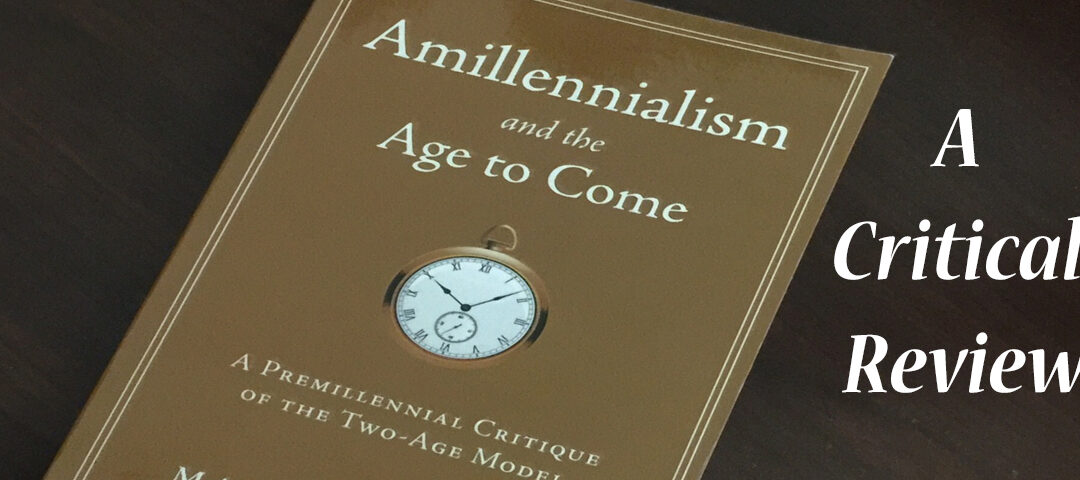
Amillennialism and the Age to Come—A Critical Review # 3
Overview
In my first two posts, I have attempted to introduce and express appreciation for Waymeyer’s Amillennialism and the Age to Come. Here I want to provide an overview of the book and its argument.
Chapter 1 is introductory. An overview of the entire book may be provided by an analysis of that chapter. The headings found in that chapter usefully summarize it.
The Two-Age Model of Amillennialism speaks of it as “one of the strongest arguments for the amillennial view. It also notes the importance of Riddlebarger’s A Case for Amillennialism in presenting it as an argument against Premillennialism.
The Two-Age Model of Amillennialism presents a summary of biblical evidence for the two-age model.
The Two-Age Model as an Interpretive Grid makes the point that “amillennialists have increasingly regarded this model as the hermeneutical lens through which the rest of Scripture, including Revelation 20, should be viewed.” (4)
The Two-Age Model as an Amillennial Argument affirms that amillennialism views it “as a decisive refutation of the kingdom of premillennialism.” (6)
The Need for a Premillennial Response draws the conclusion that Premillennialists must respond to this argumentation. Waymeyer says: “Because any compelling defense of premillennialism must respond to the strongest and most recent argumentation of its theological opponents, a premillennial critique of the two-age model is long overdue.” (7)
Revisiting the Hermeneutical Foundation argues that “Such a critique must begin in the realm of hermeneutics. Waymeyer finds two hermeneutical problems with the two-age argument for amillennialism. “The first problem concerns identifying Revelation 20 as an unclear passage.” (8) “The second problem concerns the use of the two-age model as an interpretive grid.” (9) He warns that such a use of the two-age model “silences the contribution of those passages by forcing them to conform to his theological system.” He adds: “In this way, systematic theology is used to determine exegesis rather than vice versa.” (9)
Reconsidering the Starting Point states that the best way to approach this issue is “to trace the doctrine of the coming kingdom throughout biblical revelation. …. In the process, it must be recognized that later revelation often supplements and thereby clarifies previous revelation by providing broader context or additional detail, but it never changes the meaning of earlier passages in the process.” (11)
The Clarifying Role of Revelation 20 leads Waymeyer finally to say that Revelation 20 “as the fullest and most comprehensive presentation of the eschatological events surrounding the Second Coming … should be allowed to clarify previous revelation about the coming kingdom.” (12)
The Approach of the Critique provides, then, an overview of Waymeyer’s book after the introductory chapter. “The first section (chapters 2-5) focuses on the Old Testament, with an exegesis of several prophetic passages which predict a period of time that is distinct from the present age and the eternal state. …. The second section (chapters 6-10) transitions to the New Testament and responds directly to the three ways that the two-age model is used as an argument against premillennialism. …. The final section of his critique (chapters 11-14) focuses on Revelation 20:1-6.” (14-15) Waymeyer then states the conclusion of his argument: “If Revelation 20 clearly teaches an earthly reign of Christ between the present age and the eternal state, there must be some way to harmonize this intermediate kingdom with the two ages in the New Testament.” (15)

Dr. Sam Waldron is the Academic Dean of CBTS and professor of Systematic Theology. He is also one of the pastors of Grace Reformed Baptist Church in Owensboro, KY. Dr. Waldron received a B.A. from Cornerstone University, an M.Div. from Trinity Ministerial Academy, a Th.M. from Grand Rapids Theological Seminary, and a Ph.D. from Southern Baptist Theological Seminary. From 1977 to 2001 he was a pastor of the Reformed Baptist Church of Grand Rapids, MI. Dr. Waldron is the author of numerous books including A Modern Exposition of the 1689 Baptist Confession of Faith, The End Times Made Simple, Baptist Roots in America, To Be Continued?, and MacArthur’s Millennial Manifesto: A Friendly Response.