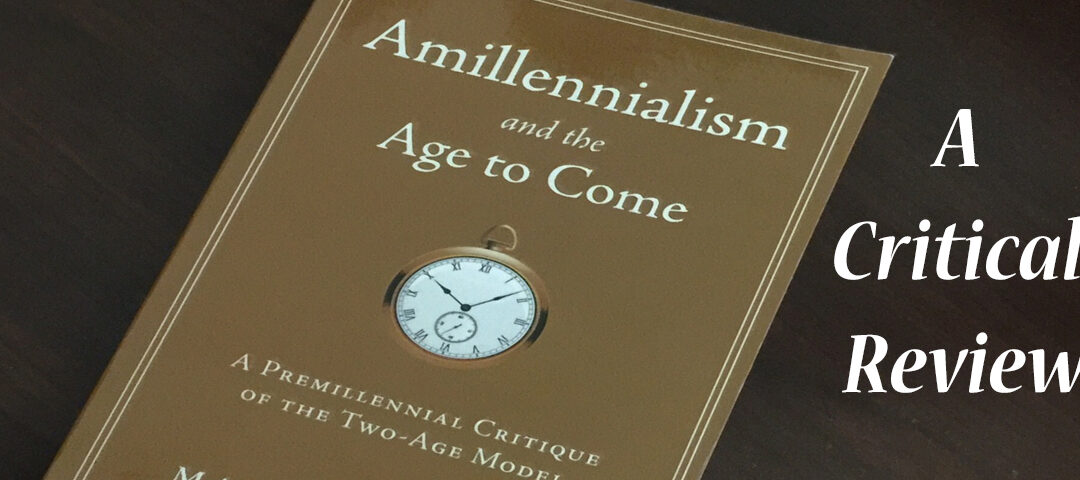
by Sam Waldron | May 22, 2017 | Book Reviews, Eschatology
Part 1, Part 2, Part 3, Part 4, Part 5, Part 6
Second Criticism: Hermeneutical Priority Must Be Given to the New Testament over the Old Testament and the More Literal New Testament Passages over the More Figurative. (Continued.)
In my last post I said that in a very real sense Waymeyer’s book constitutes an emphatic denial of (what I thought were) self-evident hermeneutical principles. Those principles were that clear passages must be given priority over difficult passages, literal passages over figurative passages, and general truths about eschatology before the details of prophecy. He does this by giving hermeneutical priority to Old Testament prophecy and Revelation 20 over the teaching of the New Testament. I am incredulous, but let me respond to Waymeyer with something more than incredulity.
First, let me affirm a concern of Waymeyer’s which I believe has some validity. He says: “The second problem concerns the use of the two-age model as an interpretive grid.” (9) He warns that such a use of the two-age model “silences the contribution of those passages by forcing them to conform to his theological system.” He adds: “In this way, systematic theology is used to determine exegesis rather than vice versa.” (9) In general, it seems to me, this is a fair warning with regard to the use of the hermeneutical principle known as the analogy of faith. Care must be taken not to silence the richness of divine revelation by a too facile assumption that we know what Scripture cannot say in light of our understanding of other indisputable truths of Scripture. Divine revelation is greater and more mysterious than our finite and fallen minds may realize. No doubt, the analogy of faith has been abused by those who have deduced contradictions where there was only supplementation by other plain truths of Scripture. This is a danger of which Systematicians must always beware.
The real danger in our day, however, is the tendency of Evangelicals to interpret Scripture in a way uninformed by historical theology and detached from any recognizable systematic theology. Thus, the danger about which Waymeyer warns is probably not the greatest danger we face today. Instances could be multiplied of interpretations of biblical passages which simply refuse to confront the practical contradictions they impose on ordinary Christians. One reputable theologian argues that the exegesis of Hebrews 3, 6, and 10 teaches the apostasy of genuine Christians. Yet he refuses to show how this is consistent with other passages that teach the opposite and even refuses to interpret those passages in a way consistent with their exegesis of Hebrews.
Listen to Calvin R. Schoonhoven in the article entitled, “The Analogy of Faith,” in Scripture, Tradition, and Interpretation (Grand Rapids: Eerdmans, 1978), 105: “Although the “analogy-of-faith” devotee may assert that whatever these texts say they cannot teach that a “saved” person could be forever lost so as never again to be able to experience repentance, this is precisely what is taught here. These statements must not be interpreted in the context of other teachings; they must be interpreted in the context of Hebrews and from the perspective of this writer. Such strong words should not be interpreted by some sort of “illumination” from other passages.”
Such exegesis is simply irresponsible. The goal of all Christian teaching is to teach Christians to observe all that Christ commanded (Matthew 28:18-20). It is simply impossible for the ordinary Christian to practice a theological contradiction.
This is not, of course, the practical error into which Waymeyer falls. He believes that ultimately Scripture is self-consistent. He actually uses the analogy of faith himself to argue that Revelation 20 must expand our understanding of Luke 20 and what we might naturally conclude it means. (105) I say these things, however, because we all need to remember the necessity and responsibility of providing a coherent interpretation of Scripture to the Christian church. We may not wave aside the analogy of faith in our hermeneutics. It is in principle perfectly legitimate for Amillennialists to argue that the clear teaching of clear Scriptures require something other than a Premillennial interpretation of Revelation 20. If, for instance, the New Testament teaches—as it assuredly does—a general judgment of all men living and dead at Christ’s Second Coming issuing in the eternal state, then whatever Revelation 20 teaches it cannot teach Premillennialism. I think that it is plain that the New Testament does teach such a general judgment in many places and in clear language and that such a judgment is legitimately part of the analogy of faith by which the interpretation of Revelation 20 must be controlled.
Part 8
Dr. Sam Waldron is the Academic Dean of CBTS and professor of Systematic Theology. He is also one of the pastors of Grace Reformed Baptist Church in Owensboro, KY. Dr. Waldron received a B.A. from Cornerstone University, an M.Div. from Trinity Ministerial Academy, a Th.M. from Grand Rapids Theological Seminary, and a Ph.D. from Southern Baptist Theological Seminary. From 1977 to 2001 he was a pastor of the Reformed Baptist Church of Grand Rapids, MI. Dr. Waldron is the author of numerous books including A Modern Exposition of the 1689 Baptist Confession of Faith, The End Times Made Simple, Baptist Roots in America, To Be Continued?, and MacArthur’s Millennial Manifesto: A Friendly Response.
by Sam Waldron | May 17, 2017 | Book Reviews, Eschatology
Part 1, Part 2, Part 3, Part 4, Part 5
Second Criticism: Hermeneutical Priority Must Be Given to the New Testament over the Old Testament and the More Literal New Testament Passages over the More Figurative.
In my book, End Times Made Simple, I assumed with little argument that when it comes to interpreting the Bible as a whole (and, therefore, its eschatology in particular) that there were certain “self-evident” principles which must be followed. They were that clear passages must be given priority over difficult passages, literal passages over figurative passages, and general truths about eschatology before the details of prophecy. In a very real sense Waymeyer’s book constitutes an emphatic denial of these (what I thought were) self-evident hermeneutical principles. What do I mean?
First, Waymeyer insists on giving priority to Old Testament prophetic passages with regard to the doctrine of the coming of the kingdom. This is evident in the very order of the book in which Part 1 is devoted to a treatment of “The Intermediate Kingdom in the Old Testament.” The problem is that this treatment of the Old Testament is deliberately un-informed by the teaching of the New Testament about the coming of the kingdom of God. This approach is clear. Waymeyer says that his approach is: “to trace the doctrine of the coming kingdom throughout biblical revelation. …. In the process, it must be recognized that later revelation often supplements and thereby clarifies previous revelation by providing broader context or additional detail, but it never changes the meaning of earlier passages in the process.” (11) [Italics are mine.] My response to this focuses on the statement later revelation “never changes the meaning of earlier passages.” This assertion begs the whole question. The very question at stake is the meaning of the earlier passages and whether this meaning can be understood fully and properly apart from the teaching of the New Testament. I will show below that there is reason to view the Old Testament prophecies which Waymeyer discusses in Part 1 as both figurative and less clear than their New Testament explanations.
Second, Waymeyer insists on giving priority to Revelation 20 over the rest of the New Testament. Once more this is clear in the very structure of the book. He sandwiches the New Testament teaching before the Book of Revelation between his treatment of the Old Testament prophecies in Part 1 of the book and the treatment of Revelation 20 in Part 3. This order does not indicate a prioritizing of the New Testament two-age grid over Revelation 20. In fact, it indicates just the opposite. It really represents Waymeyer’s desire to have Revelation 20 trump the rest of the New Testament, because it is the last card played in the Bible. He makes this very clear by two things he says. In one place he remarks: “The first problem concerns identifying Revelation 20 as an unclear passage.” (8) In another he adds: “as the fullest and most comprehensive presentation of the eschatological events surrounding the Second Coming … should be allowed to clarify previous revelation about the coming kingdom.” (12) Thus, denying that Revelation 20 is an unclear passage and so affirming that hermeneutically it is on a par with the literal passages in the New Testament, he then plainly asserts the superiority of Revelation 20 by saying that it is the fullest and most comprehensive presentation of eschatology. Thus, it must be allowed to clarify previous revelation.
In this way Waymeyer contradicts the view which I and other Amillennialists take as self-evident that the teaching of the New Testament is both more clear and literal than that of either Old Testament prophecy or the Book of Revelation. Frankly, I am incredulous at this contradiction! Does Waymeyer really want to maintain Revelation 20 is more clear than Luke 20? Does he really want to maintain that the visionary and apocalyptic character of prophetic literature is superior to the mainly literal language of the New Testament in its clarity? I think it is plainly not. I also continue to think that it should be obvious that it should not be given this kind of hermeneutical priority.
But let me respond to Waymeyer with something more than incredulity. I will do so in my next post.
Part 7
Dr. Sam Waldron is the Academic Dean of CBTS and professor of Systematic Theology. He is also one of the pastors of Grace Reformed Baptist Church in Owensboro, KY. Dr. Waldron received a B.A. from Cornerstone University, an M.Div. from Trinity Ministerial Academy, a Th.M. from Grand Rapids Theological Seminary, and a Ph.D. from Southern Baptist Theological Seminary. From 1977 to 2001 he was a pastor of the Reformed Baptist Church of Grand Rapids, MI. Dr. Waldron is the author of numerous books including A Modern Exposition of the 1689 Baptist Confession of Faith, The End Times Made Simple, Baptist Roots in America, To Be Continued?, and MacArthur’s Millennial Manifesto: A Friendly Response.
by Sam Waldron | May 5, 2017 | Book Reviews, Eschatology
Part 1, Part 2
Overview
In my first two posts, I have attempted to introduce and express appreciation for Waymeyer’s Amillennialism and the Age to Come. Here I want to provide an overview of the book and its argument.
Chapter 1 is introductory. An overview of the entire book may be provided by an analysis of that chapter. The headings found in that chapter usefully summarize it.
The Two-Age Model of Amillennialism speaks of it as “one of the strongest arguments for the amillennial view. It also notes the importance of Riddlebarger’s A Case for Amillennialism in presenting it as an argument against Premillennialism.
The Two-Age Model of Amillennialism presents a summary of biblical evidence for the two-age model.
The Two-Age Model as an Interpretive Grid makes the point that “amillennialists have increasingly regarded this model as the hermeneutical lens through which the rest of Scripture, including Revelation 20, should be viewed.” (4)
The Two-Age Model as an Amillennial Argument affirms that amillennialism views it “as a decisive refutation of the kingdom of premillennialism.” (6)
The Need for a Premillennial Response draws the conclusion that Premillennialists must respond to this argumentation. Waymeyer says: “Because any compelling defense of premillennialism must respond to the strongest and most recent argumentation of its theological opponents, a premillennial critique of the two-age model is long overdue.” (7)
Revisiting the Hermeneutical Foundation argues that “Such a critique must begin in the realm of hermeneutics. Waymeyer finds two hermeneutical problems with the two-age argument for amillennialism. “The first problem concerns identifying Revelation 20 as an unclear passage.” (8) “The second problem concerns the use of the two-age model as an interpretive grid.” (9) He warns that such a use of the two-age model “silences the contribution of those passages by forcing them to conform to his theological system.” He adds: “In this way, systematic theology is used to determine exegesis rather than vice versa.” (9)
Reconsidering the Starting Point states that the best way to approach this issue is “to trace the doctrine of the coming kingdom throughout biblical revelation. …. In the process, it must be recognized that later revelation often supplements and thereby clarifies previous revelation by providing broader context or additional detail, but it never changes the meaning of earlier passages in the process.” (11)
The Clarifying Role of Revelation 20 leads Waymeyer finally to say that Revelation 20 “as the fullest and most comprehensive presentation of the eschatological events surrounding the Second Coming … should be allowed to clarify previous revelation about the coming kingdom.” (12)
The Approach of the Critique provides, then, an overview of Waymeyer’s book after the introductory chapter. “The first section (chapters 2-5) focuses on the Old Testament, with an exegesis of several prophetic passages which predict a period of time that is distinct from the present age and the eternal state. …. The second section (chapters 6-10) transitions to the New Testament and responds directly to the three ways that the two-age model is used as an argument against premillennialism. …. The final section of his critique (chapters 11-14) focuses on Revelation 20:1-6.” (14-15) Waymeyer then states the conclusion of his argument: “If Revelation 20 clearly teaches an earthly reign of Christ between the present age and the eternal state, there must be some way to harmonize this intermediate kingdom with the two ages in the New Testament.” (15)
Part 4
Dr. Sam Waldron is the Academic Dean of CBTS and professor of Systematic Theology. He is also one of the pastors of Grace Reformed Baptist Church in Owensboro, KY. Dr. Waldron received a B.A. from Cornerstone University, an M.Div. from Trinity Ministerial Academy, a Th.M. from Grand Rapids Theological Seminary, and a Ph.D. from Southern Baptist Theological Seminary. From 1977 to 2001 he was a pastor of the Reformed Baptist Church of Grand Rapids, MI. Dr. Waldron is the author of numerous books including A Modern Exposition of the 1689 Baptist Confession of Faith, The End Times Made Simple, Baptist Roots in America, To Be Continued?, and MacArthur’s Millennial Manifesto: A Friendly Response.
by Sam Waldron | May 1, 2017 | Book Reviews, Eschatology
Part 1
Appreciation
In my last post, I mentioned that there are a number of things for which I can express genuine appreciation in Waymeyer’s book. Here are some of them:
First, I agree with Waymeyer’s rejection of eschatological agnosticism. In his preface, he condemns those who avoid the topic of eschatology and “even seem proud of their agnosticism” (vii). He avers that “Scripture reveals too much about the subject of eschatology for Christians to be content to be in the dark, especially those who preach the Word and shepherd the flock.” I could not agree more. In fact, I do agree more! For me, as I will argue, eschatology is even more central to Christianity and the gospel than it is for Waymeyer. Still, I have heard too many jokes making light of eschatology and too many people teasing about being “Pan-millennialists” (because everything will “pan” out alright in the end). Such humor misses, I think, the importance of eschatology in the Bible. The Bible is a story—yes, a true story—but a story nonetheless. Everything in a story depends on how the story ends. Eschatology tells us how the biblical story ends. That is how important eschatology is!
Second, and in his Preface again, Waymeyer expresses his foundational commitment to the doctrine of “sola scriptura at the heart of reformed theology” and goes on to say that it “should drive us to a careful exegesis of the relevant biblical passages … about the end times” (viii). Well said! My disagreement with Waymeyer is not about this fundamental principle, but about what constitutes the “careful exegesis” of which he speaks.
In the third place by way of appreciation let me compliment Waymeyer on his identification of what he calls “the Two-Age Model” as at the heart of the modern Amillennial polemic against Premillennialism. He says: “One of the strongest arguments for the amillennial view involves what is known as the “two-age model,” an eschatological framework high-lighted by Geerhardus Vos in the early twentieth century” (1). Waymeyer actually notes this by way of a quotation from my book. As he quotes me, I do believe that Vos’ contributions are “epochal” in their importance. I congratulate him on seeing the importance of this point in the debate clearly. Later he notes that “none of the major premillennial works in recent years has directly and substantially addressed this amillennial argument” and that “a premillennial critique of the two-age model is long overdue” (7). Once more, I think Waymeyer is seeing the contours of the argument clearly in this assertion.
In the fourth place, I believe that Waymeyer is to be thanked for his attempt to present fairly and at some length Amillennial arguments on the above point and on other points throughout his book (2-7, 34-40, 50-51, 78-79, 88-90, 107-110 etc.). It seems to me that Waymeyer has made a commendable attempt to treat his adversaries’ arguments fairly and thoroughly. It is, of course, a different thing to suggest that he has been wholly successful in this attempt. I will point out in my critique deficiencies in his attempt. Yet he has made a serious attempt to treat our arguments accurately. This is very good and much better than previous Premillennial polemics. All this leads me, however, to my last commendation.
In the fifth place, Waymeyer has maintained an objective and Christian tone in his argument. That is to say, he treats his Amillennial opponents as serious, Bible-believing Christians and refrains from the kind of disrespectful and frankly un-Christian tone of too many prophetic polemics in the past. As I have said elsewhere[1], however seriously we may disagree with Dispensationalism or Premillennialism, and however consequential we may think the logical and practical implications of their positions are, the argument between the four major views of eschatology held by Christians (Postmillennialism, Amillennialism, Historic Premillennialism, and Dispensational Premillennialism) is historically an argument among Christians. It is, in other words, an argument among those who hold the doctrinal core of beliefs necessary for historic orthodoxy. It is those professed “Christians” who have denied the doctrines of the future judgment, the future resurrection of the flesh (body), and the future, visible, bodily Second Coming of Christ that have denied (and departed from) the faith once delivered to all the saints. It is not Amillennialism, Premillennialism, or Postmillennialism that has departed in radical error from the faith once delivered to all the saints.
Part 3
[1]See both my MacArthurs’s Millennial Manifesto (Reformed Baptist Academic Press, 2008), 1-4; More of the End Times Made Simple (Calvary Press, 2009), 13-31.
Dr. Sam Waldron is the Academic Dean of CBTS and professor of Systematic Theology. He is also one of the pastors of Grace Reformed Baptist Church in Owensboro, KY. Dr. Waldron received a B.A. from Cornerstone University, an M.Div. from Trinity Ministerial Academy, a Th.M. from Grand Rapids Theological Seminary, and a Ph.D. from Southern Baptist Theological Seminary. From 1977 to 2001 he was a pastor of the Reformed Baptist Church of Grand Rapids, MI. Dr. Waldron is the author of numerous books including A Modern Exposition of the 1689 Baptist Confession of Faith, The End Times Made Simple, Baptist Roots in America, To Be Continued?, and MacArthur’s Millennial Manifesto: A Friendly Response.