by Richard Barcellos | Dec 16, 2010 | Biblical Theology, Historical Theology, New Testament, Old Testament, Systematic Theology
Part I: The Perpetuity of the Decalogue under the New Covenant in Owen and Others
Part II: Matthew 5:17 and the Perpetuity of the Decalogue under the New Covenant in Owen and Others
Part III: The Multi-functional Utility of the Decalogue in Owen and Others
Part IV: The Idea of Abrogation in Owen and Others
1. John Owen. Owen teaches that the whole law of Moses (even the moral element) has been abrogated. Commenting on Hebrews 7:18, 19, Owen says:
I have proved before that “the commandment” in this verse [Heb. 7:18] is of equal extent and signification with “the law” in the next. And “the law” there doth evidently intend the whole law, in both the parts of it, moral and ceremonial, as it was given by Moses unto the church of Israel [emphasis added].[1]
Commenting on Hebrews 7:12, Owen says:
It was the whole “law of commandments contained in ordinances,” or the whole law of Moses, so far as it was the rule of worship and obedience unto the church; for that law it is that followeth the fates of the priesthood [emphasis added].[2]
Wherefore the whole law of Moses, as given unto the Jews, whether as used or abused by them, was repugnant unto and inconsistent with the gospel, and the mediation of Christ, especially his priestly office, therein declared; neither did God either design, appoint, or direct that they should be co-existent [emphasis added].[3]
Owen, of course, carefully qualifies what he means by the whole law and its abrogation. Commenting again on Hebrews 7:18, 19, he says:
Nor is it the whole ceremonial law only that is intended by “the command” in this place, but the moral law also [emphasis his], so far as it was compacted with the other into one body of precepts for the same end [emphasis added]; for with respect unto the efficacy of the whole law of Moses, as unto our drawing nigh unto God, it is here considered.[4]
Again, Owen says:
By all these ways was the church of the Hebrews forewarned that the time would come when the whole Mosaical law, as to its legal or covenant efficacy, should be disannulled, unto the unspeakable advantage of the church [emphasis added].[5]
This comes in a section in which Owen is showing how “the whole law may be considered …absolutely in itself” or “with respect …unto the end for which it was given” or “unto the persons unto whom it was given.”[6] He calls the law “the whole system of Mosaical ordinances, as it was the covenant which God made with the people of Horeb. For the apostle takes ‘the commandment,’ and ‘the law’ for the same in this chapter; and ‘the covenant,’ in the next, for the same in them both.”[7] Owen is concentrating on the whole Mosaic law, i.e., it is the law in its totality as it related to God’s Old Covenant people that has been abrogated. Thus the abrogation of the law in Owen refers to the whole law as it functioned in Old Covenant Israel.[8]
2. John Calvin. This understanding of abrogation is found in Calvin also. Calvin taught that the abrogation of the law under the New Covenant in no way abrogates the Decalogue in every sense of the word. Commenting on Rom. 7:2, Calvin says:
…but we must remember, that Paul refers here only to that office of the law which was peculiar to Moses; for as far as God has in the ten commandments taught what is just and right, and given directions for guiding our life, no abrogation of the law is to be dreamt of; for the will of God must stand the same forever. We ought carefully to remember that this is not a release from the righteousness which is taught in the law, but from its rigid requirements, and from the curse which thence follows. The law, then, as a rule of life, is not abrogated; but what belongs to it as opposed to the liberty obtained through Christ, that is, as it requires absolute perfection [emphasis added].[9]
It is important to note that “the term ‘law’ for Calvin may mean (1) the whole religion of Moses…; (2) the special revelation of the moral law to the chosen people, i.e., chiefly the Decalogue and Jesus’ summary…; or (3) various bodies of civil, judicial, and ceremonial statutes.”[10] Calvin says, “I understand by the word ‘law’ not only the Ten Commandments, which set forth a godly and righteous rule of living, but the form of religion handed down by God through Moses.”[11] Calvin views the law in various ways. So when he speaks of abrogation, he does not intend absolute abrogation, but relative abrogation in terms of the law considered not in itself, but in its redemptive-historically conditioned use. Commenting on the concept of abrogation in Calvin, one Calvin scholar said, “the Law was not in itself abrogated by the Christ, but only the slavery and malediction attaching to it under the ancient Covenant.”[12] According to Calvin, therefore, the Moral Law has not been abrogated, as such. What has been abrogated or fulfilled in Christ for believers is its function as a curse. “The law itself is not abolished for the believer, but only the maledictio legis… [F]or Calvin the law is related above all to believers for whom, however, the maledictio is removed.”[13]
3. Zacharias Ursinus. In his commentary on the Heidelberg Catechism, while discussing the extent that Christ abrogated the law and the extent that it is still in force, Zacharias Ursinus says:
The ordinary and correct answer to this question is, that the ceremonial and judicial law, as given by Moses, has been abrogated in as far as it relates to obedience; and that the moral law has also been abrogated as it respects the curse, but not as it respects obedience [emphasis added].[14]
The moral law has, as it respects one part, been abrogated by Christ; and as it respects another, it has not [emphasis added].[15]
But the moral law, or Decalogue, has not been abrogated in as far as obedience to it is concerned. God continually, no less now than formerly, requires both the regenerate and the unregenerate to render obedience to his law [emphasis added].[16]
4. Francis Turretin. A similar understanding of abrogation is found in Francis Turretin. In volume 2 of his Institutes of Elenctic Theology, Turretin entitles chapter XXIII as follows:
THE ABROGATION OF THE MORAL LAW
XXIII. Whether the moral law is abrogated entirely under the New Testament. Or whether in a certain respect it still pertains to Christians. The former we deny; the latter we affirm against the Antinomians.[17]
Notice Turretin’s careful qualifications (i.e., “entirely” and “in a certain respect”). While discussing the abrogation of the moral law, he says, “In order to apprehend properly the state of the question, we must ascertain in what sense the law may be said to have been abrogated and in what sense not.”[18] Then, after listing three senses in which the law has been abrogated, he says, “But the question only concerns its directive use–whether we are now freed from the direction and observance of the law. This the adversaries maintain; we deny.”[19]
Turretin does what we have seen in others. He has a view of abrogation which both includes the Decalogue and does not include the Decalogue. This is because the law can be viewed from different theological and redemptive-historical vantage points.
5. Protestant Scholasticism. Finally, concerning the lex Mosaica [law of Moses], which, representing the view of Protestant Scholasticism, he defines as the moral law as given to Israel by God in a special revelation to Moses on Mount Sinai, Richard Muller says, “As a norm of obedience belonging to the [covenant of grace], the law remains in force under the economy of the New Testament.”[20] Muller recognizes the fact that Protestant Scholastics considered the law in different ways. Therefore, when we examine their statements about abrogation, we must take this into consideration. If we do not, we may take their statements on the abrogation of the law in an absolute manner and make them mean something they did not.
We have seen that Owen’s view of abrogation was similar to Calvin’s, Ursinus’, Turretin’s, and Protestant Scholasticism’s. With them, he carefully and repeatedly qualifies what he means by abrogation. He stands clearly within Reformed orthodoxy at this point. His view of abrogation neither necessarily demands the elimination of the Decalogue as a unit in all senses under the New Covenant, nor is it contradicted by the inclusion of the Decalogue as a unit under the New Covenant. Though with his own nuances and emphases, Owen’s view is substantially that of others in his day. It was Calvin’s, Ursinus’s, Turretin’s, Protestant Scholasticism’s, as well as that of the Westminster Confession of Faith, the Savoy Declaration, and the 2nd LCF.[21]
From the evidence presented, Owen must be understood to view abrogation as both including and not including the Decalogue, depending on how it is viewed. If this is the case, his understanding of abrogation, though with its own nuances and emphases, has clear and ample precedent in Calvin, Ursinus, Turretin, and Protestant Scholasticism.
[1] Owen, Works, XXI:464.
[2] Owen, Works, XXI:428.
[3] Owen, Works, XXI:429.
[4] Owen, Works, XXI:458.
[5] Owen, Works, XXI:469.
[6] Owen, Works, XXI:466.
[7] Owen, Works, XXI:471.
[8] I defended this view of abrogation in my IDOTD. “Hearty agreement must be given when New Covenant theologians argue for the abolition of the Old Covenant. This is clearly the teaching of the Old and New Testaments (see Jeremiah 31:31-32; Second Corinthians 3; Galatians 3, 4; Ephesians 2:14-15; Hebrews 8-10). The whole law of Moses, as it functioned under the Old Covenant, has been abolished, including the Ten Commandments. Not one jot or tittle of the law of Moses functions as Old Covenant law anymore and to act as if it does constitutes redemptive-historical retreat and neo-Judaizing. However, to acknowledge that the law of Moses no longer functions as Old Covenant law is not to accept that it no longer functions; it simply no longer functions as Old Covenant law. This can be seen by the fact that the New Testament teaches both the abrogation of the law of the Old Covenant and its abiding moral validity under the New Covenant.” See Barcellos, IDOTD, 61.
[9] John Calvin, Calvin’s Commentaries (Grand Rapids: Baker Book House, re. 1984), IXX:246.
[10] Calvin, Institutes, II.vii, n. 1.
[11] Calvin, Institutes, II.vii.1.
[12] Hesselink, Calvin’s Concept, 203.
[13] Hesselink, Calvin’s Concept, 256.
[14] Ursinus, Commentary, 492.
[15] Ursinus, Commentary, 495.
[16] Ursinus, Commentary, 496.
[17] Turretin, Institutes, II:ix.
[18] Turretin, Institutes, II:141.
[19] Turretin, Institutes, II:141, 42.
[20] Muller, Dictionary, 174.
[21] See chapters 4 and 19 of these Confessions.
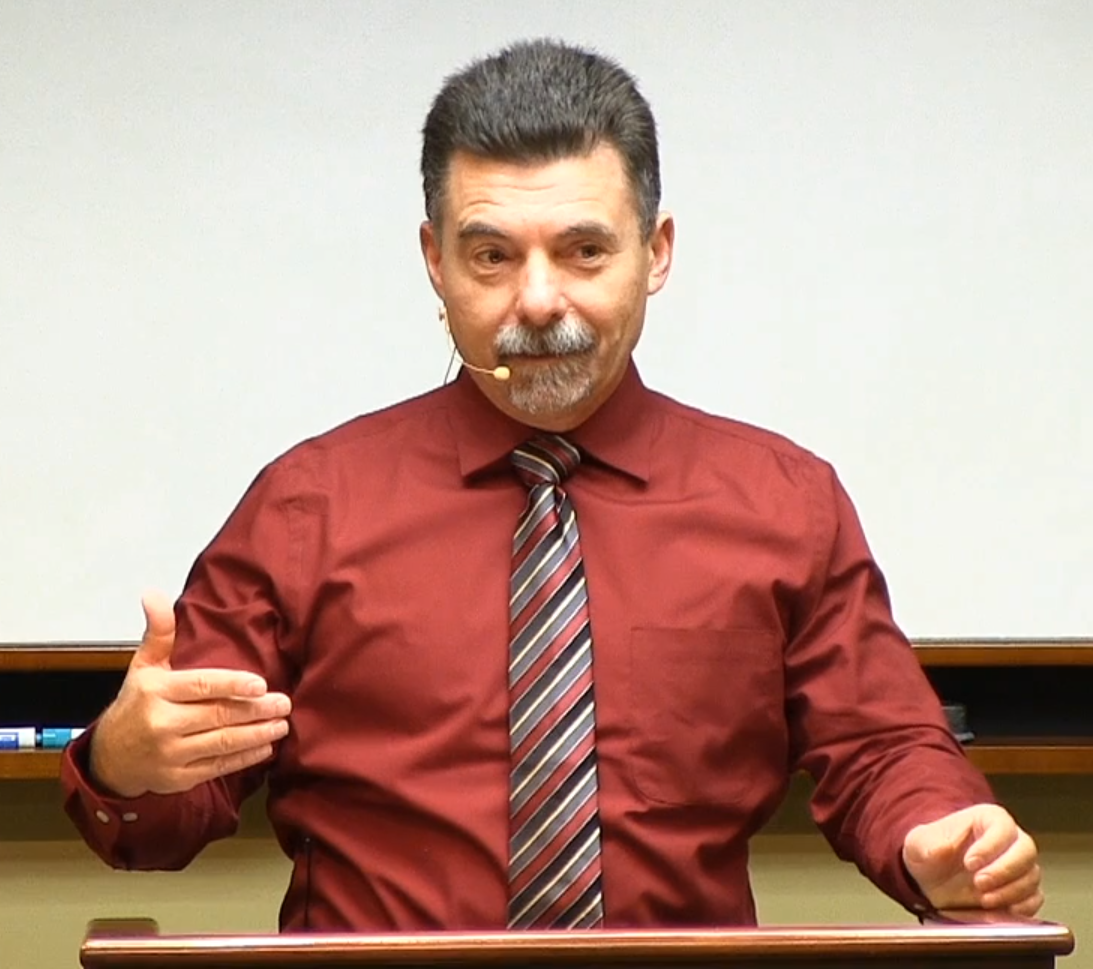
Dr. Richard Barcellos is associate professor of New Testament Studies. He received a B.S. from California State University, Fresno, an M.Div. from The Master’s Seminary, and a Th.M. and Ph.D. from Whitefield Theological Seminary. Dr. Barcellos is pastor of Grace Reformed Baptist Church, Palmdale, CA. He is author of Trinity & Creation, The Covenant of Works, and Getting the Garden Right. He has contributed articles to various journals and is a member of ETS.
Courses taught for CBTS: New Testament Introduction, Biblical Hermeneutics, Biblical Theology I, Biblical Theology II.
by Richard Barcellos | Nov 30, 2010 | Biblical Theology, Historical Theology
Part I: The Perpetuity of the Decalogue under the New Covenant in Owen and Others
Part II: Matthew 5:17 and the Perpetuity of the Decalogue under the New Covenant in Owen and Others
Part III: The Multi-functional Utility of the Decalogue in Owen and Others
1. John Owen. Owen viewed the Decalogue as having more than one function. He did not view it as Old Covenant law alone. His understanding of the multi-functional utility of the Decalogue can be seen clearly in several places of his Hebrews commentary. For instance, commenting on Heb. 9:5 (referenced above), he says, “The law [the Decalogue], as unto the substance of it, was the only law of creation, the rule of the first covenant of works.”[1] Later he claims that “what was in the tables of stone was nothing but a transcript of what was written in the heart of man originally; and which is returned thither again by the grace of the new covenant.”[2] Notice that he views the Decalogue as functioning several ways; first, “as unto the substance of it, …the only law of creation”; second, “the rule of the first covenant of works”; third, that which “was in the tables of stone”; fourth, “a transcript of what was written in the heart of man originally”; and fifth, that “which is returned [to the heart of man] again by the grace of the new covenant.”
Commenting on Hebrews 7:18, 19 (also referenced previously), he says:
Nor is it the whole ceremonial law only that is intended by “the command” in this place, but the moral law also [emphasis his], so far as it was compacted with the other into one body of precepts for the same end [emphasis added]; for with respect unto the efficacy of the whole law of Moses, as unto our drawing nigh unto God, it is here considered.[3]
Here he views the Decalogue as a unit “so far as it was compacted with the other [ceremonial law] into one body of precepts for the same end.” In other words, he is considering the Decalogue not absolutely or in itself (see below), but relatively or as it was ‘compacted’ with the ceremonial law under the Old Covenant.
While discussing the causes of the Sabbath and arguing for the morality and immutability of the essence of the fourth commandment, he makes this statement concerning the nature and function of the Decalogue under the Old Covenant:
The nature of the decalogue, and the distinction of its precepts from all commands, ceremonial or political, comes now under consideration. The whole decalogue, I acknowledge, as given on mount Sinai to the Israelites, had a political use, as being made the principal instrument or rule of the polity and government of their nation, as peculiarly under the rule of God. It had a place also in that economy or dispensation of the covenant which that church was then brought under; wherein, by God’s dealing with them and instructing of them, they were taught to look out after a further and greater good in the promise than they were yet come to the enjoyment of. Hence the Decalogue itself, in that dispensation of it, was a schoolmaster unto Christ.[4]
First, Owen views the Decalogue as the core of the law of the Old Covenant. He says, “The whole decalogue, …as given on mount Sinai to the Israelites, had a political use, as being made the principal instrument or rule of the polity and government of their nation.” Second, he makes the point that the Decalogue was “made the principal instrument or rule of the polity and government” of Israel under the Old Covenant. This is something that it was not until that time. He viewed it as already in existence, though in a different form and revealed in a different manner, but now being “made” something it was not. It was now “made” to fit the redemptive-historical conditions of the Old Covenant. This seems even more likely, since he goes on to say, “Some, indeed, of the precepts of it, as the first, fourth, and fifth, have either prefaces, enlargements, or additions, which belonged peculiarly to the then present and future state of that church in the land of Canaan.”[5] Third, he also viewed it as “a schoolmaster unto Christ.”
Next, speaking of the Decalogue “in itself, and materially,” he says:
But in itself, and materially considered, it was wholly, and in all the preceptive parts of it, absolutely moral. Some, indeed, of the precepts of it, as the first, fourth, and fifth, have either prefaces, enlargements, or additions, which belonged peculiarly to the then present and future state of that church in the land of Canaan; but these especial applications of it unto them change not the nature of its commands or precepts, which are all moral, and, as far as they are esteemed to belong to the Decalogue, are unquestionably acknowledged so to be.[6]
Notice that he has transitioned from viewing the Decalogue in its Old Covenant functions to viewing the Decalogue in itself. We might say that he was considering it relatively speaking, as it functioned under the Old Covenant, but now he is considering it absolutely (or “in itself”), as it functions transcovenantally. First, he distinguishes between the Decalogue “as being made the principal instrument or rule of the polity and government of their [Old Covenant Israel’s] nation” and “in itself.” Hence, “in itself” and “in all the preceptive parts of it,” the Decalogue is “absolutely moral.” Second, he says that the Decalogue under the Old Covenant had redemptive-historical “prefaces, enlargements, or additions” peculiar to the conditions in which they [the church in the land of Canaan] lived. These are positive, covenantal appendages added to the Decalogue and applicable to Old Covenant Israel in the land of Canaan.
From these statements, the following observations are relevant to our purpose. First, Owen viewed the Decalogue both relatively and absolutely, depending on its function in redemptive history. Second, he viewed the Decalogue (i.e., that which “was in tables of stone… as unto the substance of it”) functioning various ways and in all of the epochs of redemptive history. He saw it functioning in the Garden of Eden. He regarded it as the law of creation, the rule of the Adamic covenant of works, and the law that was written on Adam’s heart. He then saw it functioning in a special manner under the Old Covenant. He also saw it functioning under the New Covenant. He taught that it was this same law, as unto its substance, “which is returned thither [to the heart of man] again by the grace of the new covenant.”[7] He viewed it as the rule of life for all men,[8] because “in all the preceptive parts of it” it is “absolutely moral.” And as stated earlier, he viewed it as related to the active and passive obedience of Christ and hence, connected and essential to the doctrine of justification.[9]
2. John Calvin. In many places Calvin clearly identified the Decalogue as a special form of the Natural Law.[10] For instance, Calvin said, “Now that inward law, which we have above described as written, even engraved, upon the hearts of all, in a sense asserts the very same things that are to be learned from the two Tables.”[11] Calvin “saw the revealed law as given in the ten commandments as a specially accommodated restatement of the law of nature for the Jews.”[12] He clearly held that by nature Gentiles without special revelation possessed the general knowledge of the Decalogue, though that knowledge is obscured by sin.[13] Hesselink says, “There is no denying that for Calvin the content of the moral law is essentially the same as that inscribed on the hearts of humans ‘by nature’.”[14] Wendel says, “One can even say that, for Calvin, the Decalogue is only a special application of the natural law which God came to attest and confirm.”[15]
Calvin’s view of the multi-functional utility of the Decalogue is no secret. It is also evidenced by the fact that he clearly upheld the perpetuity of both tables of the law for New Covenant believers.[16] For instance, he says:
The whole law is contained under two heads. Yet our God, to remove all possibility of excuse, willed to set forth more fully and clearly by the Ten Commandments everything connected with the honor, fear, and love of him, and everything pertaining to the love toward men, which he for his own sake enjoins upon us.[17]
Calvin clearly held that the Decalogue, all Ten Commandments, functioned as the basic, fundamental law of the Bible and as a universal ethical canon for all men based on creation. He also believed in the basic centrality of the entire Decalogue under the New Covenant. Similar to Owen, Calvin holds to the multi-functional utility of the Decalogue.
3. Zacharias Ursinus. As stated above, in his Commentary on the Heidelberg Catechism, while discussing the question “To What Extent Has Christ Abrogated The Law, And To What Extent Is It Still In Force,” Ursinus says, “The moral law has, as it respects one part, been abrogated by Christ; and as it respects another, it has not.”[18] He continues, “But the moral law, or Decalogue, has not been abrogated in as far as obedience to it is concerned.”[19] Ursinus, like Owen and Calvin, holds to a multi-functional utility of the Decalogue.
4. Francis Turretin. While discussing the use of the Moral Law, Turretin says:
A twofold use of the law may be laid down—absolute and relative. The former regards the law in itself; the latter regards the law in relation to the various states of man. The absolute (which obtains in every state of man) is that it may be a unique, full and certain rule of things to be done and avoided by each of us as well towards God as his neighbor. Thus there is no work truly and properly good and acceptable to God which does not agree with the law and is not prescribed by it; and whatsoever is not commanded nor forbidden by it is to be considered in its own nature indifferent and left to the freedom of man, unless this freedom has been restricted by some positive law.[20]
In Turretin, the Moral Law or Decalogue is the inscripturated form of the Natural Law.[21] Notice that Turretin views the Moral Law absolutely and relatively. Viewing it absolutely, it is applicable “in every state of man.” How does he view the Moral Law relatively? He continues:
The relative use is manifold according to the different states of man. (1) In the instituted state of innocence, it was a contract of a covenant of works entered into with man and the means of obtaining life and happiness according to the promise added to the law…
(2) In the destitute state of sin, the use of the law cannot be “justification” because it was weak in the flesh. …Still there is a threefold use of the law [in man’s destitute state of sin]. (a) For conviction… (b) For restraint… (c) For condemnation…
(3) In the restored state of grace, it has a varied use with respect to the elect, both before and after their conversions. Antecedently, it serves (a) to convince and humble man… (b) To lead men to Christ…
It not only antecedently prepares the elect man for Christ, but consequently also directs him already renewed through Christ in the ways of the Lord; serving him as a standard and rule of the most perfect life…[22]
Relatively, or considering the law in its relation ‘to the different states of man,’ the law has various functions as it pertains to the lost and the saved throughout all ages. In other words, there is a multi-functional utility to the law. Its utility transcends covenantal bounds. Due to the nature of the Decalogue, it cannot be eliminated from any era of redemptive history, which includes the New Covenant era. Turretin’s view is that of Owen, Calvin, and Ursinus.
5. Protestant Scholasticism. Richard Muller defines Moral Law in Protestant scholastic thought as follows:
[S]pecifically and predominantly, the Decalogus, or Ten Commandments; also called the lex Mosaica …, as distinct from the lex ceremonialis …and the lex civilis, or civil law. The lex moralis, which is primarily intended to regulate morals, is known to the synderesis [the innate habit of understanding basic principles of moral law] and is the basis of the acts of conscientia [conscience–the application of the innate habit above]. In substance, the lex moralis is identical with the lex naturalis …but, unlike the natural law, it is given by revelation in a form which is clearer and fuller than that otherwise known to the reason.[23]
While defining the Mosaic Law, he says:
…the moral law or lex moralis (q.v.) given to Israel by God in a special revelation to Moses on Mount Sinai. In contrast to the moral law known in an obscure way to all rational creatures, the lex Mosaica is the clear, complete, and perfect rule of human conduct. The Protestant scholastics argue its completeness and perfection from its fulfillment, without addition, by Christ. Since the law does promise life in return for obedience, the Reformed argue that in one sense it holds forth the abrogated foedus operum (q.v.), or covenant of works, if only as the unattainable promise of the righteous God and the now humanly unattainable requirement for salvation apart from grace. In addition, the Reformed can argue that Christ’s perfect obedience did fulfill the covenant of works and render Christ capable of replacing Adam as federal head of humanity. Primarily, however, the Reformed view the law as belonging to the Old Testament dispensatio (q.v.) of the foedus gratiae (q.v.), or covenant of grace. It is the norm of obedience given to God’s faithful people to be followed by them with the help of grace. As a norm of obedience belonging to the foedus gratiae, the law remains in force under the economy of the New Testament. Lutheran orthodoxy, which does not follow the covenant schema typical of the Reformed, also views the law as the perfect standard of righteousness and the absolute norm of morals, which requires conformity both in outward conduct and inward obedience of mind, will, and affections.[24]
These definitions of key theological terms and concepts used by Protestant Scholasticism amply display that it held to the multi-functional utility of the Decalogue.
Owen’s view of the multi-functional utility of the Decalogue comports with his view of abrogation (see below), Jeremiah 31:33, 2 Co. 3:3, and Matthew 5:17, and also with many of his theological contemporaries. There is a way to understand Owen on abrogation which both eliminates the Decalogue from the New Covenant and preserves it (see below). Relatively speaking, as the Decalogue functioned under the Old Covenant, it has been abrogated. Absolutely speaking, as the Decalogue represents and summarily comprehends the Moral Law as to its substance, it has not and cannot be abrogated. It has more than one function.
[1] Owen, Works, XXII:215.
[2] Owen, Works, XXII:215.
[3] Owen, Works,XXI:458.
[4] Owen, Works, XVIII:365, 66.
[5] Owen, Works, XVIII:366.
[6] Owen, Works, XVIII:366.
[7] Owen, Works, XXII:215.
[8] Owen, Works, XXII:215.
[9] Owen, Works, XXII:89, 90. “But in the new covenant, the very first thing that is proposed, is the accomplishment and establishment of the covenant of works, both as to its commands and sanction, in the obedience and suffering of the mediator.”
[10] Some of the following material comes from Barcellos, IDOTD, 92, 93, and is used with permission from Founders Press.
[11] John Calvin, Institutes of the Christian Religion (Philadelphia: The Westminster Press, 1960), II.viii.1.
[12] I. John Hesselink, Calvin’s Concept of the Law (Allison Park, PA: Pickwick Publications, 1992), 51.
[13] Calvin, Institutes, II.viii.1.
[14] Hesselink, Calvin’s Concept, 10.
[15] Francois Wendel, Calvin, Origins and Developments of His Religious Thought (Grand Rapids: Baker Book House, re. 1997), 206.
[16] Calvin, Institutes, II.vii.13.
[17] Calvin, Institutes, II.viii.12.
[18] Ursinus, Commentary, 495.
[19] Ursinus, Commentary, 496.
[20] Turretin, Institutes, II:137.
[21] Turretin, Institutes, II:6, 7.
[22] Turretin, Institutes, II:138-140.
[23] Muller, Dictionary, 173-74.
[24] Muller, Dictionary, 174.
Dr. Richard Barcellos is associate professor of New Testament Studies. He received a B.S. from California State University, Fresno, an M.Div. from The Master’s Seminary, and a Th.M. and Ph.D. from Whitefield Theological Seminary. Dr. Barcellos is pastor of Grace Reformed Baptist Church, Palmdale, CA. He is author of Trinity & Creation, The Covenant of Works, and Getting the Garden Right. He has contributed articles to various journals and is a member of ETS.
Courses taught for CBTS: New Testament Introduction, Biblical Hermeneutics, Biblical Theology I, Biblical Theology II.