by Sam Waldron | May 17, 2017 | Book Reviews, Eschatology
Part 1, Part 2, Part 3, Part 4, Part 5
Second Criticism: Hermeneutical Priority Must Be Given to the New Testament over the Old Testament and the More Literal New Testament Passages over the More Figurative.
In my book, End Times Made Simple, I assumed with little argument that when it comes to interpreting the Bible as a whole (and, therefore, its eschatology in particular) that there were certain “self-evident” principles which must be followed. They were that clear passages must be given priority over difficult passages, literal passages over figurative passages, and general truths about eschatology before the details of prophecy. In a very real sense Waymeyer’s book constitutes an emphatic denial of these (what I thought were) self-evident hermeneutical principles. What do I mean?
First, Waymeyer insists on giving priority to Old Testament prophetic passages with regard to the doctrine of the coming of the kingdom. This is evident in the very order of the book in which Part 1 is devoted to a treatment of “The Intermediate Kingdom in the Old Testament.” The problem is that this treatment of the Old Testament is deliberately un-informed by the teaching of the New Testament about the coming of the kingdom of God. This approach is clear. Waymeyer says that his approach is: “to trace the doctrine of the coming kingdom throughout biblical revelation. …. In the process, it must be recognized that later revelation often supplements and thereby clarifies previous revelation by providing broader context or additional detail, but it never changes the meaning of earlier passages in the process.” (11) [Italics are mine.] My response to this focuses on the statement later revelation “never changes the meaning of earlier passages.” This assertion begs the whole question. The very question at stake is the meaning of the earlier passages and whether this meaning can be understood fully and properly apart from the teaching of the New Testament. I will show below that there is reason to view the Old Testament prophecies which Waymeyer discusses in Part 1 as both figurative and less clear than their New Testament explanations.
Second, Waymeyer insists on giving priority to Revelation 20 over the rest of the New Testament. Once more this is clear in the very structure of the book. He sandwiches the New Testament teaching before the Book of Revelation between his treatment of the Old Testament prophecies in Part 1 of the book and the treatment of Revelation 20 in Part 3. This order does not indicate a prioritizing of the New Testament two-age grid over Revelation 20. In fact, it indicates just the opposite. It really represents Waymeyer’s desire to have Revelation 20 trump the rest of the New Testament, because it is the last card played in the Bible. He makes this very clear by two things he says. In one place he remarks: “The first problem concerns identifying Revelation 20 as an unclear passage.” (8) In another he adds: “as the fullest and most comprehensive presentation of the eschatological events surrounding the Second Coming … should be allowed to clarify previous revelation about the coming kingdom.” (12) Thus, denying that Revelation 20 is an unclear passage and so affirming that hermeneutically it is on a par with the literal passages in the New Testament, he then plainly asserts the superiority of Revelation 20 by saying that it is the fullest and most comprehensive presentation of eschatology. Thus, it must be allowed to clarify previous revelation.
In this way Waymeyer contradicts the view which I and other Amillennialists take as self-evident that the teaching of the New Testament is both more clear and literal than that of either Old Testament prophecy or the Book of Revelation. Frankly, I am incredulous at this contradiction! Does Waymeyer really want to maintain Revelation 20 is more clear than Luke 20? Does he really want to maintain that the visionary and apocalyptic character of prophetic literature is superior to the mainly literal language of the New Testament in its clarity? I think it is plainly not. I also continue to think that it should be obvious that it should not be given this kind of hermeneutical priority.
But let me respond to Waymeyer with something more than incredulity. I will do so in my next post.
Part 7
Dr. Sam Waldron is the Academic Dean of CBTS and professor of Systematic Theology. He is also one of the pastors of Grace Reformed Baptist Church in Owensboro, KY. Dr. Waldron received a B.A. from Cornerstone University, an M.Div. from Trinity Ministerial Academy, a Th.M. from Grand Rapids Theological Seminary, and a Ph.D. from Southern Baptist Theological Seminary. From 1977 to 2001 he was a pastor of the Reformed Baptist Church of Grand Rapids, MI. Dr. Waldron is the author of numerous books including A Modern Exposition of the 1689 Baptist Confession of Faith, The End Times Made Simple, Baptist Roots in America, To Be Continued?, and MacArthur’s Millennial Manifesto: A Friendly Response.
by CBTSeminary | May 11, 2017 | Book Reviews, Eschatology
Part 1, Part 2, Part 3, Part 4
First Criticism: Prophetic foreshortening must not be applied to New Testament prophecy. (Continued.)
In my last post, I promised to give my readers two conclusive arguments against Waymeyer’s idea that prophetic foreshortening is characteristic of New Testament prophecy. Here is the first one.
First, it directly contradicts the assertion of Jesus that the one who is least in the kingdom is greater than John the Baptist (Matt. 11:11). This is a confusing statement to many and little understood. Its relevance for the present argument is immense. Allow me some space to open up its true meaning.
John the Baptist gladly embraced Jesus as the one who would usher in the glorious and irresistible coming of the kingdom (John 1:29). But when Jesus continued to preach the nearness of the kingdom and even preach the actual presence of the kingdom (Matt. 12:28f.) without the coming of the judgment of the wicked and the onset of the glorious consummation which he had prophesied (Matt 3:10-12), John the Baptist began to have doubts. When John was arrested and imprisoned, the problem became acute. How could the kingdom have come already in Jesus while John was rotting in Herod’s prison? Prison was the last place John expected to be after the coming of the kingdom! Thus, we read in Matthew 11:2-11, “Now when John in prison heard of the works of Christ, he sent word by his disciples, 3 and said to Him, “Are You the Expected One, or shall we look for someone else?” 4 And Jesus answered and said to them, “Go and report to John what you hear and see: 5 the BLIND RECEIVE SIGHT and the lame walk, the lepers are cleansed and the deaf hear, and the dead are raised up, and the POOR HAVE THE GOSPEL PREACHED TO THEM. 6 And blessed is he who keeps from stumbling over Me.” …. 11 “Truly, I say to you, among those born of women there has not arisen anyone greater than John the Baptist; yet he who is least in the kingdom of heaven is greater than he.””
How could Jesus say that the one who was least in the kingdom of heaven was greater than John? Verse 11 in speaking of the one “who is least in the kingdom” being greater than John the Baptist refers to John in his distinctive capacity as a prophet. That is the capacity in which John is being considered in this context as verses 12-14 make clear: “And from the days of John the Baptist until now the kingdom of heaven suffers violence, and violent men take it by force. For all the prophets and the Law prophesied until John. And if you care to accept it, he himself is Elijah, who was to come.”
Prophets were distinguished for their knowledge of the mysteries of the kingdom. It is in this respect that Jesus ranks John as least in the kingdom. It is in his capacity as a prophet—the last and greatest of the Old Testament prophets—that Jesus is referring to John. It is, therefore, at the point of insight with regard to the mysteries relating to the coming of the kingdom that the one who is least in the kingdom is greater than John.
Old Testament prophets and prophecy had, as we have noted, what we may call a flattened perspective about the future. To put it in other words, the prophets were given little depth perception about the future. Sometimes, therefore, events that were widely separated in future time can be found predicted and mixed together in their writings. Consider for example the prophecy of Micah about the exile of Israel to and their deliverance from Babylon (Micah 4:9f.) and how this is intimately connected to predictions of the birth and glory of the Messiah (Micah 5:2f.). It is for this reason that the New Testament clearly teaches that prophets themselves did not at times understand clearly the things they were prophesying (1 Peter 1:10-12).
We learn from Matthew 11:2-6 that a godly and believing man like the great prophet John the Baptist struggled with the seeming inconsistency of Jesus’ preaching of the kingdom and with what the Old Testament itself had led the Jews to expect (Dan 2:44). Can we think, therefore, that Jesus’ disciples would be immune to the same doubts? No, they would have to face the same question. How could the all-conquering, glorious eschatological kingdom of God be present in this former carpenter and His Galilean followers?
The parables of the kingdom in Matthew 13 purport to explain the mystery of the kingdom. Thus, the question addressed is how the kingdom could be present in Jesus, His preaching, and His disciples. The common emphasis of these parables is Jesus’ response to this question. This response is the theme of these parables. It is that the kingdom has come and is present in a form unexpected by the Jews, but that this present form anticipates its future, glorious consummation. To put this in other words, the theme of these parables is that the coming of the kingdom has two phases. It unfolds in two stages. It comes in a form unexpected by the Jews (and even John the Baptist), before it comes in its final glorious form. It is in this two stage coming of the kingdom that the mystery of the kingdom is revealed. Matthew 13 is the intended explanation of this mystery of the kingdom. The one who is least in the kingdom now understands that the kingdom comes in two stages—something that the prophets including John the Baptist—did not understand. The one who is least in the kingdom understands that Jesus is coming twice.
But in explaining the mystery of the kingdom in this way, Jesus brings an end to prophetic foreshortening. He explains the mystery. Thus, the least in the kingdom—then and now—is greater than John the Baptists and all the other Old Testament prophets. To apply prophetic foreshortening to New Testament prophecy is to turn back the clock. It is to put New Testament Christians in the same position as Old Testament prophets. It is to say that Jesus really did not explain the mystery of the kingdom. Virtually, Waymeyer is saying that the kingdom does not come only twice. Mysteriously and in a way not explained in Matthew 13 by Jesus, it actually comes three times: in the present age, in the millennial kingdom, and then in the eternal state.
And all this brings me to a second and consequent criticism. The notion that prophetic foreshortening is to be applied to New Testament prophecy creates havoc with biblical eschatology. Waymeyer substantially and virtually argues that in spite of the way certain passages sound (105), the principle of prophetic foreshortening allows us to see two resurrections, two judgments, and two ages to come where the Bible only speaks of one.
But this application of prophetic foreshortening to New Testament prophecy by Premillennialists is self-defeating. If such gaps still exist, then why may there not be three resurrections, three judgments, and three ages to come, and for that matter three comings of Christ—something that Dispensationalists like Waymeyer already in a sense actually believe! If it justifies Dispensationalism, why may not it justify a Super-Dispensationalism? If Jesus’ explanation of the mystery is not in some sense its final explanation, then New Testament prophecy may mean or include virtually anything. There is an end to the sufficiency of Scripture for prophetic interpretation if we accept Waymeyer’s application of prophetic foreshortening to New Testament prophecy.
There is an old hymn with this prayer: “Be darkness, at Thy coming, light, Confusion, order in Thy path.” The above discussion is the first of many places in which I find the result of Waymeyer’s hermeneutic to be the exact opposite. Its result is not light, but darkness; not order, but confusion. It cannot, therefore, be divine.
Part 6
CBTS Faculty fully subscribe to the 1689 Confession of Faith, hold an advanced
degree in their field of instruction, and possess significant pastoral experience.
by Sam Waldron | May 5, 2017 | Book Reviews, Eschatology
Part 1, Part 2
Overview
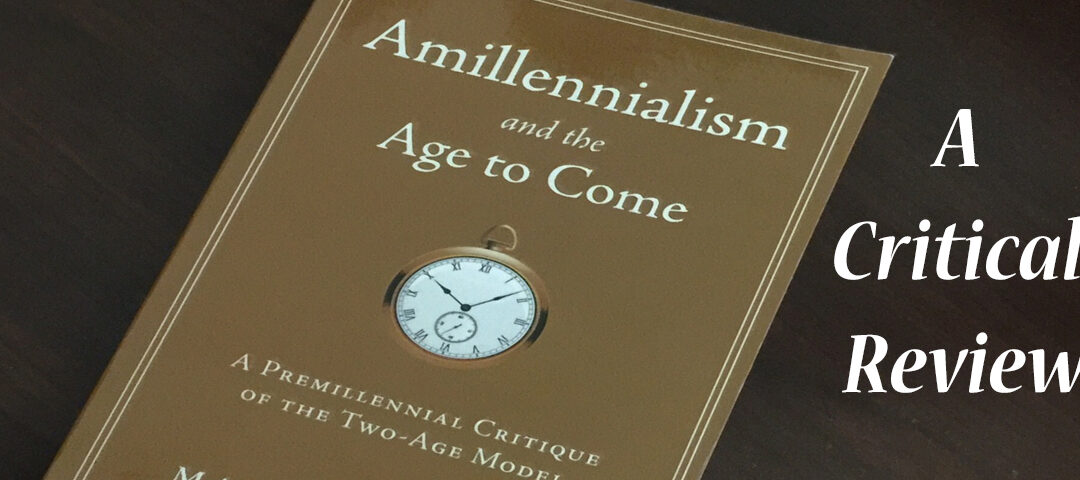
In my first two posts, I have attempted to introduce and express appreciation for Waymeyer’s Amillennialism and the Age to Come. Here I want to provide an overview of the book and its argument.
Chapter 1 is introductory. An overview of the entire book may be provided by an analysis of that chapter. The headings found in that chapter usefully summarize it.
The Two-Age Model of Amillennialism speaks of it as “one of the strongest arguments for the amillennial view. It also notes the importance of Riddlebarger’s A Case for Amillennialism in presenting it as an argument against Premillennialism.
The Two-Age Model of Amillennialism presents a summary of biblical evidence for the two-age model.
The Two-Age Model as an Interpretive Grid makes the point that “amillennialists have increasingly regarded this model as the hermeneutical lens through which the rest of Scripture, including Revelation 20, should be viewed.” (4)
The Two-Age Model as an Amillennial Argument affirms that amillennialism views it “as a decisive refutation of the kingdom of premillennialism.” (6)
The Need for a Premillennial Response draws the conclusion that Premillennialists must respond to this argumentation. Waymeyer says: “Because any compelling defense of premillennialism must respond to the strongest and most recent argumentation of its theological opponents, a premillennial critique of the two-age model is long overdue.” (7)
Revisiting the Hermeneutical Foundation argues that “Such a critique must begin in the realm of hermeneutics. Waymeyer finds two hermeneutical problems with the two-age argument for amillennialism. “The first problem concerns identifying Revelation 20 as an unclear passage.” (8) “The second problem concerns the use of the two-age model as an interpretive grid.” (9) He warns that such a use of the two-age model “silences the contribution of those passages by forcing them to conform to his theological system.” He adds: “In this way, systematic theology is used to determine exegesis rather than vice versa.” (9)
Reconsidering the Starting Point states that the best way to approach this issue is “to trace the doctrine of the coming kingdom throughout biblical revelation. …. In the process, it must be recognized that later revelation often supplements and thereby clarifies previous revelation by providing broader context or additional detail, but it never changes the meaning of earlier passages in the process.” (11)
The Clarifying Role of Revelation 20 leads Waymeyer finally to say that Revelation 20 “as the fullest and most comprehensive presentation of the eschatological events surrounding the Second Coming … should be allowed to clarify previous revelation about the coming kingdom.” (12)
The Approach of the Critique provides, then, an overview of Waymeyer’s book after the introductory chapter. “The first section (chapters 2-5) focuses on the Old Testament, with an exegesis of several prophetic passages which predict a period of time that is distinct from the present age and the eternal state. …. The second section (chapters 6-10) transitions to the New Testament and responds directly to the three ways that the two-age model is used as an argument against premillennialism. …. The final section of his critique (chapters 11-14) focuses on Revelation 20:1-6.” (14-15) Waymeyer then states the conclusion of his argument: “If Revelation 20 clearly teaches an earthly reign of Christ between the present age and the eternal state, there must be some way to harmonize this intermediate kingdom with the two ages in the New Testament.” (15)
Part 4
Dr. Sam Waldron is the Academic Dean of CBTS and professor of Systematic Theology. He is also one of the pastors of Grace Reformed Baptist Church in Owensboro, KY. Dr. Waldron received a B.A. from Cornerstone University, an M.Div. from Trinity Ministerial Academy, a Th.M. from Grand Rapids Theological Seminary, and a Ph.D. from Southern Baptist Theological Seminary. From 1977 to 2001 he was a pastor of the Reformed Baptist Church of Grand Rapids, MI. Dr. Waldron is the author of numerous books including A Modern Exposition of the 1689 Baptist Confession of Faith, The End Times Made Simple, Baptist Roots in America, To Be Continued?, and MacArthur’s Millennial Manifesto: A Friendly Response.