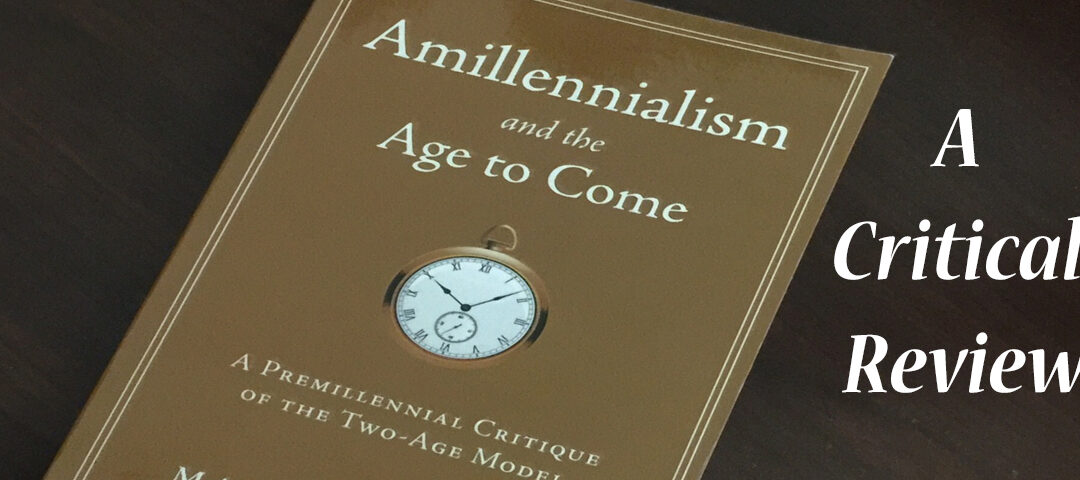
by Sam Waldron | Jul 18, 2017 | Book Reviews, Eschatology
Part 1, Part 2, Part 3, Part 4, Part 5, Part 6, Part 7, Part 8, Part 9, Part 10, Part 11, Part 12, Part 13, Part 14
Waymeyer’s Treatment of 1 Corinthians 15 Continued
Let me repeat the words with which I began my last post. “The pinnacle of the systemic confusion introduced into plain and literal New Testament passages by Waymeyer is found in his lengthy treatment of 1 Corinthians 15 on pages 147 to 171 of his book. Waymeyer’s argument consists in a number of assertions. First, there is a sequence of events at the end of Christ’s reign allowed by the use of epeita in verse 23 and eita in verse 24; and this allows for a temporal gap into which a future millennium may be inserted. Second, the reign of Christ in view in the passage is a future reign which requires a future millennial reign for its complete fulfillment. Third, “the end” in verses 24-26 includes the resurrection of unbelievers at the end of the millennium. Fourth, the assertion that death is defeated by the resurrection of believers at Christ’s Second Coming does not refer to a once-for-all defeat of death the last enemy. There are plain and, in my view, unanswerable responses to each of these assertions.” I responded to the first two of these assertions in my last post. The last two will be answered here.
“Third, ‘the end’ in verses 24-26 includes the resurrection of unbelievers at the end of the millennium.” Here it needs to be said that Waymeyer expresses some reservation about this typical premillennial interpretation of “the end” as the end of the resurrection, that is, the resurrection of unbelievers. Nevertheless, at the end of his “on the one hand, and on the other hand,” he adopts the traditional, premillennial position that this phrase is a reference, either directly or indirectly, to the resurrection of unbelievers at the end of the millennium.
In response to this little or nothing needs to be added to what I have said in the End Times Made Simple: “Against this theory the following considerations are conclusive: (1) As we have seen, the context makes no mention of the resurrection of unbelievers (vv. 18, 19). (2) The statement that all will be made alive in verse 22 is qualified by the phrase “in Christ.” Without exception this phrase has in the Apostle Paul’s writings a reference to the sphere of salvation. Unless, therefore, one is willing to adopt the heresy of universal salvation, one must limit the scope of verse 22. (3) The phrase “the end” (to telos) is never used of the last segment of the resurrection elsewhere in the New Testament.” Also conclusive against this interpretation of the end is what was noticed in my previous post. The time of “the end” is identified by the two “when’s” of verse 24. As we have seen, the second when clearly identifies the time of “the end” with the destruction of the last enemy, death, by the resurrection of believers at Christ’s Second Coming.
“Fourth, the assertion that death is defeated by the resurrection of believers at Christ’s Second Coming does not refer to a once-for-all defeat of death the last enemy.” I have already pointed to the explicit statement of Paul in 1 Corinthians 15:54-55 that at the resurrection of Christ’s people death will be abolished and defeated as one of the conclusive reasons to reject Waymeyer’s reconstruction of the meaning of verses 20-28. In response to this use of these verses, Waymeyer argues: “The most plausible way to harmonize 1 Corinthians 15:51-57 with Revelation 20 is to see the language of victory over death in this passage as applicable to each stage of resurrection set forth in Scripture.” (166) Several responses to this innovative reading of these verses may be mentioned.
In the first place, it directly contradicts verses 54-55: “But when this perishable will have put on the imperishable, and this mortal will have put on immortality, then will come about the saying that is written, ‘DEATH IS SWALLOWED UP in victory.’” Paul says “then”—not “about then.” Nor does he say “sometime after then.” He certainly does not say “over a thousand years after this.” He clearly and straightforwardly says: “then will come about the saying that is written, ‘DEATH IS SWALLOWED UP in victory.’”
In the second place, Waymeyer’s reading is made even more difficult because it is simply impossible to ignore the connection between verses 54-55 and verse 26. Granting for the sake of argument, that in another context something like Waymeyer’s reading might be possible. It is not possible in this context, because of the contextual connection between the verses 54-55 and verse 26.
In the third place, the deplorable hermeneutics driving Waymeyer’s reading must be noticed. For him the question is how to reconcile 1 Corinthians 15 with Revelation 20. Clearly, the force driving the innovative reading of 1 Corinthians 15:54-55 is the Premillennial interpretation of Revelation 20. I have pointed out in previous posts just how misguided and backwards it is to allow a highly figurative passage written in apocalyptic language to exercise a normative, hermeneutical influence over a straightforward and literal passage like 1 Corinthians 15. To introduce an alien universe of discourse into 1 Corinthians 15 from Revelation 20 is destructive of the clarity of Scripture.
Dr. Sam Waldron is the Academic Dean of CBTS and professor of Systematic Theology. He is also one of the pastors of Grace Reformed Baptist Church in Owensboro, KY. Dr. Waldron received a B.A. from Cornerstone University, an M.Div. from Trinity Ministerial Academy, a Th.M. from Grand Rapids Theological Seminary, and a Ph.D. from Southern Baptist Theological Seminary. From 1977 to 2001 he was a pastor of the Reformed Baptist Church of Grand Rapids, MI. Dr. Waldron is the author of numerous books including A Modern Exposition of the 1689 Baptist Confession of Faith, The End Times Made Simple, Baptist Roots in America, To Be Continued?, and MacArthur’s Millennial Manifesto: A Friendly Response.
by Sam Waldron | Jul 5, 2017 | Book Reviews, Eschatology
Part 1, Part 2, Part 3, Part 4, Part 5, Part 6, Part 7, Part 8, Part 9, Part 10, Part 11, Part 12
Waymeyer’s Treatment of Luke 20
Perhaps the clearest and most comprehensive, single statement of the New Testament’s “two-age” eschatology is found in Luke 20:34-36. For this reason it has become foundational to contemporary Amillennialism’s critique of Premillennialism. Waymeyer focuses on this passage on pages 102-105 of his book. Here is the passage: “Jesus said to them, “The sons of this age marry and are given in marriage, 35 but those who are considered worthy to attain to that age and the resurrection from the dead, neither marry nor are given in marriage; 36 for they cannot even die anymore, because they are like angels, and are sons of God, being sons of the resurrection.”
The Amillennialist treatment of this passage assumes that the meaning is straightforward and clear. It contrasts the two ages at four points. This age is characterized by marriage, but the age to come by no marriage. This age is characterized by death and dying, but the age to come by no death and dying. This age is characterized and inhabited by natural men, but the age to come by resurrected men. Finally, this age is characterized by righteous and wicked men co-existing, but the age to come by the fact that its inhabitants are exclusively sons of God.
Waymeyer acknowledges, as I have previously pointed out, that this passage—taken alone—naturally suggests these contrasts and the polemic against Premillennialism which may be based on them. (105) How does he seek to evade what appears to be the natural force of this passage?
He begins by noting that the context of its assertions is a debate between Jesus and the Sadducees over the reality of the resurrection (Luke 20:27f.). (103) He is, of course, correct in this. His argument is, then, that the passage is not so much about the age to come, but about the resurrection and that it is unnecessary to apply everything Jesus says about the resurrection to the age to come. (104) In a footnote he seeks to buttress the implicit distinction he makes here between the resurrection and the age to come by noting that the passage speaks of “that age and the resurrection of the dead.” (103-104) He takes the conjunction (kai) to mean that there is some distinction between the age to come and the resurrection of the dead.
What is wrong with this reading of the passage?
First, it begs the question as to why Jesus introduces the concept of the two ages and the contrast between them at all. As Waymeyer rightly points out, the context is about the resurrection. Why, then, does Jesus introduce the two ages? It seems to me that, once this question is asked, that the natural and even necessary answer to it must be that the concept of the two ages is simply Jesus’ own way of speaking of the contrast between the age of resurrection and the present age. If this is not the case, then Jesus introduces an extraneous and irrelevant distinction into this discussion which only confuses the issue. The age of resurrection is, in other words, the age to come; and the age to come is the age of resurrection. To distinguish the two is to miss Jesus’ whole point.
Second, everything about the passage and its contrast between the two ages conspires to confirm this. Everything about Waymeyer’s distinction, on the other hand, tends to confuse and corrupt the clarity of the passage.
Third, everything about the parallel passages in the New Testament tends to contradict Waymeyer’s attempted distinction. Passage after passage associates the age to come with eternal life in the eschatological and resurrected sense (Matt. 12:32; Mark 10:30; Luke 18:30; 1 Timothy 6:17-19). Passage after passage concludes the present age with the Second Coming of Christ (Matt. 13:40, 49; 24:3; Titus 2:12-13); and Christ’s coming brings the transformation of the new body to all of His people including especially all of those who survive until His return (1 Cor. 15:51, 52; 1 Thessalonians 4:15-17). Thus, the age to come is the age of resurrection for all of Christ’s people.
Fourth, what is true of the New Testament parallels in general is especially true of the closest parallel to Luke 20:34-36. Here I refer to the teaching of Jesus in the parable of the wheat and weeds explained in Matthew 13:36-43. In that passage there is the same contrast between two periods of time—the age of sowing and the age of reaping. There is the same contrast between the present mixture of good and evil men in the world and a future period in which wicked men are rooted out of Christ’s field. There is the same contrast between the natural character of the present age and the supernatural character of the future period in which the righteous shine forth as the sun in the kingdom of their Father (Matt. 13:43)—a clear reference to Daniel 12:3 and the resurrection of the righteous. All this is clearly parallel to the teaching of Jesus in Luke 20:34-36. What is devastating, however, for Waymeyer’s exegesis of Luke 20 is that it specifically contradicts his notion of a distinction between the age to come and the resurrection. At Christ’s coming all the wicked are rooted out of His field-kingdom-world; and all the righteous enter the glory of the resurrection. The coming of the future age of reaping brings the extirpation of the wicked from the world by the Second Coming and the glorification of the righteous. The passage is incapable the distinction that Premillennial reads into Luke 20:34-36.
Fifth, Waymeyer’s footnote emphasizing the kai conjunction ignores a well-known alternative use or meaning of kai known as the epexegetical or appositional use. In this construction which is common in the New Testament the kai explains or expounds the previous words. It is simply misleading and unacceptable for Waymeyer merely to assume his own understanding and not to mention or discuss the epexegetical or appositional meaning which would destroy his thesis of a distinction between the age to come and the resurrection. Everything, on the other hand, that we have seen above points to the epexegetical meaning as the right understanding of the kai.
Here in Waymeyer’s treatment of Luke 20:34-36 we see a constant feature of his exegetical work which should disturb the reader. The result of his Premillennial approach is to create confusion in passages which appear at first clear to the straightforward reader of Scripture. Distinctions are imposed on passages which are not obvious in any way in the passage itself and which actually contradict the most natural reading of the passage. We have seen this in Matthew 25. We observe it again here in Luke 20. We will see the tendency of Waymeyer’s Premillennial hermeneutic to undermine and erode the clarity of Scripture again in 1 Corinthians 15.
Dr. Sam Waldron is the Academic Dean of CBTS and professor of Systematic Theology. He is also one of the pastors of Grace Reformed Baptist Church in Owensboro, KY. Dr. Waldron received a B.A. from Cornerstone University, an M.Div. from Trinity Ministerial Academy, a Th.M. from Grand Rapids Theological Seminary, and a Ph.D. from Southern Baptist Theological Seminary. From 1977 to 2001 he was a pastor of the Reformed Baptist Church of Grand Rapids, MI. Dr. Waldron is the author of numerous books including A Modern Exposition of the 1689 Baptist Confession of Faith, The End Times Made Simple, Baptist Roots in America, To Be Continued?, and MacArthur’s Millennial Manifesto: A Friendly Response.
by Sam Waldron | Jul 5, 2017 | Book Reviews, Eschatology
Part 1, Part 2, Part 3, Part 4, Part 5, Part 6, Part 7, Part 8, Part 9, Part 10, Part 11
Waymeyer’s Treatment of Matthew 25
At this point in these blog posts, we turn from what are mainly hermeneutical criticisms of Waymeyer to an examination of his treatment of various passages which together form the bedrock of the Amillennial position. On pages 115-124, Waymeyer labors to provide an acceptable Premillennial interpretation of the judgment passage found in Matthew 25:31-46. We think that he fails. The scope of this response does not allow a point by point discussion of Waymeyer’s treatment of Matthew 25, but the following is one example of why his Premillennial interpretation cannot stand.
On the face of it this passage certainly appears to support the Amillennial position by teaching a general judgment. The scope of this judgment is universal: “all the nations.” Cf. Matthew 25:31. The result of this judgment is eternal: “eternal punishment … eternal life.” Cf. Matthew 25:46. The timing of this judgment is Christ’s Second Coming: “when the Son of Man comes in His glory.” Cf. Matthew 25:31. A general judgment composed of three conceptual pillars eliminates the possibility of Premillennialism. No eschatological room is left for the kind of interim, millennial kingdom defended by Waymeyer. After the Second Coming there are no natural men left to populate, procreate in, or deviate from the ways of God in a Premillennial millennium.
Waymeyer’s attempts to provide such natural men strain credibility. Several of his assertions fall into this category. Here is an example. He says. “… premillennialists generally believe that Matthew 25:31-46 describes not the final judgment of all mankind, but rather the judgment of the nations which exist when Jesus returns, specifically concerning either their entrance into the millennial kingdom or their consignment to eternal fire.” (116) In this assertion Waymeyer manages to combine several ideas which strain exegetical credibility.
(1) He manages directly to contradict the clear assertion that the results of this judgment are eternal punishment for the wicked and eternal life for the righteous. This contrast (as the orthodox have pointed out ad infinitum against annihilationists and universalists) requires that the eternal punishment be parallel to the eternal life. The Premillennial argument here advocated by Waymeyer undoes that clear parallel by substituting entering a millennial kingdom for entering eternal life. How is this entering a temporary millennium parallel to eternal punishment?
(2) The interpretation of “the nations” as (only) the living nations which exist when Christ returns (and not all mankind) forgets that Jesus does not say “the nations,” but “all the nations.” It, then, contradicts the meaning of “all the nations” in Matthew and the parallel passages. While “the nations” in Matthew refers to the Gentiles, “all the nations” has a universal scope. “All the nations” is used in only two other passages in Matthew. One of them in the very context of Matthew 25:32, the Olivet Discourse. In Matthew 24:14 and in Matthew 28:19 it is used to refer to the universal scope of the gospel proclamation in the last days. Since we know that this gospel proclamation (the Great Commission) is first made to the Jewish nation and then to all the nations of the world (Luke 24:47; Acts 1:8), “all the nations” cannot be restricted to the Gentiles. Furthermore, it cannot be given the nationalistic connotation favored by Premillennialists. Clearly, “all the nations” are composed of individuals who either believe the gospel and are saved or refuse it and are lost. This judgment does not concern whole nations entering the millennial kingdom or not, but individuals entering eternal life or not!
(3) Here is another serious difficulty, then, for the Premillennial attempt to limit the scope of this judgment “the nations that exist when Jesus returns” (and thus living nations). It is that the language of Matthew 25:32 suggests that the judgment here described must include all those who have heard the universal, gospel proclamation. This surely will and must include some who have died by the time of Christ’s return. It also requires the dubious notion that some wicked men will survive Christ’s return in fire to destroy the adversaries. This, in light of the clear descriptions of the destruction resulting from Christ’s return, is highly questionable. Cf. Matthew 13:40-43; 24:31-50; 1 Thessalonians 5:3; 2 Thessalonians 1:5-10. But even more insurmountable for the Premillennial interpretation is the fact that it has to ignore and even defy (what seems to me to be) the clear fact that Matthew 25:31f. is the final stanza in a song of judgment that runs throughout the teaching of Matthew’s Gospel. Previous verses in that song may be found in Matthew 7:21-23; 11:20-24; 12:41-42; 13:40-43; and 16:27. Premillennialists are forced to say that the judgment repeatedly described in these passages (which clearly included individuals who have died) is not the judgment of Matthew 25:31-46. Their interpretation of Matthew 25 is, thus, not contextual.
Dr. Sam Waldron is the Academic Dean of CBTS and professor of Systematic Theology. He is also one of the pastors of Grace Reformed Baptist Church in Owensboro, KY. Dr. Waldron received a B.A. from Cornerstone University, an M.Div. from Trinity Ministerial Academy, a Th.M. from Grand Rapids Theological Seminary, and a Ph.D. from Southern Baptist Theological Seminary. From 1977 to 2001 he was a pastor of the Reformed Baptist Church of Grand Rapids, MI. Dr. Waldron is the author of numerous books including A Modern Exposition of the 1689 Baptist Confession of Faith, The End Times Made Simple, Baptist Roots in America, To Be Continued?, and MacArthur’s Millennial Manifesto: A Friendly Response.
by Sam Waldron | Jun 8, 2017 | Book Reviews, Eschatology
Part 1, Part 2, Part 3, Part 4, Part 5, Part 6, Part 7, Part 8, Part 9, Part 10
The Test Case of Isaiah 65:17-25
In previous posts I have challenged Waymeyer’s hermeneutical priorities. I have argued that notwithstanding his refusal to do so, hermeneutical priority must be given to the New Testament over the Old Testament. I also argued that the more literal New Testament passages must be given priority over the more figurative prophetic genres of much of the prophetic literature of the Old Testament and the Book of Revelation.
In this post those hermeneutical priorities must be tested in relation to one of the Old Testament prophetic passages on which Waymeyer believes he can build a case for what he calls “the intermediate kingdom” of the millennium. That passage is Isaiah 65:17-25. As he says in his treatment of this passage, I have stated in the End Times Made Simple that this may provide one of the most plausible passages in favor of a future millennial kingdom which falls short of the eternal state.
This is so because taken literally and interpreted in terms of the naïve hermeneutics Waymeyer espouses it seems to teach that a period of time is coming which far surpasses the present, but which still contains the reality of death. The key verse is Isaiah 65:20: “No longer will there be in it an infant who lives but a few days, Or an old man who does not live out his days; For the youth will die at the age of one hundred And the one who does not reach the age of one hundred Will be thought accursed.” Similar are the words of verses 22-23a: “They will not build and another inhabit, They will not plant and another eat; For as the lifetime of a tree, so will be the days of My people, And My chosen ones will wear out the work of their hands. 23 “They will not labor in vain, Or bear children for calamity …”
I have several responses to the use Waymeyer makes of this passage.
First, the figurative genre of prophetic literature may not be ignored in the way that Waymeyer does in interpreting this passage. If such a verse occurred in historical narrative I would admit that its meaning would be clear. It does not, however, occur in such a literal genre of Scripture. It occurs in prophetic literature which is composed of what Numbers 12:8 calls “dark sayings.” This means that a naïve literalism is out of place in interpreting such a statement.
Waymeyer cites and criticizes Richard Bauckham who says that “Prophecy can only depict the future in terms of the present.” (38). I admit that this statement goes a little too far. The Old Testament does predict the resurrection. In fact, Isaiah himself predicts the resurrection world in Isaiah 25:8—as Waymeyer points out. Still, it remains true that in terms of actually apprehending, deeply understanding, or “getting a feel” for what the age of resurrection might be like, there is still a necessary place for depicting the future in terms of the present. Even we who live in New Testament times grope for understanding about such a future. This is where the vivid, figurative language which depicts the future in terms of the absence of the miseries of the present has an important place. Storms makes this point in a more balanced fashion: “The best and most intelligible way the original author of this prophecy could communicate the realistic future glory of the new heaven and new earth, to people who were necessarily limited by the progress of revelation to that point in time, was to portray it in the hyperbolic or exaggerated terms of an ideal present.” (39). I would only add to Storms that in an important sense we also are so limited. We really do not know what living in the glory of the world of resurrection will be or feel like. We ourselves have a difficult time having a right and proper sense of it. And if we do—who have the light of the New Covenant—, then how much did the Old Testament saints who lived before life and immortality was brought to light through the gospel! That brings me to my second point.
Second, when interpreting such figurative passages of Scripture, we must pay close attention to the real intention of what is said. Let me say this very clearly. The true purpose and deepest intention of Isaiah 65:20 is certainly not to affirm the presence of death in the future state. At best, this is a secondary implication, and when it comes to figurative passages such secondary implications must be evaluated very critically. The true intention of these verses is to affirm the absence of the great and terrible tragedies that fill the present age with such deep sorrows. Some of us know the terrible sorrows of which Isaiah 65:20 speaks. We know the deep sorrow of burying our children. We know the painful frustration of laboring and toiling only to see our work destroyed. We know what it means to work hard for something and then see what we have built inherited by someone else. We know what it means to “bear children for calamity.” Isaiah’s clear purpose and true point is to affirm that all such sorrows and tragedies will be banished from the age of which he is speaking. It is a sad trivializing of Isaiah’s words to find in them a proof text for death in the millennium. It really constitutes extreme callousness to his glorious affirmation. Such a hermeneutical response to Isaiah 65:20-23 is incredibly insensitive. Given the figurative genre of these words, it is also wholly unnecessary.
Third, such an interpretation is also incredibly insensitive to how this passage is interpreted in the New Testament. This is, of course, the other hermeneutical principle and priority upon which I have insisted in previous posts. There are clear interpretive statements made about Isaiah 65:17-25 in the New Testament. We do not find anything in any of them about a millennium where death still exists.
Granted, Waymeyer acknowledges that there are certainly allusions to Isaiah 65:17-25 in the New Testament which apply it to the eternal state. He seeks to explain these references by way of “prophetic conflation.” (42-45). By way of such prophetic conflation, Waymeyer believes that he can meet the Amillennial polemic based on the way in which the New Testament applies the words of this passage. He can, thus, have the best of both worlds: the Premillennial interpretation he favors and the application to the eternal state found in the New Testament.
The reader should note, in the first place, that Waymeyer has actually granted the central point I want to make here. He appears to agree that the allusions to Isaiah 65:17-25 in the New Testament understand it to speak of the eternal state and, therefore, of a period in which there is no death. He is certainly right to agree with Amillennialists about this. For there are clear references throughout Isaiah 65:17-25 to conditions which can only be fulfilled in the perfection of the eternal state. Its joy is eternal (Isa. 65:18). Weeping is banished (Isa. 65:19). No evil or harm is done in God’s holy mountain—the New Jerusalem (Isa. 65:25). It seems to me, however, that Waymeyer’s use of the idea of prophetic conflation in this matter is misguided and finally futile. This is true for at least two reasons.
In the first place, it ignores the hermeneutical priority of the New Testament over the Old Testament. This means that we are bound to interpret the Old Testament as the New Testament does. What needs to be pointed out, then, is that, not only does the New Testament apply Isaiah 65:17-25 to the eternal state, but that it never takes it to speak of the Premillennialist’s millennium at all. The Premillennial interpretation of Isaiah 65:17-25 is absent from every possible allusion to the passage in the New Testament! The new heavens and new earth (Isaiah 65:17) is a reference to the eternal state in the New Testament (2 Pet. 3:13; Rev. 21:1). The New Jerusalem (Isa. 65:18) only descends from heaven in the eternal state (Rev. 21:2-4). The banishment of weeping is found only in the eternal state (Rev. 21:2-4).
Waymeyer’s use of prophetic conflation in order to explain the clear references to the eternal state is misguided for a second reason. The very passage on which the Premillennialist seeks to argue for the presence of death in the condition described in Isaiah 65:17-25 is actually understood quite differently by the New Testament. Here we need to look closely at the flow of thought or structure of Isaiah 65.
Verse 19 asserts that there will no longer be weeping in the state predicted. This is clearly fulfilled according to the New Testament by the eternal state in the clear allusion to Isaiah 65:19 in Revelation 21:2-4. There John says explicitly that the absence of weeping entails no more death! Revelation 21:4 says explicitly: “and He will wipe away every tear from their eyes; and there will no longer be any death; there will no longer be any mourning, or crying, or pain; the first things have passed away.” Crying in Revelation 21:4 is the exact word used in the LXX to translate the weeping of Isaiah 65:19!
But what must be seen and weighed in connection with all this is that verses 20-23 of Isaiah 65 are the explanation in that passage of the statement of Isaiah 65:19, “And there will no longer be heard in her the voice of weeping and the sound of crying.” Thus, the New Testament takes verses 20-23 not to describe a time in which death continues, but interprets them of a time in which there will no longer be any death! The phrase, “there will no longer be any death,” is, then, the New Testament summary of Isaiah 65:20-23. Thus, the New Testament in Revelation 21:4 actually supports the figurative, Amillennial interpretation of Isaiah 65:20-23.
Waymeyer’s misunderstanding of biblical, hermeneutical principles and priorities, thus, betrays him into a misguided interpretation of Isaiah 65:17-25 which brings him into collision with the teaching of the New Testament. Space does not permit me to show this with regard to the other passages which he thinks teach an intermediate (millennial) kingdom in the Old Testament. I am satisfied, however, that proper hermeneutical principles and priorities will also explain those passages in a way which removes their supposed support for Premillennialism. If Isaiah 65—the most plausible support for a Premillennial kind of intermediate kingdom to be found in the Old Testamant—can be so clearly understood in a manner supportive of the Amillennial position, then so also can the other passages he brings forward.
Dr. Sam Waldron is the Academic Dean of CBTS and professor of Systematic Theology. He is also one of the pastors of Grace Reformed Baptist Church in Owensboro, KY. Dr. Waldron received a B.A. from Cornerstone University, an M.Div. from Trinity Ministerial Academy, a Th.M. from Grand Rapids Theological Seminary, and a Ph.D. from Southern Baptist Theological Seminary. From 1977 to 2001 he was a pastor of the Reformed Baptist Church of Grand Rapids, MI. Dr. Waldron is the author of numerous books including A Modern Exposition of the 1689 Baptist Confession of Faith, The End Times Made Simple, Baptist Roots in America, To Be Continued?, and MacArthur’s Millennial Manifesto: A Friendly Response.
by Sam Waldron | May 31, 2017 | Book Reviews, Eschatology
Part 1, Part 2, Part 3, Part 4, Part 5, Part 6, Part 7, Part 8
Second Criticism: Hermeneutical Priority Must Be Given to the New Testament over the Old Testament and the More Literal New Testament Passages over the More Figurative. (Continued.)
In my last post I pointed out that Waymeyer’s priorities ignore and contradict the plain teaching of the Bible, that the prophetic genre of revelation is characterized as “dark sayings” (Numbers 12:6-8) and cannot be given priority over the clear and literal deliverances of the New Testament. My third comment builds on this reality.
Third, and now to be more specific, it is clear that Revelation 20 is also a passage that comes to us in the visionary, prophetic, or apocalyptic genre. It also, then, is by definition a figurative, less clear, and more obscure passage. As such, it must not be allowed to trump the clear teaching of the rest of the New Testament. On what basis do I say this?
I say it, first, because if anybody can actually read the rest of Revelation (especially chapters 4-19) and not find themselves scratching their heads again and again about the meaning of its prophetic visions, well, they are better than I am and almost all other Christians. Yes, there are high points like Revelation 5 which deal with the high points of Scripture like the ascension and enthronement of Christ. Nevertheless, even these passages are stated in what is clearly, highly and continuously, symbolic language. Revelation 20 may thus seem clear from within a Premillennial perspective, but it certainly has not seemed clear to those coming from other perspectives. It also could be shown that Premillennialism has its own many internal controversies about the meaning and implications of Revelation 20.
But the main and even more cogent point is this. The Book of Revelation bears all the marks of prophetic vision and is, thus, what Numbers 12:8 calls “dark sayings.” This includes Revelation 20. On what basis do I say that? One of the clearest markers of the prophetic, visionary, or apocalyptic genre is the use of the words, “I saw,” in its various forms. This marker occurs three times in Revelation 20:1-10 (once in verse 1 and twice in verse 4). These words frequently designate in Scripture a vision or dream seen by the inner eye of the prophet in his mind. In those cases the vision does not refer literally to anything in the external or physical world. There are simply symbolic parallels between the visionary world and the external world.
The Greek verb translated, “I saw,” in Revelation 20:1 and 4 actually occurs 63 times in the Book of Revelation and almost exclusively refers to the visions and dreams which the Apostle John saw as a prophet. The peculiarity of the genre of the Revelation is illustrated by the fact that these 63 occurrences are almost 1/7th of its 483 occurrences in the New Testament. The darkness or difficulty of such language as compared to normal or literal language is underscored not only in Numbers 12:8, but also in another book that is marked by this genre, Daniel.
In Daniel 8 Daniel sees the vision of the ram, the goat, the little horn, and the suspension of regular sacrifice in the temple. The word used in the LXX of Daniel 8:1-2 to identify this vision is the same as that used in Revelation 20 and throughout the Revelation. After the conclusion of the vision the difficulty of interpreting such visionary revelation is underscored in Daniel 8:15-17: “When I, Daniel, had seen the vision, I sought to understand it; and behold, standing before me was one who looked like a man. And I heard the voice of a man between the banks of Ulai, and he called out and said, “Gabriel, give this man an understanding of the vision.” So he came near to where I was standing, and when he came I was frightened and fell on my face; but he said to me, “Son of man, understand that the vision pertains to the time of the end.” Clarifying interpretation is necessary for such revelation as Daniel was given in Daniel 8 in order for it to be understood. Such interpretive help is not necessary for normal speech and literal communication, but such interpretive help is necessary for visions like those seen in Daniel 8.
Hence, for Waymeyer to maintain the hermeneutical priority of Revelation 20 over the rest of the New Testament betrays great insensitivity to its literary genre and a refusal to acknowledge the comparative difficulty of interpreting such language as compared to the normal speech of historical narrative and epistolary discourse which dominates the rest of the New Testament. We must in our interpretation of the Bible give hermeneutical priority to the clear before the difficult, the literal before the figurative, and the general before the detailed.
Part 10
Dr. Sam Waldron is the Academic Dean of CBTS and professor of Systematic Theology. He is also one of the pastors of Grace Reformed Baptist Church in Owensboro, KY. Dr. Waldron received a B.A. from Cornerstone University, an M.Div. from Trinity Ministerial Academy, a Th.M. from Grand Rapids Theological Seminary, and a Ph.D. from Southern Baptist Theological Seminary. From 1977 to 2001 he was a pastor of the Reformed Baptist Church of Grand Rapids, MI. Dr. Waldron is the author of numerous books including A Modern Exposition of the 1689 Baptist Confession of Faith, The End Times Made Simple, Baptist Roots in America, To Be Continued?, and MacArthur’s Millennial Manifesto: A Friendly Response.