Not growing up believing in Santa Clause, I can honestly say that I do not understand the tradition behind it. I cannot fathom why kids would be so devastated when the Santa Clause myth is ruined. But I did grow up with nativity scenes and other Christmas traditions that are indelibly cemented in most of the cultural minds of Western Christianity. But many of these legends are just that. They have no basis in the Bible, but they are now commonly accepted views surrounding Christ’s birth. Ask anyone, and they’ll tell you that Marry rode a donkey from Nazareth to Bethlehem. It’s in all the movies, Christmas plays, and nativity scenes. But is it from the Bible?
If what I’m about to write is true, it could be a devastating blow to some who are so reliant on tradition. But I prefer to be biblical as much as possible. And as one who teaches the NT ecclesiastically and academically, I want Christians to be informed by Scripture first rather than tradition. Indeed, we want our traditions to be informed by Scripture!
 If you have ever seen the movie The Nativity Story, then you will recognize many of these Christmas legends. Or you may have grown up with those nativities that display a wooden, barn-like scene as a Christmas decoration. They are likely built around traditions that are greatly lacking Scripture. In this article, we will consider many assumptions and even overthrow scenes of Jesus’ birth that are widely held, dearly cherished, yet almost certainly false. Perhaps you will know some of these myths (like the “3 kings”). But others may be new to you.
Legend #1: Mary rode on a donkey to get to Bethlehem
While donkeys are a prominent animal in the Scriptures, one place they are absent in the narrative of Scripture is at the birth of our Lord. The only two biblical accounts of his birth, Matthew 1–2 and Luke 1–2, make no mention of a donkey. The assumption is that certainly Joseph would not make Mary walk the entire way to Bethlehem. Well, maybe she did walk it. We just don’t know. No doubt, Joseph was a righteous man. Chivalrous even? But the Scriptures are silent while this legend is ubiquitous. This tradition corresponds with the next one, that Mary was near delivery at the time of the journey and would have had to ride a donkey. But let’s not assume that for now. The typical way for commoners to travel was by foot. Even pregnant women midway through the pregnancy would be able to slowly hike the trek from Nazareth to Bethlehem (around 70 miles). This myth is unconfirmed at best and unlikely at worst.
Legend #2: Mary was near her delivery date when they traveled to Bethlehem
This myth likely comes from Luke 2:5 in the KJV which says that Mary was “great with child.” We hear that as near her delivery date. However, Luke simply used the word for “pregnant” in Greek. It is only used here in the NT, but in the Greek OT and non-biblical Greek sources, it always refers to pregnancy in general. Most modern translations use the expression “with child” whereas the CSB is more direct: “Mary, who was engaged to him and was pregnant.”
Going one step further, Luke 2:6 says they were there in Bethlehem already when her days were completed to give birth. How long had they been in Bethlehem, we are not told. The Greek text uses a form to indicate a duration of time had elapsed (ἐν τῷ εἶναι αὐτοὺς ἐκεῖ). But I believe we can say that Joseph was not a dunder head. He would not have travelled in such a way that would put Marry in a difficult situation for travel. That would also increase his own difficulties. This legend makes for great cinema, but it lacks any roots from Scripture.
Legend #3: Born in a stable or cave
This is where we can be a bit more objective and rule out the legend completely. Since Jesus was placed in a manger after his birth, the assumption is that he was delivered in a place surrounded by animals. Luke anticipates the curiosity of the readers in Luke 2:7 after the mention of a manger, an animal feeding trough. Why a manger and with the animals? Because, as the tradition goes and translations have supported, “there was no room for him in the inn” (see Legend #4).
The “stable” theory is mostly an anachronism. Most Jews had no such thing, for how would they protect their animals from theft during the night? The same is true with storing animals in a cave overnight. It’s just not practical. These two nativity scene scenarios lack historical probability. What is more, the text says nothing about stables or caves. There is only the assumption that Jesus must have been born around animals because a manger is mentioned. True enough, that seems possible. But are animals housed anywhere else in 1st century Bethlehem? The real question is: where were mangers in 1st century towns like Bethlehem? For that answer, we come to Legend #4.
Legend #4: “No room in the inn”
Again, this is another tradition caused by the translations like the KJV, NKJV, ESV, and NASB which read in Luke 2:7: “[she] laid him in a manger; because there was no room for them in the inn.” However, the word translated “inn” at v. 7 is kataluma; κατάλυμα. This word is used one other time at Luke 22:11 KJV: “The Master saith unto thee, Where is the guestchamber [kataluma], where I shall eat the passover with my disciples?” Lexicons will confirm that the word in question is better understood as a “guestroom” for special lodging purposes—a fitting scenario for Joseph making a family visit to his ancestral hometown for the Roman census.
Added to that, there is a more specific Greek word for “inn” (pandocheion; πανδοχεῖον) used at Luke 10:34 speaking of the good Samaritan: “[he] set him on his own beast, and brought him to an inn [pandocheion], and took care of him.” Luke clearly distinguishes between an inn and a guestroom. Translations like the NIV and CSB do a better job of conveying this: CSB “[she] placed him in a manger, because there was no guest room [kataluma] available for them.”
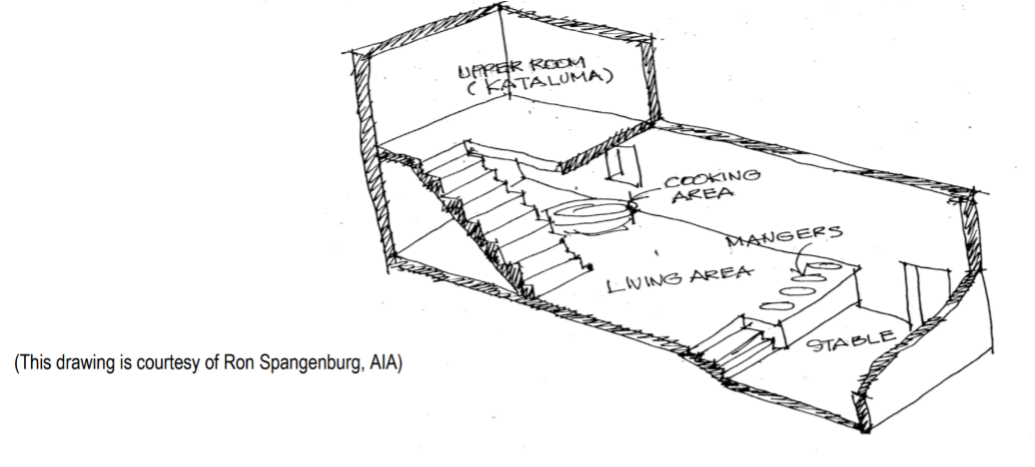 Now legends 3 and 4 are further debunked by the way a 1st century Jewish residence was designed. It explains both the “guest room” as well as the location of the manger. Most homes included a walled courtyard for the animals just below the residence. This would keep the animals protected from theft at night but separate from the family dining/sleeping area. To feed the creatures, there were mangers set up in the courtyard. One of the first chores at sun-up would be to take the animals outside for their grazing and to allow the courtyard to be cleaned. Most homes also included a storage room that would double as a guest room. This is the kataluma mentioned in Luke 2:7 and 22:11. Many times, it was set off or even higher than the family living area—an “upper room.”
The most likely scenario is that Joseph and Mary arrived at a busy time in Bethlehem considering the census. And as family would likely house family, Joseph came to a relative’s home that almost certainly was already occupying other family visitors. Therefore, there was no room for them in the guestroom. And so Mary and Joseph either squeezed in with main family in the daily living area, or they had to make do with the animals, a much safer prospect than sleeping outside the walls of the home. When it came time for delivery, wherever Mary was (probably in the family living area?), the three of them (Joseph, Mary, and now Jesus) returned to their spot while putting the newborn in the manger between the living area and courtyard. In other words, there was no inn. Nor was there a mean innkeeper. There was no cave or stable. There was just a crowded home filled with Joseph’s relatives traveling to the city of David for the census. This may even be confirmed when the Magi later visit Jesus in Matt 2:11 NKJV, “And when they had come into the house, they saw the young Child with Mary His mother, and fell down and worshiped Him.” They visited him in a house, as we would expect.
To summarize both the flaws of Legends 3 and 4, hear NT scholar Kenneth Bailey:
It is not “a room” but rather “the guest room,” more specifically, “the guest room” of a home, naturally. This translation gives new understanding to the story of Jesus’ birth. Joseph and Mary arrive in Bethlehem. They find shelter with a family whose separate guest room is full, and are accommodated among the family in acceptable village style. The birth takes place there on the raised terrace of the family home, and the baby is laid in a manger… If we assume the perspective of a Palestinian reader, the present form of the verse makes good sense. The author records, “And she gave birth to her first-born son and wrapped him in swaddling cloths, and laid him in a manger.” The (Palestinian) reader instinctively thinks, “Manger—oh—they are in the main family room. Why not the guest room?” The author instinctively replies, “Because there was no place for them in the guest room.” The reader concludes, “Ah, yes—well, the family room is more appropriate anyway.” Thus, with the translation “guest room,” all of the cultural, historical and linguistic pieces fall into place. … The raised terrace on which the family ate, slept and lived was unsoiled by the animals, which were taken out each day and during which time the lower level was cleaned.
Legend #5: “We three kings”
It is a widely held tradition that Jesus was visited on the night of his birth. Luke 2 records shepherds and tradition include three kings named Caspar, Melchior, and Balthazar. However, they were not kings but magi (μάγοι) or wisemen from the east. Almost certainly, there was more than three. That number likely derives from the three gifts presented to Jesus (Matt 2:11). Indeed, it is quite improbable that such a group of scholars and students of stars would travel in such a small pack. Journeys from the east (associations with Babylon most likely) often entail large caravans, if for no other reason than safety. Indeed, their presence would hardly gain the attention of Herod if only three men rode into Jerusalem. But if a large caravan from the east traveled a great distance, that would catch the eyes of almost everyone in Jerusalem.
Legend # 6: The magi were present at the birth
This legend appears in almost every nativity scene and movie. Whoever the magi were, and however many there were, one thing we can be certain of: they were not present at the birth of Christ. Matt 2:1 indicates that it was after Jesus was born that they arrived in Jerusalem to seek Herod’s assistance. Though we are not told exactly, perhaps the star appeared the same night of Jesus’ birth. This is the implication of Herod’s questioning about the star’s timing in Matt 2:7. Therefore, if the star appeared around or at the birth of our Lord, and the magi had to travel a great distance to Jerusalem, then it would be impossible for them to be present at the birth.
Indeed, the journey from the area of Babylon (the likely location of the Magi) to Jerusalem is roughly a four-month trek. For Ezra the scribe and his caravan, it was reported that his journey to Jerusalem took four months (Ezra 7:8–9). It is very probable that the speed of the journey for the Magi had not changed since Ezra’s time. Therefore, it is safe to conclude that the Magi arrived many months after the birth.
Further evidence indicates that it could have been more than a year before the Magi arrived in Jerusalem. This is suggested by the fact that Herod sought to kill all the male children two years old and under. Certainly, most could tell the difference between a six-month-old and an eighteen-month-old. But if Herod was not alerted about the birth of the Messiah for six to twelve months, then he was likely hedging his bets and covering possible scenarios. If the Magi had reported to Herod about a newborn King not even weeks old, then there would have been no reason for Herod to kill so widely or indiscriminately. Therefore, the Magi were probably appearing before Herod several months after the birth of Jesus.
Conclusion & Reflection
I no longer take pleasure in bursting the bubbles of tradition that I once enjoyed. I would rather encourage people’s faith than erode it. However, as believers in Christ and his word, we must train ourselves to be governed by Scripture first and foremost and not tradition, no matter how wholesome or deeply rooted these traditions go. Therefore, all of our traditions need to be calibrated and formed around Scripture. And if by “testing the spirits” we can include testing our traditions, and in doing so makes you feel uncomfortable, then perhaps you need to reevaluate yourself in light of the spirit of this tradition.
On the inverse side, having a more historically situated and biblically oriented understanding of the birth of our Lord makes for better Scripture reading, learning, and preaching. Truth will always uplift over tradition, especially when those legends of tradition are in error.

Dr. Timothy Decker is one of the pastors of Trinity Reformed Baptist Church of Roanoke, VA, having joined them in 2018. He holds a B.A. and M.A. biblical studies from Carolina University (formerly Piedmont International University), a Th.M. in New Testament from Southeastern Baptist Theological Seminary, and a Ph.D. in biblical studies from Capital Seminary and Graduate School. In his dissertation research, he examined the style of biblical Hebrew poetry in the New Testament. He has presented various papers at academic society meetings and authored numerous articles in several different scholarly journals. He is a member of ETS and IBR. When he is not reading or researching, he enjoys spending time with his wife and four children.
Courses taught at CBTSeminary: Elementary Greek I, Elementary Greek II