by Tom Hicks | May 19, 2026 | Historical Theology
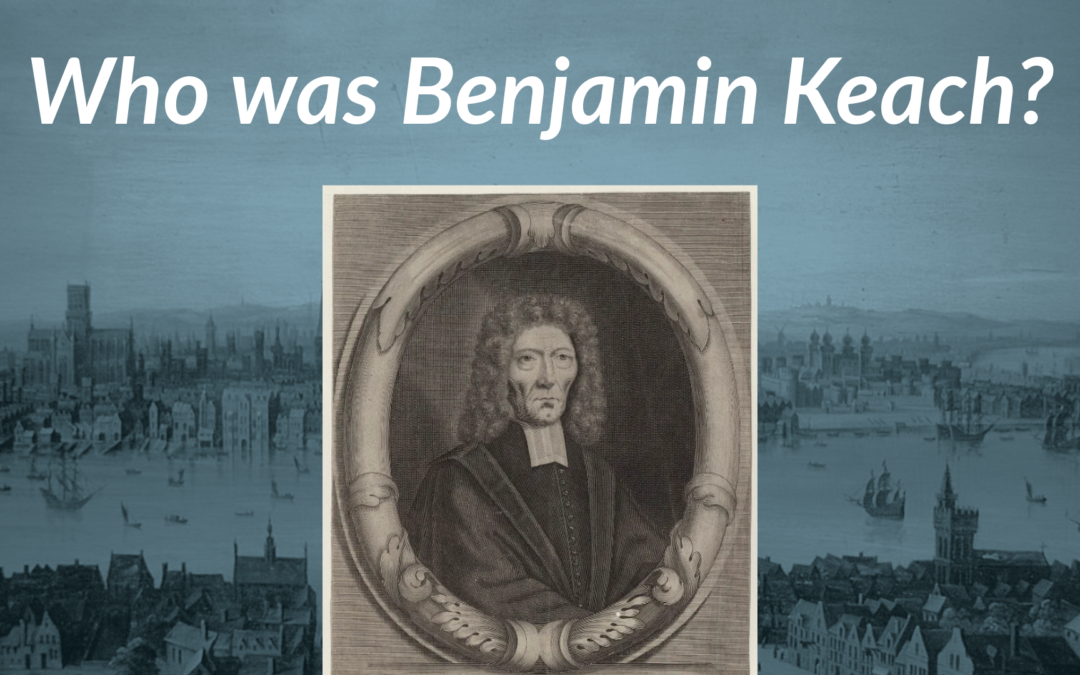
Benjamin Keach was the greatest theologian of the second generation among English Baptists. He was raised in a Christian home, converted at age 15, and began pastoring at age 18 at a little church in Winslow, England.
During his first pastorate at Winslow, he wrote a little booklet called “The Child’s Instructor,” which included sections on believers’ baptism. This got him into a lot of trouble with the authorities, so he was arrested. The judge even pressured the jury to find him guilty. So Keach was thrown into jail for two weeks, put in stocks, pilloried, mocked, and made fun of in front of the town. After they let him out, Keach continued to preach.
But then he made a move in his theology to the doctrines of grace. He had been an Arminian, but around the time that he became a Calvinist, he changed churches and began pastoring in Southwark, England. There, he preached the Word of God faithfully. But Keach is well-known for the several controversies he was involved in, one of which was the hymn-singing controversy. One of the reasons we sing hymns today as Baptists, practically speaking, is because Keach won that debate. His side argued that we should sing hymns in churches.
But Keach himself would say that his most important controversy was with Richard Baxter and the doctrine of Neonomianism. Keach opposed Richard Baxter’s legalistic Neonomian theology, and he asserted, instead, the reformed doctrine of justification, which is the ground of our assurance of salvation and is one of the motives of our obedience to Christ.
If you would like to learn more about Benjamin Keach, you can audit or register for a class taught by Tom Hicks and Chris Holmes titled “The Life & Ministry of Benjamin Keach.”
Stay in touch with CBTSeminary
For more information about CBTS, go to CBTSeminary.org
Consider giving to CBTSeminary to help us train the next generation of gospel ministers.
Apply to CBTS today to be sharpened for a lifetime of faithful ministry.
Follow CBTS on our socials: X | Instagram | Facebook | YouTube
Sign up for our newsletter and receive monthly updates related to the Seminary.
by CBTS | May 18, 2026 | Announcements
Fall 2026 Live Class Registration Open (Including Summer & Modular Offerings)
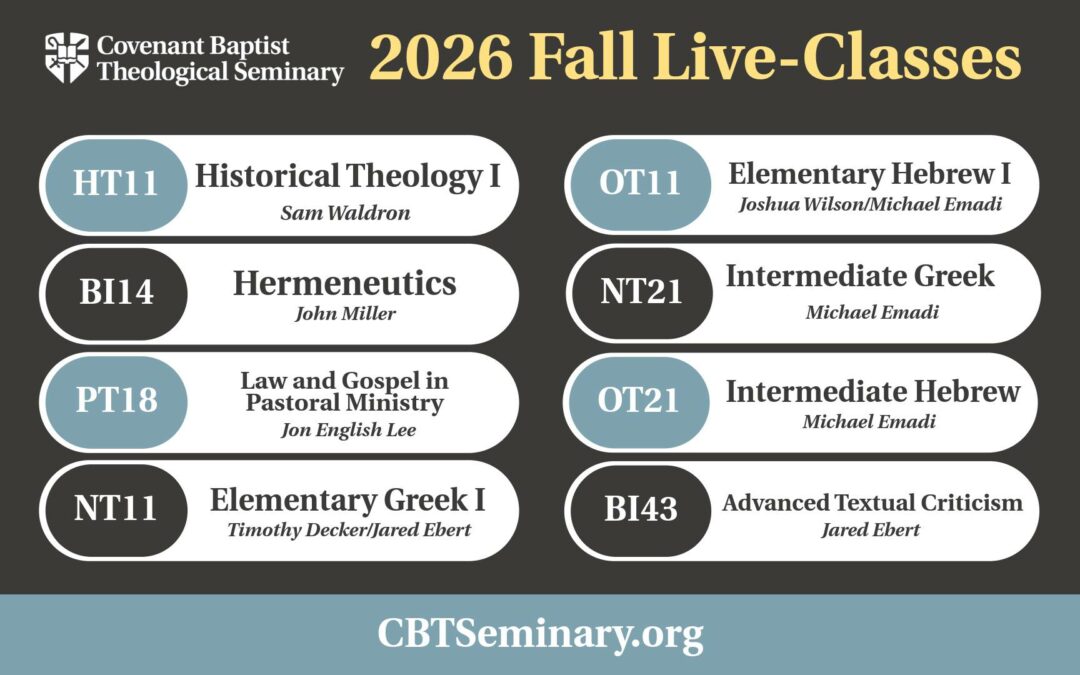
Registration is now open for the live Fall 2026 courses at Covenant Baptist Theological Seminary, along with summer and modular offerings. Whether you are beginning your studies or continuing your degree program, we are excited to announce the various upcoming live courses available. You can view the course schedule here as well as descriptions of each course below.
Upcoming Courses
Summer & Modular Courses
OT42 — Hebrew Exegesis: Genesis 1–11
Taught by Dr. Josh Wilson Mondays, 6:00 AM CST | Begins June 1, 2026 This advanced Hebrew course studies the language, grammar, and structure of Genesis 1–11. Students will learn the advanced elements of Classical Hebrew grammar and syntax, the methodology and application of discourse analysis, and apply these elements and methodologies to the exegesis and exposition of Genesis 1-11.
HT53 — History of Christian Philosophy
Taught by Dr. Dewey Dovel September 4–7, 2026 | Modular Course | Owensboro, KY This course surveys major developments in Christian philosophical thought and examines how Christians throughout history have interacted with important philosophical questions and ideas.
PT56 — Crisis Counseling & Legal Issues in Biblical Counseling
Taught by Dr. J. Ryan Davidson November 5–7, 2026 | Modular Course | Montgomery, AL This course explores biblical counseling in crisis situations while also addressing important legal considerations counselors may face in ministry settings.
Fall 2026 Courses
NT11 — Elementary Greek I
Session 1: Dr. Timothy Decker Mondays & Thursdays | 6:00–7:15 PM CST Session 2: Professor Jared Ebert Mondays & Thursdays | 6:00–7:15 AM CST Elementary Greek introduces students to the fundamentals of New Testament Greek grammar and vocabulary. Students begin developing skills needed for reading and understanding the New Testament in its original language. The instructor will guide students toward achieving a basic grasp of the Koine Greek language.
NT21 — Intermediate Greek
Taught by Professor Michael Emadi Mondays & Thursdays | 5:00–6:15 PM CST This course provides an advanced study of Greek syntax with application to the translation and analysis of the Greek New Testament and other early Christian literature. The instructor will guide students toward achieving a basic reading competence in the Koine (or Hellenistic) Greek language.
OT11 — Elementary Hebrew I
Session 1: Dr. Josh Wilson Mondays | 6:00–9:00 AM CST Session 2: Professor Michael Emadi Mondays & Thursdays | 6:30–7:15 PM CST Elementary Hebrew introduces the foundations of Classical Hebrew grammar and vocabulary. Students will gain an introduction to the basic elements of Classical Hebrew, learn word recognition through a study of Hebrew phonology and morphology, gain proficiency in Hebrew vocabulary, and apply these learned skills to the translation and interpretation of the Hebrew Old Testament.
OT21 — Intermediate Hebrew: Syntax & Exegesis
Taught by Professor Michael Emadi Saturdays | 9:00–11:30 AM CST An intermediate study of Hebrew syntax with application to the translation, analysis, and exegesis of the books of Jonah and Genesis 19. The instructor will guide students toward achieving a basic grasp of the Classical Hebrew language through a study of the Hebrew text of Jonah and Genesis 19.
BI14 — Hermeneutics
Taught by Professor John Miller Hybrid Modular: October 16 (12–4 PM CST), October 17 (7 AM–4 PM CST), November 13–14 (same schedule) This course introduces principles and methods for interpreting Scripture faithfully. Students will be introduced to the issues involved with the theory and practice of Reformed hermeneutics. The course covers technical terminology, principles and practice of hermeneutics, history of hermeneutics, canonical structure and hermeneutics, Jesus, John, and Paul on the Old Testament, parabolic interpretation, contemporary issues, and other issues related to interpretive philosophy and method.
BI16 — Hermeneutics for Counseling
Taught by Professor John Miller & Dr. Brad Beevers Hybrid Modular: October 16–17 in-person sessions, then Tuesdays beginning October 20 | 6–8 PM CST via Zoom This course applies sound interpretive principles specifically to biblical counseling ministry, helping students apply Scriptures skillfully and accurately in counseling situations.
HT11 — Historical Theology I
Taught by Dr. Sam Waldron Tuesdays | 6:30–8:20 PM CST This course considers Christian doctrine as expressed in the history of Christianity. The first of the three major periods of church history and historical theology is considered in this course. This course provides a prolegomena to the study of historical theology, an overview of the expansion of Christianity in the early church period, a discussion of the doctrinal significance of the Apostolic Fathers, and a consideration of the two great developments in the history of doctrine in the early church period: the recognition of the canon and Trinitarianism.
PT18 — Law and Gospel in Pastoral Ministry
Taught by Dr. Jon English Lee Hybrid Intensive | October 24 & November 14 | 8:00 AM–5:00 PM CST | Owensboro, KY The theology and application of the Law and Gospel theology to pastoral ministry is an essential study for a biblical pastoral ministry. This theology will be applied to various issues in the pastoral ministry, including: preaching, counseling, church unity and mission, church discipline, Christian freedom and Christian liberty, guidance, pastoral cases, and marriage and family life.
PT38 — Counseling Children and Adolescents
Taught by Dr. Brad Beevers Thursdays | 6:00–8:00 PM CST This course examines biblical counseling principles and their application to the unique challenges and needs of children and adolescents.
HT14 — Baptist History
Taught by Dr. Brandon Rhea Tuesdays & Thursdays | 3:00–4:30 PM CST This course surveys the history of the Baptist movement and traces important theological developments, figures, and convictions that shaped Baptist identity.
BI43 — Advanced Textual Criticism
Taught by Professor Jared Ebert Tuesdays & Fridays | 6:00–7:30 AM CST This course is a study on the practice and principles of Reformed textual criticism. It will survey a theology of Scripture and its relationship to textual criticism, and the principles employed by the Reformed tradition in centuries past. The class will also instruct the students in the basics of paleography, the practice of Old and New Testament textual criticism, and the effect this discipline has on preaching and Bible translation.
WR11 — Writing and Research
Taught by Drs. Chris Holmes & Jon English Lee Thursdays | 3:00–4:00 PM CST Clear and effective communication is an essential skill, particularly for ministry. This course introduces foundational academic writing and research skills, helping students grow in clarity, organization, and scholarly communication with confidence and skill. Students will be taught to prepare written assignments that are carefully researched, organized, and argued.
How to Register
Ready to begin planning your Fall 2026 semester? Registration is now open. Current students can register through the CBTS Hub in Pathway, while prospective students can begin by submitting an application. Registration Instructions Registration for Fall 2026 courses takes place through the CBTS Hub, which is available to active CBTS students through Pathway, the CBTS learning portal. The Hub allows students to register for courses, manage semester fees, and handle other school-related purchases. To register:
- Log in to Pathway. Click on your name in the top-right corner to view your profile.
- Click on the Hub button in the bottom-right corner.
- Navigate to the Courses section and browse available offerings.
- Add your desired courses to your cart.
- Complete registration and payment (students may choose full payment or installment options when available).
Need help? View the CBTS Support page to browse FAQs or to contact CBTS Support.
Stay in touch with CBTSeminary
For more information about CBTS, go to CBTSeminary.org Consider giving to CBTSeminary to help us train the next generation of gospel ministers. Apply to CBTS today to be sharpened for a lifetime of faithful ministry. Follow CBTS on our socials: X | Instagram | Facebook | YouTube Sign up for our newsletter and receive monthly updates related to the Seminary.
by Ben Habegger | May 11, 2026 | Apologetics, New Testament, Old Testament, Systematic Theology
*Editor’s Note: The views expressed in this series are not intended as an official statement of CBTS or a uniform position of its faculty. This material is offered in the spirit of faith seeking understanding and to encourage further theological reflection. To read more installments in this series, click here: 1, 2, 3, 4, 5, 6, 7, 8, 9, and 10.
The Complete Atonement at the Cross
We have been interacting with the teaching that the dead Jesus had to descend in his disembodied soul to a place of confinement for spirits, whether to release the spirits of Old Testament saints, or to make a proclamation to wicked spirits, or both. This teaching says that, in his deceased humanity, Jesus did not go to be with the Father in heaven. Rather, in terms of Jesus’ human nature, he had no access to heaven after his death until his bodily resurrection.
The first biblical doctrine which I will use to argue against that idea is the doctrine that Christ completed his work of atonement on the cross.
When Jesus had received the sour wine, he said, “It is finished,” and he bowed his head and gave up his spirit.
(John 19:30)
Ridderbos says this about Jesus’ triumphant announcement in John 19:30:
It is precisely as a reference to the task the Father gave Jesus to perform that this cry indicated for him not only the end of the road that he had to travel but also the completed work of salvation that he had accomplished for his own as the new foundation laid once for all for the life of the world.[1]
Once Jesus died on the cross, no further work was necessary to secure atonement full and free. Christ certainly had no need to be kept out of his Father’s heavenly presence in a subterranean holding area (which is purportedly the whole point of Old Testament believers being confined there). God the Father had already carried out upon Jesus the full judicial demands of the curse.
By contrast, a descent of Christ into Hades can imply a further work necessary for complete atonement, a work after the cross itself. In supporting the idea of a descent to hell, Sam Renihan proposes the idea that, just as the scapegoat was sent into the wilderness to Azazel on the Day of Atonement, so Christ had to be sent to the fallen angels in Sheol. Speaking of Azazel, Renihan writes,
Taken as a reference to a fallen angel, if not Satan himself, this means that atonement is achieved through one goat’s blood being presented to God, and the other goat being delivered over to the pit, to Azazel, to Sheol and the fallen angels. A debt of blood must be paid to God. A debt of death must be paid to Sheol.[2]
Against this idea stands the simple truth that atonement was complete at the cross.
The Forgiveness of Sins before the Cross
We have covered this in a previous post on Sheol in the Old Testament.
23 For all have sinned and fall short of the glory of God, 24 and are justified by his grace as a gift, through the redemption that is in Christ Jesus, 25 whom God put forward as a propitiation by his blood, to be received by faith. This was to show God’s righteousness, because in his divine forbearance he had passed over former sins. 26 It was to show his righteousness at the present time, so that he might be just and the justifier of the one who has faith in Jesus.
(Romans 3:23–26)
3 For what does the Scripture say? “Abraham believed God, and it was counted to him as righteousness.” 4 Now to the one who works, his wages are not counted as a gift but as his due. 5 And to the one who does not work but believes in him who justifies the ungodly, his faith is counted as righteousness, 6 just as David also speaks of the blessing of the one to whom God counts righteousness apart from works:
7 “Blessed are those whose lawless deeds are forgiven,
and whose sins are covered;
8 blessed is the man against whom the Lord will not count his sin.”
(Romans 4:3–8)
If the Old Covenant saints already had full forgiveness and justification before the cross, then all reason for them to be confined in a restful compartment of Hades and restricted from God’s immediate presence in heaven is gone.[3] Thus, Christ did not need to release anyone from Hades.
The Old Testament Hope of Heaven after Death
Again, we have covered this in a previous blog post on Sheol in the Old Testament. We know that two redeemed sinners in the Old Testament, Enoch and Elijah, were taken directly to heaven without experiencing death. They were translated, instantly glorified in body and spirit. If Old Testament believers were not allowed to see God in his heavenly glory, were Enoch and Elijah arbitrary exceptions to the rule?
In Psalm 49:15 and Psalm 73:24, we also see that the wording of God taking Enoch and Elijah was then applied to the hope of all believers that God would take or receive them at death (in contrast to the fate of the wicked at death). Indeed, the gospels record not only Elijah but also Moses (who had experienced death) appearing in glory with Christ prior to the cross. Not only was Moses not confined to a subterranean holding place, but he appeared in the same heavenly glory as Elijah, and together they basked in Christ’s divine glory as well as the glory cloud from which came the Father’s voice. There was nothing preventing a deceased Old Testament saint from beholding and being enveloped by this glory of God. Peter, James, and John were uniquely privileged to glimpse such things before they died (as the gospel writers emphasize), but Moses and Elijah’s glorious state and direct communion with God in the glory cloud was not unique for departed saints.
We must face this key issue. Did the Old Testament saints already have full forgiveness of sins before Christ’s death and resurrection, or were they barred from God’s heavenly presence, though “saved on credit” (as some have put it)? Even our Reformed Baptist brother Sam Renihan understood this foundational logic of his position: “Though the saints of old were comforted in paradise, Abraham’s Bosom, so long as they remained in Sheol, exiled from the light of God’s glory, Satan was victorious over them.”[4] Geerhardus Vos rightly responds:
The doctrine of the limbus patrum collapses together with the proposition that the Old Testament saints did not partake of complete salvation. If they had justification, regeneration, the full sacraments [here I would apparently differ with Vos about the topic of sacraments, though his larger point stands], then there is no reason at all for denying them salvation at their death.[5]
Jesus’ Anticipation of His Father’s Presence after Death
Throughout his Upper Room Discourse to his apostles the night of his betrayal, Jesus persistently speaks of his death, together with his resurrection and ascension, as his going to the Father. Though he does view his death as inseparable from his subsequent resurrection glory at points, Christ also says things which point particularly to his death (prior to his resurrection) as his leaving this earth to be with the Father. This points to his anticipation of heaven at his death, before his resurrection. We can see this in John’s Gospel, even beginning before the upper room.
33 Jesus then said, “I will be with you a little longer, and then I am going to him who sent me. 34 You will seek me and you will not find me. Where I am you cannot come.”
(John 7:33–34)
21 So he said to them again, “I am going away, and you will seek me, and you will die in your sin. Where I am going, you cannot come.” 22 So the Jews said, “Will he kill himself, since he says, ‘Where I am going, you cannot come’?” 23 He said to them, “You are from below; I am from above. You are of this world; I am not of this world.
(John 8:21–23)
31 When he had gone out, Jesus said, “Now is the Son of Man glorified, and God is glorified in him. 32 If God is glorified in him, God will also glorify him in himself, and glorify him at once. 33 Little children, yet a little while I am with you. You will seek me, and just as I said to the Jews, so now I also say to you, ‘Where I am going you cannot come.’
36 Simon Peter said to him, “Lord, where are you going?” Jesus answered him, “Where I am going you cannot follow me now, but you will follow afterward.”
(John 13:31–33, 36)
2 In my Father’s house are many rooms. If it were not so, would I have told you that I go to prepare a place for you? 3 And if I go and prepare a place for you, I will come again and will take you to myself, that where I am you may be also. 4 And you know the way to where I am going.” 5 Thomas said to him, “Lord, we do not know where you are going. How can we know the way?” 6 Jesus said to him, “I am the way, and the truth, and the life. No one comes to the Father except through me 28 You heard me say to you, ‘I am going away, and I will come to you.’ If you loved me, you would have rejoiced, because I am going to the Father, for the Father is greater than I.
(John 14:2–6, 28)
5 But now I am going to him who sent me, and none of you asks me, ‘Where are you going?’
16 “A little while, and you will see me no longer; and again a little while, and you will see me.” 17 So some of his disciples said to one another, “What is this that he says to us, ‘A little while, and you will not see me, and again a little while, and you will see me’; and, ‘because I am going to the Father’?” 18 So they were saying, “What does he mean by ‘a little while’? We do not know what he is talking about.” 19 Jesus knew that they wanted to ask him, so he said to them, “Is this what you are asking yourselves, what I meant by saying, ‘A little while and you will not see me, and again a little while and you will see me’? 20 Truly, truly, I say to you, you will weep and lament, but the world will rejoice. You will be sorrowful, but your sorrow will turn into joy. 21 When a woman is giving birth, she has sorrow because her hour has come, but when she has delivered the baby, she no longer remembers the anguish, for joy that a human being has been born into the world. 22 So also you have sorrow now, but I will see you again, and your hearts will rejoice, and no one will take your joy from you.
28 I came from the Father and have come into the world, and now I am leaving the world and going to the Father.
(John 16:5, 16–22, 28)
Additionally, as I have written in an earlier post, Luke’s Gospel records Jesus’ promise of his own entrance into heavenly paradise on the day of his death.
39 One of the criminals who were hanged railed at him, saying, “Are you not the Christ? Save yourself and us!” 40 But the other rebuked him, saying, “Do you not fear God, since you are under the same sentence of condemnation? 41 And we indeed justly, for we are receiving the due reward of our deeds; but this man has done nothing wrong.” 42 And he said, “Jesus, remember me when you come into your kingdom.” 43 And he said to him, “Truly, I say to you, today you will be with me in paradise.”
(Luke 23:39–43)
Paradise is a word in the Greek Old Testament for a magnificent garden or forested park, and particularly refers as a proper noun or technical term to Eden, the garden of God. The word becomes a synonym for Eden. What is the whole point of Eden? It was holy ground, a sanctuary where God walked and talked with man in unhindered communion; but man’s sin expelled him from Paradise, which was then guarded by cherubim and a flaming sword. Paradise is hardly a fitting word for a place, however pleasant, which keeps people out of God’s glorious presence. But it is the perfect word for the heavenly place of full communion between God and his saints, Eden restored and perfected. The New Testament confirms this. According to 2 Corinthians 12:2–3, Paradise is in the third heaven. According to Revelation 2:7 and 22:1–2, Paradise is, like the original Eden, the location of the tree of life, and that location is now the heavenly Jerusalem. But nowhere in scripture is Paradise a place cut off from God’s immediate presence, distant from his holy mountain and sanctuary. Paradise never was a compartment of Hades. Therefore, we know that the very day they died on those crosses, both Jesus and the repentant thief went immediately to the third heaven, the Paradise of God.
Conclusion
Believers prior to Christ’s death and resurrection already had the hope of heaven immediately following death. It is not demonstrable from the scriptures (later Jewish writings notwithstanding) that deceased saints before the cross went anywhere but the heavenly presence of God. In harmony with that conclusion, the scriptures also teach that Jesus Christ went to be with his Father in heaven as soon as he died. On the very day of his crucifixion, Christ went to Paradise, which the Bible identifies as heaven. So it is with us. As did Christ our head, we go at death to be in God’s immediate presence; and on the day of resurrection, our spirits will come from heaven to be united with our glorified bodies (1 Thessalonians 4:14), just as Jesus our Lord rose bodily from the dead. In no sense was Jesus’ spirit separated from his Father after death; and neither will our spirits be separated from God by death.
Stay in touch with CBTSeminary
For more information about CBTS, go to CBTSeminary.org
Consider giving to CBTSeminary to help us train the next generation of gospel ministers.
Apply to CBTS today to be sharpened for a lifetime of faithful ministry.
Follow CBTS on our socials: X | Instagram | Facebook | YouTube
Sign up for our newsletter and receive monthly updates related to the Seminary.
[1] Herman N. Ridderbos, The Gospel according to John: A Theological Commentary, translated by John Vriend (Grand Rapids: Eerdmans, 1997), 617–618.
[2] Samuel D. Renihan, Crux, Mors, Inferi: A Primer and Reader on the Descent of Christ (Independently Published, 2021), 60.
[3] Cf. the discussion in Francis Turretin, Institutes of Elenctic Theology, Volume 2, translated by George Musgrave Giger, edited by James T. Dennison, Jr. (Phillipsburg, NJ: P&R Publishing, 1994), 247–261.
[4] Renihan, Crux, Mors, Inferi, 68.
[5] Geerhardus Vos, Reformed Dogmatics, translated and edited by Richard B. Gaffin, Jr. (Bellingham, WA: Lexham Press, 2020), 1104.
Ben Habegger first served in full-time pastoral ministry near Detroit, Michigan from 2013-2017 and has now been vocational pastor at Hope Reformed Baptist Church of Aloha, Oregon (formerly Glencullen Baptist Church of Portland, Oregon) since January of 2020. He has a Master of Divinity degree from Detroit Baptist Theological Seminary and a Master of Arts in Reformed Baptist Studies from Covenant Baptist Theological Seminary. Ben and his wife Theresa have four children.