
by Sam Waldron | Mar 31, 2026 | Systematic Theology
The chapter entitled, Of Effectual Calling, is the first of four chapters dealing with the blessing God bestows in the Covenant of Grace. It precedes chapters on justification, adoption, and sanctification. It precedes those chapters in the Confession because it is logically prior and foundational to the blessings they discuss.
I suppose that someone studying the Confession might be surprised that it contains no chapter on regeneration. That subject is, however, dealt with under the heading of effectual calling. I think there is wisdom in this because discussions of regeneration sometimes become abstracted from the gospel. Effectual calling keeps the discussion of God’s mighty saving work in regeneration from becoming detached from the gospel.
Let me explain. Effectual calling is related to the work of Christ. 1 Cor 1:9 makes this clear. It reads: “God is faithful, through whom you were called into fellowship with His Son, Jesus Christ.” It underscores the gospel-centered and Christ-centered nature of the doctrine. Effectual calling is related to our personal salvation in this way:
Salvation is found only in Christ. By nature we are not in but far away from Christ. Yet we are united to Christ by the effectual call.
Now let’s read the first two paragraphs of Chapter 10. Here is paragraph 1:
“Those whom God hath predestinated unto life, he is pleased in his appointed, and accepted time, effectually to call, by his Word and Spirit, out of that state of sin and death in which they are by nature, to grace and salvation by Jesus Christ; enlightening their minds spiritually and savingly to understand the things of God; taking away their heart of stone, and giving unto them a heart of flesh; renewing their wills, and by his almighty power determining them to that which is good, and effectually drawing them to Jesus Christ; yet so as they come most freely, being made willing by his grace.”
Now listen to paragraph 2 which emphasizes the sovereignty of the grace of effectual calling already mentioned said in paragraph 1:
“This effectual call is of God’s free and special grace alone, not from anything at all foreseen in man, nor from any power or agency in the creature, being wholly passive therein, being dead in sins and trespasses, until being quickened and renewed by the Holy Spirit; he is thereby enabled to answer this call, and to embrace the grace offered and conveyed in it, and that by no less power than that which raised up Christ from the dead.”
There are five things that need to be emphasized about effectual calling. We will eventually talk about …
- Its Factuality
- Its Individuality
- Its Priority
- Its Efficacy
- Its Instrumentality
There is a call different from the general, gospel call. The gospel call is real. It comes to all who hear the gospel. The gospel of Christ freely offers all who hear it salvation. But that is not what we mean by effectual calling. Effectual calling is different. It does not come to all offering salvation. It comes to some assuring their salvation. Such a call is directly implied by one of the most famous, biblical passages among the general, gospel call. Matt. 22:14 teaches: “For many are called, but few are chosen.” 1 Cor. 1:23-24 speaks specifically of the effectual call: “but we preach Christ crucified, to Jews a stumbling block and to Gentiles foolishness, but to those who are the called, both Jews and Greeks, Christ the power of God and the wisdom of God.” Many hear the gospel of Christ crucified who do not respond to it as the wisdom and power of God. “The called,” however, do respond by believing in Christ and seeing in Him the wisdom and power of God for their salvation.
Consider also biblical statement like these:
Rom. 1:6 among whom you also are the called of Jesus Christ
Rom. 8:28 And we know that God causes all things to work together for good … to those who are (the) called according to His purpose.
Jude 1:1 Jude … To those who are the called, beloved in God the Father, and kept for Jesus Christ:
The called are only those saved by the gospel. The fact is that there is an effectual distinct from the general, gospel call.
Dr. Sam Waldron is the Academic Dean of CBTS and professor of Systematic Theology. He is also one of the pastors of Grace Reformed Baptist Church in Owensboro, KY. Dr. Waldron received a B.A. from Cornerstone University, an M.Div. from Trinity Ministerial Academy, a Th.M. from Grand Rapids Theological Seminary, and a Ph.D. from Southern Baptist Theological Seminary. From 1977 to 2001 he was a pastor of the Reformed Baptist Church of Grand Rapids, MI. Dr. Waldron is the author of numerous books including A Modern Exposition of the 1689 Baptist Confession of Faith, The End Times Made Simple, Baptist Roots in America, To Be Continued?, and MacArthur’s Millennial Manifesto: A Friendly Response.

by CBTS | Mar 30, 2026 | Announcements
FOR IMMEDIATE RELEASE
March 31, 2026
CBTSeminary is pleased to announce a new partnership with African Christian University.
African Christian University (ACU) is an organization based in Lusaka, Zambia, that seeks to provide Higher Education from a biblical worldview. The vision of ACU is “to be an excellent tertiary educational institution that glorifies God through a training that is biblical, innovative, stewardship-oriented, and truly African.” The mission of ACU is “to educate students from the Christian worldview in the contemporary and historic body of truths through the classical liberal arts and sciences for all spheres of life and vocations by exercising students’ discernment, discipling holistically, and equipping with practical skills.”
This new partnership will enable students who graduate from ACU with a Master of Arts in Pastoral Theology to transfer degree credits into the CBTS M.Div program. This agreement also ensures that CBTS MDiv students abroad will be guided toward qualified pastoral mentors through the recommendations of the ACU School of Divinity.
ACU is led by Dr. Conrad Mbewe, who holds two primary positions:
-
Founding Chancellor: He has served as the university’s first Chancellor since its inception (officially appointed in 2013). In this role, he acts as the titular head and “ambassador-at-large” for the institution.
-
Dean of the School of Divinity: He provides academic and spiritual leadership for the university’s theological programs, overseeing the training of “pastor-theologians” and the development of a curriculum rooted in a biblical worldview.
Outside of his work at ACU, he continues to serve as the Pastor of Kabwata Baptist Church, a role he has held since 1987. He is widely recognized as a leading voice in African Reformed theology, often referred to as the “Spurgeon of Africa.”
For more information about ACU, visit: https://acu.ac.zm/
For more information about CBTS, visit: CBTSeminary.org
by CBTS | Mar 23, 2026 | Announcements
FOR IMMEDIATE RELEASE
March 23, 2026
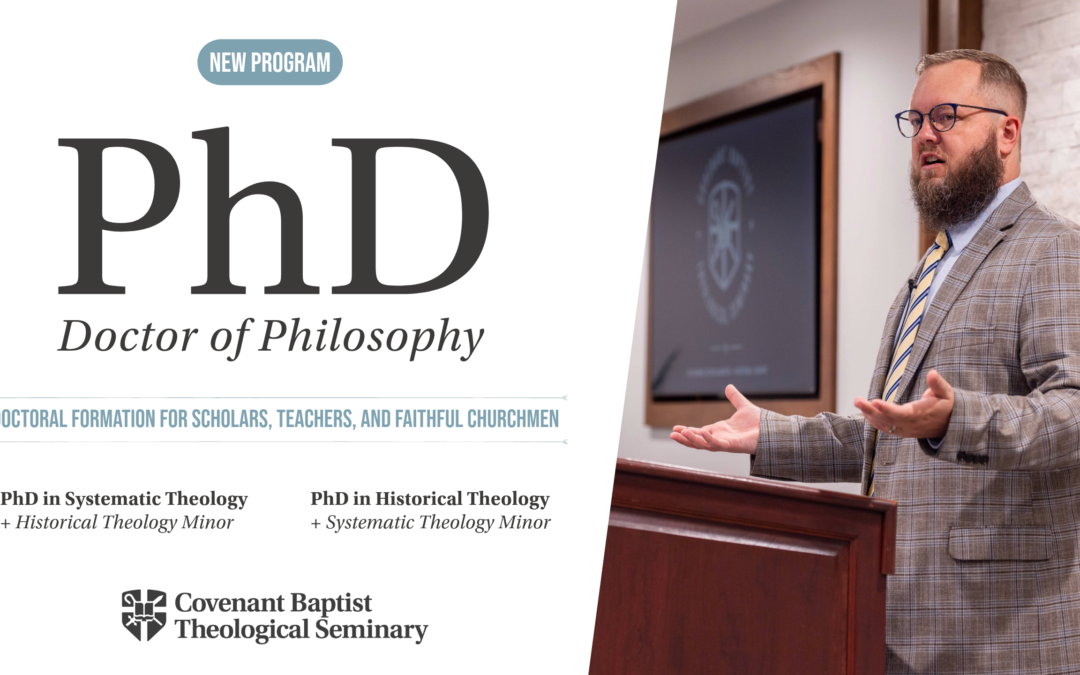
Today, CBTSeminary announces the launch of its Doctor of Philosophy (Ph.D.) program, set to begin in 2027. This landmark initiative marks a significant step forward for the seminary, further solidifying its commitment to providing rigorous confessional education for the next generation of Christian leaders and scholars.
For years, many aspiring Reformed Baptist scholars and academic leaders have had to seek advanced degrees at institutions that may not align with their specific doctrinal convictions. Dr. Jon English Lee, Academic Dean at CBTS, explains the motivation behind the new program:
“We asked ourselves: Why do we keep sending our future faculty and academic leaders to institutions that we may not agree with doctrinally? With the Lord’s help, we hope to answer that need by having a fully in-house accredited Ph.D. program.”
The CBTS Ph.D. program is designed to sharpen students’ academic training and advanced research skills, preparing them to serve as faculty members in seminaries and Bible colleges both domestically and abroad. Students can choose to major in either Systematic Theology or Historical Theology, with a corresponding minor in the other field. The program is structured to be completed in as few as five years and incorporates both in-person and distance learning components, making it accessible to students around the world.
At the heart of the CBTS Ph.D. program is a commitment to the Second London Baptist Confession of Faith. Students will be mentored and guided by faculty members who fully subscribe to this historic confession, ensuring that their academic pursuits are grounded in a solid theological foundation.
You can listen to Dr. Lee introducing the program here: https://youtu.be/9P2NcvX40DA?si=s5I8Yvtvb3hCdZtV
Learn more about the CBTS Ph.D. program on our website: https://www.cbtseminary.org/degree-programs/phd

by CBTS | Mar 11, 2026 | Announcements
FOR IMMEDIATE RELEASE
March 16, 2026
Today, CBTS announces the appointment of Dr. Timothy Decker as ThM Program Director. Dr. Decker is one of the pastors of Trinity Reformed Baptist Church of Roanoke, VA, having joined them in 2018. He holds a B.A. and M.A. biblical studies from Carolina University (formerly Piedmont International University), a Th.M. in New Testament from Southeastern Baptist Theological Seminary, and a Ph.D. in biblical studies from Capital Seminary and Graduate School. In his dissertation research, he examined the style of biblical Hebrew poetry in the New Testament. He has presented various papers at academic society meetings and authored numerous articles in several different scholarly journals. He is a member of ETS and IBR. When he is not reading or researching, he enjoys spending time with his wife and four children.
Statement from Dr. Decker
“In my time in academia, I have always been a big advocate of the Master of Theology (ThM) degree. It gives men a unique opportunity to specialize in a particular field of study in theology, history, or biblical studies which has great benefit in the pastorate, for preparation for doctoral studies, or even for personal gain. This is one of many reasons I am grateful for the opportunity to take up the role of CBTS’s ThM Director. We have top notch faculty advisors who exhibit both academic excellence as well as a pastoral heart. The curriculum at CBTS is flexible yet rigorous, the tuition is affordable, and the research benefits are ever expanding. I am very excited to help students complete their ThM studies with a research project or thesis defense. This is the highlight of the program, and the culmination of the student’s research and study. I count it a joy to oversee this department at CBTS. May God be pleased to raise up pastor-theologians by way of this ThM program.”
Program Details
The Master of Theology (ThM) program is designed to deepen the student’s theological understanding to better serve in pastoral ministry, teaching, or further academic scholarship. Students have two tracks to choose from: the Research Option or the Reformed Baptist Studies track (Thesis Option).
This program will expand and deepen a student’s abilities in ministry by providing a focused opportunity in advanced biblical scholarship. Students are equipped for leadership in pastoral ministry and academia as they gain greater mastery in an area of study than is normally possible at the MDiv level. This program is an excellent choice for the student who is seeking further expertise in a specific area of study or seeking further preparation before a PhD program.
For more information about our ThM program, visit CBTSeminary.org/degree-programs/ThM
by Ben Habegger | Mar 9, 2026 | Systematic Theology
*Editor’s Note: The views expressed in this series are not intended as an official statement of CBTS or a uniform position of its faculty. This material is offered in the spirit of faith seeking understanding and to encourage further theological reflection. To read more installments in this series, click here: 1, 2, 3, 4, 5, 6.
Introduction
So far in this blog series, we have examined the major scriptural terms translated hell. Now we must touch upon a couple synonyms which further inform the doctrine of hell. The first is the Greek word ἄβυσσος (abussos, often translated Abyss). The second term is the Greek verb form (ταρταρόω) of the name τάρταρος (Tartaros or Tartarus). Though we have encountered some strange teachings about a subterranean holding place for spirits—even righteous spirits according to some—yet we should not deny scripture’s references to a prison for wicked spirits—a prison which, being the opposite of heaven, is not “above” but “beneath”.
This realm “under the earth” seems to be assumed in at least two New Testament texts. The first text twice encompasses all creation by speaking of those “in heaven… on earth…” and “under the earth,” including also those “in the sea” in the second instance.
2 And I saw a mighty angel proclaiming with a loud voice, “Who is worthy to open the scroll and break its seals?” 3 And no one in heaven or on earth or under the earth was able to open the scroll or to look into it.
13 And I heard every creature in heaven and on earth and under the earth and in the sea, and all that is in them, saying,
“To him who sits on the throne and to the Lamb
be blessing and honor and glory and might forever and ever!”
(Revelation 5:2–3, 13)
Such universal statements in an apocalyptic vision are paralleled by Paul’s plain statement in one of his epistles:
9 Therefore God has highly exalted him and bestowed on him the name that is above every name, 10 so that at the name of Jesus every knee should bow, in heaven and on earth and under the earth, 11 and every tongue confess that Jesus Christ is Lord, to the glory of God the Father.
(Philippians 2:9–11)
Notwithstanding my disagreement with Sam Renihan regarding Christ’s descent into Hades, Renihan does helpfully explain that scriptural references to the unseen world must be handled with care:
Now you are likely wondering if the Scriptures positively assert and teach that literally within the globe of this earth, Satan, demons, and the dead dwell. It is undeniable that many Christians throughout history have believed this, but we are not required to think that. Why? For the same reason that we do not believe that heaven is literally “above” our world.
Heaven and Sheol are invisible realms of spiritual existence. We cannot see them. So, God has given them names based on the highest heights and deepest depths of what is visible to man in observable creation. The Scriptures use language from the visible world to make the invisible world perceptible and understandable to us.[1] – Samuel D. Renihan, Crux, Mors, Inferi: A Primer and Reader on the Descent of Christ, p. 28
Certainly, though invisible to us, both the present heaven and the present hell are still actual locations. The nature of the present heaven especially demonstrates this. Enoch and Elijah and Jesus Christ himself (and probably others who rose from the dead with Christ according to Matthew 27:52–53) already inhabit heaven in glorified, immortal bodies. Heaven is a definite location which is visible and habitable to those in glorified bodies; but that realm is invisible to us. There could be much stimulating speculation on such topics as the invisible realms, but we must also stop short of turning our sanctified speculations into dogmatic doctrines. That said, we have come now to consider more biblical words describing that which lies beneath. You might say we are looking at hell from yet another angle. Let us begin with the term often translated as “the bottomless pit” or “the abyss.”
Old Testament Background for the Abyss: the Depths of the Pit
One Hebrew word for depth, תְּהוֹם (tehom), often referred to the sea (“the deep”) but sometimes was also poetically associated with the depths of the earth or the grave. Here is one such text where the plural of tehom is translated “the depths”:
You who have made me see many troubles and calamities
will revive me again;
from the depths of the earth
you will bring me up again.
(Psalm 71:20)
The fluid conceptual relationship between the depths of the sea and the depths of the earth is helpful for understanding how Romans 10:6–7 adapts Deuteronomy 31:11–14 in a surprising way, even adapting what Deuteronomy says of the sea to speak of a hypothetical descent into the abyss of death. In the Deuteronomy text, Moses is exhorting Israel to keep the Old Covenant law given them by God:
11 “For this commandment that I command you today is not too hard for you, neither is it far off. 12 It is not in heaven, that you should say, ‘Who will ascend to heaven for us and bring it to us, that we may hear it and do it?’ 13 Neither is it beyond the sea, that you should say, ‘Who will go over the sea for us and bring it to us, that we may hear it and do it?’ 14 But the word is very near you. It is in your mouth and in your heart, so that you can do it.”
(Deuteronomy 31:11–14)
In Romans 10, the apostle Paul uses parallel wording to speak not of the law but of Christ in the gospel:
5 For Moses writes about the righteousness that is based on the law, that the person who does the commandments shall live by them. 6 But the righteousness based on faith says, “Do not say in your heart, ‘Who will ascend into heaven?’” (that is, to bring Christ down) 7 “or ‘Who will descend into the abyss?’” (that is, to bring Christ up from the dead). 8 But what does it say? “The word is near you, in your mouth and in your heart” (that is, the word of faith that we proclaim); 9 because, if you confess with your mouth that Jesus is Lord and believe in your heart that God raised him from the dead, you will be saved.
(Romans 10:5–9)
Romans 10:7 may also be similar to the lxx of Psalm 107:26 (106:26 in the lxx), which translated the Hebrew plural of tehom with the Greek plural of the word for abyss (ἄβυσσος) (though still referring in the psalm to the watery depths of the sea). In any case, Romans 10:7 reflects Old Testament language for the grave (as in Psalm 71:20, quoted above); it does not conclusively teach Christ’s “descent into hell.” We will return to such language for the grave in a future blog post regarding Christ’s descent (particularly in discussion of Matthew 12:40).
Alongside the depths (or abyss), the Old Testament also uses the imagery of the pit for the fate of the dead. Somewhat like the Hebrew word sheol, this wording could refer either to death and the grave in general or to the particular fate of the wicked. Consider the following examples:
1 I will extol you, O Lord, for you have drawn me up
and have not let my foes rejoice over me.
2 O Lord my God, I cried to you for help,
and you have healed me.
3 O Lord, you have brought up my soul from Sheol;
you restored me to life from among those who go down to the pit.
(Psalm 30:1–3)
14 Deliver me
from sinking in the mire;
let me be delivered from my enemies
and from the deep waters.
15 Let not the flood sweep over me,
or the deep swallow me up,
or the pit close its mouth over me.
(Psalm 69:14–15)
3 For my soul is full of troubles,
and my life draws near to Sheol.
4 I am counted among those who go down to the pit;
I am a man who has no strength,
5 like one set loose among the dead,
like the slain that lie in the grave,
like those whom you remember no more,
for they are cut off from your hand.
6 You have put me in the depths of the pit,
in the regions dark and deep.
7 Your wrath lies heavy upon me,
and you overwhelm me with all your waves.
(Psalm 88:3–7)
In a text where some find a veiled reference to Satan’s initial pride and rebellion, we explicitly find a taunt against the very arrogant and very human king of Babylon. The context is the downfall and death of this human tyrant. In such a context, Sheol and the pit are synonyms for the grave as the king’s corpse is abandoned to the maggots and refused a kingly burial:
3 When the Lord has given you rest from your pain and turmoil and the hard service with which you were made to serve, 4 you will take up this taunt against the king of Babylon:
“How the oppressor has ceased,
the insolent fury ceased!”
9 “Sheol beneath is stirred up
to meet you when you come;
it rouses the shades to greet you,
all who were leaders of the earth;
it raises from their thrones
all who were kings of the nations.
10 All of them will answer
and say to you:
‘You too have become as weak as we!
You have become like us!’
11 Your pomp is brought down to Sheol,
the sound of your harps;
maggots are laid as a bed beneath you,
and worms are your covers.
12 “How you are fallen from heaven,
O Day Star, son of Dawn!
How you are cut down to the ground,
you who laid the nations low!
13 You said in your heart,
‘I will ascend to heaven;
above the stars of God
I will set my throne on high;
I will sit on the mount of assembly
in the far reaches of the north;
14 I will ascend above the heights of the clouds;
I will make myself like the Most High.’
15 But you are brought down to Sheol,
to the far reaches of the pit.
16 Those who see you will stare at you
and ponder over you:
‘Is this the man who made the earth tremble,
who shook kingdoms,
17 who made the world like a desert
and overthrew its cities,
who did not let his prisoners go home?’
18 All the kings of the nations lie in glory,
each in his own tomb;
19 but you are cast out, away from your grave,
like a loathed branch,
clothed with the slain, those pierced by the sword,
who go down to the stones of the pit,
like a dead body trampled underfoot.
20 You will not be joined with them in burial,
because you have destroyed your land,
you have slain your people.”
(Isaiah 14:3–4, 9–20a)
Though such Hebrew poetry may focus primarily on the physical death and decay of Babylon’s king, it is not unreasonable to hear overtones of the afterlife as the shades are roused to watch his descent “to the far reaches of the pit.” Similarly, the fall of the city of Tyre is pictured as its descent “to dwell in the world below,” a place of ancient ruins. The city descends to the pit, meaning at least that it is devoted to death and will no more be inhabited by the living. Again, this descent could conceivably have reference beyond simple death to the fact that a pagan city’s inhabitants have been brought down to hell, imprisoned in the pit.
15 “Thus says the Lord God to Tyre: Will not the coastlands shake at the sound of your fall, when the wounded groan, when slaughter is made in your midst?
19 “For thus says the Lord God: When I make you a city laid waste, like the cities that are not inhabited, when I bring up the deep over you, and the great waters cover you, 20 then I will make you go down with those who go down to the pit, to the people of old, and I will make you to dwell in the world below, among ruins from of old, with those who go down to the pit, so that you will not be inhabited; but I will set beauty in the land of the living.
(Ezekiel 26:15, 19–20)
New Testament Significance of the Abyss: the Present Hell, Particularly for Angels
The word for abyss or bottomless pit appears relatively few times in the New Testament, but perhaps the plainest reference to it as a place of present torment appears in Luke’s Gospel.
26 Then they sailed to the country of the Gerasenes, which is opposite Galilee. 27 When Jesus had stepped out on land, there met him a man from the city who had demons. For a long time he had worn no clothes, and he had not lived in a house but among the tombs. 28 When he saw Jesus, he cried out and fell down before him and said with a loud voice, “What have you to do with me, Jesus, Son of the Most High God? I beg you, do not torment me.” 29 For he had commanded the unclean spirit to come out of the man. (For many a time it had seized him. He was kept under guard and bound with chains and shackles, but he would break the bonds and be driven by the demon into the desert.) 30 Jesus then asked him, “What is your name?” And he said, “Legion,” for many demons had entered him. 31 And they begged him not to command them to depart into the abyss. 32 Now a large herd of pigs was feeding there on the hillside, and they begged him to let them enter these. So he gave them permission. 33 Then the demons came out of the man and entered the pigs, and the herd rushed down the steep bank into the lake and drowned.
(Luke 8:26–33)
In his parallel account, Matthew writes, “And behold, they cried out, ‘What have you to do with us, O Son of God? Have you come here to torment us before the time?’” (Matthew 8:29) Perhaps shockingly for us, we learn that the many demons inhabiting this poor man were terrified that Jesus the Son of God had come to cast them into torment in the abyss “before the time” of the final judgment day. Clearly, wicked spirits think it possible that they could be imprisoned in hellish torment before the great day of judgment.
The abyss also appears amid the symbolic imagery of John’s Apocalypse and is at least a symbol for God’s restraint placed upon evil spirits. Some might envision Satan currently residing in the literal location called the abyss (much as our premillennial brethren would envision happening after Christ’s second coming), while others would say that this is only a symbol of his spiritual limitations in this gospel age. I do not intend to dogmatically affirm either option here, but only to note the appearances of the abyss in the Book of the Revelation.
First, we find in Revelation 9 apparently demonic beings first confined within and then released from what could be translated “the pit of the abyss” or “the bottomless pit.” Their ruler or king is called in Revelation 9:11 “the angel of the bottomless pit,” named Abaddon (Hebrew)/Apollyon (Greek), meaning “Destruction/Destroyer”. Since their leader is called an angel, and since his name is an Old Testament synonym for death and hell (cf. Job 26:6; 28:22; 31:12; Psalm 88:11; Proverbs 15:11; 27:20), this text could reinforce the picture of present hellish confinement for some wicked angels. Note also the comparison of the pit of the abyss with its smoke to a great furnace. Here is another link to scriptural descriptions of fiery torment in hell, a theme connected in this text with the hellish torment demonically inflicted upon men who then wish in vain to die.
1 And the fifth angel blew his trumpet, and I saw a star fallen from heaven to earth, and he was given the key to the shaft of the bottomless pit. 2 He opened the shaft of the bottomless pit, and from the shaft rose smoke like the smoke of a great furnace, and the sun and the air were darkened with the smoke from the shaft. 3 Then from the smoke came locusts on the earth, and they were given power like the power of scorpions of the earth. 4 They were told not to harm the grass of the earth or any green plant or any tree, but only those people who do not have the seal of God on their foreheads. 5 They were allowed to torment them for five months, but not to kill them, and their torment was like the torment of a scorpion when it stings someone. 6 And in those days people will seek death and will not find it. They will long to die, but death will flee from them.
7 In appearance the locusts were like horses prepared for battle: on their heads were what looked like crowns of gold; their faces were like human faces, 8 their hair like women’s hair, and their teeth like lions’ teeth; 9 they had breastplates like breastplates of iron, and the noise of their wings was like the noise of many chariots with horses rushing into battle. 10 They have tails and stings like scorpions, and their power to hurt people for five months is in their tails. 11 They have as king over them the angel of the bottomless pit. His name in Hebrew is Abaddon, and in Greek he is called Apollyon.
(Revelation 9:1–11)
Next we encounter the abyss as a place of restraint from which the dragon–empowered beast rises (though in Revelation 13 the beast rises from the depths of the sea). In both the references to the beast rising from the bottomless pit, the context suggests that here we are viewing the final incarnation of the seven-headed, ten-horned beast of Revelation 13. That is, the final antichrist seems to be in view. Writing of God’s two witnesses (who represent the church’s prophetic witness to this wicked world), John says, “And when they have finished their testimony, the beast that rises from the bottomless pit will make war on them and conquer them and kill them…” (Revelation 11:7)
Likewise, Revelation 17 speaks of the final incarnation of the seven-headed, ten-horned beast as a final king who will receive authority for one hour, a man who “goes to destruction” (Revelation 17:11–12; cf. “the son of destruction” in 2 Thessalonians 2:3). This final expression of the beast will rise from the bottomless pit.
The beast that you saw was, and is not, and is about to rise from the bottomless pit and go to destruction. And the dwellers on earth whose names have not been written in the book of life from the foundation of the world will marvel to see the beast, because it was and is not and is to come.
(Revelation 17:8)
Finally, we find the dragon—that old serpent the devil himself—first restrained and then released from the bottomless pit.
1 Then I saw an angel coming down from heaven, holding in his hand the key to the bottomless pit and a great chain. 2 And he seized the dragon, that ancient serpent, who is the devil and Satan, and bound him for a thousand years, 3 and threw him into the pit, and shut it and sealed it over him, so that he might not deceive the nations any longer, until the thousand years were ended. After that he must be released for a little while.
7 And when the thousand years are ended, Satan will be released from his prison 8 and will come out to deceive the nations that are at the four corners of the earth, Gog and Magog, to gather them for battle; their number is like the sand of the sea. 9 And they marched up over the broad plain of the earth and surrounded the camp of the saints and the beloved city, but fire came down from heaven and consumed them.
(Revelation 20:1–3, 7–9)
Here, it is noteworthy for an Amillennial understanding of the Apocalypse that, whereas the earlier visions of John show the devil-empowered beast or final antichrist rising from the abyss to make war on the saints, here the vision shows the devil himself released from the abyss to make war on the saints. This parallel fits the pattern in which Revelation 20 repeats the same events from earlier visions (albeit from a different angle), just as Revelation 20 repeats the Gog and Magog imagery of Revelation 19.
In any case, the abyss appears throughout the Apocalypse as a place of restraint for the devil and his agents. While this much is certain, the heavy use of symbolism throughout John’s visions makes it difficult to know how literally to take their references to the abyss. Nevertheless, the reference in Luke’s narrative certainly informs us that the abyss is a real place of possible torment in the present, a place of imprisonment which a legion of evil spirits dreaded. Next, we will observe in this connection a verb which Peter uses to describe angels being “cast into hell.”
[1] Samuel D. Renihan, Crux, Mors, Inferi: A Primer and Reader on the Descent of Christ (Independently Published, 2021), 28.
Ben Habegger first served in full-time pastoral ministry near Detroit, Michigan from 2013-2017 and has now been vocational pastor at Hope Reformed Baptist Church of Aloha, Oregon (formerly Glencullen Baptist Church of Portland, Oregon) since January of 2020. He has a Master of Divinity degree from Detroit Baptist Theological Seminary and a Master of Arts in Reformed Baptist Studies from Covenant Baptist Theological Seminary. Ben and his wife Theresa have four children.