
by CBTS Student | Dec 2, 2025 | Practical Theology
I was having a conversation recently about Turkish delight. I am sorry if you are a fan of that particular treat, but it is not good. Our conversation revolved around Edmund’s decision to betray his family over the allure of the stuff in The Lion, The Witch, and the Wardrobe. Apparently what passes for Turkish delight today is very different from what Lewis was imagining when he wrote the infamous scene. Perhaps if Lewis had known what a miserable experience Turkish delight has come to be, he would have picked something that tasted better.
Though he didn’t intend it, the current state of the treat combined with Edmund eating it with abandon paints a great picture of the allure of sin. It made me think of how sin tempts us, because in foolishness, we don’t know In Proverbs 9, the woman Folly calls out to the simple and draws them into her lair. She promises them something which is sweet to the taste: “Stolen water is sweet, and bread eaten in secret is pleasant.” (v.17) You see, sin has a reputation for being pleasing. The reputation is not altogether unearned, afterall it feels much better to lie to your parents about where you were than it does to tell them the truth and come under their godly discipline; it seems like it feels better to spend time with the woman at work who ‘gets you’ than to go home to your wife and kids. But these things are deceiving. If you only knew their true cost, then their allure would be lessened!
To think you can flirt with sin–that you can just have a taste–is foolish. Before long you will find you have gorged yourself upon the filth, and given up everything for it. In chapter 7, a similar scene plays out and Folly sets the hook and reels the man in.
“With much seductive speech she persuades him; with her smooth talk she compels him. All at once he follows her, as an ox goes to the slaughter, or as a stag is caught fast till an arrow pierces its liver; as a bird rushes into a snare; he does not know that it will cost him his life. (v.21-23)
Sin seems sweet because of what we think it will do for us–give us power, money, pleasure, control, friends–but the truth is that the pleasure is fleeting, and what it really gives us is death. Sin would have you never be satisfied except that you take just one more bite. . .and yet another.
But there is one who is perfectly sweet and he gives us the greatest reward–he gives us eternal life. Jesus Christ offers us the only thing which will truly satisfy our longing: himself.
Resist the temptation of the flesh to pursue those things which seem like they will be sweet, but really can never satisfy. Instead, follow the exhortation of the psalmist who says, “Oh, taste and see that the LORD is good!” (Psalm 34:8)
About the Author
Robert Gardner serves as the Pastor of Discipleship at Morningview Baptist Church (Montgomery, Alabama). He holds an M.A. in Theological Studies and is pursuing a Master of Divinity from Covenant Baptist Theological Seminary. He and his wife, Kate, have four wonderful children.

This blog post is authored by a student of Covenant Baptist Theological Seminary.
by Sam Waldron | Dec 2, 2025 | Systematic Theology
The Confession carefully limits and qualifies free will. And it does this in several ways:
First, free will is not utter unpredictability, but was under the control of God’s sovereign will even in the state of innocence.
5:4 The almighty power, unsearchable wisdom, and infinite goodness of God, so far manifest themselves in his providence, that his determinate counsel extendeth itself even to the first fall …
6:1 … in eating the forbidden fruit, which God was pleased, according to his wise and holy counsel to permit, having purposed to order it to his own glory.
We learn, then, this important truth. Divine freedom (God’s decretive will) and human freedom are not in conflict.
The second way in which the Confession limits free will is this: Our wills are controlled by our ethical disposition and moral nature.
Par 3 affirms that the free wills of unconverted men are unable to will to do “any spiritual good.” Matt 12:33-35 confirms this:
“Either make the tree good and its fruit good, or make the tree bad and its fruit bad; for the tree is known by its fruit. You brood of vipers, how can you, being evil, speak what is good? For the mouth speaks out of that which fills the heart. “The good man brings out of his good treasure what is good; and the evil man brings out of his evil treasure what is evil.”
Par 5 affirms that the free wills of glorified men are immutably fixed on good.
Cf. Eph 4:13 until we all attain to the unity of the faith, and of the knowledge of the Son of God, to a mature man, to the measure of the stature which belongs to the fullness of Christ.
Cf. Heb. 12:23 … the spirits of the righteous made perfect,
A third limitation is this: Being tied to human nature, it exists in different states.
The Confession illustrates this, moving from the instability of innocence to the immutability of the state of glory. Finite, ethical beings undergo a moral and ethical development. Christ as a man underwent maturation from immature ethical righteousness to matured holiness (Luke 2:40, 52; Heb. 2:10, 18; 5:8, 9). We also experience ethical maturation being either progressively hardened or progressively sanctified. This is a sobering thought. We are becoming what we shall eternally be.
Here is a “Concluding Summary” of what we have learned: Free will is not a faculty for making random decisions. Such a view actually destroys any meaningful free will. Today compatibilist and libertarian views of free will are distinguished. The Confession endorses what is called compatibilism. It teaches free will, but a compatibilist view of free will. That is, it teaches that free will is compatible both with divine sovereignty and total inability. We will take up total inability next time.
Dr. Sam Waldron is the Academic Dean of CBTS and professor of Systematic Theology. He is also one of the pastors of Grace Reformed Baptist Church in Owensboro, KY. Dr. Waldron received a B.A. from Cornerstone University, an M.Div. from Trinity Ministerial Academy, a Th.M. from Grand Rapids Theological Seminary, and a Ph.D. from Southern Baptist Theological Seminary. From 1977 to 2001 he was a pastor of the Reformed Baptist Church of Grand Rapids, MI. Dr. Waldron is the author of numerous books including A Modern Exposition of the 1689 Baptist Confession of Faith, The End Times Made Simple, Baptist Roots in America, To Be Continued?, and MacArthur’s Millennial Manifesto: A Friendly Response.
by CBTS Student | Dec 2, 2025 | Practical Theology
What a Friend We Have in Jesus.
This timeless hymn is very well known. Whether you heard it in church growing up or not, it is one of the best-known hymns of all time. According to one study, it ranks nineteenth in popularity among all hymns. While researching this hymn, I stumbled upon a website called hymnary.org, which offered a brief synopsis of the man who wrote it, Joseph M. Scriven. Scriven, an Irish native and Canadian immigrant, wrote this hymn based on his life’s trials.
He had grand ambitions to join the military, but was turned away because of poor health. He also had plans to marry his then fiancée, but she passed shortly before they wed. Sometime thereafter, he met another young woman he planned to marry, but the day before the wedding, she, too, passed away due to illness. Needless to say, Scriven had faced more tragedy in his lifetime than most would face in several lifetimes.
After the tragic passing of his first fiancée, Scriven came to know Jesus as his Lord and Savior. Some time after all these events had taken place, his mother took ill and was soon to pass also. Scriven wrote this poem for his mother to comfort her in her final moments. Nobody knew of this poem besides the two of them until many years later, when music was added to it. This, now famous, hymn, though not eloquently written as far as song or poetic structure is concerned, repeats a phrase several times throughout.
“Take it to the Lord in Prayer.”
This hymn has slowly become one of my personal favorites and has only increased since learning of its origins. I didn’t hear this hymn a lot in church growing up, like I did others, such as Amazing Grace or How Great Thou Art, but I also didn’t understand the true awe-inspiring beauty of this hymn or the others then either.
Now today, this hymn has helped me understand better the true nature of my Lord Jesus. What a friend? I’ve had plenty of friends in my lifetime, and I have a few now. I’m sure you, the reader, have plenty of friends too. You seem like a catch. What I will say, however, is that your friends have probably hurt you somewhere along the way. Chances are, you have hurt them as well.
I make this point to encourage you to look at your friendships and yourself and compare it to Jesus. [If you are trusting in Christ,] not only did Jesus die for you and for me, but daily we still sin against Him. Yet, His love doesn’t change for us. He has died for your every sin, past, present, and future. He has taken care of the biggest problem you will ever encounter in life. Every other trial or temptation we will ever face in this life can be taken to Jesus because He is the all-wise, all-powerful, all-good Counselor, King, and Friend.
The question, though, is this. How do we get counsel from Jesus?
The Christian life looks like this. We pray to God and bring our pleas to Him, and this is how we communicate with Him. No prayer is too big or too small for God. Oftentimes, when we pray, we withhold certain things that we would pray for because it seems silly to pray for such a thing. Mind you, I do believe there are certain things we should and should not pray for.
God is not a genie in a bottle, but the King of all who cares for and provides for His children according to His will. Regardless, the result of our prayers and supplications to Him, the result will always be for our good and His glory. Remember that.
What a friend. He died for us, cleansed us of our sins, and gives us His Word so that we can know Him better, love Him more, and worship Him rightly. This doesn’t encapsulate the entirety of the Christian life and duty, but it does give us what we need for our communication with God.
Most men who experienced the life Scriven did would have gone the opposite way. Turned to a vice that would have likely killed him. Instead, he leaned on his Friend who sticks closer than a brother.
Christian reader, lean your full weight on your Friend, Jesus. Take it to the Lord in prayer. You might be reading this, and you are fully content. If that is you, then I say to you, “Amen.” Rejoice and give thanks to the Lord for His mighty work in your life.
If you are the Christian reader who is reading this and questioning whether or not God is good or even real, I say to you, “Go to God with your heart in hand.” Christ has suffered, been tempted (yet without sin), mourned over loss, and felt the betrayal of a friend. Not only does He hear you, but He also sympathizes with you, and He will comfort you. You might not feel this comfort today, or even tomorrow, but resting on Him who loves you is the safest place for you to lean your head. God may seem not to be “working” in your life, but He is never deaf to your prayers. Take it to the Lord in prayer.
About the Author
Grant Billings is a student at Covenant Baptist Theological Seminary (BDiv/MDiv), member at Hurstbourne Baptist Church in Louisville, Kentucky, husband to Mary-Caroline, and father to Sawyer. He is working toward his degree in hopes to serve in pastoral ministry. In his free time, Grant enjoys writing, reading, and spending time with his family. He is a lover of music and coffee and would love to open his own coffee shop one day. Grant is originally from Kankakee County, Illinois, and currently resides in Louisville, where he has been for 7 years.
This blog post is authored by a student of Covenant Baptist Theological Seminary.

by Sam Waldron | Dec 1, 2025 | Systematic Theology
Do Calvinists and Calvinistic Confessions like the 1689 teach that men have free will? I think you could find many pamphlets and essays by Reformed teachers on this subject that seem to give different answers to this question. As with many other questions, it all depends on what you mean by free will!
As I understand it, the 1689 and its five paragraphs on the subject first affirm and then carefully define free will in its first paragraph. After that it speaks of the fact that free will exists in a fourfold state. Let’s take up its affirmation and definition of free will first. Listen to paragraph 1 of Chapter 9:
“God hath endued the will of man with that natural liberty and power of acting upon choice, that it is neither forced, nor by any necessity of nature determined to do good or evil.”
In context, this statement is both a clear affirmation of free will and a careful definition.
It affirms that the will of man has natural liberty. “God hath endued the will of man with that natural liberty.” This is an affirmation of a kind of free will. It is “power of acting upon choice.” Does the Bible teach free will in this sense? Yes, I think so.
Matthew 17:12 but I say to you that Elijah already came, and they did not recognize him, but did to him whatever they wished.
James 1:14 But each one is tempted when he is carried away and enticed by his own lust.
Deuteronomy 30:19 “I call heaven and earth to witness against you today, that I have set before you life and death, the blessing and the curse. So choose life in order that you may live, you and your descendants,
The human will is not “forced” by “any necessity of nature to do good or evil.” This is the Confession’s definition of “free will.”
Cf. Chapter 3:1: “nor is violence offered to the will of the creatures; nor the liberty or contingency of second causes taken away, but rather established.
When Calvinism rejects “free will” defined in other ways, it is not adopting behavioralism or physical or chemical determinism. Otherwise, there could not be human responsibility, and the Bible does teach human responsibility.
Proverbs 1:24-33 Because I called and you refused, … I will mock when your dread comes …. For the waywardness of the naive will kill them, And the complacency of fools will destroy them.
John 3:18-19 … he who does not believe has been judged already, because he has not believed in the name of the only begotten Son of God. This is the judgment, that the Light has come into the world, and men loved the darkness rather than the Light
Against some “Calvinists” (both contemporary and in the past), we must affirm the free will of man. But we must, while affirming it, also carefully and biblically define it.
Dr. Sam Waldron is the Academic Dean of CBTS and professor of Systematic Theology. He is also one of the pastors of Grace Reformed Baptist Church in Owensboro, KY. Dr. Waldron received a B.A. from Cornerstone University, an M.Div. from Trinity Ministerial Academy, a Th.M. from Grand Rapids Theological Seminary, and a Ph.D. from Southern Baptist Theological Seminary. From 1977 to 2001 he was a pastor of the Reformed Baptist Church of Grand Rapids, MI. Dr. Waldron is the author of numerous books including A Modern Exposition of the 1689 Baptist Confession of Faith, The End Times Made Simple, Baptist Roots in America, To Be Continued?, and MacArthur’s Millennial Manifesto: A Friendly Response.
by Ron Miller | Dec 1, 2025 | Biblical Worship, Ecclesiology, New Testament, Practical Theology, Preaching, Reformed Theology, Regulative Principle, Sacraments, Sermons, Worship
*Editor’s Note: The following series on Baptism was originally delivered sermonically by Pastor Ron Miller to Covenant Baptist Church in Clarksville, TN. As each of the four installments are released, they will eventually be linked together here.
The Uses of Baptism | Ron Miller
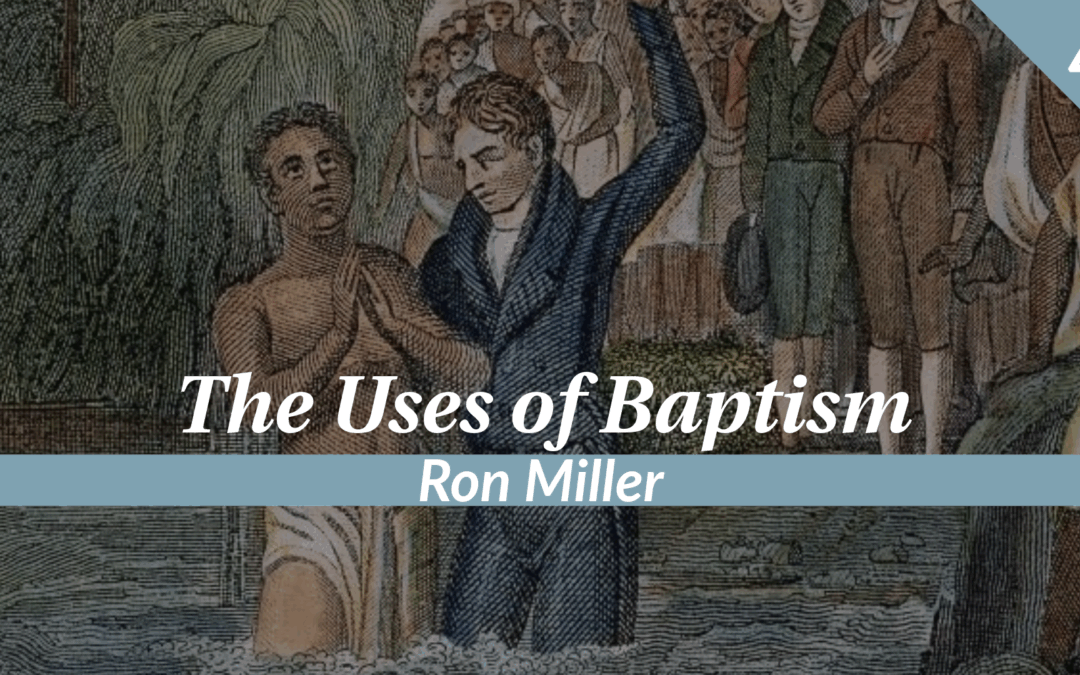
God has designed baptism to visibly display aspects of the gospel and benefit his church. How does it do this? I want to show you from Scripture that it does this in three main ways.
I. Baptism Visibly Proclaims God’s Glory in Salvation through Judgment
1 Peter 3:20-21. In this series, we’ve looked at these verses several times. I hope you recall that there is in them a comparison between Noah’s salvation in the ark through water and New Covenant baptism which saves as an appeal or pledge to God by the resurrection of Jesus Christ. God was glorified in Noah’s salvation through the waters of judgment. Baptism, our text says, is the anti-type or fulfillment of this. Baptism similarly saves through the waters of judgment.
So, baptism displays the sovereign grace and power of God in saving men. They are plunged by their sins into fearful judgment. They are spiritually dead and buried in the waters. But God intervenes. In the picture of baptism, he rescues them from judgment and brings them to new life. By the power of the resurrection of Jesus Christ, they are raised from the dead. So, baptism puts God’s work on visible display, and it boasts in his power. Baptism doesn’t exalt the supposed free will or wise choice of the one being baptized. No, it is the sovereign grace of God that is dramatically reenacted in baptism.
This is, in part, why baptism can rightly be considered a part of New Covenant worship. It publicly praises God for his salvation. It does not have to be done in the congregation, but it is proper and ordinarily done there because baptism visibly proclaims God’s glory in salvation through judgment.
The other two uses of baptism grow out of it being a visible word or sacrament. And they can be summed up this way: Baptism is (secondly) a sign and (thirdly) a seal of the New Covenant or the Covenant of Grace. Sacraments are visible and tangible ways of participating in the promises of God. They are displayed and you engage with God in them. And as we will see this accomplishes certain things.
II. Baptism is a Sign of New Covenant Membership
Baptism visibly proclaims God’s New Covenant promises of forgiveness and salvation by our union with Jesus Christ and the believer’s acceptance of those promises. Faith is what unites us to Christ and makes us members of the New Covenant. Adam is no longer our representative covenant head; Jesus Christ is. We are no longer under the curse of the covenant of works but are now in the Covenant of Grace.
Other biblical covenants had signs which when accepted showed membership in the covenant. So, the Abrahamic and Mosaic covenants had circumcision as a sign of the covenant. To be circumcised in that context was to become a Jew; it was to join the covenant people of God; it was to under the covenant of God. So too, in the New Covenant, baptism is the way a person becomes recognizable as a Christian. Baptism formalizes and publicizes salvation. It makes what is spiritual and inward, visible and outward. As one man has said, “Baptism is the body of which faith is the soul”. Baptism is the outward mark of a Christian disciple. Baptism declares, “this man is a follower of Christ.”
More than this, Baptism completes the outward conversion process. Conversion is often thought of as only an internal or spiritual process. It includes the conviction of sin, repentance, the coming of faith and its exercise toward Christ and more. But Scripturally-speaking, a person’s conversion from death to life, from the Devil to Christ, from self to God, from sin to righteousness also includes some outward or visible changes and actions. Repentance is an inward grace but if it is real, it has outward effects. If faith is real, it publicly names Christ as Lord. And baptism is part of the conversion process in the New Testament historical accounts. The apostles commanded more than inward belief. They did command “repent and believe” but they also said in Acts 2, “repent and be baptized”. That was how they were to save themselves from their crooked generation. Ananias said to Paul, “Rise, and be baptized, and wash away your sins, calling on his name”. Calling on the name of Christ is vital, but it is not all that is demanded. Baptism is the outward sign of conversion, of union with Christ, of membership in the New Covenant.
So, baptism is necessary for a person to be Scripturally considered a Christian. There are no unbaptized Christians in the New Testament. And there ought not to be any among us. If you claim Christ and want to be his follower, then you need to follow! You need to obey his command to be baptized. You may say, but I’m a Christian. Let me gently ask you something: Where in Scripture does it teach that you declare yourself a Christian? American individualism might teach that, but I don’t believe Scripture does. You must profess. Yes. But do you hold the keys of the kingdom or does the church? Do you hold the keys to the entrance to God’s church or do they? Did Paul announce his Christianity or did the church need to accept him as a brother? Does a person decide to be baptized on their own or does the church have a say in it? The Scriptural pattern is that when the church and its administrator agree to baptize you, that baptism places the name “brother” on you publicly. And you keep that name until the church removes it, for it is the church that judges those inside the church. (1 Cor. 5:11-12).
A word about testimonies. You have one if you are to be baptized. But ultimately the church is not joining you, you are joining them. So, you must believe what they believe, the apostolic message.
Being immersed into Christ in baptism means you have put him on. (Gal 3:27.) You are part of Christ’s body and so baptism also functions as the initiation into church membership. Surely all who are in Christ should join with a local manifestation of that body, the local church! There may be exceptions. The Ethiopian eunuch had no church to join in the wilderness. The initial converts in any place won’t join a church by their baptism, but these are temporary situations that do not allow the regular pattern to be ignored. What is the regular pattern? When a person is baptized, they are added to the church. Acts 2:41, “so those who received his word were baptized and there were added that day about three thousand souls”. There are many different understandings about the mechanics and subjects of baptism. But virtually all churches throughout church history have agreed that baptism is the door of entrance to the church. Since it fundamentally portrays union with Christ, how can it not also symbolize union with his body. Can Christ be divided from himself? Of course not.
III. Baptism is a Seal of the New Covenant
By this we mean God confirms and assures us of our salvation through baptism. Ultimately, God himself in the person of the Holy Spirit is the seal of our New Covenant salvation. Twice in Ephesians, the Holy Spirit is said to seal believers. And while that is true, the Holy Spirit uses means to seal salvation to us. Primarily, he uses the Word and the sacraments to assure us, convince us, comfort us, that we are his; that our sins are forgiven; that his promises to us are yes and amen in Christ; that we have power to obey him better; that we are indeed true Christians. So, these ordinances function as means of grace. God is speaking in them and saying, “I am for you; you are in Christ; your sins are washed away; it was my power that did this, do not doubt; you have new life, I love you and I have fellowship with you.” And when we participate in these sacraments, we are saying to God, “I accept; you are my God and Lord; I believe, help my unbelief, I give myself to you.” God is not saying in this visible Gospel that he rejects you. Baptism proclaims his acceptance of you in Christ.
This should convince and strengthen you in your Christian profession. Remember your baptism and with greater understanding may God grant greater grace.
Ron has been pastor of Covenant Baptist Church since July of 2017. Pastor Ron is thankful for being raised in a Christian home where God called him to salvation at an early age. He loves his wife, public worship, and pastoring this local church. He has a special interest in aiding theological education in North and South America and in teaching Baptist history. Ron is the host of the weekly podcast Particular Pilgrims.