*Editor’s Note: The following is Part 2 in a five-part series on the Nicene Creed authored by Dr. Brandon Rhea. To read the other installments in this series, click on the following numbers: 1, 2, 3, 4, 5.
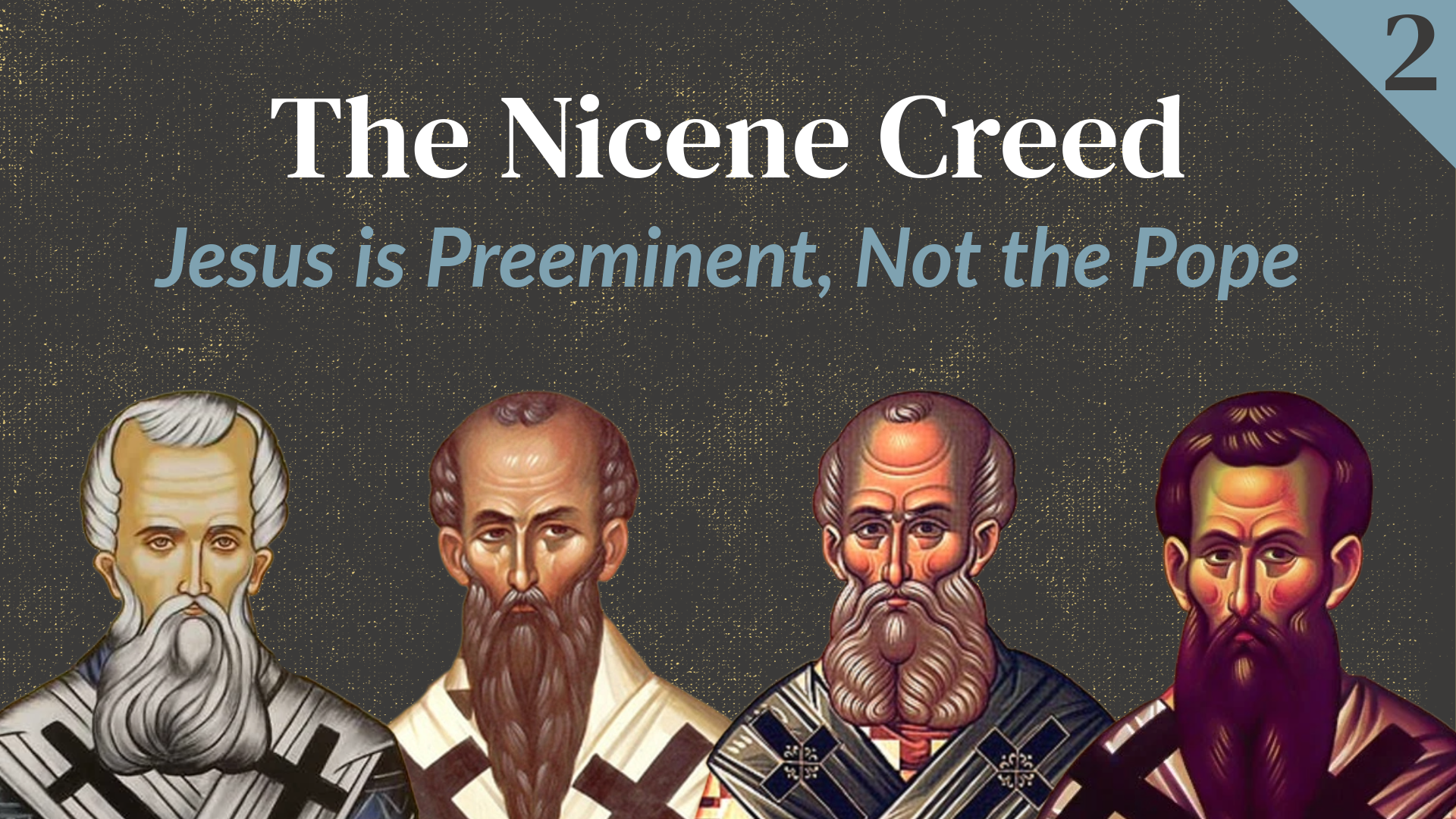
On May 8, 2025, white smoke puffed out of a chimney at the Sistine Chapel, telling the world that the Roman Catholic Church had a new Pope. To the surprise of many, an American from Chicago named Robert Prevost was chosen by the electors. He took the title Leo XIV for his reign. In response to his election, American Catholics rejoiced while Chicago natives took a victory lap. The Pope is White Sox fan who attended a game at the 2005 World Series. He also roots for his alma mater Villanova. Leaders in the American Catholic Church hope that his election will renew the church in our country and cause growth.
How should we view the Pope? Is he a Christian? Does he preach the same gospel as Peter? Should we hold communion with the Pontiff since Protestants and Catholics confess the Nicene Creed? Should we consider him to be an antichrist? Does the Pope supersede the honor and titles which are only reserved for our Lord and Savior Jesus Christ?
To answer these questions in our second installment in this blog series on the Nicene Creed, we must look at Scripture. Colossians 1:18, says, “And He is the head of the body, the church, who is the beginning, the firstborn from the dead, that in all things He may have the preeminence.”[1] The Bible describes Jesus Christ as the Head of the Church who has all authority and gives life to the body. He has the place of preeminence meaning the highest rank or honor. Jesus is not a private, major, colonel, or lieutenant in the army. Rather, He stands as a five-star general whom lesser generals must salute.
To the contrary of biblical teaching, the Roman Catholic Church makes the Pope preeminent and not Jesus Christ. Each Pope officially holds the titles of Supreme Pontiff of the Universal Church, Vicar of Jesus Christ, and the Successor of [Peter] the Prince of the Apostles. The Pope thus acts as the head of the church and as the representative of Jesus on the earth even though the vicar of Christ is the Holy Spirit and not a man.
Catholics teach that the Pope is the head and sustainer of the church and not Jesus, as Colossians 1 teaches. To prove the point, Robert Bellarmine who was a Catholic theologian in the 17th century whose writings defended the church’s views during the time of the Reformation, wrote, “What is at stake when the question arises of the primacy of the Pontiff? Very briefly, the heart of Christianity.”[2]
Charles Spurgeon renounced the office of the Pope. He said, “Of all the dreams that ever deluded men, and probably of all blasphemies that ever were uttered, there has never been one which is more absurd and which is more fruitful in all manner of mischief than the idea that the Bishop of Rome can be the head of the church of Jesus Christ. No, these popes die, and are not; and how could the church live if its head were dead? The true Head ever liveth, and the church ever liveth in him.”[3]
Moreover, Catholic doctrine teaches that the Pope sustains the Church. At Vatican I (1869-1870), theologians met to discuss the Pope’s authority in the church.[4] That council declared the Pope as the defender and sustainer of the church against the gates of hell. Yet in Matthew 16, Jesus promised to sustain the church as it advances in the world against the powers of darkness. Catholics have put their hope in the Papacy and not in Jesus Christ to give life to the body. To deny the Pope’s supremacy to rule and sustain the church was made an anathema or a false teaching. A person cannot disagree with their conclusion without being excommunicated from the church. In response to this ruling, some Catholics in Europe split off from Rome to form the Old Catholic Church. They are like Roman Catholics except for denying the Pope’s supremacy.
To sustain the body of the church, Vatican I also declared papal infallibility. This teaching says the pope is infallible—without error—when he speaks from the chair (ex cathedra) on matters of faith and morals. Therefore, if you ran into the pope on the street and asked him a question, his answer would not be considered infallible. He, however, has the power to declare doctrine and practice for the church, and it must be received as if it is the Word of God. Rather than trusting in Sola Scriptura, Catholics trust in the Papacy to interpret and declare doctrine. This brings up a pertinent question: Who is right when the Pope contradicts Jesus Christ? Do you follow the Papacy or the Bible? Of course, Catholics have to follow the Papacy and twist the Bible to line up with their false teaching.
Why did the Papacy develop? In the fifth century, when the Roman Empire in the west collapsed, the Church filled in the vacuum. The bishop of Rome, therefore, took on the customs and the authority found in Caesar. He no longer had only a religious office, but he took upon himself a civil office. From the fifth century until the mid-1800s, the Pope ruled over vast lands in Italy as a king. Instead of having Jesus as the head and king of the church, the Pope blasphemously surpassed Him in preeminence.
One of the lines in the Nicene Creed says, “We believe in one, holy, catholic, and apostolic church.” Those four words describe the nature of the church, but Roman Catholics have a different interpretation than Reformed Baptists. First, for the church to be one, Catholics say the unity is found in the institution. Everyone must be baptized into the Church to be united together. In contrast, Protestants say our unity comes through being united to Christ by the work of the Holy Spirit. Christ as our head unites us and not the Pope.
Second, the creed says that the church is holy. Catholics believe the institution of the church has a supernatural holiness. To be and grow in holiness, a person must be in that institution. The church has seven sacraments which adherents must exercise to grow in grace on the road to purgatory and heaven. As Reformed Baptists, however, we believe Christ has made us holy at the moment of salvation. We have His righteousness as our own and have been set a part for His service. From our new identity in Christ, we grow in obedience to God’s Word.
Third, Rome calls itself the catholic church. They claim universality since they are the only church with a Papacy. Moreover, it has the sacraments and seeks to bring everyone around the world into its sphere. Yet Reformed Baptists do not define “catholic” as an institution. Rather the term includes all true believers in Christ even if they do not belong to our denomination. Hence, Baptists, Presbyterians, Anglicans, Charismatics, seeker sensitive, and many more belong to the universal church despite our differences in doctrine and practice if we confess the same gospel.
Fourth, the Catholic Church bases its legitimacy on being apostolic. They believe to be the stewards of unwritten traditions which go back to the Apostles. The Pope, therefore, can trace his succession back to Peter which is the basis for being the head of the church. Being the true church depends on this succession and not on doctrine. Protestants, however, believe being apostolic rests on teaching and confessing the same doctrine as the Apostles. We do not have to trace our existence back to Peter, name by name through a spiritual family tree. What makes a church truly authentic is if it is adhering to the faith as expressed in the Bible.
As Protestant heirs of the Reformation, how should we view the Pope? I suggest looking to the example of Ian Paisely. He was an evangelical minister and politician from Northern Ireland. When the European Parliament invited Pope John Paul II to speak at their assembly, Ian Paisley who served in that body objected. After the Pope took the podium, Paisley held up a sign, “Pope John Paul II Antichrist,” and shouted “I renounce you as Christ’s enemy.”
Do not be sucked into the smells and bells. Yes, even though the current Pope is American, we should not be proud but dismayed. He preaches peace among the nations, but he is an antichrist masquerading as an angel of light. Do not honor the Pope, because it is blasphemy. Roman Catholics are not Christians like us, but they are pagans wrapped in a Christian veneer. Instead, for the honor of our Lord and Savior, we must condemn the Papacy and put our hope in Jesus. He alone is the head and sustainer of His bride—the church.
[1] All Scripture references are from the New King James Version.
[2] Robert Bellarmine, as quoted in William Cunningham, Historical Theology, vol. 1 (Edinburgh, The Banner of Truth Trust, 2024), 224
[3] Charles Spurgeon, The Metropolitan Tabernacle Pulpit, vol. 14 (Pasadena, TX; Pilgrim Publications, 1982), 621.
[4] The First Dogmatic Constitution of the Church of Christ, as quoted in R.C. Sproul, Are We Together? A Reformed Baptist Analyzes Roman Catholicism (Sandford, FL: Ligonier Ministries: 2012), 91.
Brandon Rhea (Ph.D. Historical Theology at Midwestern Baptist Theological Seminary) is a pastor and an ACBC certified Biblical counselor. He met his wife, Karise, while doing pulpit supply in 2013-14. In April 2016, he accepted the call to pastor at Faith Baptist Church in Kirksville, Missouri. He loves history and has a heart for street preaching and evangelism. He is the author of “Spurgeon’s Forgotten Sabbatarianism” and teaches “Spurgeon on the Law & Sabbath” for Covenant Baptist Theological Seminary.