
Review of Rooker’s The Ten Commandments
The Ten Commandments: Ethics for the Twenty-First Century
Mark F. Rooker
(Nashville: B&H Publishing Group, 2010, 234pp.)
reviewed by Richard C. Barcellos
Mark F. Rooker’s The Ten Commandments (TC) is volume 7 in the NAC Studies in Bible & Theology series put out by B&H Academic. Dr. Rooker is professor of Old Testament and Hebrew at Southeastern Baptist Theological Seminary in Wake Forest, NC. TC is a nice, hardback volume with recommendations by Walter C. Kaiser, Jr. and Jerry Vines, among others. It contains a bibliography and name, subject, and Scripture indices.
I first heard of this book when a student from the Southern Baptist Theological Seminary, Louisville, KY, emailed me asking if I thought Rooker quoted me in context while referencing my In Defense of the Decalogue (IDOTD). I did not even know who Rooker was, nor had I heard of the book. I immediately ordered a review copy and read the book this fall. I’ll comment on Rooker’s references to IDOTD later. In case you are wondering, I have no problem with his quotes in the context in which he used them, though I am sure we differ on some finer points.
Preface
Something in the one-page Preface that caught my eye was this: “The reader of this volume will clearly see that the Ten Commandments are founded on the creation account of Gen 1-2” (xi).
Introduction
The Introduction has the following headings: The Influence of the Ten Commandments; The Significance of the Ten Commandments in the Old Testament; The Significance of the Ten Commandments in Judaism; The Significance of the Ten Commandments in Christianity; The Enumeration of the Ten Commandments; The Ten Commandments in their Ancient Near Eastern Background; The Context of the Ten Commandments; and The Addressees of the Ten Commandments. Rooker is clear that he thinks the Ten Commandments are important. He says, for instance:
…the Ten Commandments have stood the test of time and will continue as long as civilization exists. The influence of the Ten Commandments on the Western world is beyond doubt. No other document has had such a great influence on Western Culture. (1)
Rooker then gives historical examples in Western history where the Ten Commandments have influenced many (1-3). Though I appreciate Rooker’s desire to highlight the importance of the Ten Commandments, I do not find his examples compelling me to agree with such an assertion – i.e., “No other document has had such a great influence on Western Culture.”
Rooker sees special significance in the Ten Commandments. He argues that, in one sense, they are distinct from and foundational to all other laws of the Bible. He says:
The Ten Commandments are literally the “Ten Words” …in Hebrew. The use of the term dabar, “word,” in this phrase distinguishes these laws from the rest of the commandments (miswa), statues (hoq), and regulations (mispat) in the Old Testament. (3)
The Ten Commandments should be viewed as fundamental to all the laws of the Bible. They may be compared to the Constitution of the United States, and the laws that follow (Exod 21:1-23:19) as somewhat analogous to sections of federal law dealing with particular matters. (4; Rooker references D. Stuart, Exodus, NAC, 441.)
The special role of the Ten Commandments is seen in the fact that they were placed in the ark of the covenant, “the most holy article of the tabernacle/temple furniture…” (5). It is in this context of discussion that Rooker says, “The Ten commandments express the eternal will of God” (6). A little further on, he says that
the laws in the Decalogue are not entirely new to Israel. The Bible presupposes a moral code long before the theophany on Mount Sinai. This is indicated in earlier biblical events such as the slaying of Abel by his brother Cain (Gen 4), as well as the judgments of the flood (Gen 6-9) and the destruction of Sodom and Gomorrah (Gen 19). The expression of God’s will in the Decalogue is commensurate with His nature. (6)
While discussing the significance of the Ten Commandments in Christianity, Rooker distances himself from those who think that the Ten Commandments have served their purpose and are no longer relevant for Christian ethics. Rooker says:
The New Testament church accepted the Decalogue as the substance of Christian ethics at an early date. Early attestation of its importance is clear not only from the numerous citations of the Ten Commandments in the New Testament (Matt 5; 19; Mark 10; Luke 18:20; Rom 13:9; Jas 2:11) but also from the apostle Paul stating emphatically that the tenth commandment convinced him he was a sinner (Rom 7:7-8). Under the teaching of the tenth commandment, sin stirred up a world of iniquity in his heart. The New Testament nowhere rescinds the ethics of the Ten Commandments. (9)
These words clearly distance Rooker from others in our day who see the function of the Decalogue as limited to old covenant Israel (i.e., New Covenant Theology).
The last page of the Introduction discusses the addressees of the Ten Commandments. Rooker says, “The Ten Commandments are addressed to the nation of Israel… ….The Ten Commandments were given directly to every individual Israelite…” (23) These statements might appear to be contradicting some of the things Rooker has already said. However, if one understands that the Ten Commandments have more than one function in the Bible, there is no contradiction in Rooker at this point. Rooker himself holds to a multifunctional utility of the Decalogue. He sees it related to creation and redemption; to Israel, to the Moral Law, to the Natural Law, and to Christian Ethics (175-199).
Chapters 1-10
Chapters 1-10 take up each commandment in order. Each chapter is outlined basically the same. The basic outline is as follows: introduction, the meaning of the commandment, the commandment elsewhere in the OT, the commandment in the NT, and a conclusion. I really appreciate this approach. It helps readers get a grasp of the usage of each commandment in both testaments. Rooker shows ample acquaintance with relevant contemporary, scholarly literature. I would have liked to see much more interaction with Reformed theologians on this issue (especially older ones). I found this lack somewhat of a disappointment, especially while dealing with the fourth commandment (see my comments below). All in all, though, the chapters are well-written and informed, full of Scripture, and easy to follow.
One chapter needing some comment on is chapter 4 on the fourth commandment. Something I appreciate much is this statement: “The oft-repeated notion that the Sabbath was originally only a day of rest without any worship activity is unfounded” (91). He made this statement after showing “[t]he association of the sanctuary and priestly ritual with the Sabbath day…” (90). The Sabbath day under the old covenant was a “holy convocation” or “sacred assembly” (90). It was a special day of rest and public worship.
While discussing the fourth commandment, Rooker makes these statements about the Sabbath and creation:
Unlike the previous commands, the fourth is stated positively. It is dependent on the creation account of Gen 1-2, which also describes the cessation of the Creator’s work and affirms that the Sabbath is sanctified… (92)
…at Mount Sinai Israel was commanded to honor this day that was established at the beginning (Gen 2:1-3). The Sabbath commandment is to be read in light of the creation account that focuses on the sanctification of the seventh day. (93-94)
…[the fourth commandment] is the only commandment specified in the creation account… (99)
The Sabbath is not only the focus of the Ten Commandments; it is also the climax of the creation account (Gen 1:1-2:3) and suggests that creation and the giving of the Ten Commandments are related. (176)
Does Rooker hold that the Sabbath is, therefore, a creation ordinance and for all men of all time? The answer would seem to be yes, based on these words, “The Sabbath was made for man. The fact that the work and rest pattern was established in the work of God Himself indicates that this principle for mankind had universal significance and application” (102).
What place does Rooker see for the fourth commandment in Christian ethics? He rightly sees the Sabbath as a type of Christ (99) and as a sign with Israel as God’s old covenant nation (99). He says:
In addition, it is the only one of the Ten Commandments that is not repeated in the New Testament. The New Testament instead speaks of its typical nature. As a shadow it was fulfilled in Christ’s ministry in giving rest, but it also awaits a future fulfillment. (99)
But he goes on to qualify as follows:
Yet the fourth commandment is not without relevance for the modern Christian. The principles involved in observance of the Sabbath law are applicable today. The principles of work, rest, and worship that emerge from the Sabbath law are extremely meaningful in their application to the contemporary Christian. (99-100)
There is much to agree with in these words.
Because Rooker sees the Sabbath as typological of Christ, he does not see it as binding (as such) on believers or anyone else today. I agree that the Christo-typical function of the Sabbath is no more. As he states in the quote above, however, there are abiding principles from the Sabbath law that are applicable today, but the Sabbath, in its Christo-typical function, is no more. But is that the only function of the Sabbath in the Bible? I think it has more than just a Christo-typical function.
A denial of an abiding new covenant Sabbath is further illustrated where Rooker argues against the Lord’s Day being the new covenant application of the Sabbath law (98-99). He says:
While there is solid evidence that the early Christians were beginning to worship on Sunday in honor of the resurrection, there is no evidence that Sunday was to be considered the new Sabbath day of rest and the way Christians would now keep the fourth commandment. Thus, Sunday did not replace the Sabbath… (99)
Obviously, Rooker does not see the Lord’s Day as a Sabbath under the new covenant in application of the fourth commandment. He sees practical application from the fourth commandment, but not an abiding Sabbath to be rendered for the people of God on the Lord’s Day, the first day of the week, Sunday.
I find myself agreeing with much of what Rooker says about the fourth commandment, but I also find myself wanting him to say more and qualify more carefully. As for me, if the Sabbath is grounded in creation, made for man, incorporated into (and thus predating and transcending) Israel’s Decalogue, part of the Decalogue (which has various functions, one of which is the heart of old covenant law another of which is the heart of new covenant law [Jer. 31:33]), related to redemption, and other things, I don’t see a problem with it being an abiding law for Christians, granting a change in its application due to the redemptive-historical shift brought on by the resurrection of Christ, the sign of the new creation and seal of redemption accomplished.
Conclusion
In the Conclusion, Rooker’s headings are as follows: Interrelationship of the Ten Commandments; Mosaic Covenant and the Plan of God; Israel and the Law; The Church and the Law; The New Testament and the Law; The New Testament and the Ten Commandments; The Ten Commandments and Moral Law; Moral Law and the Christian; The Moral Law and the Natural Law; and A Final Word. There is much good theological discussion in light of the main section of the book, but I can only comment on a two things.
Rooker has a great discussion on distinctions in the law of the OT on pp. 181-86. I will only whet your appetite with these words: “A distinction can be made between what is universal and what uniquely applied to Israel’s special circumstance” (182). I found this section very helpful.
It is in the Conclusion where Rooker references my IDOTD six times. Though I am sure we differ here and there on some issues, on the main, I found his use of IDOTD judicious.
I recommend this book to anyone interested in a contemporary scholar interacting with mostly contemporary sources on the place of the Ten Commandments in the Bible.
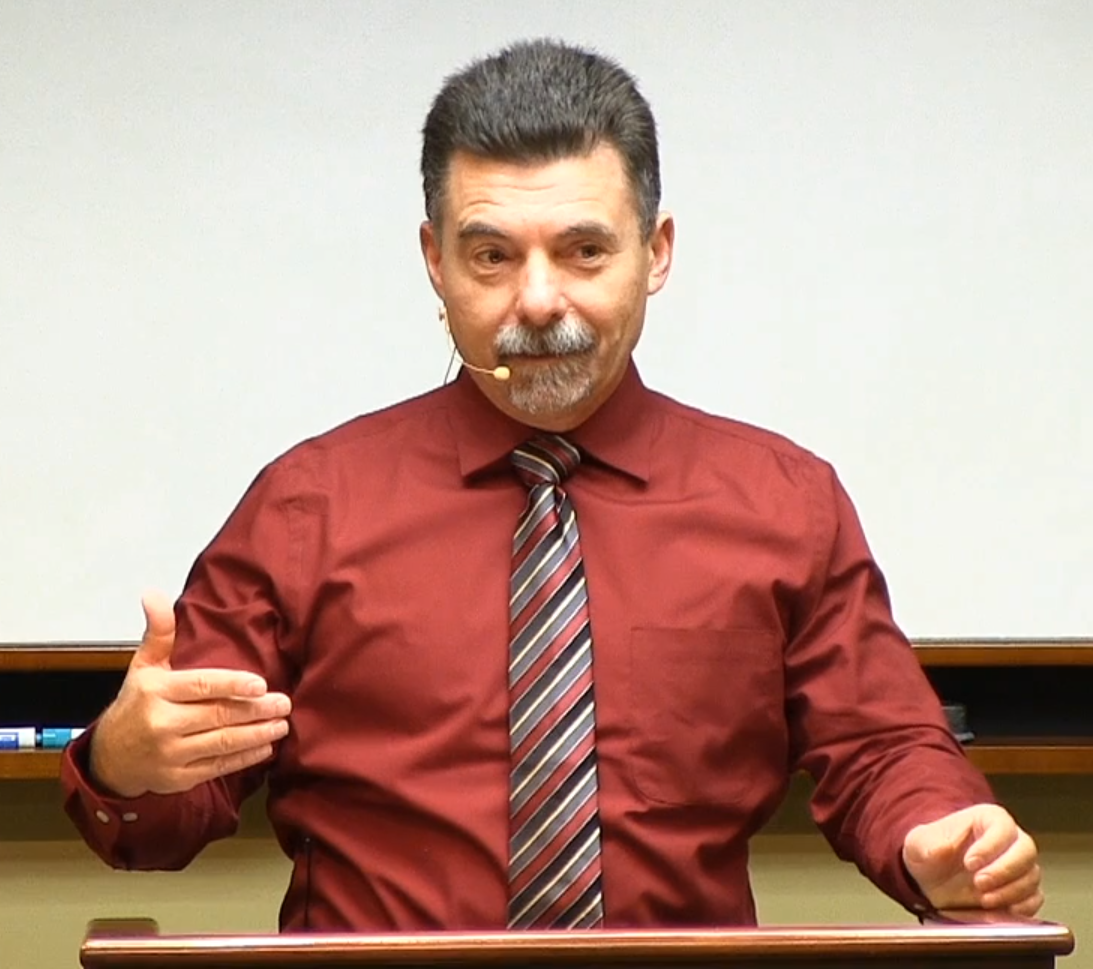
Dr. Richard Barcellos is associate professor of New Testament Studies. He received a B.S. from California State University, Fresno, an M.Div. from The Master’s Seminary, and a Th.M. and Ph.D. from Whitefield Theological Seminary. Dr. Barcellos is pastor of Grace Reformed Baptist Church, Palmdale, CA. He is author of Trinity & Creation, The Covenant of Works, and Getting the Garden Right. He has contributed articles to various journals and is a member of ETS.
Courses taught for CBTS: New Testament Introduction, Biblical Hermeneutics, Biblical Theology I, Biblical Theology II.