CBTS Faculty fully subscribe to the 1689 Confession of Faith, hold an advanced
degree in their field of instruction, and possess significant pastoral experience.
The Bible often cites itself and alludes to previous persons, events, or institutions. Why does it do this? It does this because it has one ultimate author, with a unified plan, worked-out in history, to glorify himself through his Son, our Lord Jesus Christ. It does this because this unified plan centering around what the Son of God does is God’s “plan A” from before the foundation of the world. All revelation is tethered around the skull-crushing seed of the woman (Gen. 3:15) who brings many sons to glory (Heb. 2:10). Persons, events, and institutions of the Old Testament are often typological of Christ, his sacrificial life of service unto death, and his body, the church. What God began in the Garden, God completes in the exalted Redeemer. Though Adam failed as God’s son in the Garden, and though Israel failed as God’s son in the Promised Land, the last and greater Adam and the faithful representative of Israel does not fail. He both obeys to procure righteousness leading to a state of exaltation and suffers the punishment due our sins. He erects a temple on the earth that is slowly spreading throughout the entire globe. He was God tabernacling among men who erected a temple of which both Jews and Gentiles are citizens and priests and kings. He did this as the heir to God’s covenantal promises to Abraham (Genesis 12, 15, 22), David (2 Samuel 7), and Israel (Jeremiah 31). Why does the New Testament refer to promises to Abraham, David, and Israel so often as being fulfilled in Christ? Because all revelation prior to the sufferings and glory of the Redeemer was preparatory and anticipatory. The New Testament reads the Old Testament similar to the way the Old Testament reads itself. What God does in space and time is often done in anticipation of something greater to come in the future. The Old Testament set the stage for a greater exodus, a greater temple, a greater Servant of the Lord (greater Israel), a greater David, and a greater heaven and earth. Christ (i.e., what he accomplishes, inaugurates, and brings to eschatological fruition) is the fulfillment of these greater expectations. Indeed, “for as many as are the promises of God, in Him they are yes…” (2 Corinthians 1:20). When we read, interpret, and explain the Bible, let us never forget its God-glorifying, unifying center – our Lord Jesus Christ. The Scriptures of the Old and New Testaments testify of him (John 5:39).
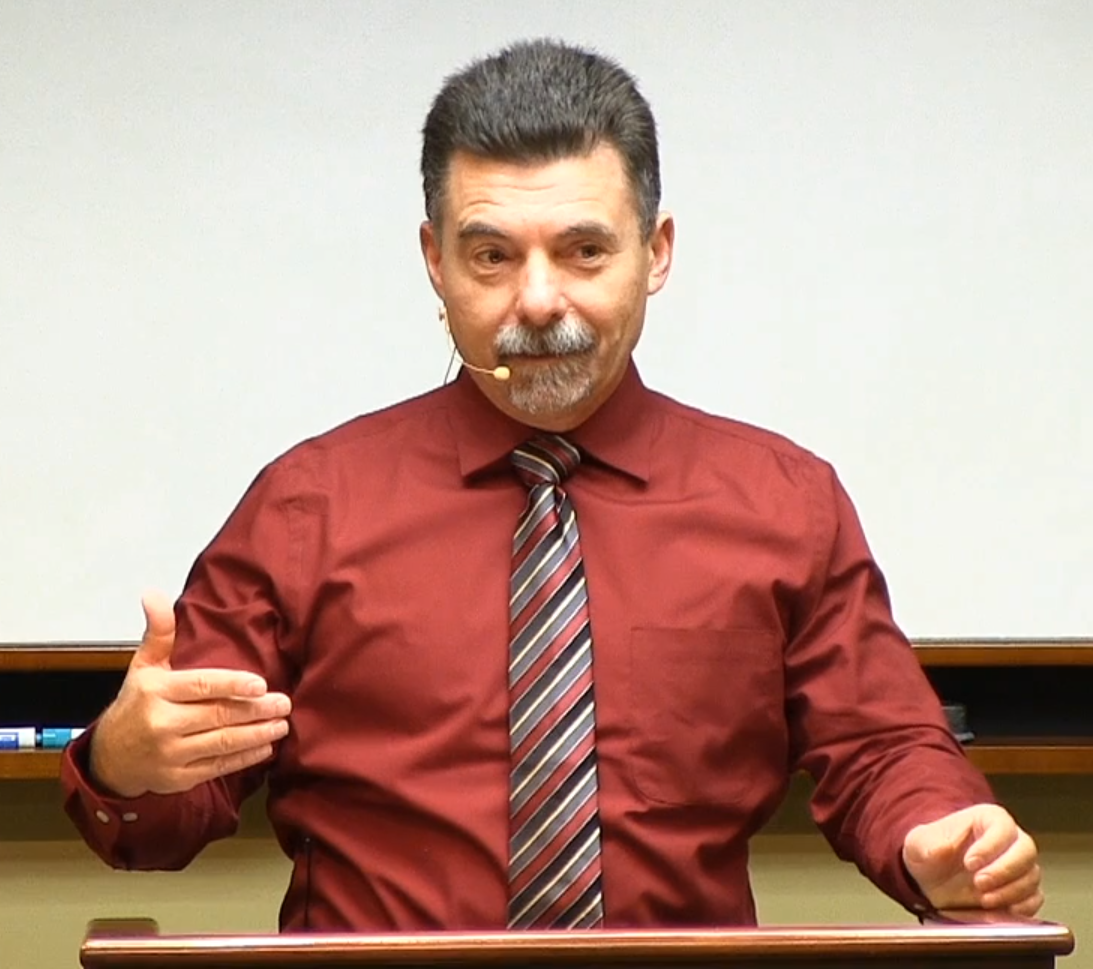
Dr. Richard Barcellos is associate professor of New Testament Studies. He received a B.S. from California State University, Fresno, an M.Div. from The Master’s Seminary, and a Th.M. and Ph.D. from Whitefield Theological Seminary. Dr. Barcellos is pastor of Grace Reformed Baptist Church, Palmdale, CA. He is author of Trinity & Creation, The Covenant of Works, and Getting the Garden Right. He has contributed articles to various journals and is a member of ETS.
Courses taught for CBTS: New Testament Introduction, Biblical Hermeneutics, Biblical Theology I, Biblical Theology II.
We use cookies on our website to give you the most relevant experience by remembering your preferences and repeat visits.
By clicking “Accept”, you consent to the use of ALL the cookies. Do not sell my personal information.
This website uses cookies to improve your experience while you navigate through the website. Out of these, the cookies that are categorized as necessary are stored on your browser as they are essential for the working of basic functionalities of the website. We also use third-party cookies that help us analyze and understand how you use this website. These cookies will be stored in your browser only with your consent. You also have the option to opt-out of these cookies. But opting out of some of these cookies may affect your browsing experience.
Necessary cookies are absolutely essential for the website to function properly. These cookies ensure basic functionalities and security features of the website, anonymously.
Cookie
Duration
Description
cookielawinfo-checkbox-analytics
11 months
This cookie is set by GDPR Cookie Consent plugin. The cookie is used to store the user consent for the cookies in the category "Analytics".
cookielawinfo-checkbox-functional
11 months
The cookie is set by GDPR cookie consent to record the user consent for the cookies in the category "Functional".
cookielawinfo-checkbox-necessary
11 months
This cookie is set by GDPR Cookie Consent plugin. The cookies is used to store the user consent for the cookies in the category "Necessary".
cookielawinfo-checkbox-others
11 months
This cookie is set by GDPR Cookie Consent plugin. The cookie is used to store the user consent for the cookies in the category "Other.
cookielawinfo-checkbox-performance
11 months
This cookie is set by GDPR Cookie Consent plugin. The cookie is used to store the user consent for the cookies in the category "Performance".
viewed_cookie_policy
11 months
The cookie is set by the GDPR Cookie Consent plugin and is used to store whether or not user has consented to the use of cookies. It does not store any personal data.
Functional cookies help to perform certain functionalities like sharing the content of the website on social media platforms, collect feedbacks, and other third-party features.
Performance cookies are used to understand and analyze the key performance indexes of the website which helps in delivering a better user experience for the visitors.
Analytical cookies are used to understand how visitors interact with the website. These cookies help provide information on metrics the number of visitors, bounce rate, traffic source, etc.
Advertisement cookies are used to provide visitors with relevant ads and marketing campaigns. These cookies track visitors across websites and collect information to provide customized ads.