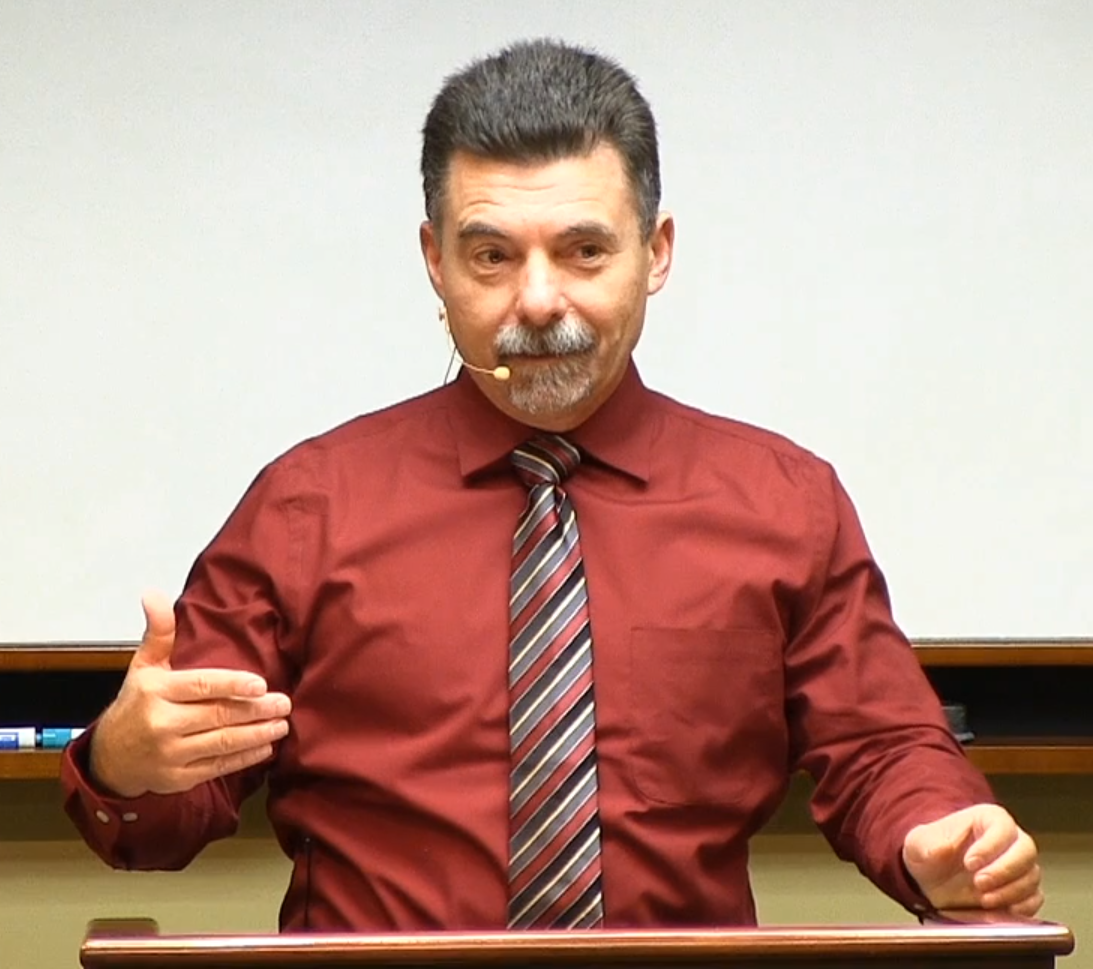
by Richard Barcellos | May 13, 2011 | Hermeneutics, Historical Theology
Four-fold method (quadriga): Of the many things the era of the Middle Ages is known for, one of its most important contributions to biblical interpretation came from John Cassian (circa 360-435). Cassian inherited the theory of the three senses of Scripture from his Patristic predecessors. Origen had developed the three-fold sense of Scripture – the literal (historical or somatic), the tropological (moral or pneumatic), and the allegorical (doctrinal or psychical). Cassian added a fourth – the mystical, analogical or ultimate/eschatological sense.[1] Augustine (circa 354-430) utilized a form of the four-fold method and his book On Christian Doctrine became “the volume which was to be the basic hermeneutical manual of the Middle Ages.”[2]
The medieval quadriga or fourfold pattern of meaning was comprised of the following: the literal or historical, the tropological or moral, the allegorical or doctrinal, and the anagogical or ultimate/eschatological.[3] Muller comments on the quadriga:
The carefully enunciated fourfold pattern of the Middle Ages was based upon the association, already made by Augustine and Gregory the Great, between the three Christian virtues, faith (fides…), hope (spes), and love (caritas…), and the meaning of the text of Scripture as it speaks to Christians. The church does not, then, disdain the sensus literalis or sensus historicus, the literal or historical meaning, but learns of it and uses it as the point of departure for searching out the relation of the text to the Christian virtues. When the literal or historical sense includes details concerning human conduct, it bears a lesson for caritas and issues forth in the sensus tropologicus, or tropological meaning. The trope, related to caritas, manifests the Christian agenda…, work to be done. Similarly, the literal sense may include details which point toward Christian faith: thus, the sensus allegoricus, or allegorical meaning, which has reference to fides and to the credenda… or things to be believed, by the church. Finally, the literal sense may point beyond the history it narrates to the future of the church. This is the sensus anagogicus, the anagogical sense, which relates to spes and teaches of speranda…, things to be hoped for. Although this fourfold pattern was subject to abuse and excess, the medieval doctors generally used it in such a way as to find all meanings of a text expressed literally somewhere in Scripture, particularly in the New Testament fulfillment of the Old Testament promises. In addition, the method did not ignore the literal meaning of the text, as sometimes alleged, but used it as the basis for each of the other meanings… The method, moreover, did not demand that all four meanings be found in each text. The quadriga was summed up in the following mnemonic couplet taught in the medieval schools: Litera gesta docet, quid credas allegoria;/moralis quid agas, quo tendas anagogia (“The letter teaches of deeds, allegory of what is believed;/morality of what is done, anagoge of things to come.”).[4]
Muller goes on to point out that the fourfold method, prior to the Reformation, began to be slowly put aside for a simpler method. What the Reformers and the post-Reformation Protestant (Lutheran and Reformed) orthodox both retained from the fourfold method was its “concern for the direct address of the text to the church…”[5] This is a concern shared with the New Testament itself, the Apostolic Fathers, the Patristics, and all Evangelicals today. This basic concern may be answered in diverse ways, but it follows all Christian interpreters through the ages.
[1] Bray, Biblical Interpretation, 133.
[2] Muller, Dictionary, 254.
[3] Cf. Muller, Dictionary, 254-55; Muller, PRRD, II:469ff.; and Steinmetz, “The Superiority of Pre-Critical Exegesis,” 30ff.
[4] Muller, Dictionary, 254-55.
[5] Muller, Dictionary, 255.
Dr. Richard Barcellos is associate professor of New Testament Studies. He received a B.S. from California State University, Fresno, an M.Div. from The Master’s Seminary, and a Th.M. and Ph.D. from Whitefield Theological Seminary. Dr. Barcellos is pastor of Grace Reformed Baptist Church, Palmdale, CA. He is author of Trinity & Creation, The Covenant of Works, and Getting the Garden Right. He has contributed articles to various journals and is a member of ETS.
Courses taught for CBTS: New Testament Introduction, Biblical Hermeneutics, Biblical Theology I, Biblical Theology II.
by Richard Barcellos | May 11, 2011 | Hermeneutics
The radio speaker that Sunday morning was a successful minister in one of the major Protestant denominations. His text was Acts 5. His topic was “power.” He spoke eloquently of the many ways in which most of us misuse our authority. Parents abuse their children by their negativism. Government leaders show insensitivity to the pains of those in need. We destroy by our criticism when we should build up with our praise.
As he approached the last part of his radio message, the preacher finally came to his text. In the narrative of Acts he found a dramatic example of the misuse of power. Ananias and Sapphira, weak Christians who had just given in to their temptations, were in need of reassurance and upbuilding. The apostle Peter, in an ugly display of arrogance, abused his authority and denounced their conduct with awful threats. Terror consumed each of them in turn, and they died on the spot under Peter’s unbearable invective.[1]
Hopefully all of us shook our heads in unbelief as the misuse of Acts 5 above was read. We can grant that all of us misuse our authority, but we cannot grant that the story of Ananias and Sapphira in Acts 5 was put there by Luke (and God!) for preachers to expound upon the ugly reality of heavy-handedness.
But how can we be sure that the preacher above got the meaning of the text wrong? The correct answer is that we can be sure he got the text wrong because the text in its context clearly does not indicate that its purpose is to highlight the abuse of authority. In other words, interpreting the text in its context will not bring us to the conclusion of the radio preacher.
Our answer to the question above brings us into the vast world of hermeneutics. Our answer assumed that Bible texts possess meaning. It assumed that the meaning of Bible texts can be known by readers far-removed from the world of the Bible. It assumed that the English language can convey what was originally written in Greek and so on and so forth. This misuse of Acts 5 highlights the importance of hermeneutics. Many other examples could be given to drive home the point – the study of and principles for the interpretation of the Bible are of vast importance.
[1] Moises Silva, “Has the Church Misread the Bible?” in Moises Silva, editor, Foundations of Contemporary Interpretation (Grand Rapids: Zondervan Publishing House, 1996), 17.
Dr. Richard Barcellos is associate professor of New Testament Studies. He received a B.S. from California State University, Fresno, an M.Div. from The Master’s Seminary, and a Th.M. and Ph.D. from Whitefield Theological Seminary. Dr. Barcellos is pastor of Grace Reformed Baptist Church, Palmdale, CA. He is author of Trinity & Creation, The Covenant of Works, and Getting the Garden Right. He has contributed articles to various journals and is a member of ETS.
Courses taught for CBTS: New Testament Introduction, Biblical Hermeneutics, Biblical Theology I, Biblical Theology II.
by Richard Barcellos | May 6, 2011 | Hermeneutics, Historical Theology
Introduction: Gerald Bray opens his discussion of Medieval interpretation as follows:
The medieval period of biblical interpretation is one of the most complex and difficult of all, and it has not received the attention it deserves from theologians or biblical scholars. Most of the work in this field has been done by medievalists, who cannot escape the all-pervasive role which the Bible played during those centuries. But medievalists have their own agenda, and it is not always possible for a theologian to gain ready access to their work. There is also the fact that centuries of training have made Protestant scholars particularly wary of the medieval period, which they have been inclined to think of as an age of darkness. As most modern biblical scholars have been Protestants, this prejudice has contributed to the relative neglect of medieval exegesis.[1]
Not only do Bray’s statements seem to reflect reality, they are peculiarly true of me. I have been trained to think of the Middle Ages as the dark era of Christian interpretation and, thus, unhelpful and unnecessary for anything good. Certainly the rise of Islam during the eighth century had its ill effects upon Western culture at large and Christian interpretive methods in particular. The old Mediterranean culture broke up and neither Greek nor Latin were universal languages. During the Middle Ages Western Christians maintained Latin while those in the East did not. Some time in the ninth century Charlemagne (Holy Roman Emperor, crowned as such by Pope Leo III) “sponsored a revival of learning, which officially recognized that the ancient world had disappeared. Latin now had to be learned as a foreign tongue, even in Italy…”[2] This and other factors, such as illiteracy and a distinctly monolithic, “Christian” culture made the common Christian entirely dependant upon professional scholars who taught the clergy and, especially, the papacy (“Church”) as the final word on interpreting the Bible.
The Middle Ages should not be viewed as a single-minded, monolithic era culturally, philosophically, or theologically. There were phases of development occurring at different places and at different times.[3] Due to this reality, various men contributed various things at different times which ended up creating the Late Middle Ages, which is what most view as the Middle Ages come to maturity and against which the Renaissance and Reformation protested.
[1] Bray, Biblical Interpretation, 129.
[2] Bray, Biblical Interpretation, 129.
[3] Cf. Bray’s four phases of periodization in Bray, Biblical Interpretation, 131-33.
Dr. Richard Barcellos is associate professor of New Testament Studies. He received a B.S. from California State University, Fresno, an M.Div. from The Master’s Seminary, and a Th.M. and Ph.D. from Whitefield Theological Seminary. Dr. Barcellos is pastor of Grace Reformed Baptist Church, Palmdale, CA. He is author of Trinity & Creation, The Covenant of Works, and Getting the Garden Right. He has contributed articles to various journals and is a member of ETS.
Courses taught for CBTS: New Testament Introduction, Biblical Hermeneutics, Biblical Theology I, Biblical Theology II.
by Richard Barcellos | Apr 29, 2011 | Hermeneutics, Historical Theology
Antioch: Silva says, “We would not be exaggerating greatly if we described the progress of biblical exegesis as the gradual abandonment of allegorical interpretation.”[1] The Antiochene school arose as “a fairly systematic program aimed at debunking the more objectionable features of Origen’s approach.”[2] It is obvious from subsequent history that it failed at this task.
A school at Antioch was established toward the end of the third century by Lucian (circa A.D. 240-312). It became the rival school to Alexandria. Antioch’s most respected pupils were Theodore of Mopsuestia (circa A.D. 350-428) and John Chrysostom (circa A.D. 354-407). As noted above, the Antiochene school utilized aspects of literalism, typology, and allegory, though certainly not like the Alexandrians. Where did the Antiochenes get their brand of literalism from? Dockery suggests, “It is likely that wherever the synagogue’s influence was felt, the church’s interpretation of Scripture had a tendency toward literalism. Certainly this was the case at Antioch.”[3] Granting Dockery’s claim, we see once again how contemporary factors contribute to hermeneutical practice.
Antioch’s unique contribution to the history of Christian hermeneutics is stated clearly and succinctly by Dockery, when he says, “the distinctive feature in the Antiochene hermeneutical method was theoria.”[4] Theoria was a complex method of interpretation. It is, therefore, simplistic to label Antioch as the literal school. As we are learning, things aren’t always as simple and clear-cut as we might think. Theoria involved aspects of what we would call literalism, a modified form of allegory, and typology.[5] Also, between individual authors there were various expressions of these hermeneutical methods.
If we asked the question: What is the Antiochene school’s over-arching hermeneutical contribution to the history of Christian interpretation? The expanded answer would be the further development of a typological interpretation of the Old Testament in the light of the first advent of Christ and the New Testament Scriptures. Dockery says, “Perhaps, as Rowan A. Greer has suggested, it is better to think of typological exegesis as the normative method of Antiochene exegesis.”[6] Dockery continues:
Typology, rightly conceived, asserts that since Christ is the culmination of the line of Abraham and of David and is the fulfillment of the hope of Israel, the Old Testament description of Israel’s history, institutions, worship, and prophetic message often anticipate the life and work of Christ. Chrysostom and the Antiochene school distinguished allegorical interpretation from typological interpretation in two primary ways. Typological interpretation attempted to seek out patterns in the Old Testament to which Christ corresponded, while allegorical exegesis depended on accidental similarity of language between two passages. Second, typological interpretation depended on a historical interpretation of the text. The passage, according to the Antiochenes, had only one meaning, the literal (extended by theoria[7]), and not two as suggested by the allegorists. In the typological approach, the things narrated by the text had to be placed in relationship to things which were not in the text, but which were still to come.[8]
The Antiochene theory of typology was fueled by their view of the fulfillment which took place at the first advent of Christ and how Christ and the Apostles interpreted the Old Testament.
The major difference between Alexandria and Antioch, in terms of exegetical conclusions, occurred while interpreting the Old Testament. Their understandings of the Gospels and the rest of the New Testament was very similar. Once again, the major issue was the interpretation of the Old Testament and its relation to the New. Alexandria utilized allegory of the Neoplatonic variety; Antioch utilized typology of the New Testament variety.
Finally, as with the Alexandrians, the Antiochenes adhered to the rule of faith which kept them within orthodox bounds on the essential doctrines of the Christian faith.
[1] Silva, “Has the Church Misread the Bible?,” 47.
[2] Silva, “Has the Church Misread the Bible?,” 47.
[3] Dockery, Biblical Interpretation, 105. Dockery references Rowan A. Greer, Theodore of Mopsuestia: Exegete and Theologian (London: Faith, 1961), 86-88.
[4] Dockery, Biblical Interpretation, 107.
[5] See the discussion in Hall, Reading Scripture, 160-63.
[6] Dockery, Biblical Interpretation, 110.
[7] We will be confronted with this concept – literal-extended meaning – in subsequent discussion.
[8] Dockery, Biblical Interpretation, 118-19.
Dr. Richard Barcellos is associate professor of New Testament Studies. He received a B.S. from California State University, Fresno, an M.Div. from The Master’s Seminary, and a Th.M. and Ph.D. from Whitefield Theological Seminary. Dr. Barcellos is pastor of Grace Reformed Baptist Church, Palmdale, CA. He is author of Trinity & Creation, The Covenant of Works, and Getting the Garden Right. He has contributed articles to various journals and is a member of ETS.
Courses taught for CBTS: New Testament Introduction, Biblical Hermeneutics, Biblical Theology I, Biblical Theology II.
by Richard Barcellos | Apr 25, 2011 | Hermeneutics, Historical Theology
Introduction: Our study of the Patristics has set the stage for a brief discussion on the schools of Alexandria and Antioch. In one sense, they are a natural development of things already in place. In fact, Bradley Nassif claims, “Origen did not invent his interpretive techniques but borrowed them from a complex hermeneutical environment [Christian and non-Christian] that was already present in his day.”[1] Both Christian allegory and Christian typology pre-date these schools of thought. These two schools have sometimes been pitted against each other. Silva says:
This description, however, leaves out a series of interesting and suggestive bits of information. It is simplictic, for example, to view Origen and the Antiochenes as representing two opposite approaches more or less exclusive of each other. As we shall see, Origen used and defended literal interpretation on a number of occasions. Moreover, certain exegetical features that we would quickly dismiss as in some sense “allegorical” were consciously adopted as legitimate by the Antiochene exegetes.[2]
Silva goes on to give two examples of allegory by Antiochenes – Chrysostom and Theodoret. Chrysostom interprets Jesus’ making wine from water as “changing wills that are weak and inconsistent.” Theodoret takes the dew from heaven and the fatness of the earth of Genesis 27:39 this way: “…according to the higher interpretation they depict the divinity of the Lord Christ by means of the expression dew; and by the fatness of the earth, his humanity received from us.”[3]
More recent studies have uncovered less discontinuity in their hermeneutical methods. What used to be seen as an antithetical pendulum is now seen as a sort of mini-pendulum with more continuity than previously thought. Whereas the Alexandrians were seen as primarily allegorists and the Antiochians were seen as primarily literalists further study has shown that the two schools, though certainly not one and the same, have more in common than a first glance approach might conclude. Both schools developed in similar historical, theological, and philosophical contexts and were, as are we, affected by those contexts. As stated above, both Christian allegory (Alexandria) and Christian typology (Antioch) had the same goal – the Christian use of the Old Testament.
[1] Bradley Nassif, “Origen,” in DMBI, 793.
[2] Silva, “Has the Church Misread the Bible?,” 47.Cf. Christopher A. Hall, Reading the Scripture with the Church Fathers (Downers Grove, IL: InterVarsity Press, 1998), 157.
[3] Silva, “Has the Church Misread the Bible?,” 47.
Dr. Richard Barcellos is associate professor of New Testament Studies. He received a B.S. from California State University, Fresno, an M.Div. from The Master’s Seminary, and a Th.M. and Ph.D. from Whitefield Theological Seminary. Dr. Barcellos is pastor of Grace Reformed Baptist Church, Palmdale, CA. He is author of Trinity & Creation, The Covenant of Works, and Getting the Garden Right. He has contributed articles to various journals and is a member of ETS.
Courses taught for CBTS: New Testament Introduction, Biblical Hermeneutics, Biblical Theology I, Biblical Theology II.