
Brief survey of the history of hermeneutics – 8. Antioch
Antioch: Silva says, “We would not be exaggerating greatly if we described the progress of biblical exegesis as the gradual abandonment of allegorical interpretation.”[1] The Antiochene school arose as “a fairly systematic program aimed at debunking the more objectionable features of Origen’s approach.”[2] It is obvious from subsequent history that it failed at this task.
A school at Antioch was established toward the end of the third century by Lucian (circa A.D. 240-312). It became the rival school to Alexandria. Antioch’s most respected pupils were Theodore of Mopsuestia (circa A.D. 350-428) and John Chrysostom (circa A.D. 354-407). As noted above, the Antiochene school utilized aspects of literalism, typology, and allegory, though certainly not like the Alexandrians. Where did the Antiochenes get their brand of literalism from? Dockery suggests, “It is likely that wherever the synagogue’s influence was felt, the church’s interpretation of Scripture had a tendency toward literalism. Certainly this was the case at Antioch.”[3] Granting Dockery’s claim, we see once again how contemporary factors contribute to hermeneutical practice.
Antioch’s unique contribution to the history of Christian hermeneutics is stated clearly and succinctly by Dockery, when he says, “the distinctive feature in the Antiochene hermeneutical method was theoria.”[4] Theoria was a complex method of interpretation. It is, therefore, simplistic to label Antioch as the literal school. As we are learning, things aren’t always as simple and clear-cut as we might think. Theoria involved aspects of what we would call literalism, a modified form of allegory, and typology.[5] Also, between individual authors there were various expressions of these hermeneutical methods.
If we asked the question: What is the Antiochene school’s over-arching hermeneutical contribution to the history of Christian interpretation? The expanded answer would be the further development of a typological interpretation of the Old Testament in the light of the first advent of Christ and the New Testament Scriptures. Dockery says, “Perhaps, as Rowan A. Greer has suggested, it is better to think of typological exegesis as the normative method of Antiochene exegesis.”[6] Dockery continues:
Typology, rightly conceived, asserts that since Christ is the culmination of the line of Abraham and of David and is the fulfillment of the hope of Israel, the Old Testament description of Israel’s history, institutions, worship, and prophetic message often anticipate the life and work of Christ. Chrysostom and the Antiochene school distinguished allegorical interpretation from typological interpretation in two primary ways. Typological interpretation attempted to seek out patterns in the Old Testament to which Christ corresponded, while allegorical exegesis depended on accidental similarity of language between two passages. Second, typological interpretation depended on a historical interpretation of the text. The passage, according to the Antiochenes, had only one meaning, the literal (extended by theoria[7]), and not two as suggested by the allegorists. In the typological approach, the things narrated by the text had to be placed in relationship to things which were not in the text, but which were still to come.[8]
The Antiochene theory of typology was fueled by their view of the fulfillment which took place at the first advent of Christ and how Christ and the Apostles interpreted the Old Testament.
The major difference between Alexandria and Antioch, in terms of exegetical conclusions, occurred while interpreting the Old Testament. Their understandings of the Gospels and the rest of the New Testament was very similar. Once again, the major issue was the interpretation of the Old Testament and its relation to the New. Alexandria utilized allegory of the Neoplatonic variety; Antioch utilized typology of the New Testament variety.
Finally, as with the Alexandrians, the Antiochenes adhered to the rule of faith which kept them within orthodox bounds on the essential doctrines of the Christian faith.
[1] Silva, “Has the Church Misread the Bible?,” 47.
[2] Silva, “Has the Church Misread the Bible?,” 47.
[3] Dockery, Biblical Interpretation, 105. Dockery references Rowan A. Greer, Theodore of Mopsuestia: Exegete and Theologian (London: Faith, 1961), 86-88.
[4] Dockery, Biblical Interpretation, 107.
[5] See the discussion in Hall, Reading Scripture, 160-63.
[6] Dockery, Biblical Interpretation, 110.
[7] We will be confronted with this concept – literal-extended meaning – in subsequent discussion.
[8] Dockery, Biblical Interpretation, 118-19.
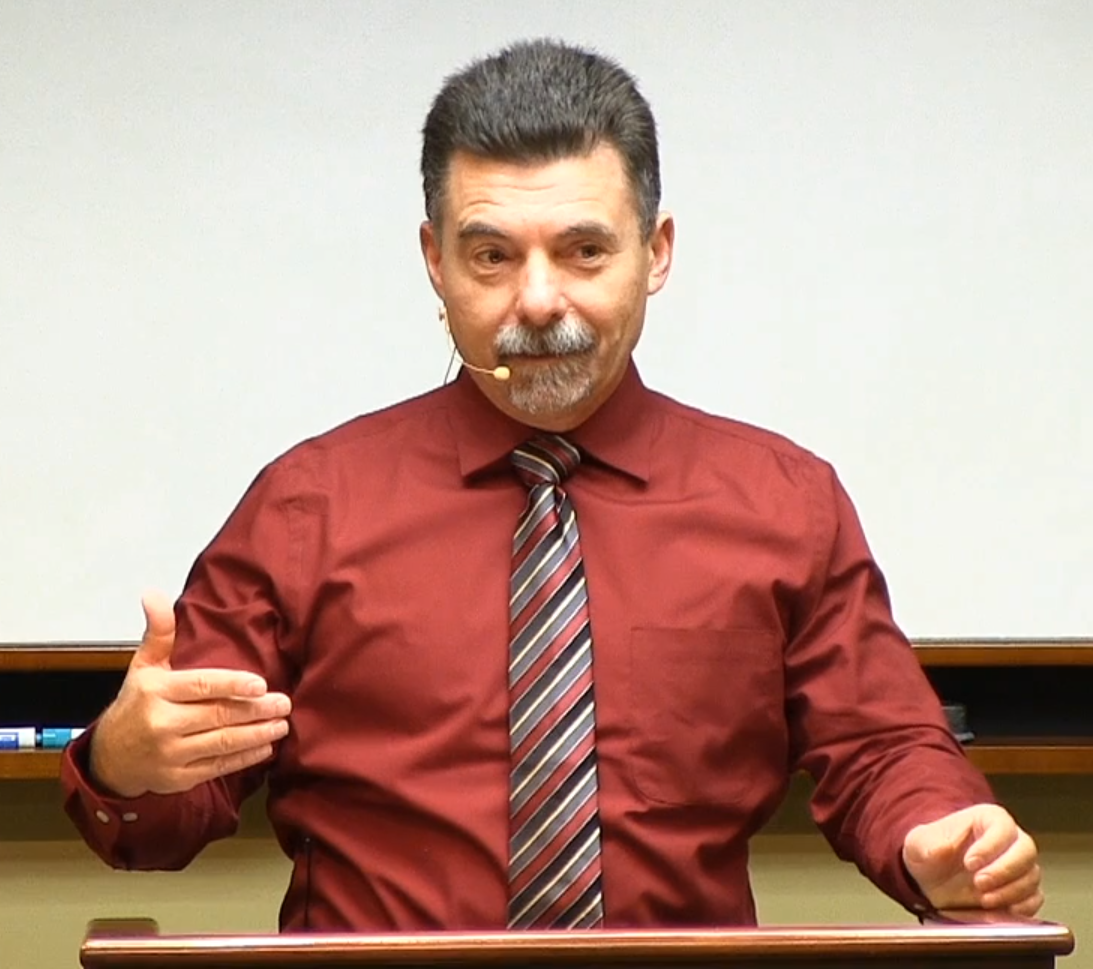
Dr. Richard Barcellos is associate professor of New Testament Studies. He received a B.S. from California State University, Fresno, an M.Div. from The Master’s Seminary, and a Th.M. and Ph.D. from Whitefield Theological Seminary. Dr. Barcellos is pastor of Grace Reformed Baptist Church, Palmdale, CA. He is author of Trinity & Creation, The Covenant of Works, and Getting the Garden Right. He has contributed articles to various journals and is a member of ETS.
Courses taught for CBTS: New Testament Introduction, Biblical Hermeneutics, Biblical Theology I, Biblical Theology II.