Introduction
I am addressing this subject because I am convinced that the lack of a biblical approach is not only responsible for many common errors that have plagued the study of church history, but is also not well understood by many influenced by the retrieval movement.
Now, in constructing a biblical approach to the study of church history, we will deal with five perspectives with which the study of the history of the church must be approached. You may think of these perspectives as constructing a runway from which the study of church history must lift off. In order to construct this runway, we must make five passes with the heavy equipment of God’s Word down the course of the runway.
The first perspective which forms a biblical approach to church history is this:
I. Church history reflects, enshrines, or contains the supernatural activity of Christ through His Spirit.
Only one text is needed to establish this first perspective on the study of church history. It is Matthew 28:18-20. Matthew 28:18‑20 must be regarded as a classic text on the subject of the relation of Christ and His church during this age. The focal point of this relationship is stated in the promise of v. 20a, “and lo, I am with you always.” Please notice four things about this promise.
A. The Recipient of the Promise
This promise is given to the universal church of Jesus Christ. Confirmation of this comes from the fact that the Great Commission, as stated here and elsewhere in the New Testament, was given directly to the apostolate, that body of men which formed the foundation of the church (Matt. 28:16; Luke 24:46-49 with 33-36; Acts 1:1-8). It is the church, then, as established on the foundation of the apostles and prophets (Eph. 2:20) that is the recipient of this promise of Christ.
B. The Duration of the Promise
Notice the duration of this promise. Most important for our purposes is the fact that, though the commission is given directly to the apostles of Christ, it cannot be restricted to the apostolic period of church history. The promise of Christ’s powerful presence with His church is clearly stated in v. 20a. That this promise remains in effect after the apostolic period and throughout the history of the church is clear from three considerations.
First, it follows the statement of the universal scope of the church’s commission contained in the phrase, “all the nations”. This commission was not exhaustively fulfilled by the apostles. Since the commission remains for the post-apostolic church to complete, the promise given with a view to its fulfillment must also remain in effect.
Second, the promise is modified by the phrase “all the days” or “always” as it is translated in the NASB. This naturally suggests a period not restricted to the lifetimes of the apostles.
Third, the phrase “all the days” and the promise it modifies is defined by the concluding words of v. 20 and the Gospel of Matthew, “even to the consummation of the age.” This phrase clearly refers to the time when Christ bodily returns in glory to usher in the age to come. If any further proof of the meaning of the consummation of the age within the context of the Gospel of Matthew is necessary, the four other occurrences of this phrase in this gospel will put the matter beyond doubt (Matt. 13:39, 40, 49; 24:3).
The context of this promise assures us, then, that Christ will be specially and graciously present with His people throughout the church or gospel age. Christ is not absent from His people during the inter-adventual period flanked by His first and second comings.
C. The Bearing of This Promise
Notice the bearing of this promise. This promise of the special and gracious presence of Christ comes in the context of the activities assumed and commanded in the Great Commission. It is for the making, the baptizing, and (note especially) the teaching of disciples that Christ promises His special presence. What a wonderful encouragement the church here possesses in the fulfillment of Christ’s great commission!
D. The Authority of this Promise
Notice the authority of this promise. This promise comes within the framework of v. 18. No earthly obstacles or decrees can override or frustrate this purpose of the King of Kings and Lord of Lords. What an absolutely thrilling encouragement in the work of church-planting! But I am not here to speak to you about the work of church-planting, but about the study of church history and the development of doctrine. Thus, we must hasten on to a second perspective with which we must approach its study. Here it is.
II. The activity of Christ in church history has a progressive character.
When Christ promises to be present with His church all the days, we are not to think that He will start from scratch on each of those days. There is a process, a growth, a building involved which spans the entire gospel age. In fact, it was the idea of building which the Great Carpenter Himself used in His most famous statement of the progressive character of His activity in church history. The passage which I am thinking of is, of course, Matthew 16:17-19.
17 And Jesus said to him, “Blessed are you, Simon Barjona, because flesh and blood did not reveal this to you, but My Father who is in heaven. 18 “I also say to you that you are Peter, and upon this rock I will build My church; and the gates of Hades will not overpower it. 19 “I will give you the keys of the kingdom of heaven; and whatever you bind on earth shall have been bound in heaven, and whatever you loose on earth shall have been loosed in heaven.”
No examination of the biblical proof for the relation of Christ to His church during this age would be complete without prominently expounding this text. It is the first mention of the church in the New Testament and one of two recorded uses of this term by Christ during his earthly life.
The crucial idea for our purposes in this text is that the building of Christ’s church spoken of here is age-long and, thus, eschatological in character. This promise, that is to say, very directly suggests the thought that Christ will build His church through the gospel age and that this process of building will only be completed at His return and only consummated in the eschatological kingdom.
Still, the question may be raised: Was it Christ’s original intention in this assertion to refer to the building of the church as an age-long process completed only at the end of the gospel age? Could He have been, perhaps, merely referring to a building completed during his life or that of His apostles? Ephesians 2:20, a Pauline interpretive comment on Matthew 16:18, obliterates these doubts by confirming three things about this promise.
First, the church mentioned is the universal church. This is clearly the force and implication of the entire context of this statement in Ephesians (1:22, 23; 5:25-27). If it is the universal church to which Jesus was referring, then the implication would appear to be that the building process continues throughout this age.
Second, the Peter‑foundation mentioned in Matt. 16:18 refers, according to Paul, to the foundation of the universal church laid in the apostles and prophets. According to the Apostle Paul, Peter is the representative of the apostolate. The apostolate, as the authentic and authoritative bearers and messengers of the truth about Himself, forms the foundation of Christ’s church. This naturally suggests that the generation of the apostles merely laid the foundation of the church and that the building process was far from complete.
Third, Paul views the building process as presently proceeding. Note the present tenses of Ephesians 2:20. The activities in which Paul regards this building process as consisting are not activities which in any way suggest restricting it to the initial period of the gospel age.
The building process is, then, age‑long and eschatological in nature. Thus, Matthew 16:18 as interpreted by Ephesians 2:20 clearly substantiates the ideas of the presence and progressive character of the activity of Christ in His church.
III. This activity of Christ in church history, with its progressive character, has a doctrinal dimension.
Christ’s progressive activity in the history of the church ensures that there will be what may be called doctrinal development. This is important because I intend to argue that the church of Christ has had a growing ability throughout the ages to understand and articulate the teaching of the Bible. I intend to argue that Baptists today owe a great debt to those whom God used to bring the church to new levels of understanding in the history of the church. I intend to argue that we have a great heritage of truth which has been bequeathed to us by the Holy Spirit through such men. Finally, I intend to argue that not all, nor even perhaps the most important of those men to whom we owe such a debt, were Baptists.
Thus, I must establish that church history is characterized by a progressive growth in the church’s understanding and speaking of the truth of the Bible. Let me, therefore, set out before you an argument which I believe indisputably confirms that there has been a progressive, doctrinal development in the history of the church. I will unfold this argument under three sub-headings:
A. The Argument Logically Stated
Let me put my argument this way. If the historical life of the church reflects the gracious activity of Christ, if this activity of Christ has a progressive character, then since a very important part of the life of the church is its doctrinal life, we may conclude that its doctrinal life will manifest a progressive character. This is just another way of saying that there will be doctrinal development in the history of the church.
B. The Argument Simply Illustrated
I acknowledge that the logical steps involved in that argument may strain rusty, rational faculties. Let me, therefore, illustrate what I am saying. Take your little five-year-old son. You know from experience that through God’s providential activity he will turn into a man by way of a progressive development or organic process. This process of growth will affect every major facet of the life of your little boy. He will grow up physically, emotionally, and intellectually. Thus, you know that instead of adding two plus three in his kindergarten workbooks, he will in ten years be studying algebra, geometry, and calculus. Why? Because the intellectual aspect of your son’s life is an integral part of his existence.
The same is true of the church. It also must grow up. Since its doctrinal or intellectual aspect is a crucial dimension of its life, we must conclude that there will be intellectual or doctrinal growth in the church.
C. The Argument Biblically Confirmed
This argument for the doctrinal development of the church is implied by each of the two passages we have so far studied. In Matt. 28:20, the promise of Christ’s gracious and powerful presence is stated with distinct reference to the teaching or doctrinal ministry of the church. Verse 20 reads, “Teaching them to observe all that I commanded you; and lo, I am with you always, even to the end of the age.” Since we know now that the activity of Christ here promised is progressive in character, it follows rather clearly that the church will have a growing ability to understand and teach all that Christ commanded.
Similarly, in Matthew 16:17-19, where Christ’s building of His church is promised, there is a focus on truth and doctrine. The church is built on the foundation of the apostolic testimony about Christ. The church is built on the rock of the truth about Jesus Christ as it was infallibly proclaimed by Peter and the other apostles. The church, therefore, has a doctrinal foundation, and we cannot eliminate doctrine from the building process of which Jesus speaks.
Many of Christ’s parables clearly confirm the general idea of organic growth as a feature of the church’s history in the gospel age. Two of the most explicit parables in this regard are found in Mark 4:26-32. Both parables emphasize the idea of organic growth in the kingdom of God. (Note especially vv. 27, 28, and 32.)
26 And He was saying, “The kingdom of God is like a man who casts seed upon the soil; 27 and he goes to bed at night and gets up by day, and the seed sprouts and grows– how, he himself does not know. 28 “The soil produces crops by itself; first the blade, then the head, then the mature grain in the head. 29 “But when the crop permits, he immediately puts in the sickle, because the harvest has come.” 30 And He said, “How shall we picture the kingdom of God, or by what parable shall we present it? 31 “It is like a mustard seed, which, when sown upon the soil, though it is smaller than all the seeds that are upon the soil, 32 yet when it is sown, it grows up and becomes larger than all the garden plants and forms large branches; so that THE BIRDS OF THE AIR can NEST UNDER ITS SHADE.”
Perhaps the clearest passage which confirms the thought of the intellectual maturation or doctrinal development of the church is to be found in Ephesians 4:11-16.[1]
11 And He gave some as apostles, and some as prophets, and some as evangelists, and some as pastors and teachers, 12 for the equipping of the saints for the work of service, to the building up of the body of Christ; 13 until we all attain to the unity of the faith, and of the knowledge of the Son of God, to a mature man, to the measure of the stature which belongs to the fullness of Christ. 14 As a result, we are no longer to be children, tossed here and there by waves and carried about by every wind of doctrine, by the trickery of men, by craftiness in deceitful scheming; 15 but speaking the truth in love, we are to grow up in all aspects into Him who is the head, even Christ, 16 from whom the whole body, being fitted and held together by what every joint supplies, according to the proper working of each individual part, causes the growth of the body for the building up of itself in love.
This passage is commonly given an individual or local church application. While such an application is not invalid, there is the necessity of seeing in it an age‑long eschatological process. Paul is concerned primarily with the visible, universal church in Ephesians, not the local church or what is sometimes called the “invisible church.” In Ephesians 2 he shows that the church is the New Israel. The New Israel is neither local nor invisible. In Ephesians 3 he shows that the church is the mystery‑body of Christ composed of both Jews and Gentiles in the age of fulfillment. In Ephesians 4:11 he states that Apostles, etc. are given as gifts to this church. It cannot, therefore, be merely a local church, and it is certainly not the “invisible church” that is here in view. Paul is thinking of the eschatological goal and consummation of the church in Ephesians. Note Ephesians 5:25‑27!
25 Husbands, love your wives, just as Christ also loved the church and gave Himself up for her, 26 so that He might sanctify her, having cleansed her by the washing of water with the word, 27 that He might present to Himself the church in all her glory, having no spot or wrinkle or any such thing; but that she would be holy and blameless.
When Ephesians 4:11-16 is read in light of this context, the conclusion must be that there is an age‑long maturing process in the visible, universal church. Very important for our purposes is the fact that, according to vv. 12-15, this goal has ethical, doctrinal, and quantitative dimensions. When maturation in the knowledge of Christ is explicitly predicated of the universal church, the idea of a doctrinal development in the history of the church is unavoidable.
Louis Berkhof has grasped the biblical perspective here. Let me conclude my exposition of the fact that there is doctrinal development in church history by quoting him.
We shall have to proceed on the assumption that the Church, despite the melancholy aberrations that characterized her search for the truth and often led her into the ways of error, yet gradually advanced in her apprehension and formulation of the truth. We shall have to assume that even such a tremendous religious upheaval as the Reformation did not constitute a complete break with the doctrinal development of the past. While many errors were exposed and corrected, the Reformers sought support for their views in the early Church Fathers and did not even hesitate to adopt some of the views that were developed during the Middle Ages. There was continuity of thought even here.[2]
IV. Church history will be troubled and invaded by an antichristian power; and thus it will be characterized by a mixture of spiritual good with spiritual evil; and this characteristic will be present in each dimension of its life including its doctrinal development.
What I am saying here, in other words, is that there will be both good and bad doctrinal developments in the visible church. Though Christ is active in the church, this does not mean that nothing but good occurs in any facet of church history.
There is a great deal of data in the New Testament which directly confirms this idea. Corinth was a true church and yet contained a large admixture of error and sin and wickedness when Paul wrote his epistles to them (1 Cor. 15:1f.; 2 Cor. 11:12f.). A Diotrephes tyrannized another true church of Christ and its genuine Christian members (3 John 9). Paul refers to a “mystery of lawlessness already at work” and implies that it will work during this age until “that lawless one will be revealed” (2 Thes. 2:7, 8). This “mystery of lawlessness” at least in its ultimate fruition appears to bear a religious character and has doctrinal results in the “deception of wickedness” and “deluding influence” (2 Thes. 2:10-11). The “man of lawlessness” will take “his seat in the temple of God” (2 Thes. 2:3, 4). However this difficult statement is to be interpreted, it seems to imply that “the mystery of lawlessness” influences the professing church of Christ or has a pseudo-Christian character. This is further confirmed by the statements of John, which identify the pseudo-Christian gnostic teachers as antichrists (1 John 2:18, 19; 4:3; 2 John 7).
I suspect, however, that many of your minds have gone directly to a passage of Scripture which so far I have deliberately skipped over. You may be saying to yourself, Isn’t this exactly what Christ was teaching in the parables of Matthew 13 and especially the parable of the tares (Matt. 13:24-30)? It would be easy to make a direct application of this passage to the question at hand and assert that there will be an organic increase and progression of evil as well as righteousness in church history.
The problem is that the field in the parable of the tares is not the church. It is the world (vv. 37-38). It is a serious error to neglect the explicit identification of the field in Matt. 13:38 and assume that the field is the church. This assumption has frequently dominated Reformed thinking on this passage. It has been customary for such thinkers to argue that good and evil are to be tolerated in the church together on the basis of this passage. I have heard that there are even Reformed Baptists who have allowed themselves to be betrayed into such an interpretation and application of the parable of the tares. Do I need to tell you, brethren, that it is emphatically not to be our policy to allow both good and evil to grow together in the church? The church is not the explicit subject of these parables of the kingdom in Matthew 13.
This does not mean, however, that there are not implications for and applications to the church in these parables. They do imply the mixed character of the church and its history. While the church as a matter of policy is not to tolerate evil men and evil doctrines within its holy precincts, yet as a matter of fact evil men and evil doctrines will often be found within her. Since the visible church exists in a world in which both good and evil are growing together, we must not be surprised to find both tendencies within the professing and visible church of Christ. In this way, the parable of tares does indirectly apply to our subject.
V. Church History will reflect the transition from the teaching of the inspired Apostles of Christ found in the New Testament to the immature and defective understandings of the Early Church after the passing of the Apostles of Christ.
Essential to a right understanding of church history is the distinction between the Apostolic and Post-apostolic periods of church history. The church is built on the foundation of the apostles and prophets (Eph. 2:20). The teaching of the New Testament regarding the Apostles of Christ (and the Prophets who supplemented them) clearly teaches their divine inspiration. This is plainly implied in these statements of Peter in 2 Peter 3.
2 Peter 3:1 This is now, beloved, the second letter I am writing to you in which I am stirring up your sincere mind by way of reminder, 2 that you should remember the words spoken beforehand by the holy prophets and the commandment of the Lord and Savior spoken by your apostles.
2 Peter 3:15-16 … just as also our beloved brother Paul, according to the wisdom given him, wrote to you, 16 as also in all his letters, speaking in them of these things, in which are some things hard to understand, which the untaught and unstable distort, as they do also the rest of the Scriptures, to their own destruction.
All this means that there is a qualitative difference between the period occupied by the inspired Apostles of Christ and the period after their passing. The Apostles were inspired. The Apostolic Fathers (the first Christian writers and writings after them), for instance, were not. Neither were the Christians and Christian writings following them.
This fundamental reality must be taken into account in our approach to and philosophy of the “authority” of church tradition and even early church history. There is no reason to assume an “apostolic” or almost “apostolic” level of inspiration in the apostolic fathers or in early church tradition. Nor is there any reason to feel an implicit obligation to follow their example.
This distinction between the Apostles and their followers in church history prepares us for what we actually encounter in their writings dating to the second and the third and into the fourth centuries of church history. Leaving aside those writings obviously influenced by heretical movements like the so-called Gnostic Christianity, we still encounter a level of immaturity in these early writings. They have three characteristics which contribute to and define this immaturity.
- Genuine Devotion—We will see the evidence in the Apostolic Fathers and those who followed them for the deep respect for the Apostles in their writings and the recognition that they were on a higher and inspired plane. There is no wish to deviate from their teachings and a commitment to follow their teachings.
- Deficient Discernment—Despite their deep respect for and desire to follow the Apostles, it will be evident in the Apostolic Fathers and their successors that there was a lack of understanding (discernment) of their teachings. The embrace of their teachings was sincere but superficial.
- Unintentional Deviation—Despite their best intentions, their superficial understanding of the Apostles led to the inclusion of ideas in their writings that were contrary to the apostolic teaching. Some of these inclusions we may class as silly or fanciful—like the inclusion of the legend of the Phoenix—as if it were true—in 1 Clement. But other inclusions were not so innocuous. There are incipient statements which, when elaborated in later centuries, would lead to the superstitions and deviations of Roman Catholicism.
The detailed evidence for assertions such as these must await our survey of the Apostolic Fathers; the reception of the New Testament Canon; the Trinitarian controversy; and the Christological debates. Each of these studies manifests that doctrinal development would characterize the church just as we have seen forecast in the New Testament. The notion of doctrinal development taught in the New Testament with regard to church history actually suggests the “fall off” from the Apostolic level of teaching which we find in the earliest, post-apostolic church. I have called this “fall off” the “cliff phenomenon.” It reflects the transition from the Apostles to their Christian followers in the following centuries. Perhaps charts may assist with grasping what I am saying.
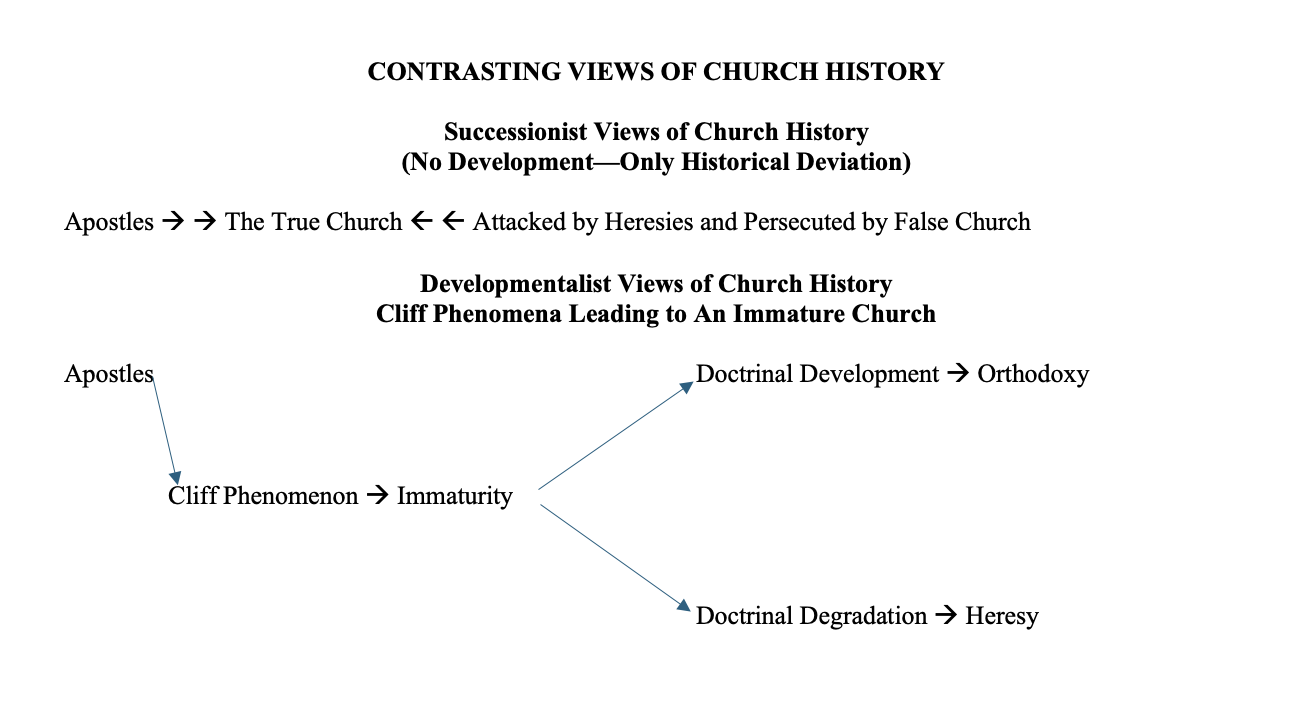
Major Lessons about the Study of Church History from a Biblical Approach:
1. The study of church history is justified and mandated by these perspectives.
Is Christ active in Church History? Then Psalm 111:2 and 105:1‑7 apply. In light of the biblical teaching that those who fear the Lord will delight in studying or seeking out His works, we must insist that the study of church history is not only justified; it is absolutely mandatory.
This is, of course, especially true for those who aspire to be teachers in Christ’s church. Any course of regular education for the ministry must involve a good acquaintance with the history of the church. One of the great deficiencies of much of theological education today is the brevity and superficiality of its treatment of historical theology.
But the study of church history is not only mandatory for ministerial students. I remind you that Psalm 111:2 says, “Great are the works of the Lord. They are studied by all who delight in them.” Individual Christians and local churches ought to consider how they are to seek out (instruct themselves in) the great works of Jehovah in church history.
2. One of the great benefits of the study of church history is the study of historical theology.
Historical theology is the study of the doctrinal development or the progress of dogma (as one man has called it) in the history of the church. The study of historical theology is one of the premier benefits in the study of church history.
Historical theology cannot, of course, in any sense be the source or authority for our doctrine. We have just spent a considerable amount of time proving that not all the developments associated with church history and historical theology will be positive and divine. Some will be negative and devilish.
But the fact that historical theology is not infallible does not mean that it is useless. A corollary of the activity of the risen Christ in Church History is that true doctrinal development may be found in the unfolding history of the church. Historical Theology, while on the one hand demanding examination under the spotlight of the Word of God, itself sheds light on the Word of God by enshrining the past fruits of the Spirit’s teaching ministry in the church. Berkhof well says:
… the development of the dogma of the Church moved along organic lines and was therefore in the main a continuous growth, in spite of the fact that the leaders of the Church in their endeavors to apprehend the truth often wandered into blind alleys, chasing will-o’-the-wisps and toying with foreign elements; and that even the Church itself, as a whole or in part, sometimes erred in its formulation of the truth.[3]
This makes clear why it is so wickedly self-sufficient for people to despise commentaries, creeds, confessions, and the teaching ministry of the church. People do this when they say, `I don’t need those old books. I have no creed but the Bible. I don’t need a pastor. All I need is my Bible and the Lord.’ Such men even clothe their wicked self-sufficiency in the doctrine of the priesthood of all believers.
The utter folly of such thinking! Do such men really think that the Spirit of the Lord will help them interpret their Bibles aright when they despise the work of that very Spirit in the church for the last 20 centuries? Do such men not realize the just penalty for such pride and arrogance? Those who will not learn from the errors of history are doomed to repeat them. Those who will not allow church history to be a faithful friend who warns against error and heresy are doomed to error and heresy themselves!
3. We must reject cynicism and adopt a believing attitude toward the study of historical theology.
Both neutral objectivity and cold cynicism are anti‑Christian attitudes to adopt towards the study of church history. Too often such attitudes have characterized professed church historians. The Christian must approach church history expecting to find reflected there the activity of the risen Lord. Its various movements, figures, or doctrines, therefore, cannot be the object of mere objective report or cynical criticism, but must be the object of evaluation in light of the revelation of Christ through the Word of God. Neutral objectivity and cold cynicism with reference to church history are the offspring of unbelieving attitudes. Let us not imitate the many church historians who reflect the attitudes of unbelief toward church history.
4. In the study of historical theology we must take into account the fact of maturation and development in the doctrinal understanding of the church.
The reality of the church’s doctrinal maturation and development has a number of significant applications to the study of church history.
First, when we speak of the maturation of the church’s doctrinal understanding, we are not asserting that the church adds anything in its history to that faith once for all delivered to the saints. The progress in the church’s dogmatic understanding is not a mechanical or external matter in which something is added to the content of Scripture. It is an organic matter in which the potential of the deposit of truth is gradually unfolded, especially through its conflict with the heresies spawned by the kingdom of darkness. There is no change in what was inspired in the Apostles and Prophets, but there is a gradual and growing change in the measure of illumination wrought in the church by the Holy Spirit. Think of the acorn and the oak tree. There is nothing in the oak tree which was not in the acorn, but there has been a mighty unfolding of the acorn’s potential.
Second, when we speak of the maturation of the church’s doctrinal understanding, this implies the comparative immaturity of the Early Church’s thought and theology. In its early history, the church was in its infancy. Thus, you must expect to find a lot of baby‑talk in early theologians. There are early theologians who defend original sin and then speak of the innocence of babies. The great Trinitarian theologian, Gregory of Nyssa, recognized the reality of doctrinal maturation when he said, “In regard to the doctrine of God, the different usage of terms is no longer so harmless, for what was a little thing then, is a little thing no longer.”[4] We must take into account the relative maturity of the church and of individuals in dealing with them.
Third, we must not expect to find doctrinal perfection and maturity in the early and medieval church. There is no ideal church hidden in the folds of early church history. You are not going to find Reformed Baptist Churches hidden in the Alps or Wales in the third century. Baptist successionism, or any other kind of successionism, in my opinion, is clearly insensitive to the New Testament teaching that organic growth, doctrinal development, and a mixed character will characterize the history of the church.
Fourth, we must expect to find great truth mixed with serious error, especially in the early stages of church history. There must be no idealizing or vilifying of any stream of church history. Thus, certain Baptists have idealized the Anabaptists and ignored the serious errors which they often embraced. We owe to Augustine a great debt for his articulation of the doctrine of irresistible grace in the Pelagian controversy, but Augustine applauded the persecution of the Donatists and provided a theological justification for it. Furthermore, Augustine regarded all sexual intercourse, even in marriage, as inevitably involving sinful lust, while Julian of Eclanum, one of his Pelagian opponents, had more biblical and wholesome views of sex and marriage. Let me reiterate the point: there must be no idealizing or vilifying of any stream of church history.
Fifth, there will be an organic increase and progression of evil as well as righteousness in this age. This thought directly relates to another question often raised by evangelical students as they study Early Church history. They ask, when did the Roman Catholic Church begin? Often the answers given fail to take into account the progressive and organic character of Church History. One could reply, one minute after the last Apostle died and probably before. One could also reply, at the Council of Trent in the 1540’s. Both answers would be correct (and so would several others), but both would also be very incomplete. Evil, as well as righteousness, proceeds by way of organic growth.
We must expect to find in the community created by the action of the Kingdom and, thus, in the history of the church, every kind of fish, good and bad. I repeat. We must not expect to find a perfect community, a perfect church hidden in the folds of church history, especially in early church history. This is a present, evil age (Gal. 1:4), and that only in the age to come will the Church be without spot or wrinkle or any such thing (Eph. 5:27). We must not view every feature of Church History like the little girl mentioned by the poet who,
When she was good
she was very, very good
but when she was bad
she was horrid.
Some people tend to see every movement, or person in Church History as “very, very good” or “horrid.” Especially in the early church, where both error and truth are only beginning to develop, this is inappropriate. There, especially, we must beware of overdoing a good guy/bad guy mentality. It is a false mentality which sees every division as a reflection of the true suffering church being persecuted by the apostate church. Things are just not that simple in a fallen world and an imperfectly redeemed church. We must avoid over‑simplification.
Conclusion
Let me conclude by citing the comments of several church historians who confirm the viewpoint I have been advocating in this essay. Listen to Schaff first:
If we compare these documents with the canonical Scriptures of the New Testament, it is evident at once that they fall far below in original force, depth, and fulness of spirit, and afford in this a strong indirect proof of the inspiration of the apostles. Yet they still shine with the evening red of the apostolic day, and breathe an enthusiasm of simple faith and fervent love and fidelity to the Lord which proved its power in suffering and martyrdom. They move in the element of living tradition and make reference oftener to the oral preaching of the apostles than to their writings…..For by the wise ordering of the Ruler of history, there is an impassable gulf between the inspiration of the apostles and the illumination of the succeeding age between the standard authority of holy Scripture and the derived validity of the teaching of the church. “The Bible” – to adopt an illustration of a distinguished writer – “is not like a city of modern Europe, which subsides through suburban gardens and groves and mansions into the open country around but like an Eastern city in the desert from which the traveler passes by a single step into a barren waste.” The very poverty of these post-apostolic writings renders homage to the inexhaustible richness of the apostolic books which like the person of Christ, are divine as well as human in their origin, character, and effect.[5]
Now hear Berkhof:
It is frequently remarked that in passing from the study of the New Testament to that of the Apostolic Fathers one is conscious of a tremendous change. There is not the same freshness and originality, depth and clearness. And this is no wonder, for it means the transition from truth given by infallible inspiration to truth reproduced by fallible pioneers. Their productions were bound to lean rather heavily on Scripture and to be of a primitive type, concerning itself with the first principles of faith rather than with the deeper truths of religion.[6]
This is strikingly stated by William Cunningham:
The striking contrast between the writings of the apostles and their immediate successors has been often remarked, and should never be overlooked or forgotten. Neander’s observation upon this subject is this: “A phenomenon singular in its kind, is the striking difference between the writings of the apostles and the writings of the Apostolic Fathers, who were so nearly their contemporaries. In other cases, transitions are wont to be gradual; but in this instance we observe a sudden change. There are here no gentle gradations, but all at once an abrupt transition from one style of language to another; a phenomenon which should lead us to acknowledge the fact of a special agency of the divine Spirit in the souls of the apostles.”[7]
Stay in touch with CBTSeminary
For more information about CBTS, go to CBTSeminary.org
Consider giving to CBTSeminary to help us train the next generation of gospel ministers.
Apply to CBTS today to be sharpened for a lifetime of faithful ministry.
Follow CBTS on our socials: X | Instagram | Facebook | YouTube
Sign up for our newsletter and receive monthly updates related to the Seminary.
[1]I am indebted to the expositions of Professor Greg Nichols’ lectures in Ecclesiology for certain of the insights in the following material.
[2]Louis Berkhof, The History of Christian Doctrines, (Baker Book House, Grand Rapids, 1978), p. 23.
[3]Berkhof, History of Doctrines, p. 22.
[4]Seeberg, A History of Doctrine, (Baker, Grand Rapids, 1978), p. 233.
[5]Schaff, vol. 2, pp. 285, 286.

Dr. Sam Waldron is the Academic Dean of CBTS and professor of Systematic Theology. He is also one of the pastors of Grace Reformed Baptist Church in Owensboro, KY. Dr. Waldron received a B.A. from Cornerstone University, an M.Div. from Trinity Ministerial Academy, a Th.M. from Grand Rapids Theological Seminary, and a Ph.D. from Southern Baptist Theological Seminary. From 1977 to 2001 he was a pastor of the Reformed Baptist Church of Grand Rapids, MI. Dr. Waldron is the author of numerous books including A Modern Exposition of the 1689 Baptist Confession of Faith, The End Times Made Simple, Baptist Roots in America, To Be Continued?, and MacArthur’s Millennial Manifesto: A Friendly Response.