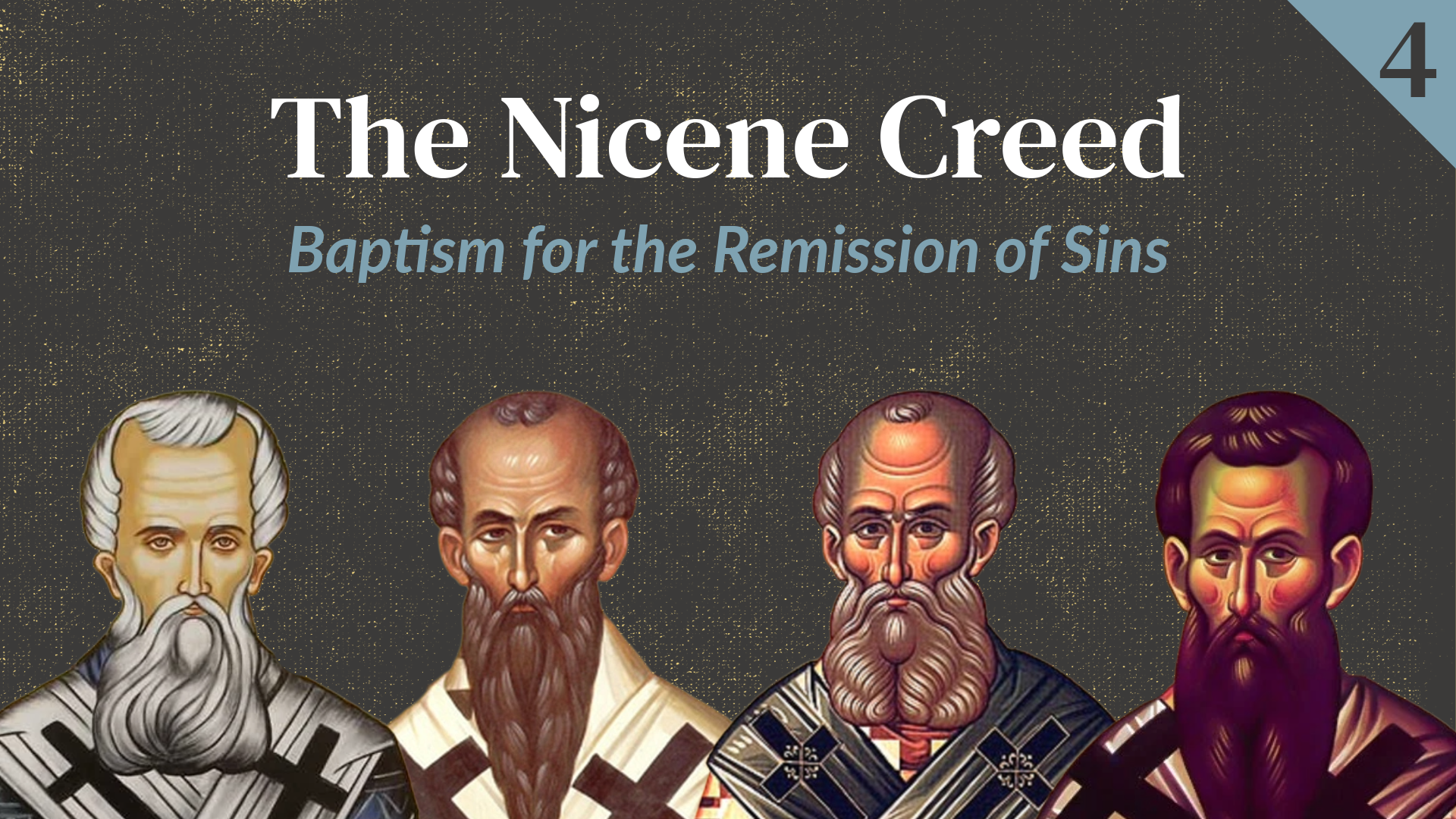
*Editor’s Note: The following is Part 4 in a five-part series on the Nicene Creed authored by Dr. Brandon Rhea. To read the other installments in this series, click on the following numbers: 1, 2, 3, 4, 5.
At the 2024 Southern Baptist Convention, the churches considered a request to include the Nicene Creed in their doctrinal statement by referring it to the Executive Committee for further study. Leading up to the Convention, at least one Baptist theologian objected to adopting the Creed due to the phrase, “We affirm one baptism for the forgiveness of sins,” because it may teach baptismal regeneration. Orthodox Baptists do not believe the waters cause a person to be born again, yet anyone who objects to this phrase reveals his biblical illiteracy. It is found in the Bible in Acts 2:38.[1]
Both Reformed Baptists and Catholics profess the Nicene Creed and believe Acts 2:38 is inspired. We, however, differ in its interpretation. The Catholic Church teaches baptismal regeneration, but Reformed Baptists reject that doctrine. Instead, the Holy Spirit regenerates by the Word and not by the water.
This article is part four in our five-part series on the Nicene Creed. Catholics and Reformed Baptists confess the Creed, but we are not of the same faith and practice. We must not deceive ourselves by uniting into an ecumenical communion. To provide evidence for my claims, let’s examine Acts 2:38.
To understand verse 38, let’s look at the context of Acts 1 and 2. In Chapter 1, Jesus ascended bodily to heaven while His disciples looked on. Before He left them, He promised to pour out the Spirit upon them in the near future. The disciples then left and went back to Jerusalem. The 120 disciples spent the next ten days praying as they waited for prophesy of Pentecost to be fulfilled. In Chapter 2, Jesus fulfills His promise by pouring out the Spirit first on the church during Pentecost. It extends to other Jews who were gathered in Jerusalem in verse 4-13. Finally, under the power of the Spirit, Peter, who denied Jesus three times, stood up before thousands and preached the gospel. He commanded the Jews to repent of their rejection and crucifixion of Jesus by believing upon Him as the Messiah.
How did the people respond? Acts 2:37 records, “Now when they heard this, they were cut to the heart, and said to Peter and the rest of the apostles, “Men and brethren, what shall we do?”[2] The Holy Spirit convicted them of their sin. He cut them to the heart meaning they were thrown into despair. God gave them eyes to see they had murdered their Messiah. Instead of worshipping Him, they joyfully crucified Him.
To their question, Peter responds in verse 38. “Then Peter said to them, “Repent, and let every one of you be baptized in the name of Jesus Christ for the remission of sins; and you shall receive the gift of the Holy Spirit.” Peter gives two commands. First, he tells them to repent which means having a change of mind regarding Jesus. Rather than thinking that Jesus is only a man who is blaspheming God’s name, they would believe Jesus is God incarnate. They would worship and serve Him as the Messiah. Next, Peter commands them to be baptized. This baptism must be done in the name of Jesus Christ. By identifying with Jesus in baptism, the believer declares his hope is in the death, burial, and resurrection of Christ. Moreover, he says “for the remission of sins.” Since the Jewish audience are sinners, they need cleansing to avoid God’s wrath. Finally, Peter makes a promise that the Holy Spirit will be given to them. This promise refers to being regenerated and indwelt by the Spirit.
How does the Catholic Church interpret this passage? They use it as the basis for teaching baptismal regeneration. The Catechism of the Catholic Church teaches, “Holy Baptism is the basis of the whole Christian life, the gateway to life in the Spirit, and the door which gives access to the other sacraments. Through Baptism we are freed from sin and reborn as sons of God; we become members of Christ, are incorporated into the Church and made sharers in her mission: ‘Baptism is the sacrament of regeneration through water in the word.’”[3]
The Catholic Church teaches that act of sprinkling causes the new birth to take place. Ex opere operato, or by the work performed, a baby or an adult is born again. It happens 100% of the time. Therefore, at baptism the waters remove the stain of original sin—the sin nature inherited from Adam. The water sets the baptized free from that bondage, so that they can cooperate with God’s grace as mediated through the Church. Furthermore, each person who is baptized becomes a son of God by having water placed upon him and is united to Christ as a member of the Church.
Who do Catholics baptize? They sprinkle both infants and adults. Why do infants need sprinkling? They need to have the stain of original sin removed. Unfortunately, Augustine made this argument in order to counter Pelagius who believed children are born blank slates. They are neither good nor evil according to the Pelagian heresy. Catholics look to Acts 2:38 which says, “let every one of you be baptized in the name of Jesus Christ for the remission of sins,” and see it as a causal relationship. Baptism forgives sins every time. To prove the point, their Catechism teaches, “By Baptism all sins are forgiven, original sin and all personal sins, as well as all punishment for sin. In those who have been reborn nothing remains that would impede their entry into the Kingdom of God, neither Adam’s sin, nor personal sin, nor the consequences of sin, the gravest of which is separation from God.”[4] They think the waters cleanse the recipient and not Jesus Christ.
What about adults? They require them to be baptized too, but they do give three exceptions to the rule. First, if a person dies as a martyr for the faith without baptism, he can be saved. Second, if a person is a catechumen, a person preparing for baptism, who dies before being baptized, he can be forgiven. Finally, they allow for salvation to heathens who have never heard of the Church. “All those who, without knowing of the Church, but acting under the inspiration of grace, seek God sincerely and strive to fulfil his will, can be saved even if they have not been baptized.” Sincere pagans, therefore, who have never heard the gospel, can be saved.
Some of you may be asking, “How are infants baptized without faith?” Catholics get around this objection by saying the Godparents and the whole church supplies the missing faith. Even though the individual child does not have faith in Christ, an alien faith is supplied in the child’s place. On that basis, the child can and should be baptized.
Since babies are being sprinkled without a profession of faith, the Catholic Church teaches that children can fall away when they grow older. Baptism gives them initial cleansing and grace, but they must continue to cooperate, or they may lose justifying grace. Hence, they need to go to confession and do penance since they will pollute themselves again through their sins. They receive new grace by participating in the Mass. Yet even if a Roman Catholic completely falls away by becoming a heretic, they still consider that person to be a Catholic or to be a Christian. Why? Baptism places an indelible mark on that person’s soul which cannot be removed. They, therefore, have a category for practicing Catholics and nonpracticing Catholics. A person can go years without attending a Mass and still be Catholic, since he was baptized as a baby. In contrast, as Reformed Baptists, when we exercise church discipline, we are removing the “Christian” label from that person. We no longer consider them to be a saved, since they are walking in unrepentant sin.
Having considered the Roman Catholic Church’s interpretation of Acts 2:38, what does it truly mean? To answer that question, we must compare Scripture to Scripture. Some commentators come to their conclusions based upon the Greek grammar, but there are various lexical and grammatical arguments which can be debated. Instead, the deciding factor rests upon understanding Acts 2:38 in light of all of Scripture. Let’s turn to 1 Peter 3:21 for guidance. “There is also an antitype which now saves us—baptism (not the removal of the filth of the flesh, but the answer of a good conscience toward God), through the resurrection of Jesus Christ, who has gone into heaven and is at the right hand of God, angels and authorities and powers having been made subject to Him.”
In the context of 1 Peter 3, the apostle refers to God saving Noah and his family from the flood through the ark. Noah heeded God’s warning about the coming flood and believed in the promise of being spared by building an ark. The flood is a type of baptism. The waters of the flood did not remove the sins of Noah and neither do the waters of baptism. Rather, the waters are a sign of one’s appeal to Jesus Christ for salvation. The ark saved Noah in the same manner that Jesus Christ saves us. He removes our sins and gives us a new nature. Baptism is a sign of that removal.
Question 97 of the Baptism Catechism asks, “What is baptism?” Here is the answer. “Baptism is an ordinance of the New Testament instituted by Jesus Christ, to be unto the party baptized a sign of his fellowship with him, in his death, burial, and resurrection; of his being ingrafted into; of remission of sins; and of his giving up himself unto God through Jesus Christ, to live and walk in newness of life.”[5] Baptism, therefore, is an outward sign of what Jesus Christ has done for us by faith in Him. The waters do not remove our sins, adopt us into the family of God, nor restore our relationship with Him.
Having the right meaning of baptism in mind, let us go back to Acts 2:38. Why does Peter call upon the Jews to be baptized? It is an opportunity for those who were public enemies of Jesus Christ to show their new faith in Christ. By publicly identifying with Jesus in baptism, they declare to the world that they have been saved and have repented of their hostilities towards the Messiah.
The problem with the Rome’s teaching on baptism is that they confuse the sign with the reality. For example, if you see a sign on the road which says, “Draw Bridge Ahead,” you know that the sign marker is not the draw bridge. A draw bridge is built over a river and has the ability to raise up in the middle on both sides to allow boat traffic through it without hitting the bridge. The sign warns the driver that he may have to stop if the bridge is up. Nobody stops in front of the sign and takes pictures in front of it. You do not go back and show it to your family and say, “Here is a picture of me in front of the draw bridge.” Why? It is the sign and not the real thing. Similarly, Catholics treat the sign as the cause of salvation. The Holy Spirit causes people to be saved through the Word and not through baptism (John 3:5-8).
Going back to Acts 2, Peter commands the crowd to be baptized in the name of Jesus Christ. Why? The sinner is calling upon Jesus to save him and not the water. By identifying with Christ in baptism, the sinner confesses his hope for salvation in Jesus. He was saved before entering the baptismal pool, since his confidence is in Christ’s work on the cross. Jesus lived the perfect life of obedience for him and took the curse upon himself on the cross. By resting upon Christ and not the water or religious works, the sinner has peace with God. We call this teaching Solus Christus. Christ alone saves and no one else. Roman Catholics teach that Christ and baptism saves.
Martin Luther, the great Reformer and defender of justification by faith alone, said, “Justification is the article by which the church stands and falls.” What did he mean? He meant that a body can only be a true church if it rightly understands justification. If it says a person is justified by faith and works, then it falls and becomes a synagogue of Satan. If, however, it believes salvation is by faith alone in Jesus, then the church remains a pillar and buttress of the truth.
If you are not trusting in Jesus Christ alone for your salvation, then you are not saved. You are condemned. You may say, “I believe in God. I do good works. I was baptized.” You are not a true Christian. You are trusting in your self-righteousness to earn salvation, but salvation cannot be earned. It is a gift from God that is received by faith. Christ alone saves sinners. Being a member of a church does not save. The Pope does not have power to save, taking the Mass does not save, and being baptized does not save. Responding to an altar call and saying the sinner’s prayer does not save either. Jesus alone saves. Therefore, believe in Jesus Christ alone, and you will be saved. Then be baptized as a sign of your faith in Christ.
[1] See R. Lucas Stamps’s article on why Baptists can and should confess this phrase. https://www.centerforbaptistrenewal.com/blog/2024/6/20/one-baptism-for-the-remission-of-sins-baptists-and-the-baptism-clause?rq=baptism%20for%20the%20remission%20of%20sins
[2] All Scripture references are from the New King James Version.
[3] The Catechism of the Catholic Church, 1213.
[4] Ibid., 1263.
[5] https://founders.org/library/the-baptist-catechism/
Brandon Rhea (Ph.D. Historical Theology at Midwestern Baptist Theological Seminary) is a pastor and an ACBC certified Biblical counselor. He met his wife, Karise, while doing pulpit supply in 2013-14. In April 2016, he accepted the call to pastor at Faith Baptist Church in Kirksville, Missouri. He loves history and has a heart for street preaching and evangelism. He is the author of “Spurgeon’s Forgotten Sabbatarianism” and teaches “Spurgeon on the Law & Sabbath” for Covenant Baptist Theological Seminary.