by CBTS | Jan 13, 2026 | Announcements
As Covenant Baptist Theological Seminary reflects on 2025, the year stands as a profound milestone: two decades of training men for the gospel ministry. The Lord has grown CBTS into a robust institution for confessional theological education, and this is to the praise of God alone.
In 2025, CBTS added multiple administrators to the staff, celebrated our first ThM graduate, and rejoiced in God for sparing Dr. Timothy Decker’s life through a heart transplant. CBTS also offered several online classes to more than 470 students worldwide. Below are some of the in-person events and modular courses from 2025.
January Module
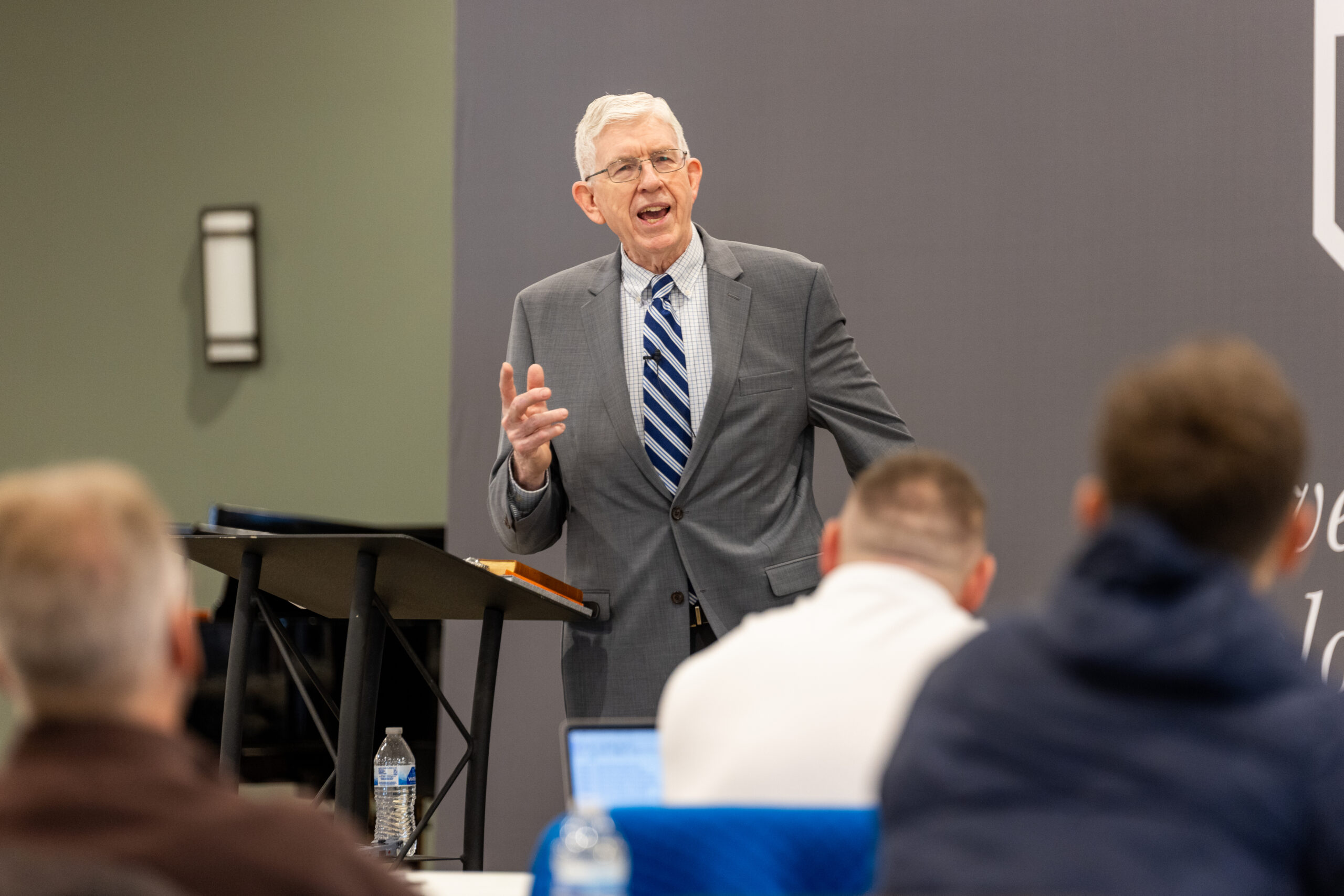
The academic year began in January 2025 with a modular course in Louisville, KY, that underscored the seminary’s commitment to Baptist history and practical ministry. Renowned historian Dr. Tom Nettles taught “The Pastoral Theology of Charles Spurgeon.” Drawing from his extensive research, Dr. Nettles provided students with an immersive look at how Spurgeon’s deep theological convictions—rooted in the 1689 Confession—informed his legendary pastoral care and church leadership.
CovCon’25: The Law of God
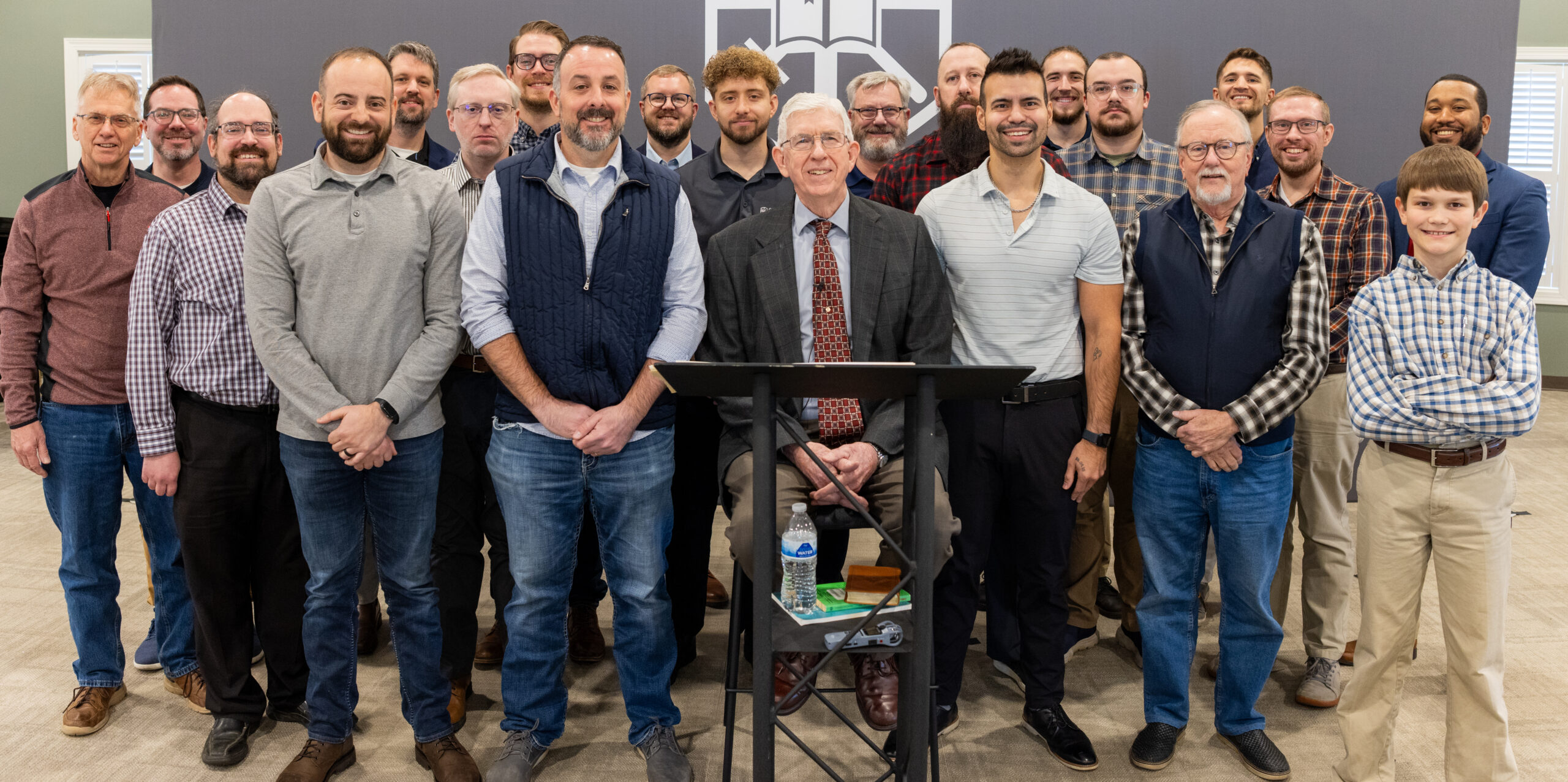
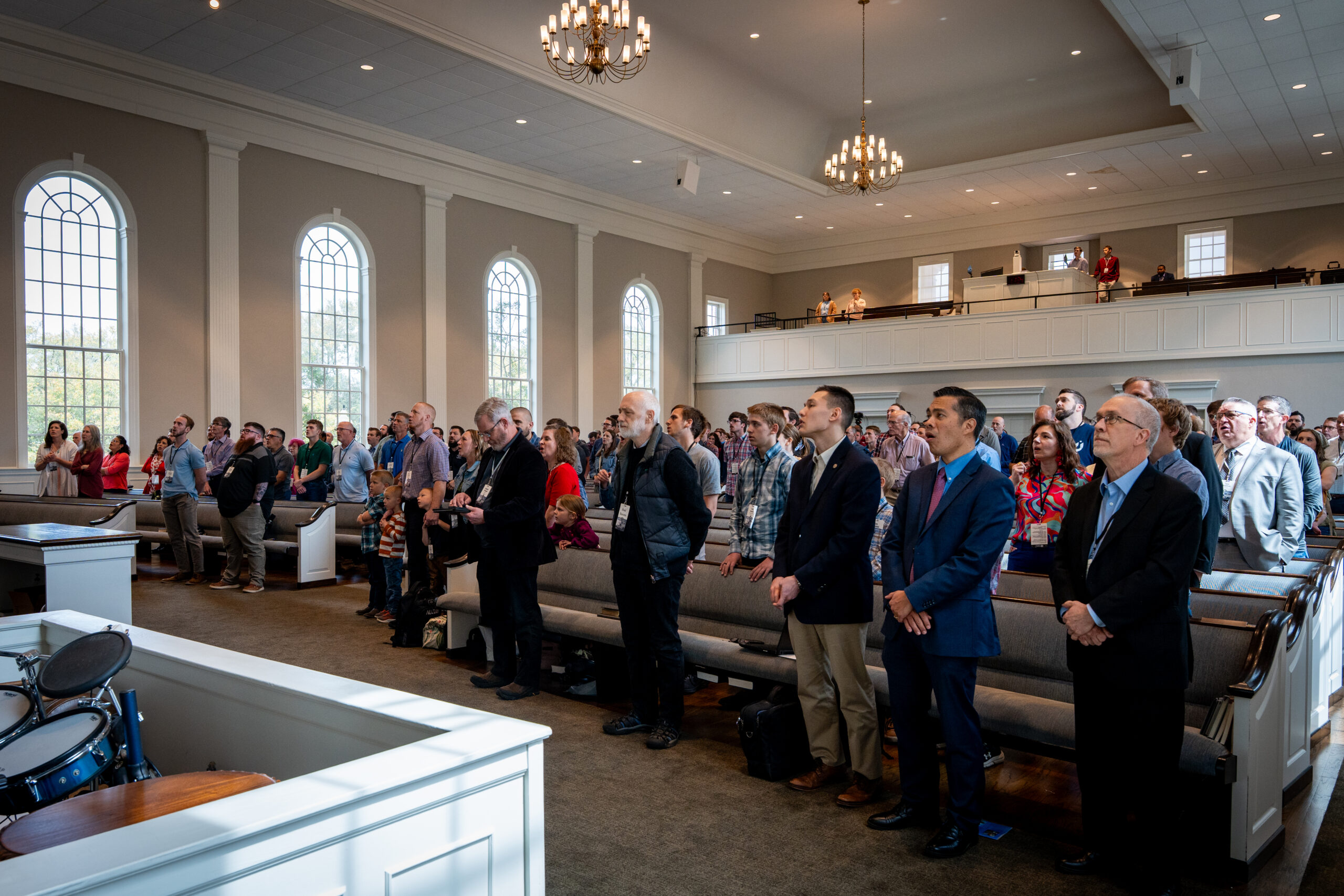
In March 2025, CBTS hosted its annual Covenant Conference in Montgomery, Alabama, focusing on the theme “The Law of God.” The conference featured insightful sessions from Sam Waldron, John Miller, Jon English Lee, and Tom Hicks, as well as guest speaker Joel Beeke. Together, they provided a comprehensive biblical defense of the law’s role in the believer’s life and addressed contemporary issues related to Christian Nationalism.
A Historic Graduation
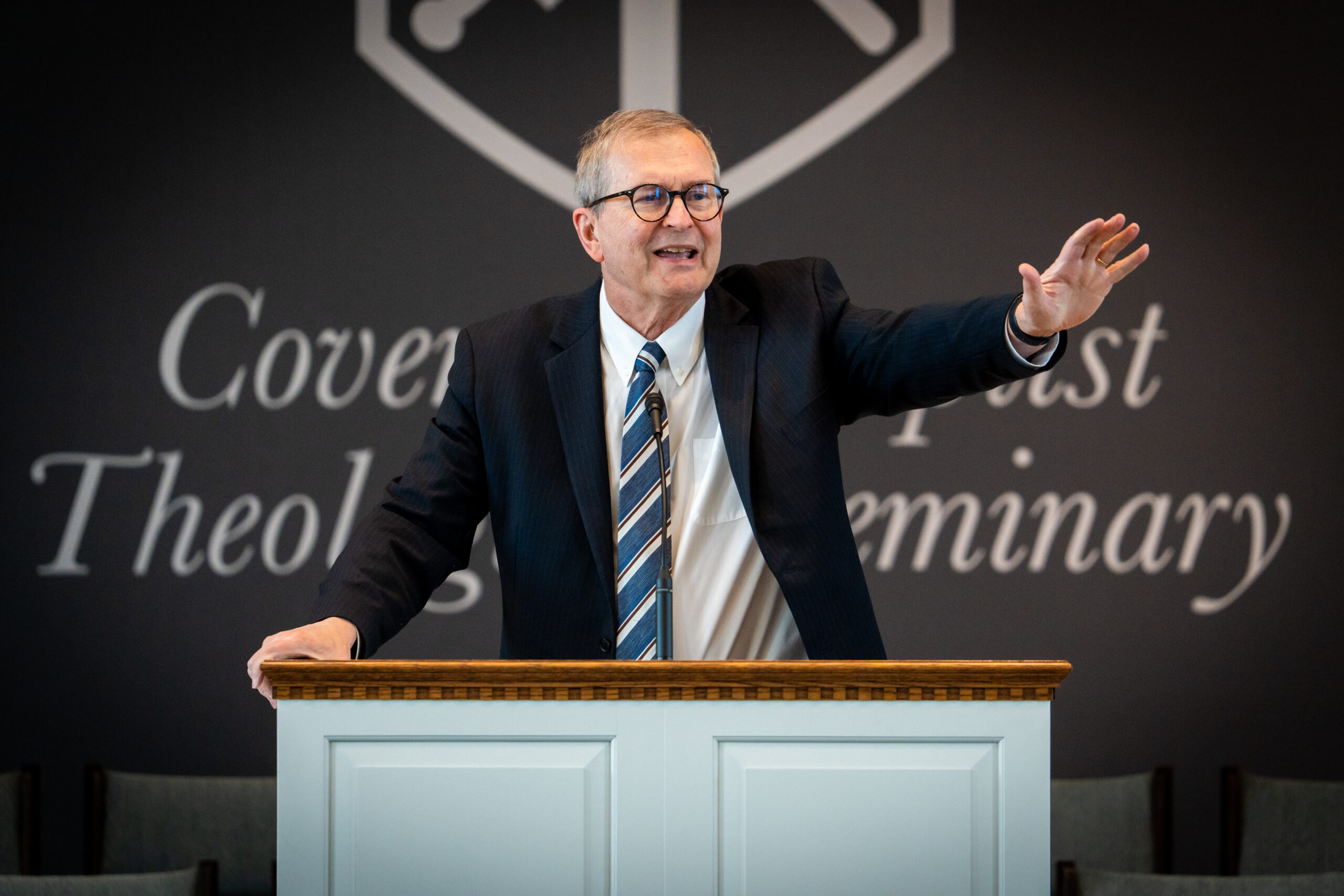
The highlight of the spring season arrived in May 2025 with the seminary’s commencement ceremony. This was a landmark event as the seminary honored its largest-ever graduating class of 34 men. Paul Washer delivered the commencement address, offering a powerful charge to the graduates to remain steadfast in the ministry.
May Module
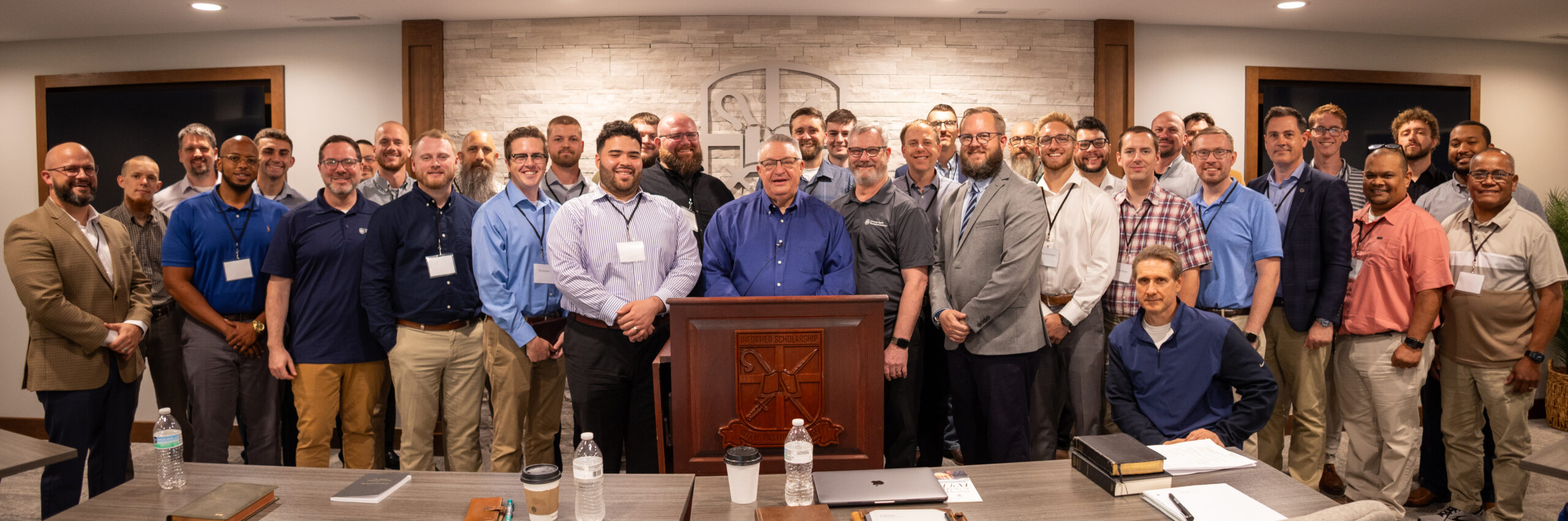
The weekend of graduation was also a time of rigorous study. Dr. Sam Waldron taught a concurrent live module: “Exposition of the Book of Romans.” Students spent the weekend diving into the doctrinal depths of Paul’s letter, ensuring that even amidst celebration, the work of exegetical training continued.
Summer Seminar
In addition to the modular courses, CBTS hosted a specialized seminar in the summer of 2025 focused on the legacy of a key figure in modern Reformed Baptist history. This seminar, held in July, featured a series of lectures by Pastor Dave Chanski that explored the ministry principles and homiletical legacy of Albert N. Martin. The sessions focused on the practical application of Martin’s “Pastoral Theology” series, with a particular emphasis on the biblical priority of preaching and the public reading of Scripture. Designed for current and aspiring pastors, the event sought to pass on the rigorous, Christ-centered ministerial standards Martin modeled over decades of leadership at Trinity Baptist Church.
September Module
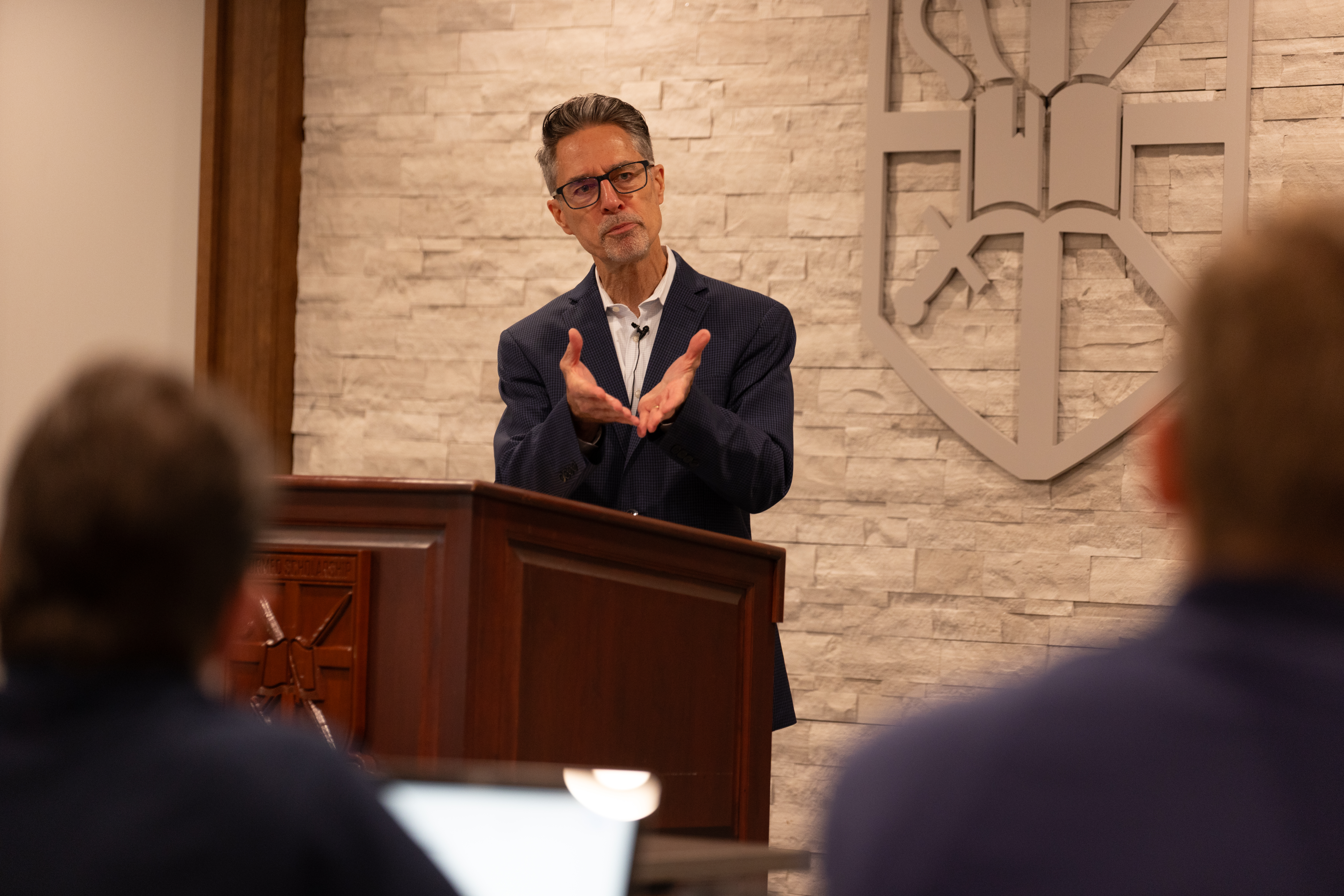
Later in the year, over Labor Day weekend in September, the seminary hosted a specialized module on the life and theology of Geerhardus Vos.” Instructors Dr. Lane Tipton and Danny Olinger guided students through the redemptive-historical method, exploring how the progress of revelation centers on the person and work of Christ.
New Website, Logos, and Merch
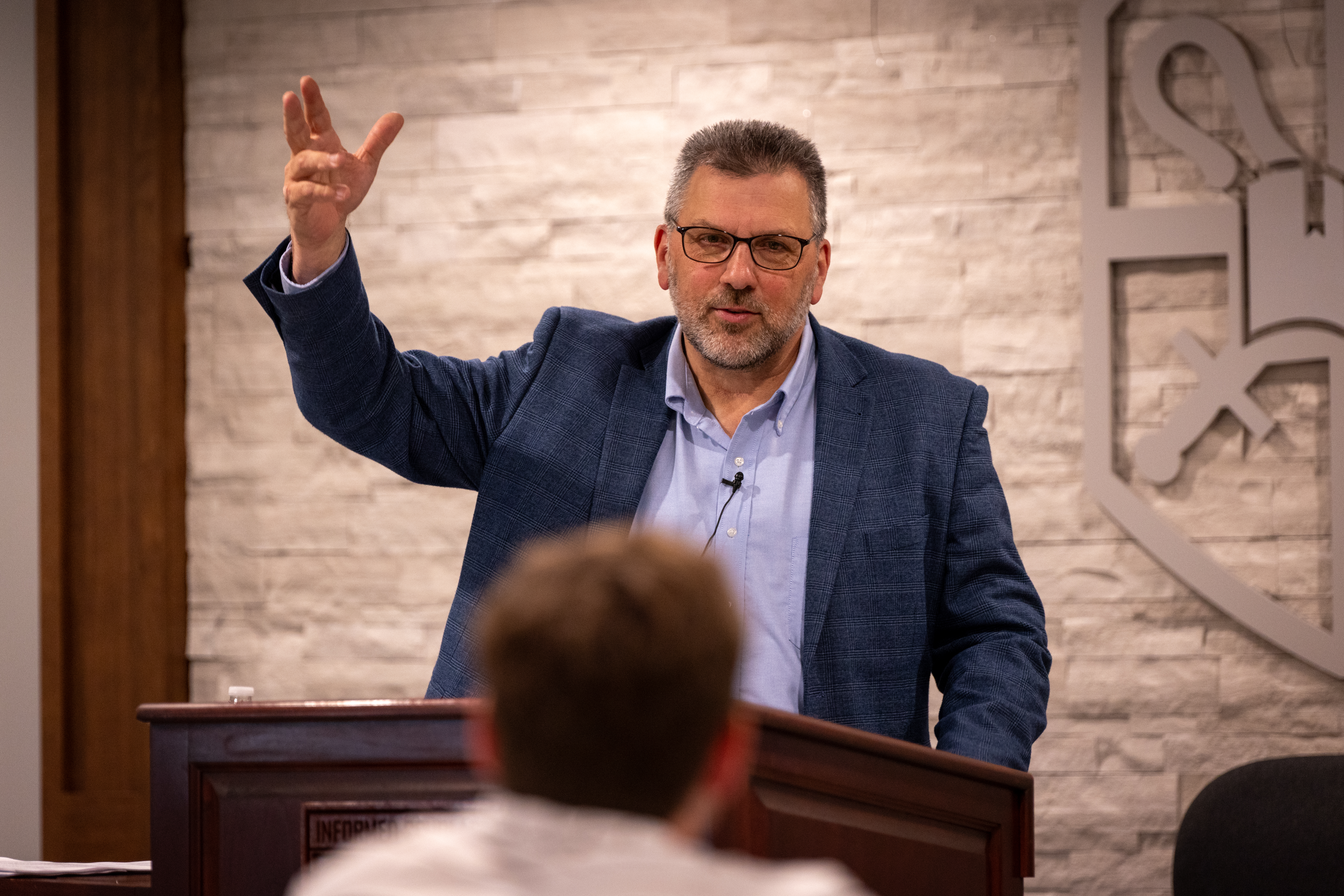
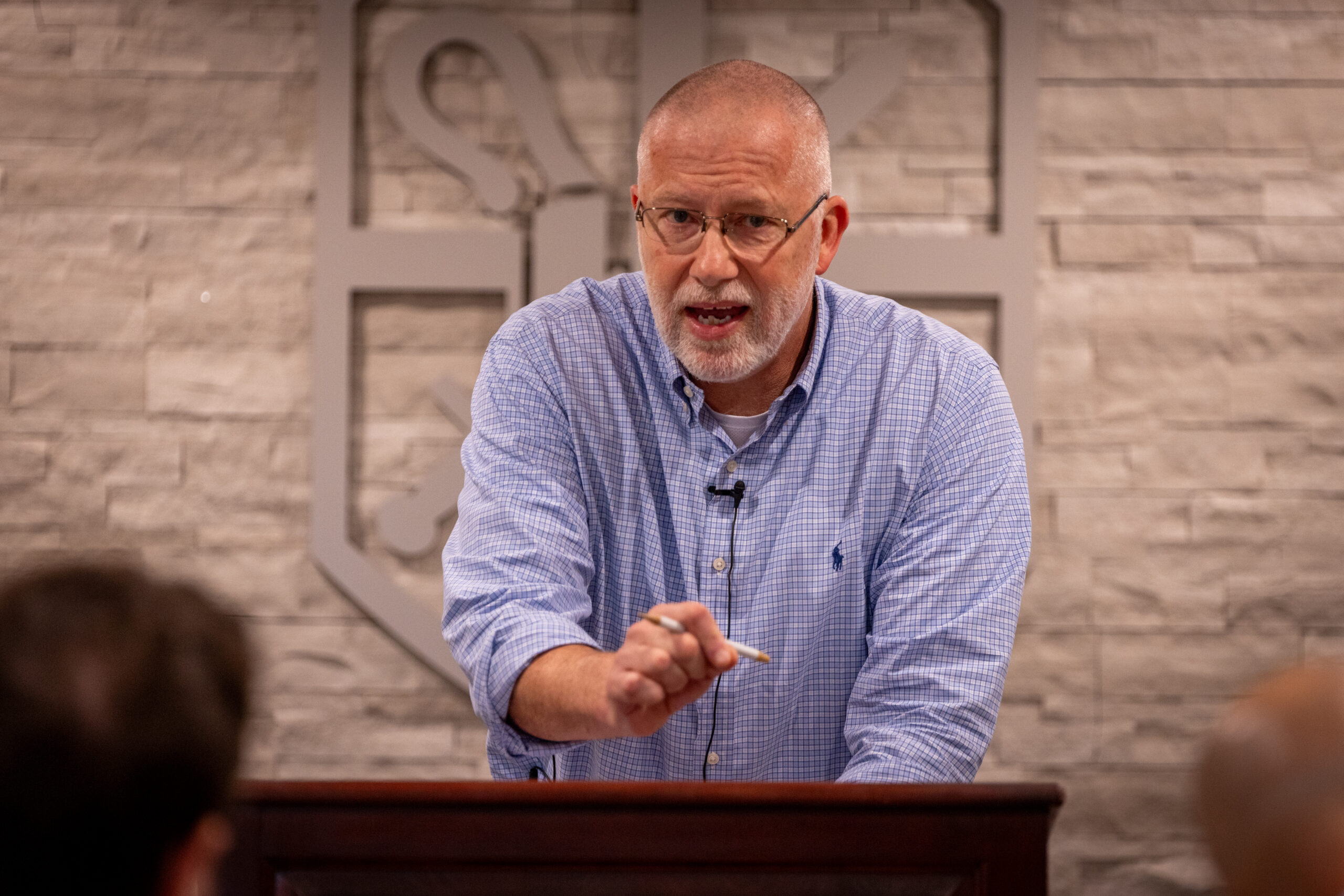
Near the end of 2025, the seminary officially unveiled a new website designed to better serve its growing student body. Alongside the digital launch, CBTS introduced new institutional logos and a new merchandise store, featuring apparel with the updated logos.

We look back to 2025 with gratitude to the Lord for His kindness toward the faculty, students, and administrators of Covenant Baptist Theological Seminary. By His grace alone, the seminary remains dedicated to providing a “Confessional, Reformed Baptist, and Affordable” education for the next generation of Christian leaders.
by Brandon Rhea | Jan 12, 2026 | Apologetics, Historical Theology, Systematic Theology
*Editor’s Note: The following is Part 5 in a five-part series on the Nicene Creed authored by Dr. Brandon Rhea. To read the other installments in this series, click on the following numbers: 1, 2, 3, 4, 5.
Recently, I read the introduction to Dr. Sam Waldron’s new book, The Doctrine of Last Things.[1] He asked, “Is eschatology necessary?” Usually when people think about the end times, the discussion centers on a person’s view of the millennium. Are you pre, post, or amillennial? Some people claim to be panmillennial—it will pan out in the end. Yet Dr. Waldron makes an astute observation. No matter a person’s view on the millennium, there are three things a Christian must believe to be orthodox. First, Jesus will return bodily from heaven. Second, there will be a resurrection of the dead. Third, there will be a Great Judgment where the lost will be sent to hell and the saved will enjoy eternity with God.
Both Reformed Baptists and the Catholic Church confesses the Nicene Creed which says, “He will come again with glory to judge the living and the dead. His kingdom will never end.” As we will discover in this article, the Catholic Church official holds to 1) Jesus’ bodily return, 2) the resurrection of the dead, and 3) the lost will spend eternity in hell. However, some of their leaders including recent Popes have doubted that anyone will be sent to hell. They teach potential universalism—it is possible everyone will be saved in the end. This final installment in our series on the Nicene Creed will cover this topic.[2]
To begin, let’s examine Revelation 20:14-15. “Then Death and Hades were cast into the lake of fire. This is the second death. 15 And anyone not found written in the Book of Life was cast into the lake of fire.”[3] After the Judgment, God will cast Death and Hades into the lake of fire. Both represent death which is the last enemy. 1 Corinthians 15:26 says, “The last enemy that will be destroyed is death.” Since it is not a material reality, God is communicating that death has ceased. No one will die again, and there will not be a place for the dead since no one will die.
What is the lake of fire? Typically, we refer to it as hell. In reality, we use the term “hell” for two different things. First, when an unbeliever dies, his soul goes to a place of temporal punishment. In the same way, when a person is arrested and awaits trial, he is housed at the county jail. Then if a jury convicts him, he will be sentenced to a prison for a longer duration. Similarly, the lake of fire which many people also call “hell” is like prison. Having served time in jail awaiting the trial, at the Judgment Day, every unbeliever will be condemned and sentenced to the lake of fire for eternity. Matthew 25:46 says, “And these will go away into everlasting punishment, but the righteous into eternal life.” Eternal punishment does not end. The sinners will not be annihilated after many years, and there will not be a second chance to repent and believe the gospel.
What is the purpose of the lake of fire? It is a place of punishment for lawbreakers. Jesus described it in Mark 9:46, “where ‘Their worm does not die And the fire is not quenched.’” The condemned will forever feel the pain of fire without being consumed by that fire. After the angels gather the lost, God will condemn them and “will cast them into the furnace of fire. There will be wailing and gnashing of teeth.” The pain and misery will never end. Their rebellion against the King requires justice.
Who is condemned to the lake of fire? First, Satan and the demons will be there according to Revelation 20:10. They do not govern or preside over it, but they are there to suffer for their sin. Second, everyone whose names are not found in the book of life. Does that mean that salvation is by works since Jesus judges our works on that great day? Absolutely not! To understand that salvation is by faith alone in Christ alone, we must read the full title of that book. For short, it goes by the Book of Life. Yet it has a fuller title. Revelation 13:8 says, “All who dwell on the earth will worship him, whose names have not been written in the Book of Life of the Lamb slain from the foundation of the world.” Those who worship idols do not have their names written in the Book of Life of the Lamb. Furthermore, Revelation 21:27 states, “But there shall by no means enter it anything that defiles, or causes an abomination or a lie, but only those who are written in the Lamb’s Book of Life.” The Book of Life belongs to the Lamb who is Jesus. He possesses it.
The Lamb, therefore, saves sinners through paying the penalty for our sin on the cross. He bore the wrath that we deserve for breaking God’s law. Then by faith in Jesus, we are united to Him. On the Judgment Day, we are judged not by our lawless deeds, but by the perfect work of Christ. Jesus’ good works are imputed to us, and on the basis of His perfect deeds, God justifies us. To the contrary, the lost are judged by their works which requires justice of eternal punishment. Hence, this passage states that there will be people in the lake of fire forever and ever.
Does the Roman Catholic Church teach that God will send people to hell? Yes and no. Yes, because their catechism affirms this teaching.[4] No, however, because in the last century, Popes and theologians in the church have taught a potential universalism. They do not say everyone will be saved, but they say that there is hope for all to be saved. God may keep hell empty and send everyone to heaven.
How do they support such a hope? Their leaders think everyone is a Christian and brother in Christ. Pope Pius XII said, “Although owing to Adam’s fall, human nature is tainted with original sin, yet it has in itself something that is naturally Christian…”[5], Karl Rahner taught the concept of anonymous Christians. He said, “the others who oppose [the Church] are merely those who have not yet recognized what they nevertheless really already are (or can be) even when, on the surface of existence, they are in opposition; they are already anonymous Christians.”[6] How can a person be a Christian if he does not confess Christ and persecutes the church?
Pope Paul VI extended salvation to Muslims, Hindus, and other religions. Speaking of Muslims, he wrote, “But the plan of salvation also includes those who acknowledge the Creator. In the first place amongst these there are the Muslims,…Nor is God far distant from those who in shadows and images seek the unknown God, for it is He who gives to all men life and breath and all things, and as Saviour wills that all men be saved.”[7] This explains why the Vatican has provided a room for Muslim scholars to pray while they do research at the Vatican library.[8] Even though Muslims believe Jesus was a prophet and not God, Catholic leaders think they can be saved without confessing Jesus to be God.
Francis, the previous Pope, made such inclusive statements too. He referred to humanity as “all brothers.” Not brothers in the sense of being created by God, but being brothers in Christ. Moreover, he told a boy that his father was in heaven, even though the man was an atheist. In another conversation, he expressed his hope that hell would be empty.
How do these Catholic leaders argue for potential universalism? First, they appeal to God’s love and grace. How can a loving God send people to hell? They, therefore, pit God’s love against His justice. There is no tension, however, since God is love, He loves holiness. Thus, He must condemn unrepentant sinners to hell, or he would not love what is pure. Moreover, to respond to this heresy, I call out their hypocrisy. These men would cry out “Injustice!” if the prisons were empty. Even they demand for murderers and dictators to be sentenced and imprisoned. Many of them would call upon the rich to be placed in prisons due to embracing social justice. Yet they want God’s prison—hell—to be empty. It would be like building prisons without intending to use them. Did God create the lake of fire to keep it empty? No! Hell is real, and real people go there.
Even though Roman Catholic leaders confess the Nicene Creed, they do not affirm this fact: there will be people in hell. The biblical witness is at stake. Is Revelation 20 correct or is it wrong? Does God’s honor as King and Lord require sinners to be condemned to hell? Absolutely!
Due to the Roman Catholic leaders’ equivocation regarding hell being populated by the lost, Reformed Baptists cannot affirm, partner, nor worship in or with members of the Roman Catholic Church. We may both profess the Nicene Creed, but we do not hold to the same meaning. Even though Rome claims to be Catholic, it has ceased “to contend earnestly for the faith which was once for all delivered to the saints.”
[1] Sam Waldron, The Doctrine of Last Things: An Optimistic Amillennial View (Conway, AR: Free Grace Press, 2025).
[2] The idea for this blog series came after reading this insightful book, Mark Gilbert and Leonardo De Chirico, ed., The Nicene Creed (Sydney: Matthias Media, 2024).
[3] All Scripture references are from the New King James Version.
[4] The Catechism of the Catholic Church, 1033-1041.
[5] Pope Pius XII, Evangelii praecones, as quoted in Mark Gilbert and Leonardo De Chirico, ed., The Nicene Creed (Sydney: Matthias Media, 2024).
[6] Karl Rahner, as quoted in Robert Letham, Systematic Theology (Wheaton, IL: Crossway, 2019), 876-877.
[7] Pope Paul VI, Lumen Gentium, https://www.vatican.va/archive/hist_councils/ii_vatican_council/documents/vat-ii_const_19641121_lumen-gentium_en.html
[8] “Vatican Library Grants Muslim Scholars a Prayer Room.” Accessed December 19, 2025. https://thecatholicherald.com/article/vatican-library-grants-muslim-scholars-a-prayer-room
Brandon Rhea (Ph.D. Historical Theology at Midwestern Baptist Theological Seminary) is a pastor and an ACBC certified Biblical counselor. He met his wife, Karise, while doing pulpit supply in 2013-14. In April 2016, he accepted the call to pastor at Faith Baptist Church in Kirksville, Missouri. He loves history and has a heart for street preaching and evangelism. He is the author of “Spurgeon’s Forgotten Sabbatarianism” and teaches “Spurgeon on the Law & Sabbath” for Covenant Baptist Theological Seminary.
by Brandon Rhea | Jan 12, 2026 | Apologetics, Historical Theology, Sacraments, Systematic Theology
*Editor’s Note: The following is Part 4 in a five-part series on the Nicene Creed authored by Dr. Brandon Rhea. To read the other installments in this series, click on the following numbers: 1, 2, 3, 4, 5.
At the 2024 Southern Baptist Convention, the churches considered a request to include the Nicene Creed in their doctrinal statement by referring it to the Executive Committee for further study. Leading up to the Convention, at least one Baptist theologian objected to adopting the Creed due to the phrase, “We affirm one baptism for the forgiveness of sins,” because it may teach baptismal regeneration. Orthodox Baptists do not believe the waters cause a person to be born again, yet anyone who objects to this phrase reveals his biblical illiteracy. It is found in the Bible in Acts 2:38.[1]
Both Reformed Baptists and Catholics profess the Nicene Creed and believe Acts 2:38 is inspired. We, however, differ in its interpretation. The Catholic Church teaches baptismal regeneration, but Reformed Baptists reject that doctrine. Instead, the Holy Spirit regenerates by the Word and not by the water.
This article is part four in our five-part series on the Nicene Creed. Catholics and Reformed Baptists confess the Creed, but we are not of the same faith and practice. We must not deceive ourselves by uniting into an ecumenical communion. To provide evidence for my claims, let’s examine Acts 2:38.
To understand verse 38, let’s look at the context of Acts 1 and 2. In Chapter 1, Jesus ascended bodily to heaven while His disciples looked on. Before He left them, He promised to pour out the Spirit upon them in the near future. The disciples then left and went back to Jerusalem. The 120 disciples spent the next ten days praying as they waited for prophesy of Pentecost to be fulfilled. In Chapter 2, Jesus fulfills His promise by pouring out the Spirit first on the church during Pentecost. It extends to other Jews who were gathered in Jerusalem in verse 4-13. Finally, under the power of the Spirit, Peter, who denied Jesus three times, stood up before thousands and preached the gospel. He commanded the Jews to repent of their rejection and crucifixion of Jesus by believing upon Him as the Messiah.
How did the people respond? Acts 2:37 records, “Now when they heard this, they were cut to the heart, and said to Peter and the rest of the apostles, “Men and brethren, what shall we do?”[2] The Holy Spirit convicted them of their sin. He cut them to the heart meaning they were thrown into despair. God gave them eyes to see they had murdered their Messiah. Instead of worshipping Him, they joyfully crucified Him.
To their question, Peter responds in verse 38. “Then Peter said to them, “Repent, and let every one of you be baptized in the name of Jesus Christ for the remission of sins; and you shall receive the gift of the Holy Spirit.” Peter gives two commands. First, he tells them to repent which means having a change of mind regarding Jesus. Rather than thinking that Jesus is only a man who is blaspheming God’s name, they would believe Jesus is God incarnate. They would worship and serve Him as the Messiah. Next, Peter commands them to be baptized. This baptism must be done in the name of Jesus Christ. By identifying with Jesus in baptism, the believer declares his hope is in the death, burial, and resurrection of Christ. Moreover, he says “for the remission of sins.” Since the Jewish audience are sinners, they need cleansing to avoid God’s wrath. Finally, Peter makes a promise that the Holy Spirit will be given to them. This promise refers to being regenerated and indwelt by the Spirit.
How does the Catholic Church interpret this passage? They use it as the basis for teaching baptismal regeneration. The Catechism of the Catholic Church teaches, “Holy Baptism is the basis of the whole Christian life, the gateway to life in the Spirit, and the door which gives access to the other sacraments. Through Baptism we are freed from sin and reborn as sons of God; we become members of Christ, are incorporated into the Church and made sharers in her mission: ‘Baptism is the sacrament of regeneration through water in the word.’”[3]
The Catholic Church teaches that act of sprinkling causes the new birth to take place. Ex opere operato, or by the work performed, a baby or an adult is born again. It happens 100% of the time. Therefore, at baptism the waters remove the stain of original sin—the sin nature inherited from Adam. The water sets the baptized free from that bondage, so that they can cooperate with God’s grace as mediated through the Church. Furthermore, each person who is baptized becomes a son of God by having water placed upon him and is united to Christ as a member of the Church.
Who do Catholics baptize? They sprinkle both infants and adults. Why do infants need sprinkling? They need to have the stain of original sin removed. Unfortunately, Augustine made this argument in order to counter Pelagius who believed children are born blank slates. They are neither good nor evil according to the Pelagian heresy. Catholics look to Acts 2:38 which says, “let every one of you be baptized in the name of Jesus Christ for the remission of sins,” and see it as a causal relationship. Baptism forgives sins every time. To prove the point, their Catechism teaches, “By Baptism all sins are forgiven, original sin and all personal sins, as well as all punishment for sin. In those who have been reborn nothing remains that would impede their entry into the Kingdom of God, neither Adam’s sin, nor personal sin, nor the consequences of sin, the gravest of which is separation from God.”[4] They think the waters cleanse the recipient and not Jesus Christ.
What about adults? They require them to be baptized too, but they do give three exceptions to the rule. First, if a person dies as a martyr for the faith without baptism, he can be saved. Second, if a person is a catechumen, a person preparing for baptism, who dies before being baptized, he can be forgiven. Finally, they allow for salvation to heathens who have never heard of the Church. “All those who, without knowing of the Church, but acting under the inspiration of grace, seek God sincerely and strive to fulfil his will, can be saved even if they have not been baptized.” Sincere pagans, therefore, who have never heard the gospel, can be saved.
Some of you may be asking, “How are infants baptized without faith?” Catholics get around this objection by saying the Godparents and the whole church supplies the missing faith. Even though the individual child does not have faith in Christ, an alien faith is supplied in the child’s place. On that basis, the child can and should be baptized.
Since babies are being sprinkled without a profession of faith, the Catholic Church teaches that children can fall away when they grow older. Baptism gives them initial cleansing and grace, but they must continue to cooperate, or they may lose justifying grace. Hence, they need to go to confession and do penance since they will pollute themselves again through their sins. They receive new grace by participating in the Mass. Yet even if a Roman Catholic completely falls away by becoming a heretic, they still consider that person to be a Catholic or to be a Christian. Why? Baptism places an indelible mark on that person’s soul which cannot be removed. They, therefore, have a category for practicing Catholics and nonpracticing Catholics. A person can go years without attending a Mass and still be Catholic, since he was baptized as a baby. In contrast, as Reformed Baptists, when we exercise church discipline, we are removing the “Christian” label from that person. We no longer consider them to be a saved, since they are walking in unrepentant sin.
Having considered the Roman Catholic Church’s interpretation of Acts 2:38, what does it truly mean? To answer that question, we must compare Scripture to Scripture. Some commentators come to their conclusions based upon the Greek grammar, but there are various lexical and grammatical arguments which can be debated. Instead, the deciding factor rests upon understanding Acts 2:38 in light of all of Scripture. Let’s turn to 1 Peter 3:21 for guidance. “There is also an antitype which now saves us—baptism (not the removal of the filth of the flesh, but the answer of a good conscience toward God), through the resurrection of Jesus Christ, who has gone into heaven and is at the right hand of God, angels and authorities and powers having been made subject to Him.”
In the context of 1 Peter 3, the apostle refers to God saving Noah and his family from the flood through the ark. Noah heeded God’s warning about the coming flood and believed in the promise of being spared by building an ark. The flood is a type of baptism. The waters of the flood did not remove the sins of Noah and neither do the waters of baptism. Rather, the waters are a sign of one’s appeal to Jesus Christ for salvation. The ark saved Noah in the same manner that Jesus Christ saves us. He removes our sins and gives us a new nature. Baptism is a sign of that removal.
Question 97 of the Baptism Catechism asks, “What is baptism?” Here is the answer. “Baptism is an ordinance of the New Testament instituted by Jesus Christ, to be unto the party baptized a sign of his fellowship with him, in his death, burial, and resurrection; of his being ingrafted into; of remission of sins; and of his giving up himself unto God through Jesus Christ, to live and walk in newness of life.”[5] Baptism, therefore, is an outward sign of what Jesus Christ has done for us by faith in Him. The waters do not remove our sins, adopt us into the family of God, nor restore our relationship with Him.
Having the right meaning of baptism in mind, let us go back to Acts 2:38. Why does Peter call upon the Jews to be baptized? It is an opportunity for those who were public enemies of Jesus Christ to show their new faith in Christ. By publicly identifying with Jesus in baptism, they declare to the world that they have been saved and have repented of their hostilities towards the Messiah.
The problem with the Rome’s teaching on baptism is that they confuse the sign with the reality. For example, if you see a sign on the road which says, “Draw Bridge Ahead,” you know that the sign marker is not the draw bridge. A draw bridge is built over a river and has the ability to raise up in the middle on both sides to allow boat traffic through it without hitting the bridge. The sign warns the driver that he may have to stop if the bridge is up. Nobody stops in front of the sign and takes pictures in front of it. You do not go back and show it to your family and say, “Here is a picture of me in front of the draw bridge.” Why? It is the sign and not the real thing. Similarly, Catholics treat the sign as the cause of salvation. The Holy Spirit causes people to be saved through the Word and not through baptism (John 3:5-8).
Going back to Acts 2, Peter commands the crowd to be baptized in the name of Jesus Christ. Why? The sinner is calling upon Jesus to save him and not the water. By identifying with Christ in baptism, the sinner confesses his hope for salvation in Jesus. He was saved before entering the baptismal pool, since his confidence is in Christ’s work on the cross. Jesus lived the perfect life of obedience for him and took the curse upon himself on the cross. By resting upon Christ and not the water or religious works, the sinner has peace with God. We call this teaching Solus Christus. Christ alone saves and no one else. Roman Catholics teach that Christ and baptism saves.
Martin Luther, the great Reformer and defender of justification by faith alone, said, “Justification is the article by which the church stands and falls.” What did he mean? He meant that a body can only be a true church if it rightly understands justification. If it says a person is justified by faith and works, then it falls and becomes a synagogue of Satan. If, however, it believes salvation is by faith alone in Jesus, then the church remains a pillar and buttress of the truth.
If you are not trusting in Jesus Christ alone for your salvation, then you are not saved. You are condemned. You may say, “I believe in God. I do good works. I was baptized.” You are not a true Christian. You are trusting in your self-righteousness to earn salvation, but salvation cannot be earned. It is a gift from God that is received by faith. Christ alone saves sinners. Being a member of a church does not save. The Pope does not have power to save, taking the Mass does not save, and being baptized does not save. Responding to an altar call and saying the sinner’s prayer does not save either. Jesus alone saves. Therefore, believe in Jesus Christ alone, and you will be saved. Then be baptized as a sign of your faith in Christ.
[1] See R. Lucas Stamps’s article on why Baptists can and should confess this phrase. https://www.centerforbaptistrenewal.com/blog/2024/6/20/one-baptism-for-the-remission-of-sins-baptists-and-the-baptism-clause?rq=baptism%20for%20the%20remission%20of%20sins
[2] All Scripture references are from the New King James Version.
[3] The Catechism of the Catholic Church, 1213.
[4] Ibid., 1263.
[5] https://founders.org/library/the-baptist-catechism/
Brandon Rhea (Ph.D. Historical Theology at Midwestern Baptist Theological Seminary) is a pastor and an ACBC certified Biblical counselor. He met his wife, Karise, while doing pulpit supply in 2013-14. In April 2016, he accepted the call to pastor at Faith Baptist Church in Kirksville, Missouri. He loves history and has a heart for street preaching and evangelism. He is the author of “Spurgeon’s Forgotten Sabbatarianism” and teaches “Spurgeon on the Law & Sabbath” for Covenant Baptist Theological Seminary.
by Brandon Rhea | Jan 12, 2026 | Apologetics, Historical Theology, Systematic Theology
*Editor’s Note: The following is Part 3 in a five-part series on the Nicene Creed authored by Dr. Brandon Rhea. To read the other installments in this series, click on the following numbers: 1, 2, 3, 4, 5.
Many years ago, while open-air preaching in the Windy City, a young man stopped to talk with us. He was Roman Catholic and wanted to discuss theology. Since our hands and feet had become frozen on that crisp winter afternoon, we went to a coffee shop to talk. Over the course of our conversation, my friend with me shared the gospel to him. Then we answered objections. At the end of our amicable conversation, the young man wanted to pray with us. My friend stopped him. “We cannot pray with you, because you are not saved. You are not a Christian.” My friend’s words astounded the young man. He looked offended and bemused. Was this the right way to respond to him?
This article is the third of a five-part series on the Nicene Creed. Throughout my examination, I am asserting a simple truth. Even though Roman Catholics and Reformed Baptists confess the Nicene Creed, they do not agree on how to define the doctrines contained therein. Yes, we both confess the deity of Jesus Christ and the necessity of His atonement, but through the Catholic Church’s traditions, they pollute the gospel with drops of poison. To prove my point, let’s examine Colossians 1:19-20 and compare it to the Catholic’s teaching on the Mass.
“For it pleased the Father that in Him all the fullness should dwell, and by Him to reconcile all things to Himself, by Him, whether things on earth or things in heaven, having made peace through the blood of His cross.”[1]
Verse 19 says that “all the fullness should dwell” in Jesus. The phrase “the Father” is supplied to explain who was pleased by this action. It is another way of saying that Jesus is God. Jesus is omnipotent, omniscient, omnipresent, and holy like the Father. He has always been God and will always be God. In church history, however, a heresy developed called adoptionism. False teachers believed Jesus was born a normal person like you and me. He was not God in the flesh nor the Son of God. Yet being a mere man, He lived a sinless existence into His adulthood. At that time, God adopted Him and elevated Him to a divine status based upon His faithfulness. This teaching must be rejected, because God became man. Man did not become God.
What was Jesus’ purpose in the incarnation? Verse 20 says, “to reconcile all things to Himself, by Him, whether things on earth or things in heaven, having made peace through the blood of his cross.” Why reconciliation? When Adam and Eve sinned in the Garden of Eden, sin entered and corrupted the world. Romans 8:20-21 says that creation cries out and longs to be delivered from the curse imposed on it. Moreover, human beings need reconciliation since we have sinned against God and are at war against Him. Romans 5:10 says, “For if when we were enemies we were reconciled to God through the death of His Son, much more, having been reconciled, we shall be saved by His life.”
How does Jesus reconcile? He did it “through the blood of His cross.” After living the perfect life of obedience to the law, Jesus paid the debt for His elect on the cross. He took the curse of breaking the law, so that we could be given the reward for keeping the law which is eternal life. Jesus had to die, so that we could live. To accomplish this task, it required two things. First, He must be God. If Jesus is not the infinite God, then He is not able to pay for all of the sins of His people. Arianism, which denies Jesus’ deity, therefore, does not have a gospel. Second, Jesus must be a man. Being God, He cannot die. Hence, by taking upon Himself a human nature, He can be crucified and die according to the flesh. Gnosticism, which says Jesus only appeared to be a man but was not a human, does not have the true gospel either. If Jesus is not God and man, then we are not saved.
The Nicene Creed confesses Jesus’ work on the cross. It says,
For us and for our salvation
he came down from heaven;
he became incarnate by the Holy Spirit and the virgin Mary,
and was made human.
He was crucified for us under Pontius Pilate;
he suffered and was buried.
The third day he rose again, according to the Scriptures.
He ascended to heaven
and is seated at the right hand of the Father.
He will come again with glory
to judge the living and the dead.
His kingdom will never end.
Even though Roman Catholics confess Jesus’ death on the cross for our sins, they deny its sufficiency. To obtain salvation, Jesus cannot die once, but His sacrifice must be re-presented at the Mass. Rome teaches transubstantiation. Trans means “across” and substance means “essence.” They believe priests have the power to change the essence of the wine and bread into the body of Christ while keeping the outward elements as bread and wine. The elements, therefore, smell, taste, and feel like bread and wine, but it is really Jesus.
Instead of giving Jesus Christ preeminence at the Lord’s Supper, they give the bread and wine honor. On the altar, churches have a holy vessel called a tabernacle. Catholics genuflect towards it, because they think it contains Jesus. Their Catechism asserts, “The Holy Sacrifice, because it makes present the one sacrifice of Christ the Savior and includes the Church’s offering.”[2] According to Catholic teaching, at the Mass, Jesus is offered repeatedly to cover their sins. Also, the Catechism teaches, “Holy Communion, because by this sacrament we unite ourselves to Christ, who makes us sharers in his Body and Blood to form a single body.”[3] To be united to Jesus, a person must go to Mass. The sacrament unites people irrespective if they have been born again by the Spirit.
How do we respond to such claims? I am with John Knox who declared the Mass to be idolatry. Catholics worship the bread and wine rather than Jesus Christ whom the bread and wine represent. Moreover, they blaspheme Jesus’ name, because they think His once and for all sacrifice 2000 years ago is not sufficient to cover our sins in the present. The Apostle Peter would disagree. 1 Peter 3:18 says, “For Christ also suffered once for sins, the just for the unjust, that He might bring us to God, being put to death in the flesh but made alive by the Spirit.” Jesus paid it all on the cross for sins past, present, and future. We cannot turn the elements into Jesus’ body, and He does not have to be re-sacrificed to save us. We are saved by faith in Him and not by partaking of the Mass. Attending Mass every day of your life will not give you peace with God. You must be born again and trust in Christ’s once for all sacrifice.
The Ligonier 2025 State of Theology shows there is confusion among professing Catholics about the role of Jesus’ sacrifice.[4] Statement 34 said, “Jesus Christ’s death on the cross is the only sacrifice that could remove the penalty of my sin.” 31% disagreed with that statement and 69% agreed. Do you see the inconsistency since the mass represents Christ’s sacrifice for pardon today? In addition, statement 35 says, “Only those who trust in Jesus Christ alone as their Savior receive God’s free gift of eternal salvation.” 42% of Catholics disagreed while 58% agreed. To be justified—declared righteous—before God according to Catholic teaching, a person must have faith in Christ and perform good works. The works makes one sanctified which is necessary to be declared righteous by God. Rome teaches justification by Jesus and your works. Reformed Baptists, however, teach justification by faith in Jesus’ works and not your own.
Both Catholics and Reformed Baptists confess the Nicene Creed’s teaching about Jesus being God and coming to die for our sins. Yet in the white margins of the Creed, the Catholic Church smuggles in a false gospel which Reformed Baptists must reject. We, therefore, are not a part of the same universal church.
[1] All Scripture references are from the New King James Version.
[2] Catechism Of The Catholic Church, 1330.
[3] Ibid., 1331.
[4] See https://thestateoftheology.com.
Brandon Rhea (Ph.D. Historical Theology at Midwestern Baptist Theological Seminary) is a pastor and an ACBC certified Biblical counselor. He met his wife, Karise, while doing pulpit supply in 2013-14. In April 2016, he accepted the call to pastor at Faith Baptist Church in Kirksville, Missouri. He loves history and has a heart for street preaching and evangelism. He is the author of “Spurgeon’s Forgotten Sabbatarianism” and teaches “Spurgeon on the Law & Sabbath” for Covenant Baptist Theological Seminary.
by Brandon Rhea | Jan 12, 2026 | Apologetics, Historical Theology, Systematic Theology
*Editor’s Note: The following is Part 2 in a five-part series on the Nicene Creed authored by Dr. Brandon Rhea. To read the other installments in this series, click on the following numbers: 1, 2, 3, 4, 5.
On May 8, 2025, white smoke puffed out of a chimney at the Sistine Chapel, telling the world that the Roman Catholic Church had a new Pope. To the surprise of many, an American from Chicago named Robert Prevost was chosen by the electors. He took the title Leo XIV for his reign. In response to his election, American Catholics rejoiced while Chicago natives took a victory lap. The Pope is White Sox fan who attended a game at the 2005 World Series. He also roots for his alma mater Villanova. Leaders in the American Catholic Church hope that his election will renew the church in our country and cause growth.
How should we view the Pope? Is he a Christian? Does he preach the same gospel as Peter? Should we hold communion with the Pontiff since Protestants and Catholics confess the Nicene Creed? Should we consider him to be an antichrist? Does the Pope supersede the honor and titles which are only reserved for our Lord and Savior Jesus Christ?
To answer these questions in our second installment in this blog series on the Nicene Creed, we must look at Scripture. Colossians 1:18, says, “And He is the head of the body, the church, who is the beginning, the firstborn from the dead, that in all things He may have the preeminence.”[1] The Bible describes Jesus Christ as the Head of the Church who has all authority and gives life to the body. He has the place of preeminence meaning the highest rank or honor. Jesus is not a private, major, colonel, or lieutenant in the army. Rather, He stands as a five-star general whom lesser generals must salute.
To the contrary of biblical teaching, the Roman Catholic Church makes the Pope preeminent and not Jesus Christ. Each Pope officially holds the titles of Supreme Pontiff of the Universal Church, Vicar of Jesus Christ, and the Successor of [Peter] the Prince of the Apostles. The Pope thus acts as the head of the church and as the representative of Jesus on the earth even though the vicar of Christ is the Holy Spirit and not a man.
Catholics teach that the Pope is the head and sustainer of the church and not Jesus, as Colossians 1 teaches. To prove the point, Robert Bellarmine who was a Catholic theologian in the 17th century whose writings defended the church’s views during the time of the Reformation, wrote, “What is at stake when the question arises of the primacy of the Pontiff? Very briefly, the heart of Christianity.”[2]
Charles Spurgeon renounced the office of the Pope. He said, “Of all the dreams that ever deluded men, and probably of all blasphemies that ever were uttered, there has never been one which is more absurd and which is more fruitful in all manner of mischief than the idea that the Bishop of Rome can be the head of the church of Jesus Christ. No, these popes die, and are not; and how could the church live if its head were dead? The true Head ever liveth, and the church ever liveth in him.”[3]
Moreover, Catholic doctrine teaches that the Pope sustains the Church. At Vatican I (1869-1870), theologians met to discuss the Pope’s authority in the church.[4] That council declared the Pope as the defender and sustainer of the church against the gates of hell. Yet in Matthew 16, Jesus promised to sustain the church as it advances in the world against the powers of darkness. Catholics have put their hope in the Papacy and not in Jesus Christ to give life to the body. To deny the Pope’s supremacy to rule and sustain the church was made an anathema or a false teaching. A person cannot disagree with their conclusion without being excommunicated from the church. In response to this ruling, some Catholics in Europe split off from Rome to form the Old Catholic Church. They are like Roman Catholics except for denying the Pope’s supremacy.
To sustain the body of the church, Vatican I also declared papal infallibility. This teaching says the pope is infallible—without error—when he speaks from the chair (ex cathedra) on matters of faith and morals. Therefore, if you ran into the pope on the street and asked him a question, his answer would not be considered infallible. He, however, has the power to declare doctrine and practice for the church, and it must be received as if it is the Word of God. Rather than trusting in Sola Scriptura, Catholics trust in the Papacy to interpret and declare doctrine. This brings up a pertinent question: Who is right when the Pope contradicts Jesus Christ? Do you follow the Papacy or the Bible? Of course, Catholics have to follow the Papacy and twist the Bible to line up with their false teaching.
Why did the Papacy develop? In the fifth century, when the Roman Empire in the west collapsed, the Church filled in the vacuum. The bishop of Rome, therefore, took on the customs and the authority found in Caesar. He no longer had only a religious office, but he took upon himself a civil office. From the fifth century until the mid-1800s, the Pope ruled over vast lands in Italy as a king. Instead of having Jesus as the head and king of the church, the Pope blasphemously surpassed Him in preeminence.
One of the lines in the Nicene Creed says, “We believe in one, holy, catholic, and apostolic church.” Those four words describe the nature of the church, but Roman Catholics have a different interpretation than Reformed Baptists. First, for the church to be one, Catholics say the unity is found in the institution. Everyone must be baptized into the Church to be united together. In contrast, Protestants say our unity comes through being united to Christ by the work of the Holy Spirit. Christ as our head unites us and not the Pope.
Second, the creed says that the church is holy. Catholics believe the institution of the church has a supernatural holiness. To be and grow in holiness, a person must be in that institution. The church has seven sacraments which adherents must exercise to grow in grace on the road to purgatory and heaven. As Reformed Baptists, however, we believe Christ has made us holy at the moment of salvation. We have His righteousness as our own and have been set a part for His service. From our new identity in Christ, we grow in obedience to God’s Word.
Third, Rome calls itself the catholic church. They claim universality since they are the only church with a Papacy. Moreover, it has the sacraments and seeks to bring everyone around the world into its sphere. Yet Reformed Baptists do not define “catholic” as an institution. Rather the term includes all true believers in Christ even if they do not belong to our denomination. Hence, Baptists, Presbyterians, Anglicans, Charismatics, seeker sensitive, and many more belong to the universal church despite our differences in doctrine and practice if we confess the same gospel.
Fourth, the Catholic Church bases its legitimacy on being apostolic. They believe to be the stewards of unwritten traditions which go back to the Apostles. The Pope, therefore, can trace his succession back to Peter which is the basis for being the head of the church. Being the true church depends on this succession and not on doctrine. Protestants, however, believe being apostolic rests on teaching and confessing the same doctrine as the Apostles. We do not have to trace our existence back to Peter, name by name through a spiritual family tree. What makes a church truly authentic is if it is adhering to the faith as expressed in the Bible.
As Protestant heirs of the Reformation, how should we view the Pope? I suggest looking to the example of Ian Paisely. He was an evangelical minister and politician from Northern Ireland. When the European Parliament invited Pope John Paul II to speak at their assembly, Ian Paisley who served in that body objected. After the Pope took the podium, Paisley held up a sign, “Pope John Paul II Antichrist,” and shouted “I renounce you as Christ’s enemy.”
Do not be sucked into the smells and bells. Yes, even though the current Pope is American, we should not be proud but dismayed. He preaches peace among the nations, but he is an antichrist masquerading as an angel of light. Do not honor the Pope, because it is blasphemy. Roman Catholics are not Christians like us, but they are pagans wrapped in a Christian veneer. Instead, for the honor of our Lord and Savior, we must condemn the Papacy and put our hope in Jesus. He alone is the head and sustainer of His bride—the church.
[1] All Scripture references are from the New King James Version.
[2] Robert Bellarmine, as quoted in William Cunningham, Historical Theology, vol. 1 (Edinburgh, The Banner of Truth Trust, 2024), 224
[3] Charles Spurgeon, The Metropolitan Tabernacle Pulpit, vol. 14 (Pasadena, TX; Pilgrim Publications, 1982), 621.
[4] The First Dogmatic Constitution of the Church of Christ, as quoted in R.C. Sproul, Are We Together? A Reformed Baptist Analyzes Roman Catholicism (Sandford, FL: Ligonier Ministries: 2012), 91.
Brandon Rhea (Ph.D. Historical Theology at Midwestern Baptist Theological Seminary) is a pastor and an ACBC certified Biblical counselor. He met his wife, Karise, while doing pulpit supply in 2013-14. In April 2016, he accepted the call to pastor at Faith Baptist Church in Kirksville, Missouri. He loves history and has a heart for street preaching and evangelism. He is the author of “Spurgeon’s Forgotten Sabbatarianism” and teaches “Spurgeon on the Law & Sabbath” for Covenant Baptist Theological Seminary.