by CBTS | Oct 22, 2025 | Announcements
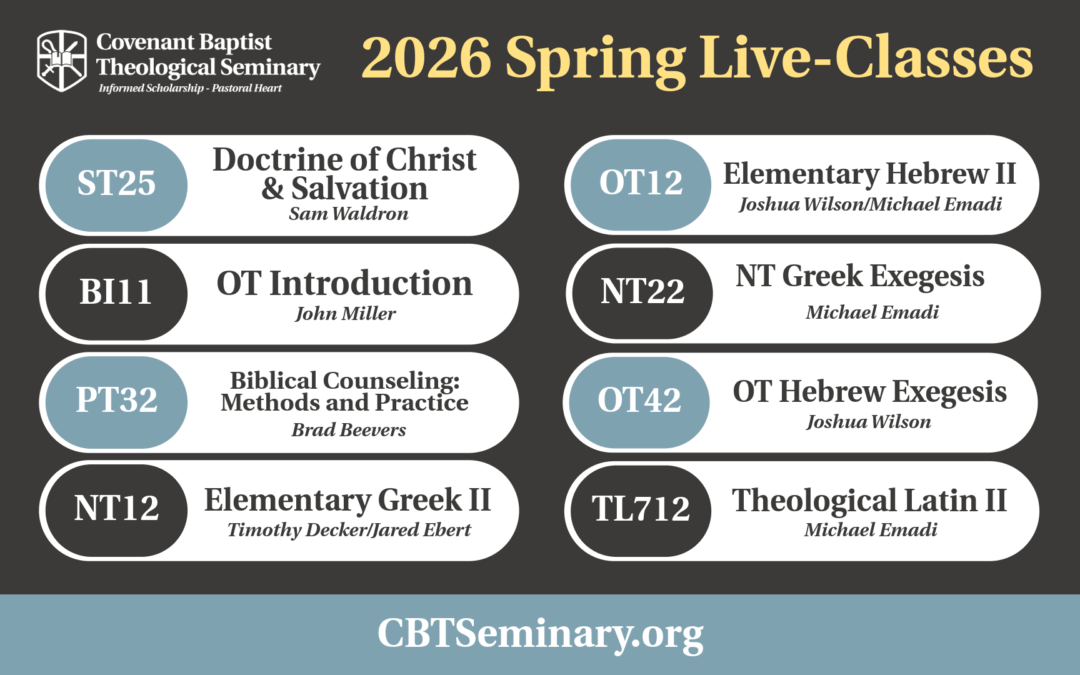
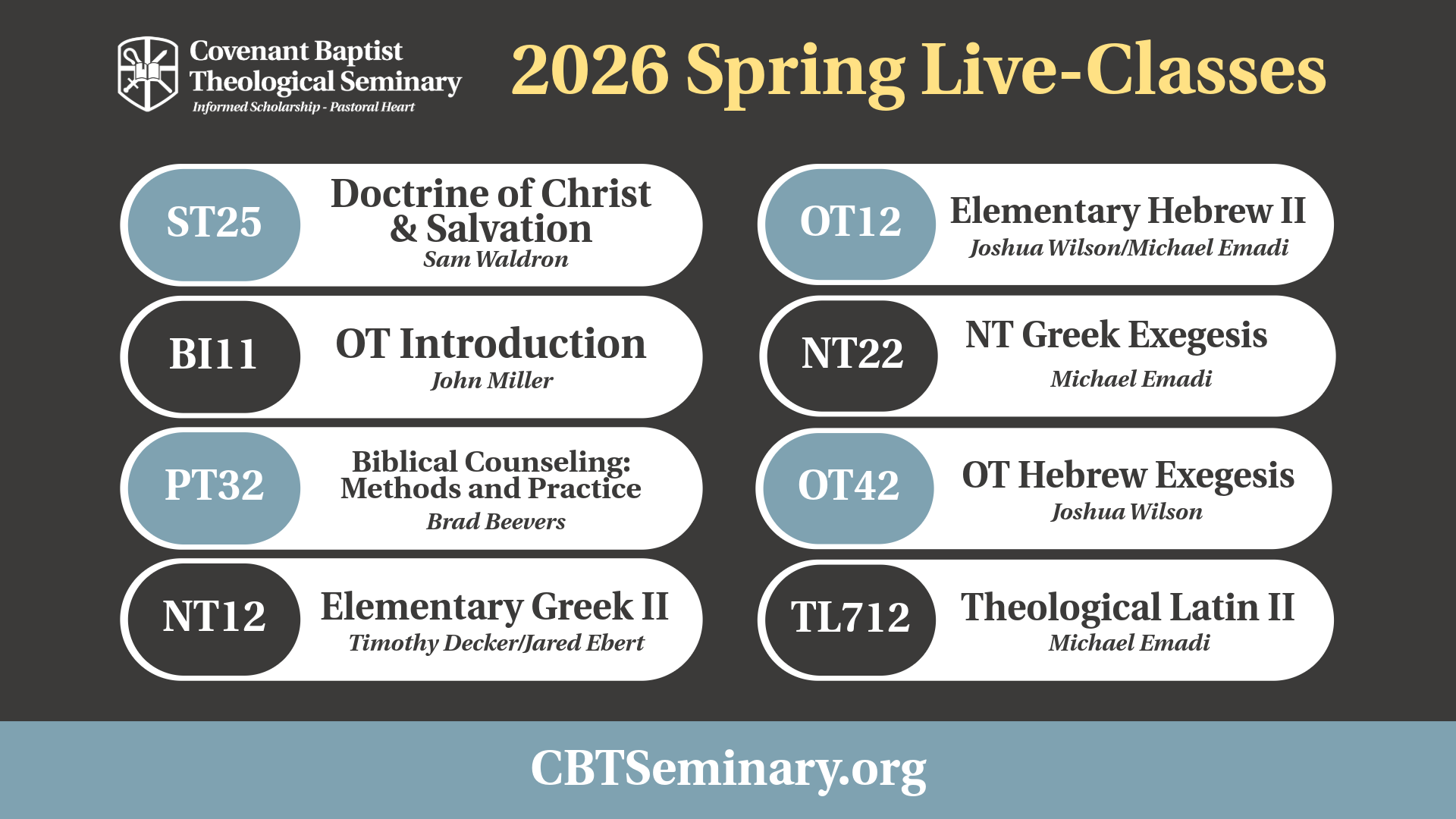
We are pleased to announce that registration is now open for our 2026 Spring live classes. We are offering a great lineup of courses this spring, and we look forward to seeing many of you there! CBTS students will need to enroll in these courses through the CBTS Hub on CBTSPathway. (Click here for instructions.) For those interested in auditing these courses, you can register here.
Intercultural Disciple Making with Dr. Evan Burns
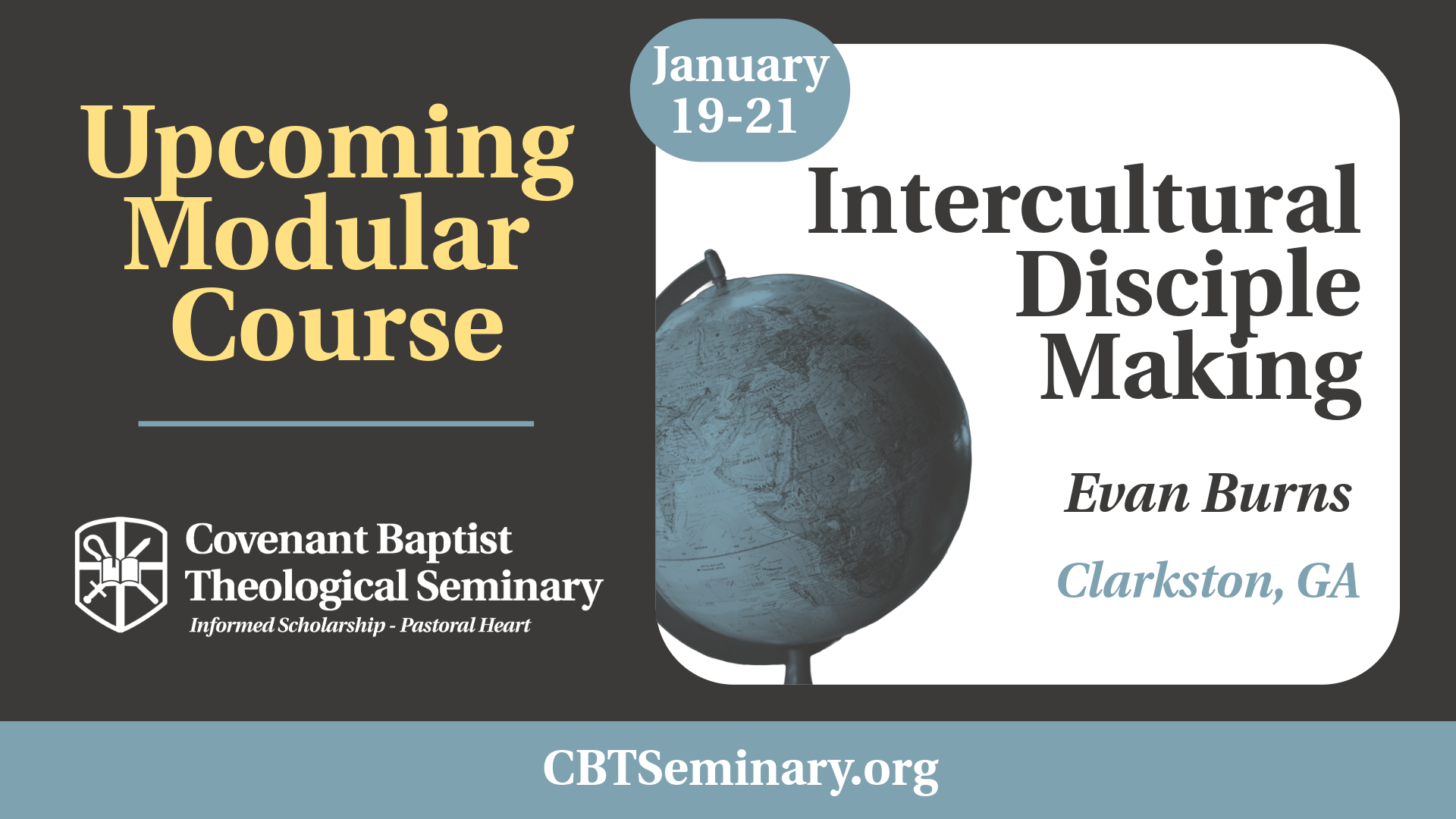
Join Dr. Evan Burns on Jan. 19-21, 2025, in Clarkston, Georgia, for his course on Intercultural Disciple Making. In this class, Dr. Burns will help students think about how to make disciples in a way that is faithful to the historical confessions, without compromising with hyper-contextualization techniques. His experience as a Missionary in Thailand will further help students think through penetrating different cultural value systems with the gospel. Listen to Dr. Burns introducing this course here.
Biblical Language Courses
There are excellent opportunities for students to grow in their proficiency in the Biblical languages this semester. Professors Decker, Ebert, Emadi, and Wilson will teach live classes via Zoom, facilitating discussion and interaction. Additionally, Professor Emadi will teach Theological Latin II for students in the ThM program and students taking Latin as an elective.
Additional Core Course Work
In addition to the in-person modular course with Dr. Burns in January and the biblical language courses taught via Zoom, students can take additional core classes to complete their degree programs.
ST25 with Sam Waldron includes a treatment of both the person and work of Christ. The treatment of the person of Christ includes study of the deity, humanity, personality, and sinlessness of our Lord. The treatment of the work of Christ includes study of the necessity, nature, and extent of His atonement. Other topics covered in the Second London Baptist Confession of Faith will also be surveyed. This course also includes a study of the backdrop and overview of the ordo salutis. The study of the backdrop will ground the doctrine of salvation in the Christian’s election and representative headship in union with Christ. The study of the overview will biblically expound the major steps in and aspects of the application of salvation.
BI11 with John Miller seeks to ground students with a thorough introduction to the Old Testament. The course will focus on issues of “general introduction” (i.e., text, canon, history, etc.) and of “special introduction” (authorship, date, purpose, theme, etc.).
PT32 with Brad Bevers will help biblical counselors implement particular methods and practices, utilizing the sufficiency and sacred Scriptures.

by Ben Carlson | Oct 20, 2025 | Biblical Theology
Having Your Head in the Clouds
Introduction
Clouds are as normal to us as the ground beneath our feet. They are just there. Sometimes they grab our attention: they might cause us to stop and stare, or feel sad, or run for cover. At other times they go completely unnoticed as we go about our day. But no matter how they affect us, clouds are floating above our heads all the time.
So, what’s so special about clouds? Why spend time considering them? It’s because the Bible has a lot to say about clouds. They are a vital part of creation which do us good (Psalm 147:8) and declare to us God’s glory (Psalm 19:1). But more importantly, they are part of God’s plan of redemption. Nick Batzig remarks, “Surprisingly, the Scriptures have much to teach, by way of illustration or allusion, about the symbolic and redemptive-historical significance of clouds.”[1]
In what follows, I want you to have your head in the clouds! I want you to consider how God uses clouds both literally and figuratively to teach us about His saving purposes in this world. And I want you to learn some valuable lessons about clouds so that when you look at them in the sky, you will not only see them filled with rain, but you will also see them filled with glorious gospel hope. May this lesson cause you to never look at clouds the same way again!
I.) God Sets His Faithfulness in the Clouds after the Flood
The first explicit place in the Bible where clouds take on redemptive significance in human history is in the flood narrative. After God pours out the floodwaters of His judgment upon the wicked, He places a rainbow in the clouds as a perpetual token and sign of His covenant faithfulness to Noah and to all creation.
God says in Genesis 9:13-16, “13I have set My bow in the cloud, and it shall be a sign of the covenant between Me and the earth. 14When I bring clouds over the earth and the bow is seen in the clouds, 15I will remember My covenant that is between Me and you and every living creature of all flesh. And the waters shall never again become a flood to destroy all flesh. 16When the bow is in the clouds, I will see it and remember the everlasting covenant between God and every living creature of all flesh that is on the earth.”
Why does God set the bow in the clouds and not somewhere else? This can be explained in a few ways. Scientifically, when sunlight passes through water droplets which fill the cloudy sky after a rainstorm, the light splits into a rainbow of colors. Pragmatically, everyone has a clear view of the bow when it is high up in the clouds. But theologically, the bow is placed in throne room of God (Revelation 4:2-3). The Bible is clear that the clouds are the symbolic place of God’s rule over the earth.
- Deuteronomy 33:26: “There is no one like the God of Jeshurun, Who rides the heavens to your help, And the clouds in His majesty.”
- Psalm 18:9: “He parted the heavens and came down, a dark cloud beneath His feet.”
- Psalm 104:3: “He lays the beams of His chambers on the waters; He makes the clouds His chariot; He rides on the wings of the wind;”
- Isaiah 19:1: “An oracle concerning Egypt. Behold, the LORD is riding on a swift cloud and comes to Egypt; and the idols of Egypt will tremble at His presence, and the heart of the Egyptians will melt within them.”
- Nahum 1:3: “The LORD is slow to anger and great in power, and the LORD will by no means clear the guilty. His way is in whirlwind and storm, and the clouds are the dust of His feet.”
From the “cloudy” place of His exalted and majestic throne, God displays a sign of His faithfulness that can be seen by all mankind. The bow in the clouds proclaims that the Sovereign King will be faithful to His promise to sustain the world and send the Redeemer into the world!
II.) God Manifests His Presence in the Clouds among the Israelites
The second place in the Bible where clouds play a redemptive role in human history is with the nation of Israel. Among His Old Covenant people, God manifests Himself in extraordinary ways in specially created clouds. These cloudy theophanies which display the powerful and glorious presence of God are seen on Mount Sinai, in the wilderness, and in the tabernacle/temple.
A.) The Thick Cloud on Mount Sinai
When the LORD gave Moses the law on Mount Sinai, He appeared to him in a thick cloud.
- Exodus 19:9: “And the LORD said to Moses, “Behold, I am coming to you in a thick cloud, that the people may hear when I speak with you, and may also believe you forever.” When Moses told the words of the people to the LORD,”
- Exodus 20:21: “So the people stood at a distance, while Moses approached the thick cloud where God was.”
- Exodus 24:15-16: “15Then Moses went up on the mountain, and the cloud covered the mountain. 16The glory of the LORD dwelt on Mount Sinai, and the cloud covered it six days. And on the seventh day He called to Moses out of the midst of the cloud.”
B.) The Pillar of Cloud in the Wilderness
In the pillar of cloud, the LORD brought the Israelites out of Egypt in the Exodus and led them through the wilderness for 40 years. This special cloud shielded them from the hot sun, protected them from their violent enemies, and guided them to the Promised Land.
- Exodus 13:21-22: 21And the LORD went before them by day in a pillar of cloud to lead them along the way, and by night in a pillar of fire to give them light, that they might travel by day and by night. 22 The pillar of cloud by day and the pillar of fire by night did not depart from before the people.
- Exodus 14:24: And in the morning watch the LORD in the pillar of fire and of cloud looked down on the Egyptian forces and threw the Egyptian forces into a panic,
- Nehemiah 9:12: By a pillar of cloud You led them in the day, and by a pillar of fire in the night to light for them the way in which they should go.
C.) The Glory Cloud in the Tabernacle/Temple
God dwelt with His people in a special way in the tabernacle and later in the temple in the glory cloud/Shekinah glory.
- Exodus 40:34-38: 34Then the cloud covered the tent of meeting, and the glory of the LORD filled the tabernacle. 35And Moses was not able to enter the tent of meeting because the cloud settled on it, and the glory of the LORD filled the tabernacle. 36Throughout all their journeys, whenever the cloud was taken up from over the tabernacle, the people of Israel would set out. 37But if the cloud was not taken up, then they did not set out till the day that it was taken up. 38For the cloud of the LORD was on the tabernacle by day, and fire was in it by night, in the sight of all the house of Israel throughout all their journeys.
- 1 Kings 8:10-11: 10And when the priests came out of the Holy Place, a cloud filled the house of the LORD, 11so that the priests could not stand to minister because of the cloud, for the glory of the LORD filled the house of the LORD.
- Leviticus 16:2: and the LORD said to Moses, “Tell Aaron your brother not to come at any time into the Holy Place inside the veil, before the mercy seat that is on the ark, so that he may not die. For I will appear in the cloud over the mercy seat.
III.) God Sends His Son on the Clouds in the End Times
The Old Testament speaks of a time when the LORD will come to the earth on a cloudy day. On this day the LORD will visit His enemies riding on the storm clouds of wrath and judgment.
- Ezekiel 30:2-3: 2“Son of man, prophesy, and say, Thus says the Lord GOD: “Wail, ‘Alas for the day! ’For the day is near, the day of the LORD is near; it will be a day of clouds, a time of doom for the nations.
- Joel 2:1-2: 1Blow a trumpet in Zion; sound an alarm on My holy mountain! Let all the inhabitants of the land tremble, for the day of the LORD is coming; it is near, 2a day of darkness and gloom, a day of clouds and thick darkness! Like blackness there is spread upon the mountains a great and powerful people; their like has never been before, nor will be again after them through the years of all generations.
- Zephaniah 1:14-15: 14The great day of the LORD is near, near and hastening fast; the sound of the day of the LORD is bitter; the mighty man cries aloud there. 15A day of wrath is that day, a day of distress and anguish, a day of ruin and devastation, a day of darkness and gloom, a day of clouds and thick darkness,
But the Old Testament also says that on this day the LORD will visit His people riding on clouds full of saving blessings.
- The Shepherd will rescue His people from the storm clouds of judgment: Ezekiel 34:11-12: 11“For thus says the Lord GOD: Behold, I, I myself will search for My sheep and will seek them out. 12As a shepherd seeks out his flock when he is among his sheep that have been scattered, so will I seek out My sheep, and I will rescue them from all places where they have been scattered on a day of clouds and thick darkness.
- The Branch will create a cloud of protection over His people: Isaiah 4:2, 5-6: 2In that day the Branch of the LORD shall be beautiful and glorious, and the fruit of the land shall be the pride and honor of the survivors of Israel. . . . 5Then the LORD will create over the whole site of Mount Zion and over her assemblies a cloud by day, and smoke and the shining of a flaming fire by night; for over all the glory there will be a canopy. 6There will be a booth for shade by day from the heat, and for a refuge and a shelter from the storm and rain.
- The Son of Man will come on the clouds to rule over His people: Daniel 7:13-14: 13“I saw in the night visions, and behold, with the clouds of heaven there came one like a son of man, and He came to the Ancient of Days and was presented before Him. 14And to Him was given dominion and glory and a kingdom, that all peoples, nations, and languages should serve Him; His dominion is an everlasting dominion, which shall not pass away, and His kingdom one that shall not be destroyed.
The New Testament reveals the fulfillment of this cloudy day. It tells us that the end-times cloudy day of the LORD has dawned in the coming of Jesus Christ. As the Good Shepherd (John 10:11, 14), Branch of David (Revelation 22:16), Son of Man (Matthew 20:28), and Yahweh in the flesh (John 1:14), Jesus comes on the clouds to show God’s faithfulness and reveal God’s glorious presence to the inhabitants of the earth. In fact, there are five major events where special clouds accompany and surround our Savior.
A.) The Cloud at Christ’s Birth in Bethlehem
Right after Christ is born, a special cloud appears to the shepherds nearby.
Luke 2:9: And an angel of the Lord appeared to them, and the glory of the Lord shone around them, and they were filled with great fear.
What was the glory of the Lord shining around them? It was most likely a bright glory cloud. In the OT, the shining of the glory of the Lord referred to the bright cloud that filled the tabernacle and temple and symbolized God’s special presence with His people. In a similar way, the glory cloud (and the angel in it) announced to the shepherds that God’s special presence had come to earth in an incomprehensible way!
B.) The Cloud at Christ’s Transfiguration on the Mountain
When Jesus took Peter, James, and John up on a high mountain and revealed His glory to them, as well as to Moses and Elijah, we are told that a special cloud suddenly appeared.
- Matthew 17:5: He was still speaking when, behold, a bright cloud overshadowed them, and a voice from the cloud said, “This is My beloved Son, with whom I am well pleased; listen to Him.“
- Mark 9:7: And a cloud overshadowed them, and a voice came out of the cloud, “This is My beloved Son; listen to Him.”
- Luke 9:34-35: 34As He was saying these things, a cloud came and overshadowed them, and they were afraid as they entered the cloud. 35And a voice came out of the cloud, saying, “This is My Son, My Chosen One; listen to Him!“
This cloud (called the Majestic Glory in 2 Peter 1:17) signaled that Jesus was the new and true temple of God where the Shekinah glory fully dwelt and shined brightest.
C.) The Cloud at Christ’s Ascension to Heaven
The ending of the Gospel of Luke tells us about the ascension of Christ to heaven.
Luke 24:50-51: 50And He led them out as far as Bethany, and lifting up His hands He blessed them. 51While He blessed them, He parted from them and was carried up into heaven.
Luke doesn’t tell us here how Jesus was carried up into heaven. But he does tell us in the Book of Acts.
Acts 1:9: And when He had said these things, as they were looking on, He was lifted up, and a cloud took Him out of their sight.
Jesus was carried up into heaven by a cloud. This was no ordinary rain cloud in the sky. Like the cloud that surrounded Jesus at His transfiguration, this was the glory cloud which powerfully lifted Him to His rightful place on His heavenly throne at the right hand of God.
D.) The Cloud at Christ’s Appearance to Paul on the Road to Damascus
Paul’s dramatic conversion to Christianity came by way of a special appearance of Christ to him, possibly in a glory cloud.
- Acts 9:3: Now as he went on his way, he approached Damascus, and suddenly a light from heaven shone around him.
- Acts 22:6: As I was on my way and drew near to Damascus, about noon a great light from heaven suddenly shone around me.
- Acts 26:13: At midday, O king, I saw on the way a light from heaven, brighter than the sun, that shone around me and those who journeyed with me.
A great, bright light from heaven shone around Paul and from it the voice of Jesus spoke. This light has connections with the glory cloud which appeared to the shepherds at the incarnation (the only other place the verb in Acts 26:13 (perilampó) is used is in Luke 2:9) and the glory cloud which appeared to the disciples at the transfiguration (in both cases, a light shines like the sun and a divine voice is heard speaking). By this Christophany, the church was protected and would soon be built up through the ministry of this man.
E.) The Cloud at Christ’s Return to Earth
The New Testament teaches that Jesus will come back to earth in the same way as He went to heaven: on a cloud.
Jesus teaches this in the Olivet Discourse.
- Matthew 24:30: Then will appear in heaven the sign of the Son of Man, and then all the tribes of the earth will mourn, and they will see the Son of Man coming on the clouds of heaven with power and great glory.
- Mark 13:26: And then they will see the Son of Man coming in clouds with great power and glory.
- Luke 21:27: And then they will see the Son of Man coming in a cloud with power and great glory.
Jesus confesses this in reply to the high priest.
- Matthew 26:64: Jesus said to him, “You have said so. But I tell you, from now on you will see the Son of Man seated at the right hand of Power and coming on the clouds of heaven.”
- Mark 14:62: And Jesus said, “I am, and you will see the Son of Man seated at the right hand of Power, and coming with the clouds of heaven.”
The two angels tell the disciples this after Christ’s ascension.
- Acts 1:9-11: 9And when He had said these things, as they were looking on, He was lifted up, and a cloud took Him out of their sight. 10And while they were gazing into heaven as He went, behold, two men stood by them in white robes, 11and said, “Men of Galilee, why do you stand looking into heaven? This Jesus, who was taken up from you into heaven, will come in the same way as you saw Him go into heaven.”
The apostle John sees this in the Book of Revelation.
- Revelation 1:7: Behold, He is coming with the clouds, and every eye will see Him, even those who pierced Him, and all tribes of the earth will wail on account of Him. Even so. Amen.
- Revelation 14:14-16: 14Then I looked, and behold, a white cloud, and seated on the cloud one like a son of man, with a golden crown on His head, and a sharp sickle in His hand. 15And another angel came out of the temple, calling with a loud voice to Him who sat on the cloud, “Put in Your sickle, and reap, for the hour to reap has come, for the harvest of the earth is fully ripe.“ 16So He who sat on the cloud swung His sickle across the earth, and the earth was reaped.
And we will be caught up in this when Christ returns.
- 1 Thessalonians 4:16-17: 16For the Lord Himself will descend from heaven with a cry of command, with the voice of an archangel, and with the sound of the trumpet of God. And the dead in Christ will rise first. 17Then we who are alive, who are left, will be caught up together with them in the clouds to meet the Lord in the air, and so we will always be with the Lord.
- Revelation 11:12: Then they [the two witnesses] heard a loud voice from heaven saying to them, “Come up here!” And they went up to heaven in a cloud, and their enemies watched them.
IV.) God Teaches Us Lessons about the Clouds in His Word
The clouds teach us much about the glorious attributes of God. From them, we learn about:
- His abundant goodness: Psalm 147:7-8: 7Sing to the LORD with thanksgiving; make melody to our God on the lyre! 8He covers the heavens with clouds; He prepares rain for the earth; He makes grass grow on the hills.
- His vast knowledge: Proverbs 3:19-20: 19The LORD by wisdom founded the earth; by understanding He established the heavens; 20by His knowledge the deeps broke open, and the clouds drop down the dew.
- His unlimited power: Psalm 68:34: Ascribe strength to God; His excellence is over Israel, And His strength is in the clouds.
- His absolute immutability: Job 35:5-8: 5Look at the heavens, and see; and behold the clouds, which are higher than you. 6If you have sinned, what do you accomplish against Him? And if your transgressions are multiplied, what do you do to Him? 7If you are righteous, what do you give to Him? Or what does He receive from your hand? 8Your wickedness concerns a man like yourself, and your righteousness a son of man.
- His utter incomprehensibility: Psalm 97:2: Clouds and thick darkness are all around Him; righteousness and justice are the foundation of His throne.
- His sole supremacy: Isaiah 14:4, 13-15: 4you will take up this taunt against the king of Babylon: . . . 13You said in your heart, ‘I will ascend to heaven; above the stars of God I will set my throne on high; I will sit on the mount of assembly in the far reaches of the north; 14I will ascend above the heights of the clouds; I will make myself like the Most High.’ 15But you are brought down to Sheol, to the far reaches of the pit.; Ezekiel 31:3, 10-11: Behold, Assyria was a cedar in Lebanon, with beautiful branches and forest shade, and of towering height, its top among the clouds. . . . 10“Therefore thus says the Lord GOD: Because it towered high and set its top among the clouds, and its heart was proud of its height, 11I will give it into the hand of a mighty one of the nations. He shall surely deal with it as its wickedness deserves. I have cast it out.
- His awful judgment: Psalm 18:11-14: 11He made darkness His covering, His canopy around Him, thick clouds dark with water. 12Out of the brightness before Him hailstones and coals of fire broke through His clouds. 13The LORD also thundered in the heavens, and the Most High uttered His voice, hailstones and coals of fire. 14And He sent out His arrows and scattered them; He flashed forth lightnings and routed them.
- His enduring faithfulness: Psalm 36:5: Your steadfast love, O LORD, extends to the heavens, Your faithfulness to the clouds.; Psalm 57:10: For Your steadfast love is great to the heavens, Your faithfulness to the clouds.; Psalm 108:4: For Your steadfast love is great above the heavens; Your faithfulness reaches to the clouds.
But the clouds also teach us about God’s glorious plan of salvation. When you look up at the sky and see the clouds, you might see the sun, but you should always see by faith the Son of God. He was promised in the clouds after the Flood; He appeared in the clouds throughout Israel’s history; He came down from the clouds 2,000 years ago; He left earth on the clouds; and He will be riding on the clouds of heaven on the last day.
Your redemption draws near from the clouds! Christ will come encircled with a rainbow and riding on a glory cloud to save you (Ezekiel 1:28; Revelation 4:3; 10:1)! On that day, the lyrics to the hymn “God moves in a mysterious way” will be literally fulfilled: “Ye fearful saints, fresh courage take; The clouds ye so much dread, Are big with mercy, and shall break, In blessings on your head.”
Conclusion
In conclusion, clouds are an important part of God’s creation, but they also play a significant role in God’s plan of redemption. God uses clouds to draw near to His people, dwell with them, reveal His glory to them, and save them from their enemies. Nick Batzig states, “From the post-deluvian revelation to the parousia, the Scripture utilizes clouds to symbolize the presence of God. The next time we are tempted to complain about it being a cloudy day, we should pause and consider how the Lord uses clouds to remind us of His immanent[2] presence and the promise of the coming of Jesus.”[3] What more can we say than, “Amen. Come [on the clouds], Lord Jesus!” (Revelation 22:20).
[1] Nick Batzig, “A Biblical Theology of Clouds”, https://www.placefortruth.org/blog/a-biblical-theology-of-clouds.
[2] The original article reads “imminent”, but after personally contacting the author, he informed he meant to use the word “immanent”.
[3] Batzig, “A Biblical Theology of Clouds”.
Ben has been one of the pastors of Grace Reformed Baptist Church of Owensboro, Kentucky, since June 2017. In February 2018, he received his Master of Divinity from Covenant Baptist Theological Seminary. Ben has been married to his lovely wife Ali since September 2011. They have four children together: Liam, Luther, Cosette, and Maezie. In his spare time, Ben enjoys playing with his kids, coaching, doing yard work, and Friday family nights.
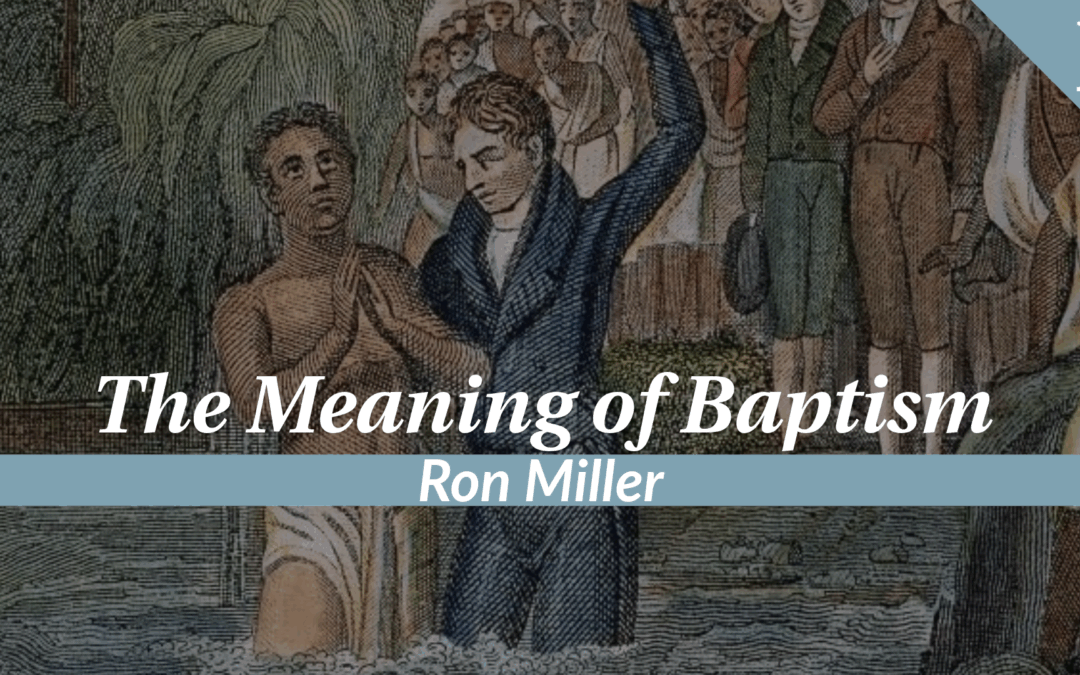
by Ron Miller | Oct 20, 2025 | Biblical Worship, Ecclesiology, New Testament, Practical Theology, Preaching, Sermons, Systematic Theology
*Editor’s Note: The following series on Baptism was originally delivered sermonically by Pastor Ron Miller to Covenant Baptist Church in Clarksville, TN. As each of the four installments are released, they will eventually be linked together here.
The Meaning of Baptism, Part 1 | Ron Miller
I. Baptism as a New Covenant Church Rite
What is baptism? According to Scripture it is a new covenant church rite in which a believer is immersed in water in the Triune name. Now because all churches this side of heaven are imperfect, there is not unanimous agreement on every part of that general definition. In fact, every main word of that definition has been challenged or modified by some church. But most churches accept this starting point definition according to the New Testament, even if they add to or qualify parts of it. But as Baptists, this is what we believe baptism is as an act. It has an element and an action; water is the element and dipping is the action. Therefore, it is to be distinguished from Spirit baptism and other religious washings. So, that is one way of answering the question, “What is baptism?”. But there are other Biblical ways as well.
II. Baptism as an Ordinance of Jesus Christ
What is baptism? It is an ordinance of Jesus Christ. Our confession in chapter 28 claims that Christian baptism is an ordinance appointed by the Lord Jesus. An ordinance is an authoritative rule laid down by a rightful lawgiver. So, local governments pass laws often called ordinances that are meant to be obeyed. And Jesus Christ has the authority, the right, and the position to ordain rituals like baptism in his church. Ephesians 1:22 and 5:23 teach that Christ is the head of the church and the head of all things to the church. Matthew. 28:18 declares that he has all authority in heaven and earth, so he defines the church’s mission. Because of his resurrection, Jesus is the enthroned king of the church. And he has made known his will about baptism in several ways:
- By approving of John’s baptism. John the Baptist’s ministry of repentance and baptism was fundamentally the same as Christian baptism. It was preparatory for it but from God the Father, John 1:33. John was not a self-appointed administrator of a strange new religious practice. And Jesus approved of his cleansing ritual in word and practice, John 3:23-24, Mt 11:11-12.
- By accepting John’s baptism. Jesus Christ fulfilled all righteousness by accepting baptism from John. Luke 3:21-22. Mt 3:13-17. Note the presence of the Trinity at his baptism. His practice sets an example for believers. We know baptism is important to our King because he underwent it himself for us.
- By baptizing through his disciples – John 3:22; 4:1-2. Jesus’ ministry included not only preaching but baptizing disciples. He did this through the 12. Occasionally, people seem surprised by the Great Commission’s inclusion of baptism. But Jesus’ public ministry had from the beginning included the baptism of repentant disciples.
- By the Great Commission. Mt 28:18-20. All the prior reasons are sufficient to know our Lord’s mind about baptism. But in a wonderful word of clarity, before his ascension, Christ tasks the church with his marching orders. And this included baptizing his followers. This famous commission is a positive law, a mandatory point of obedience laid down by the church’s only lawgiver. Baptism is not our Lord’s suggestion or option for extra spiritual people. It is the Lord’s ordinance to be obeyed in a display of loving submission to his law. It is to be the first outward act of following for those who profess that as disciples they want to follow him.
- By the apostle’s continued practice of baptism. The teaching and practice of the apostles were in accordance with Christ’s ordinance. Even a cursory look at the history in Acts and the epistles shows that baptism was continued. Jesus promised to be with his church to the end of the age to support them in their going, discipling, baptizing, and teaching, and so his will for baptism continues. It has not passed away in this age of the Spirit. Baptism wasn’t a temporary rule. It continues as the pattern set by Christ and his apostles until Christ returns. So, men and women disciples should submit to baptism as to the Lord. It is his ordinance.
III. Baptism as a Sacrament
What is baptism? It is a sacrament of the New Covenant. At its simplest level, a sacrament is a sacred thing. It is something God separates out with meaning to become special to his church. And at this level, plainly, baptism is a sacrament because it is not an ordinary dipping in water. It is not a typical bath. It is not as 1 Peter 3:21 says, “the removal of dirt from the body”. God has redefined this washing with special meaning. He has elevated it to be a sacred thing. So, baptism is a sacrament.
Now I have used the word sacrament for the almost three years I’ve been your pastor when I refer to the Lord’s Supper and Baptism. Some of you may have come from a background that didn’t use that word and even positively detested it. It’s not a word found in the Bible, but it is a word that accurately sums up some biblical teaching about the ordinances of Baptism and Lord’s Supper. So, although others corrupt the meaning and practices of the sacraments, that is no reason for us to throw the good word away. In fact, I hope you will see the rich Bible truths that are meant by this word.
But let’s return to the word sacrament. Notice from my definition – something God separates out with meaning to become special to his church – that it is God who ordains the sacraments. The new covenant sacraments are ordained by Jesus Christ. So, there is no conflict between ordinances and sacraments. Baptists and others have used both words for centuries in order to show the breadth of meaning of these gifts from God. They are two words that describe the same thing from two different perspectives. That God ordains sacraments also means that we are not free to make them, change them, or remove them. We cannot add 5 more to the 2 to get 7. We cannot deny these physical reminders of the grace of God, spiritualizing them out of existence. Sacraments are the positive law of God and as Christians, we must accept them as from the Lord.
Now have you ever asked yourself, why would God add a ceremony for his disciples that plunged them under water? It’s kind of inconvenient. He could have invented any ceremony. Why this one? Remember our definition again. God “separates out with meaning” something ordinary to make it sacred. God takes something we understand and heightens what it portrays into the spiritual realm. Before I explain what some of those things are in Baptism, let’s look quickly at the Lord’s Supper since it is more familiar to us.
Why would God choose bread and wine as the elements of the table? In part, because we already understand them at the ordinary level of feeding our bodies. So, God takes something we know from day-to-day life and elevates it with spiritual meaning. God says this bread and wine represent Christ’s body and blood which give us spiritual life. John 6:22-59 and I Cor 10:16 explain this. Ordinary food and drink strengthen our bodies. Christ received by faith through the elements of the Lord’s Supper strengthens our souls. That is one example of God giving spiritual meaning to an ordinary act that gives it a spiritual use in the church, what we call a sacrament.
So why would God ordain baptism as a sacrament? What meaning does he want to invest in it to glorify himself and benefit us? There are several answers and this first one (and the only one we will study today) may not be what you are expecting. Why would God ordain plunging in and out of water? The bible tells us one reason is that it pictures salvation through the waters of judgment. All sacraments are visible pictures, even dramas, that portray God’s promises. The sacraments are God’s visible word. What our ears hear in the new covenant gospel promises, Baptism and the Lord’s Supper portray for our other senses, especially our eyes. We see God’s promises in a symbol form in the sacraments. We are led to believe not just with our ears but our eyes. So, when we see baptism we should think this pictures life through death, indeed, salvation through Jesus.
Let me show you that from Scripture in two Old Testament types and then in the New Testament. In Genesis 7, the story of Noah and the flood, water comes as judgment over the whole earth. Water is associated with Jesus. Water is not here, a life-sustaining drink but has a frightening connotation. Noah and his family in the ark come through the waters to new life. The earth itself is replenished with new life as the floods recede. This is both true history and a typical picture of salvation thru the waters of judgment.
In Exodus 14, the waters of the Red Sea come as God’s judgment mechanism on Egypt. But Israel is saved through the waters. Again, this is true history and the greatest Old Testament picture of salvation. God’s glory is manifest in his people’s salvation through the waters of judgment. To pass through the waters is to experience the salvation of God. Other Old Testament examples and the death of Christ as a baptism could be given but I trust these two obvious ones will show the point that sometimes God’s salvation is pictured as surviving water.
1 Peter 3 tells us that baptism corresponds to this. That is, it fulfills these types or prophetic pictures of salvation. Baptism brings us visibly and bodily to the symbolic waters of judgment. Not literally but symbolically and sacramentally. Scripture identifies water with judgment; many of us have a healthy fear of water and are afraid to be baptized. This is a part of nature and should help us to appreciate what is happening in our baptism. We go down into the waters and then are saved through them as we are brought out. This dramatically portrays God’s glorious salvation of us through deserved judgment. Now this symbolism isn’t the real thing. The real thing is, according to Peter, the resurrection of Jesus Christ. His coming up to resurrection life is the effecting reality. It was his death (his entering judgment) and his life (his resurrecting victory over judgment) that when applied to us by faith, saved us from judgment.
Ron has been pastor of Covenant Baptist Church since July of 2017. Pastor Ron is thankful for being raised in a Christian home where God called him to salvation at an early age. He loves his wife, public worship, and pastoring this local church. He has a special interest in aiding theological education in North and South America and in teaching Baptist history. Ron is the host of the weekly podcast Particular Pilgrims.

by Austin McCormick | Oct 13, 2025 | Ecclesiology
Introduction
Earlier this year, former MBTS professor Matthew Barrett announced that he was becoming Anglican. Then last week, Barrett lauded one of his PhD students, Connor Shackleford, for his maturity and courage in making the same theological shift. If one were making assessments based upon social media posts alone, it would appear there is currently an increasing trajectory toward what is often called “High Church Christianity.” But social media often fails to paint the picture of the current climate. (For instance, people don’t typically post about holding to the same theological views they’re already convinced of; a few loud voices don’t determine what everyone believes, etc.). Therefore, I write to encourage those who are still committed Confessional Baptists and to exhort us to remain so. Below are three reasons “Why I’m Still a Baptist” and why you should be too.
I. Hermeneutics
One of the reasons Barrett stated for his shift to Anglicanism was that the Baptist hermeneutic is “modern to the bone.” Barrett makes this claim after expressing his displeasure with the Southern Baptist Convention for rejecting the Nicene Creed in a resolution at their 2025 annual meeting. But is the Baptist hermeneutic truly “individualistic” as Barrett says? I propose not, given the rich and robust hermeneutic methodology of the Confessional Baptist Tradition.
Baptists affirm Sola Scriptura. We affirm that Scripture is a sufficient rule for our faith and practice. We affirm that Scripture is authoritatively from God and that His voice speaking to us in Scripture must be heeded.
But we also affirm Scripture as the Norma normans—or as the Rule that rules. In other words, we are not anti-confessional, anti-creedal, or anti church history. We affirm the high value of edifying documents authored by men in history. But these writings, which help us to better understand Scripture, are a norma normata or a rule that is ruled. That is, they are under the supreme authority of the Bible. I contend that this is neither “modern” nor “individualistic.”
Reading the Baptist Tradition more thoroughly may help to better appreciate the Baptist hermeneutic. The 18th-century theologian John Gill wrote about the value and necessity of confessions and creeds in his introduction to his Complete Body of Doctrinal and Practical Divinity. Benjamin Keach wrote a tome on interpreting types to better understand Scripture. The likely editor of the 1689 Confession, Nehemiah Coxe, demonstrates masterful hermeneutical abilities in his defense against Trinitarian and Christological heresies. The Second London Confession of Faith itself has multiple paragraphs on Bible interpretation in its first chapter. The Baptists have a historically thoughtful theology of Bible interpretation. Let us take up and read.
II. Credo Baptism
The Baptist hermeneutic which teaches me that Scripture alone is the supreme judge by which all controversies of religion are to be determined (2LCF 1:10) leads me to affirm Credo Baptism. There is no command nor example in the Holy Scripture of an infant being baptized. (Baptist Catechism, Q.99) Infant Baptism is not necessarily contained in Holy Scripture. Infant Baptism is not the antitype of Old Covenant circumcision; regeneration is. Acts 2:38-39 does not teach Infant Baptism, since those who receive this New Covenant sacrament are not just described as “your children” but are epexegetically labeled “everyone who the LORD our God calls to himself.” In other words, “you,” “your children,” and “everyone” are effectually called and regenerate believers.
Rejecting Infant Baptism doesn’t make you an individualist who ignores church history. And being Reformed doesn’t necessitate affirming Paedo Baptism.[1]
For those wrestling with this doctrine, I encourage you to read Fred Malone’s book The Baptism of Disciples Alone. Then read Baptism in the Early Church by Hendrick F. Stander and Johannes P. Louw. For the best sermon I’ve heard on Acts 2:38-39, I point you to a message preached by Mr. Rexford Semard.
III. Congregational Church Governance
Peter Toon (an Anglican author) acknowledged that modern Anglican ecclesiology is foreign to the Bible. He said:
“The modern Anglican … does not see any blueprint for the polity and government of the church written in Scripture. He is too well aware that biblical studies have shown that there is no one form of ordained ministry and church government found in the books of the New Testament.”[2]
17th-century Anglicans did not affirm this view; there are other Anglicans who likely affirm that their ecclesiology is Scriptural. But Toon is content to construct an innovative ecclesiology based on how things happened in history.
Baptists would deny this as an acceptable approach and would instead turn to the Holy Scriptures to construct our argument for church order. Instead of creating an artificial hierarchy of Bishops over local churches, we understand that Bishops or Overseers are the same church office as Elders/Pastors within one local church. We further see the local church as those who have been given the keys of the kingdom from Christ to let in her own members, to remove them with church discipline, and to elect her own church officers. Moreover, local churches voluntarily associate with other churches instead of imposing authority over one another.
To better understand Plural-Elder Led Congregationalism, I refer you to Dr. Waldron’s helpful contributions in the book “Who Runs the Church?”.
A Concluding Word
Much more could be written about Baptist covenant theology, religious liberty, regenerate church membership, etc. But for now, I leave you with a phrase likely coined by Confessional Baptist Caleb Bobryck, which I hope is trendier than converting to Anglicanism:
“Stay Baptist, My Friends.”
[1] Even the Post Reformation historian Richard Muller said that John Gill belonged “to the Reformed confessional tradition.” He further stated that “this must be acknowledged despite the pointed disagreement between Baptists and the Reformed confessional tradition over the doctrine of Infant Baptism.”
Richard A. Muller, “John Gill and the Reformed Tradition: A Study in the Reception of Protestant Orthodoxy in the Eighteenth Century,” in The Life and Thought of John Gill (1697-1771) a Tercentennial Appreciation, edited by Michael Haykin. (New York: Brill, 1997), 51.
[2] Paul E. Engle and Steven B. Cowan, eds., Who Runs the Church?, Zondervan Counterpoints Collection (Grand Rapids, MI: Zondervan, 2004), 58.
Austin McCormick is a Pastor of Covenant Baptist Church (Clarksville, TN). He holds a B.A. in Biblical Studies from Spurgeon College, a M.A. in Pastoral Studies and a M.Div from Covenant Baptist Theological Seminary. By God’s free and sovereign grace, Austin was saved early in his adulthood. He is married to Rachel, and together they have three children: Geneva, Benjamin, and Bristol.

by Timothy Decker | Oct 1, 2025 | Apologetics, New Testament
*Editor’s Note: The following post is part of Dr. Timothy Decker’s series “A Worthy Inclusion? The Johannine Comma of 1 John 5:7-8.” Click the following numbers to read the other parts of this series.
1, 2, 3, 4, 5, 6, 7.
A Worthy Inclusion? The Johannine Comma of 1 John 5:7–8
Part 7: The Comma among the Textus Receptus Tradition
It is not irresponsible to ask those adherents of the Textus Receptus or the Received Text, “Which TR?”[1] Though the TR is a fairly stable tradition in itself, its rendering of the Comma reinforces the question of which edition of the TR is to be the purest. This is not meant as a blight on the TR tradition per se. Rather, it calls into question even more so the validity of the Comma’s inclusion in 1 John 5:7–8. If the TR, as the primary tradition of the Greek NT that accepts the reading of the Comma, is itself unstable, then that should call into question the Comma itself.
It has been proven already that the Comma is on very shaky ground according to the external evidence (see part 2). And its historical pedigree is not much better, restricting it to one locale and language tradition (see part 3). Even the arguments for its inclusion from the internal evidence is not convincing, at least not demanding the external evidence be overturned (see part 4 and 5). And if there is disagreement as to both its meaning and its legitimacy throughout history (part 6), perhaps there is good reason to exclude the Comma from our Bibles, as Erasmus believed and Luther did in his German translation.
Having collated 30 editions of the TR tradition in the Johannine epistles, I would like to share the results of that collation to 1 John 5:7–8 specifically. I’ll make use of two different formats to display these results. The first is how the TR would appear if it was in a critical edition which displayed all of its variants in a textual apparatus. I have patterned this presentation after the sigla of the NA28th edition. Secondly, I will use a line-by-line method similar to Reuben Swanson in order to present the various readings among the TR tradition according to each unique variant, of which there are eight (!). These two displays will demonstrate just how unstable the TR tradition is at 1 John 5:7–8.
The Critical Apparatus Display
The brilliance of the Nestle-Aland Novum Testamentum Graece editions is that it developed a system of sigla or signs to indicate a vast amount of information in a very small space. The sigla represents both the existence of a variant as well as the kind of variant. Whether you are able to interpret the sigla or not, this will give a sense of the TR’s instability.
NA28th Edition w/ Critical Apparatus
7 ὅτι τρεῖς εἰσιν οἱ μαρτυροῦντες⸂, 8 τὸ πνεῦμα καὶ τὸ ὕδωρ καὶ τὸ αἷμα, καὶ οἱ τρεῖς εἰς τὸ ἕν εἰσιν⸃.
–––––––––––
7/8 ⸂ in terra, spiritus et aqua et sanguis (+ et hi tres unum sunt in Christo Iesu vgmss; Spec). et tres sunt, qui testimonium dicunt in caelo, pater, verbum (filius 1 vgmss) et spiritus, et hi tres unum sunt (+ in Christo Iesu 1 vgmss) 1 r vgmss; Spec (Prisc Fulg)
¦ εν τω ουρανω πατηρ λογος και πνευμα αγιον και ουτοι οι τρεις εν εισιν και τρεις εισιν οι μαρτυρουντες εν τη γη πνευμα υδωρ και αιμα 61 (629)
¦ εν τω ουρανω ο πατηρ (+ και 88v.l.) ο λογος και το αγιον πνευμα και ουτοι οι τρεις εν εισιν και τρεις εισιν οι μαρτυρουντες εν τη γη το πνευμα και το υδωρ και το αιμα και οι τρεις εις το εν εισιν 88v.l. 221v.l. 2318. 2473. (429v.l. 636v.l. 918) vgcl
Though the text is fairly clean with only a few sigla, the information in the apparatus looks congested, which it is. The NA28th is simply displaying the variants highlighted in part 2 of this series. Truth be told, it only includes the general details of the various Greek manuscripts and their readings. It does not demonstrate the differences of readings of each witness, only that there are various readings by the “v.l.” superscripts. It also spends a lot more time than usual on the various Latin renderings. If we were only comparing the sigla in the main text of both, then the NA28th has only one siglum indicating a textual variant—the ⸂ and ⸃ which indicates different words used, namely the Comma. Now compare this with the TR tradition if it had a critical apparatus much like the NA28th.
Textus Receptus Tradition with Critical Apparatus[2]
7 ὅτι τρεῖς εἰσιν οἱ μαρτυροῦντες ⸋1ἐν τῷ οὐρανῷ, ⸂1 ὁ πατήρ, ⸆ ὁ λόγος, καὶ τὸ Ἅγιον Πνεῦμα⸃· ⸂2 καὶ οὗτοι οἱ τρεῖς ἕν εἰσι⸃.
8 καὶ τρεῖς εἰσὶν οἱ μαρτυροῦντες ⸂3 ἐν τῇ γῇ⸃,⸌ ⸂4 τὸ Πνεῦμα, καὶ τὸ ὕδωρ, καὶ τὸ αἷμα⸃· ⸋2 καὶ οἱ τρεῖς εἰς τὸ ἕν εἰσιν⸀.⸌
–––––––––––
7-8 ⸋1 E1 2 Ald Ger Köp Col | ⸂1 2 4 5 8 7 E3 Beb Ses ¦ 1–6 8 7 E4 5 Bry Bas ¦ 1–4 6 5 7 8 St1 ¦ text St2 3* 4 BzLat1557 BzF1–4* Bz O1 2 Elz1624 1633 Oxf1873 | ⸆ καὶ CP BzO3–5 | ⸂2 καὶ οἱ τρεῖς εἰς τὸ ἕν εἰσιν CP | ⸂3 επι της γης CP | ⸂4 πνεῦμα, καὶ ὕδωρ, καὶ αἷμα E3–5 Beb Ses Bry Bas | ⸋2 CP | ⸀εἰσι St1 2 3*
text St4 BF1–4* Bz O1 2 Elz1624 1633 Ox1873
Unlike the NA28th text, there are a total of eight sigla to indicate varition units among the witnesses. They include long omissions (⸋), different words or word order (⸂ and ⸃), an insertion (⸆), and a different spelling (εἰσιν⸀)[3]. And among the variant unit marked ⸂1, there are four different renderings of that phrase. The convenience of such an apparatus is that it marks a lot of variant readings in such a small amount of space. Nevertheless, it is a highly congested and disheveled two verses. As will be displayed below, the TR tradition has actually produced eight total variations of the Comma!
When I say that the tradition evolved or developed, I mean that very literally.[4] Among the TR tradition, the well-known phrase would not appear exactly as it does in Scrivener’s final TR form until Stephanus’s fourth and final 1551 edition. And even then, later editions, such as some of Beza’s, would revert. Now if we were to ignore the final variation of the last word of v. 8 (a final nu), then we could move this earlier to the second edition of Stephanus (1549).
Most notably, the inclusion of the comma did not begin until Erasmus’s 3rd edition of 1522. And even then, it reads almost perfectly with the Latin Vulgate, omitting the articles (Latin has no articles!) and following the Latin word order. In his 4th and 5th editions, he would include the Greek articles, but still maintain the Latin word order. However, Aldine, Gerbelius, Köpfel, Colinaeus do not include the Trinitarian formula at all! The first Stephanus edition (1546) would transpose a couple of the words. The final three minor/octavo editions of Beza would add a word. And the Complutensian Polyglot traversed its own unique path.
Now I readily admit that the variations among the 30+ editions of the TR that I consulted are very minor. Most differences are omissions of the Greek article, changing word order for “Holy Spirit,” or adding “and” to the list of heavenly witnesses. Yet these differences reflect the likelihood that the Johannine Comma developed over time and actually arose from the Latin text handed down from the Western church.
But the point here is, again, one of stability. It is more than fair to say that the inclusion of the “heavenly witnesses” in this Trinitarian formula is a staple to the TR tradition. Even the small variations among the various TR editions that depart from the common TR reading are extremely minor in terms of meaning and translation. I only include them here to be thorough and to show that the TR is not as uniform as is so often claimed.[5] And like nearly all printed Greek New Testaments, there is development and change over time, with the goal of getting the text right.
Calvin believed this to be the case as he himself likely changed GNTs over time. He would say of this passage’s inclusion, “[I]t is found in the best and most approved copies,”[6] likely meaning printed editions. Some have argued that Calvin was dissatisfied with the 1534 text of Colinaeus (which omitted the Johannine Comma) and would switch to either Erasmus’s 4th edition or Stephanus’s 1546 (first) edition.[7] If that is the case, then Calvin commented on a general form of the Comma Johanneum, but not its final form as found in the Scrivener TR, inconsequential as these earlier editions may differ. Not only that, but he pursued a printed GNT that reflects what he felt was a better text. Should we not also do likewise? Now let us display an interpretation of the above text and apparatus with a format inspired by Reuben Swanson’s display of the Greek text.[8]
A Horizontal Display of the TR Tradition
Similar to the display of the 10 Greek manuscripts that included the Comma in part 2 of this series, we will render 30 different editions of the TR in a way to point out every unique reading.
|
1) Scriv1881 Stephanus4 BezaFolios1–4* BezaOctavos1 2 Elzevirs1624 1633 Oxford1873
|
|
ὅτι τρεῖς εἰσιν οἱ μαρτυροῦντες ἐν τῷ οὐρανῷ,
ὁ πατήρ, ὁ λόγος, καὶ τὸ Ἅγιον Πνεῦμα·
καὶ οὗτοι οἱ τρεῖς ἕν εἰσι. καὶ τρεῖς εἰσὶν
οἱ μαρτυροῦντες ἐν τῇ γῇ,
τὸ Πνεῦμα, καὶ τὸ ὕδωρ, καὶ τὸ αἷμα·
καὶ οἱ τρεῖς εἰς τὸ ἕν εἰσιν.
|
|
2) Erasmus1 2 Aldine Gerbelius Köpfel Colinaeus
|
|
ὅτι τρεῖς εἰσιν οἱ μαρτυροῦντες, _______
_________________________________________________________________________________________________________________________________________________________
τὸ Πνεῦμα, καὶ τὸ ὕδωρ, καὶ τὸ αἷμα·
καὶ οἱ τρεῖς εἰς τὸ ἕν εἰσιν.
|
|
3) Complutensian Polyglot
|
|
ὅτι τρεῖς εἰσιν οἱ μαρτυροῦντες ἐν τῷ οὐρανῷ,
ὁ πατήρ, καὶ ὁ λόγος, καὶ τὸ Ἅγιον Πνεῦμα·
καὶ ___ οἱ τρεῖς εἰς τὸ ἕν εἰσι. καὶ τρεῖς εἰσὶν
οἱ μαρτυροῦντες επι της γης,
τὸ Πνεῦμα, καὶ τὸ ὕδωρ, καὶ τὸ αἷμα· __________________.
|
|
4) Erasmus3 Bebelius Sessa
|
|
ὅτι τρεῖς εἰσιν οἱ μαρτυροῦντες ἐν τῷ οὐρανῷ,
_ πατήρ, _ λόγος, καὶ _ Πνεῦμα Ἅγιον·
καὶ οὗτοι οἱ τρεῖς ἕν εἰσι. καὶ τρεῖς εἰσὶν
οἱ μαρτυροῦντες ἐν τῇ γῇ,
_ Πνεῦμα, καὶ _ ὕδωρ, καὶ _ αἷμα·
καὶ οἱ τρεῖς εἰς τὸ ἕν εἰσιν.
|
|
5) Erasmus4 5 Brylinger Basel
|
|
ὅτι τρεῖς εἰσιν οἱ μαρτυροῦντες ἐν τῷ οὐρανῷ,
ὁ πατήρ, ὁ λόγος, καὶ τὸ Πνεῦμα Ἅγιον·
καὶ οὗτοι οἱ τρεῖς ἕν εἰσι. καὶ τρεῖς εἰσὶν
οἱ μαρτυροῦντες ἐν τῇ γῇ,
_ Πνεῦμα, καὶ _ ὕδωρ, καὶ _ αἷμα·
καὶ οἱ τρεῖς εἰς τὸ ἕν εἰσιν.
|
|
6) Stephanus1
|
|
ὅτι τρεῖς εἰσιν οἱ μαρτυροῦντες ἐν τῷ οὐρανῷ,
ὁ πατήρ, ὁ λόγος, τὸ καὶ Ἅγιον Πνεῦμα·
καὶ οὗτοι οἱ τρεῖς ἕν εἰσι. καὶ τρεῖς εἰσὶν
οἱ μαρτυροῦντες ἐν τῇ γῇ,
τὸ Πνεῦμα, καὶ τὸ ὕδωρ, καὶ τὸ αἷμα·
καὶ οἱ τρεῖς εἰς τὸ ἕν εἰσι .
|
|
7) Stephanus2 3
|
|
ὅτι τρεῖς εἰσιν οἱ μαρτυροῦντες ἐν τῷ οὐρανῷ,
ὁ πατήρ, ὁ λόγος, καὶ τὸ Ἅγιον Πνεῦμα·
καὶ οὗτοι οἱ τρεῖς ἕν εἰσι. καὶ τρεῖς εἰσὶν
οἱ μαρτυροῦντες ἐν τῇ γῇ,
τὸ Πνεῦμα, καὶ τὸ ὕδωρ, καὶ τὸ αἷμα·
καὶ οἱ τρεῖς εἰς τὸ ἕν εἰσι .
|
|
8) BezaOctavos3–5
|
|
ὅτι τρεῖς εἰσιν οἱ μαρτυροῦντες ἐν τῷ οὐρανῷ,
ὁ πατήρ, καὶ ὁ λόγος, καὶ τὸ Ἅγιον Πνεῦμα·
καὶ οὗτοι οἱ τρεῖς ἕν εἰσι. καὶ τρεῖς εἰσὶν
οἱ μαρτυροῦντες ἐν τῇ γῇ,
τὸ Πνεῦμα, καὶ τὸ ὕδωρ, καὶ τὸ αἷμα·
καὶ οἱ τρεῖς εἰς τὸ ἕν εἰσιν.
|
Admittedly, many editions are very near identical to Scrivener’s final form. Beza’s three octavo editions only add “and” in v. 7. Even closer is the first three Stephanus editions that leave out the final nu at the very end of v. 8. This is a small detail, yet they are the only three that do this. This is relevant because the TR is known for “cleaning up” spelling and grammar (like “an apple” vs “a apple”). Leaving off the final nu at the end of v. 8 with v. 9 beginning with a vowel, sets up slight spelling error. This is probably why the fourth edition of Stephanus cleaned it up further. From then on, it stuck.
Nevertheless, very early on in the tradition and before influences and motivations set in, the TR tradition excluded the Comma (see reading #2) and read just like our modern Greek New Testaments (NA28th, UBS6th, SBLGNT, THGNT, Robinson & Pierpont Byzantine Textform, & Hodges and Farstad Majority Text). Perhaps most unique is the Complutensian Polyglot’s version, the rendering of which is very similar to GA 629 but without the Latinizations.
What I hope to demonstrate is the variety within the TR tradition. Scrivener followed Beza’s final folio edition of 1598. But there are seven other choices among the TR tradition. Why is Beza’s deemed the best? Only one of the Greek manuscripts reads identically with Scrivener’s. What makes GA 2318, an 18th century manuscript (!), the best of the ten?
Comparing the TR editions with the Ten Greek Manuscripts
Those on both sides of the Comma’s authenticity have claimed that three of the ten Greek manuscripts that include the Comma match Stephanus 1550 and Scrivener (221marg, 2318 and 2473).[9] Having just worked through the variations among the TR editions above, I disagree with both of them.
In my own examination of 221marg, 2318 and 2473, I have concluded that only manuscript 2318 (written in the 18th century!) is an identical match to the commonly standardized modern edition of the TR by Scrivener (1881). While 2473 was close, it was missing the final nu (or what I jokingly call in my Greek class “the rarely absent nu”). This small spelling variation (explained above) is helpful to determine from which of the TR editions it was likely copied: probably the famous and very popular Stephanus’s Editio Regia of 1550. GA 2473 was dated to 1634, after Beza, the KJV, and the Elzevirs 1633 editions (this is where the term Textus Receptus was made common). The marginal reading and text of 221 implies it is similar, but we cannot know for sure what the hand left out (see part 2). Therefore, the final form of the TR’s Comma has only one Greek manuscript behind it.
Of the 30 TR editions I have collated, only 10 are an identical match to Scrivener’s TR, the first being Stephanus’s 4th edition of 1551. Therefore, it was not known in its final form among the Protestants and Reformers until latter half of the 16th century.
Conclusion
This being the final segment of this seven-part series, I do not wish to shake the faith of believers. But I would ask you to consider the evidence and ask yourself, “Do I believe the Comma is authentic because of a tradition accepted by the papists and most Protestants at the time of the Reformation and post-Reformation or because all the evidence points to it?” For me, the choice is simple.
[1] See Mark Ward, “Which Textus Receptus? A Critique of Confessional Bibliology,” Detroit Baptist Seminary Journal 25 (2020): 51–77.
[2] The collation of the TR tradition is making use of the Scrivener 1881 edition of the TR as the primary text and comparing all of the TR editions with Scrivener’s. This is known as a diplomatic edition, which uses as its base text a manuscript or final edition, such as Scrivener’s 1881. The NA28th is an eclectic text and apparatus, seeking to ascertain from the evidence in the apparatus what the correct reading should be in the text.
[3] To include variations of the “movable nu,” I have displayed the siglum at the end of the word the sign that indicates a different word or spelling
[4] Parker implied this of the TR, “Authorized by Erasmus, canonized by Stephanus, and deified by Beza, Textus Receptus reigned pre-eminent in the reformed Churches of the sixteenth century.” T. H. L. Parker, Calvin’s New Testament Commentaries, Second ed. (Louisville, KY: Westminster John Knox Press, 1993), 155.
[5] For another example of this, see my guest article at the Evangelical Textual Criticism blog “A Critical Apparatus of the Textus Receptus Tradition,” March 2024, accessed: https://evangelicaltextualcriticism.blogspot.com/2024/03/guest-post-by-timothy-decker-critical.html.
[6] Calvin’s Commentary at 1 John 5:7.
[7] See Parker, Calvin’s New Testament Commentaries, 151–57. See also John D. Currid, Calvin and the Biblical Languages (Fearn, Scotland: Mentor, 2006), 41–42.
[8] See his 7 volumes titled New Testament Greek Manuscripts: Variant Readings Arranged in Horizontal Lines against Codex Vaticanus.
[9] See Elijah Hixson’s “The Greek Manuscripts of the Comma Johanneum (1 John 5:7–8)” (https://evangelicaltextualcriticism.blogspot.com/2020/01/the-greek-manuscripts-of-comma.html) and Taylor Desoto’s “1 John 5:7 and Modern Criticism” (https://youngtextlessreformed.com/2020/01/16/1-john-57-and-modern-criticism/).
Dr. Timothy Decker is one of the pastors of Trinity Reformed Baptist Church of Roanoke, VA, having joined them in 2018. He holds a B.A. and M.A. biblical studies from Carolina University (formerly Piedmont International University), a Th.M. in New Testament from Southeastern Baptist Theological Seminary, and a Ph.D. in biblical studies from Capital Seminary and Graduate School. In his dissertation research, he examined the style of biblical Hebrew poetry in the New Testament. He has presented various papers at academic society meetings and authored numerous articles in several different scholarly journals. He is a member of ETS and IBR. When he is not reading or researching, he enjoys spending time with his wife and four children.
Courses taught at CBTSeminary: Elementary Greek I, Elementary Greek II