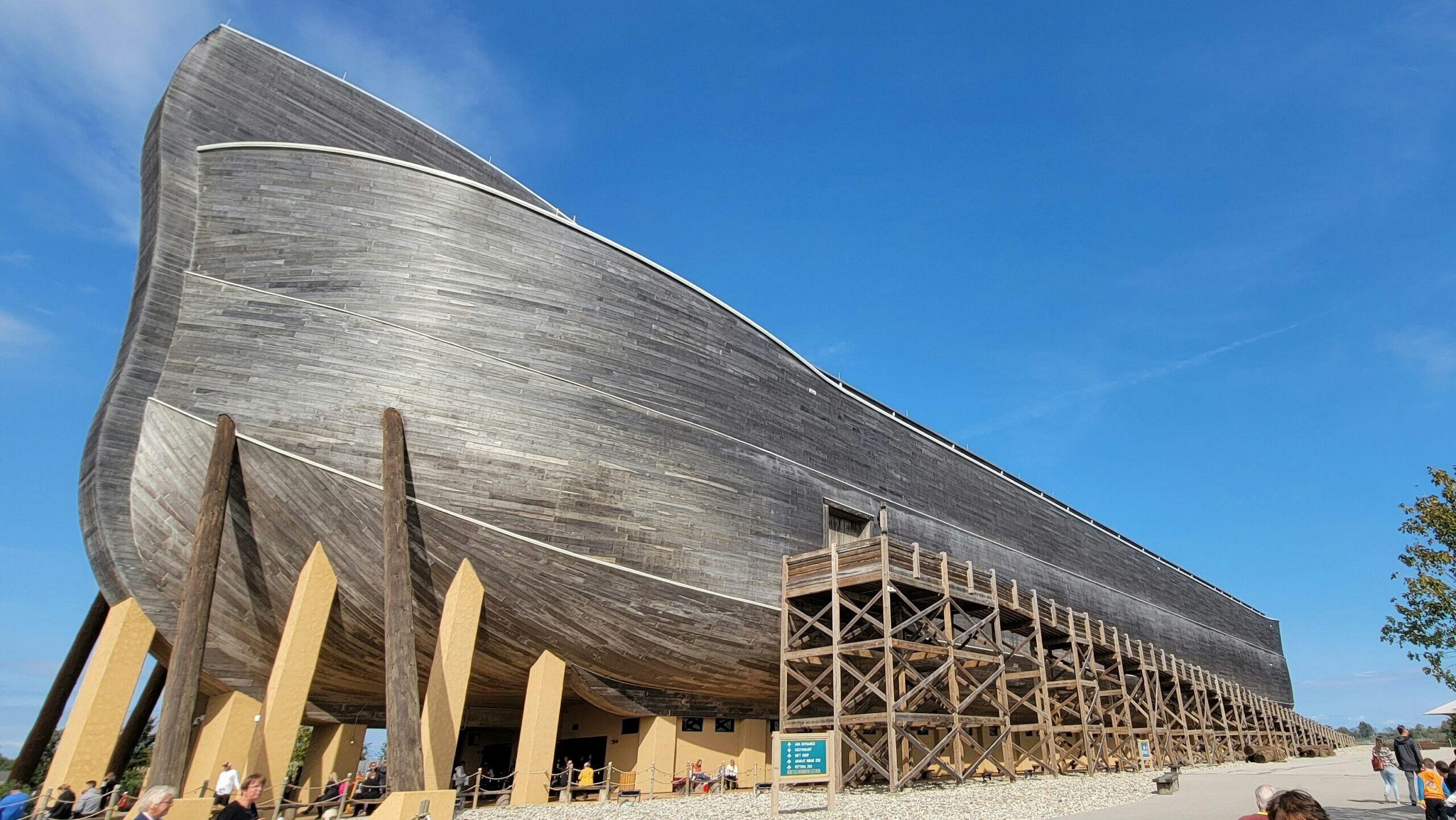
When you hear the account of the Ark, what is the first thing that comes to your mind? What is it really about?
For many, they are met with nostalgia as they remember nursery walls painted with faces of glee. Animals are smiling; the waters are calm. Everything and everyone is okay because Noah built an arky-arky out of gopher barky. Such a thought, if we are not careful, trivializes and distorts the weight of what actually occurred in the flood narrative. It removes the terror of God’s judgement and the transcendent height of his holiness. It lessens the depth of man’s dire condition in which “the LORD saw that the wickedness of man was great in the earth, and that every intention of the thoughts of his heart was only evil continually” (Genesis 6:5).
For others—perhaps out of reaction to those who seek to soften the blow of the Ark account—focus entirely on the floods of judgement. To them, the account is nothing but horror, wrath, and fury, nothing but God “regretting that he had made man on the earth” (Genesis 6:6). This thought, too, however, is a bit unbalanced. Yes, God’s flood of wrath is evident and, indeed, poured out upon the entirety of humanity, but, if we fixate on this reality alone, we miss the glory of God’s grace magnified in that He, out of steadfast love and mercy, saved a family, for “Noah found favor in the eyes of the LORD” (Genesis 6:8).
So, then, the question remains: what is Noah and the Ark all about? I want to argue that this real, historical narrative about a man and his boat is all about the Lord Jesus Christ. In other words, the account of Noah is about a God who is righteous and holy, who looks upon the earth and sees it filled with sinners, and yet out of steadfast, everlasting, covenant love, saves them in the Greater Ark which is His Son!
Charles Spurgeon agrees: “The ark, which saved from the floods of water, is a beautiful picture of Jesus Christ as the means of salvation, by whom multitudes of all flesh are preserved and saved from perishing in the floods of eternal perdition.”
This is our chief end of Old Testament interpretation, is it not? The burden and beauty of the Christian exegete is to see the person and work of Christ on every page. Our Lord modeled this hermeneutic himself while walking on the Emmaus Road: “And beginning with Moses and all the Prophets, he interpreted to them in all the Scriptures the things concerning himself” (Luke 24:27). It is fitting, therefore, to consider how the first book of Moses reveals Christ, who is our Greater Ark.
Our Ark Delivers from Greater Judgment
Genesis 6 unfolds in great familiarity. God looks upon the earth and sees nothing but wickedness abound. Such works of sin call for judgement as God himself declares: “I will blot out man whom I have created from the face of the land, man and animals, and creeping things and birds of the heavens, for I am sorry that I have made them” (Genesis 6:7).
In so destroying, God declares that he will do so by flood: “For behold, I will bring a flood of waters upon the earth to destroy all flesh in which is the breath of life under heaven. Everything that is on the earth shall die” (Genesis 6:17). The account tells us that the fountains of the great deep burst forth and that rain persisted for 40 days and 40 nights, having the flood prevail for 150 days. All of humanity and all of creation is destroyed in the sweep of the flood—save Noah and his family via the deliverance of the Ark.
These waters of judgement illustrated and typified a greater judgement…a judgement that an ark of wood could never satisfy or endure. I am writing of that great wrath of God! That is, that hellfire of blinding white righteousness and justice against evil—the judgement that endures forever and ever, where “the worm dieth not” (Mark 9:48). It is not mere flood-waters that our Ark delivers us from. It is the waters of God’s fury against our sin.
How, then, does Christ deliver us from such wrath? In the same way that Noah and his family were…by being in the Ark! The only deliverance to be found from the wrath due our sin is to be “hid in Christ with God” (Ephesians 3:13). Our Greater Ark endures judgment in our place, enduring the battering of the waves of wrath in our stead, while all who are within are safe.
Our Ark Saves Greater Multitudes
Had the Lord not saved any in the days of Noah, he would have been just and worthy of praise; therefore, the fact that he rescued 8 individuals should lead us to extol him for his salvation to undeserving humanity. Should we not glory to a greater degree then, that Christ saves a number which no man can count (Revelation 7:9)? The Lord Jesus, our Greater Ark, fits a multitude of multitudes upon his salvific ship!
In our Ark, peoples from every nation, tribe, kindred, and tongue reside. Yes, Noah and his family were saved in their boat, but in Christ, the families of the earth might find rescue, “for the earth will be filled with the knowledge of the glory of the LORD as the waters cover the sea” (Habakkuk 2:14).
Consider further the kinds of sinners who are on this blessed boat of Christ. In Genesis 9, we find that Noah was a drunkard and that Ham was dishonorable. On our Vessel of Salvation, however, we see that all manner of sinners might be forgiven and have entrance on the Ark—from idolaters and murderers to adulterers and hypocrites. This deliverance from the watery wrath owed may be availed—not by building a makeshift raft of one’s works or by running from the waves, but by entering the one door of the Ark, for “if anyone enters by me, he will be saved” (John 10:9).
Our Ark Grants Greater Security
We find this in the prescription of the build of the Ark. The Lord provided Noah specific blueprints for the ship: “Make yourself an ark of gopher wood. Make rooms in the ark, and cover it inside and out with pitch” (Genesis 6:14). The purpose of the pitch was to secure the ark from leaks. To emphasize the monergistic hand of God in protecting this family, the Scriptures record that after all entered the boat, “the LORD shut him in” (Genesis 7:16). It was, ultimately, the Lord who kept Noah and his household safe. He was secure in the Ark. No threat of flood would touch him. No drip of water would condemn him. He was safe, for God shut him in.
The bastion of assurance is found in our Greater Ark, for Christ grants this eternal security in him! The Christian is held—not by the creaks of wooden architecture, but in the hands of our Good Shepherd, which no man can remove (John 10:29-30). In Christ, you are shut in. You are locked into the vessel, in which you need not fear an awaiting eternal flood, nor dread a watery condemnation, for “there is therefore now no condemnation to them which are in Christ Jesus” (Romans 8:1).
It is to recognize in humility that the believer will certainly fail in his weakness, although he is in the boat. Yet, it is to likewise acknowledge as one has said that, “Noah fell, I’m sure, many times in the ark, but he never fell out of the Ark.”
Our Ark Provides Greater Provisions
It is helpful to consider that God commanded Noah to “take with [him] every sort of food that is eaten, and store it up. It shall serve as food for [him and all the creatures]” (Genesis 6:21). God was concerned with the needs of those in the boat. He desired that they would be nourished
and taken care of while remaining in the safety of the ark.
In a greater way, Christ gives us greater provisions as we remain in Him. It is not merely physical food, for “man does not live by bread alone” (Matthew 4:4). He has given us spiritual sustenance in the ordinary (and especially public) means of grace. As you are carried in Christ, you have been given everything that you need in prayer, the Scriptures, and the ordinances. Feast, therefore, on the Word. Commune with Him in prayer. Remember your baptism and partake in the Lord’s Supper. Relish these simple, yet greater provisions, which are meant to nourish you as we await that heavenly dry ground.
See Jesus, therefore, as your Greater Ark. Find him on every page of Scripture. See him from Genesis to Malachi as the glorious point of all.
About the Author
John William Crawford is a ThM student at Covenant Baptist Theological Seminary, with particular focus on John Gill and the doctrine of the Trinity. He received his MDiv from Midwestern Baptist Theological Seminary and his BA in Biblical Studies from Spurgeon College in Kansas City, Missouri. John William currently resides in North Alabama with his wife, Gracie, and their two (soon-to-be three!) children.

Stay in touch with CBTSeminary
For more information about CBTS, go to CBTSeminary.org
Consider giving to CBTSeminary to help us train the next generation of gospel ministers.
Apply to CBTS today to be sharpened for a lifetime of faithful ministry.
Follow CBTS on our socials: X | Instagram | Facebook | YouTube
Sign up for our newsletter and receive monthly updates related to the Seminary.

This blog post is authored by a student of Covenant Baptist Theological Seminary.