The Lord’s Supper as God’s Provision for the Doubting Christian
Recovering the Pastoral Function of the Lord’s Supper through the writings of C.H. Spurgeon.
Over the years as a pastor, I have noticed that Christians who are struggling with doubt and weakened assurance often respond by turning inward, examining the quality of their repentance, obedience, or faith for evidence of their acceptance with God. This sort of introspection ends up intensifying their spiritual uncertainty rather than elevating it.
It’s during such times I’m reminded of my own limits as a pastor, as a Christian friend, as a mere man. The soul healing that those under my care so desperately need can’t be performed by me. It must come from above! Thankfully, the Lord’s Supper aids not only the pastor in his care for God’s people, but more importantly, it rescues downcast believers from despair.
In this article, I hope to demonstrate that the Lord’s Supper should not only be cherished as God’s provision for strengthening the weak faith of doubting Christians, but furthermore, when our churches appreciate this understanding of the Supper, it can transform how God’s people approach the Table.
Recently, Particular Baptist Heritage Books republished C. H. Spurgeon’s communion meditations in Till He Come with an Appendix entitled “The Lord’s Supper as a Means of Grace by Pas. D. Scott Meadows”.
Rather than encouraging troubled Christians to discover greater reasons for confidence within themselves, in this work Spurgeon repeatedly directs them outward toward Christ, and this is precisely where the pastoral significance of the Lord’s Supper becomes apparent.
The Supper Redirects the Christian from Self to Christ
One of Spurgeon’s recurring concerns is the tendency of believers to seek peace through their own spiritual performance and good works.
In his sermon “Under the Apple Tree,” he describes troubled souls desperately searching for rest. Some pursue religious ceremonies. Others seek intellectual certainty. He then adds
“You multiplied your prayers, you poured out floods of tears, you hoped, by almsgiving and by the like, that some merit might accrue to you, and that your heart might feel acceptance with God”.
Spurgeon goes on to describe his own experience similarly. How he sought peace while under the burden of sin but could not find it until he saw Christ as the Substitute who suffered in his place. It was only after this that his thinking became profoundly simple: if Christ bore his sin and God accepted Christ as his sacrifice, he could cease searching elsewhere and “sit down under His shadow” in complete and confident rest. [i]
Friends, this highlights one of the great dangers when counseling someone struggling with assurance. We must be aware that a Christian can easily begin treating the strength of his/her faith as though it were the object of their faith.
Puritan pastor/theologian Benjamin Keach, who founded the church where Spurgeon ministered, taught “Faith only justifies, in respect of the object it apprehends and takes hold of.” [ii]
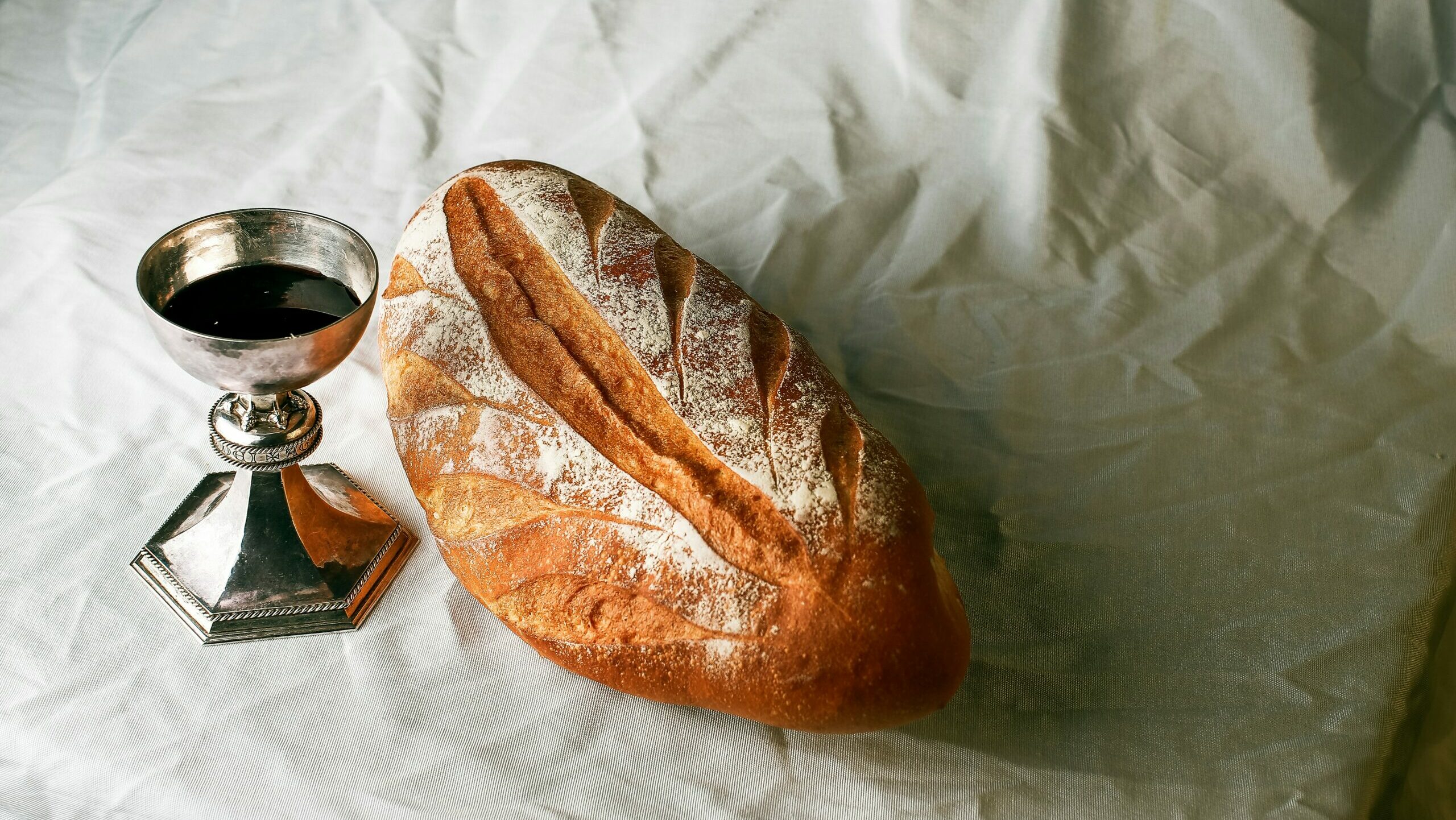
The Lord’s Supper visibly teaches this truth. The bread does not represent the believer’s faithfulness. It represents Christ’s body. The cup does not represent the believer’s spiritual achievements. It represents Christ’s blood. Thus, as a corrective, the Table directs the Christian away from the subjective question, How strong is my faith? toward the objective question, How sufficient is my Savior?
The Supper Answers Our Unworthiness with Christ’s Worthiness
Spurgeon thoughtfully presses this truth even further.
The troubled believer frequently believes that he is simply too unworthy to enjoy close fellowship with Christ. Spurgeon doesn’t answer by persuading him that he has underestimated his own worthiness. He answers by directing him toward Christ’s worthiness.
Again, in “Under the Apple Tree,” Spurgeon acknowledges the believer’s weakness, poverty, and unworthiness but places each beside the corresponding sufficiency of Christ:
“I am very weak; but He is strong, and His strength overshadows my feebleness.”
He then reaches the heart of the matter: “I am most unworthy; but He is so worthy . . . His worthiness doth overshadow my unworthiness.”[iii]
This is profoundly important for pastoral care.
Spurgeon understood well that the gospel does not comfort the troubled Christian by convincing him that he is more worthy than he thinks. In fact, the gospel agrees with his confession of unworthiness and then directs him toward the infinite worthiness of Another.
Spurgeon makes the same point in “Over the Mountains.” When the discouraged Christian protests that he is too unworthy for Christ to draw near, Spurgeon responds that “the worthiness of Christ covers your unworthiness.” [iv]
In this way, the Lord’s Supper makes this aspect of the gospel’s logic tangible, visible.
As a pastor seeking to aid those struggling with assurance, the Table becomes an especially appropriate place for me to point my fellow believer and remind them that they come confessing not, “I am worthy,” but rather, “Christ is worthy!”
The Supper Provides Refuge When Assurance Is Weak
One among many reasons why pastors ought to read Spurgeon is his realistic understanding regarding the ups and downs in the Christian’s experience.
In “Under His Shadow,” he describes seasons when believers experience little conscious enjoyment from God. Like David in Psalm 63, they find themselves spiritually thirsty, remembering previous communion with God while possessing little present comfort.
Yet Spurgeon insists that the absence of felt comfort doesn’t mean the absence of divine faithfulness.
Even when the believer cannot see the light of God’s face, faith may still rest “under the shadow of His wings.” Why? Because God has not changed. If He was previously the believer’s help, He remains his help even when His presence is obscured. [v]
Here Spurgeon distinguishes between faith and feeling in a way that speaks directly to the doubting Christian.
Assurance often weakens because Christians mistake their present consciousness of God’s favor for the reality of God’s favor itself. When spiritual emotions decline, they conclude that the relationship has changed.
However, as John Gill wisely instructed: “Christ’s love is always the same, but the sense of it in believers is variable; the one is sometimes withdrawing, the other never.”[vi]
My task as a pastor, as a Christian friend, is to remind them that God has not changed. Christ has not changed. The cross has not changed. The promises have not changed.
And this is precisely why the tangible character of the Lord’s Supper is pastorally significant. The Christian whose feelings fluctuate receives the visible signs of an unchanging gospel again.
The elements remain. The promise remains. And Christ remains – sufficient.
The Supper Strengthens Rather Than Rewards Faith
This leads us to an important distinction. Christians can easily begin treating Communion as though it is reserved for only strong or perfectly obedient believers.
However, the historic Reformed understanding represented in the appendix to Till He Come points in the opposite direction. Drawing upon the Second London Baptist Confession, the appendix by pastor Meadows explains that faith is not only produced through the ministry of the Word but is also “increased and strengthened” through baptism, the Lord’s Supper, prayer, and other divinely appointed means. [vii]
This dramatically changes how we think about the struggling communicant.
We don’t ordinarily tell a physically weak person to avoid food until they become strong enough to eat. Food is given precisely because nourishment is needed!
So it is spiritually. The Supper is not given because the believer possesses strong faith. God uses the Supper to strengthen the faith the believer possesses.
Pas. Meadows further describes one purpose of the ordinance as the “confirmation of the faith of believers” and explains that participation is designed to strengthen assurance of the believer’s inclusion in the covenant blessings of the gospel. [viii]
At this point a feel as though an important clarification is necessary. Meadow’s emphasis doesn’t eliminate the biblical imperative of self-examination. Paul commands, “Let a man examine[ix] himself, and so let him eat” (1 Cor. 11:28 KJV). Paul’s teaching is crystal clear: the Table must never become an excuse for impenitence or careless participation.
Yet notice Paul’s direction: after examination, the believer is instructed to eat.
In other words, self-examination should ultimately lead the repentant Christian toward Christ, not imprison him within himself.
At the Table, Christ Comes Near
The pastoral sensitivity of Spurgeon’s understanding reaches its height in his description of Christ’s presence with His people during the Lord’s Supper.
As a Reformed Protestant, Spurgeon of course rejects any corporeal presence[x] of Christ in the elements.
Nevertheless, he refuses to reduce the Supper to only a bare remembrance. In “Mysterious Visits,” he affirms “the true and real presence of Jesus with His people,” insisting that Christ comes spiritually to His people in their communion with Him.[xi]
Likewise, in “Over the Mountains,” Spurgeon pictures the discouraged believer separated from the enjoyment of Christ by seemingly insurmountable barriers. Yet the solution is not for the believer somehow to climb across them. Christ Himself can overcome the distance.
Then Spurgeon turns directly to the Table: “In the sacred emblems now upon this supper table, Jesus is already among us.”
Faith therefore cries, “He has come!” and looks toward Him with the declaration, “Behold the Lamb of God!” Spurgeon immediately clarifies: “His corporeal presence we have not, but His real spiritual presence we perceive.”[xii]
This provides a beautiful picture of the pastoral function of Communion. Whenever the doubting Christian comes thinking about the distance between himself and the Savior, we can encourage this proper view of the Supper, which announces Christ’s nearness.
The Table therefore doesn’t merely ask the Christian to remember something about Christ. In faithful participation, the believer communes with the living Christ and receives the benefits of His finished work afresh by faith!
Recovering the Table for Weak Christians
As pastors, we should therefore be careful about the way the Supper is presented to tender consciences.
Yes, warnings are necessary. Scripture itself supplies them. But fencing the Table must never communicate that only Christians enjoying unusually strong assurance should come.
The weak Christian needs Christ. The discouraged Christian needs Christ. The doubting Christian needs Christ. And Christ has appointed the Supper for the nourishment of His people.
The prefatory note to Till He Come records that Spurgeon ordinarily observed the Lord’s Supper every Sabbath and testified that, as the years passed, frequent obedience to Christ’s command made the Savior increasingly precious to him and the memorial celebration increasingly “helpful and instructive.” [xiii]
Let’s ask ourselves: Do we need to recover, or perhaps refresh ourselves upon Spurgeon’s pastoral function of the Lord’s Supper?
We should come to the Table expecting not merely to perform a duty but to receive divine help—not because grace magically resides in bread and wine, but because Christ has appointed the ordinance as a means through which believing hearts are directed toward Him.
The doubting Christian therefore need not wait until he can say, “My faith is strong.” He may come confessing something far better: “My Savior is strong.”
Conclusion
As I stated at the start of this article, the Christian struggling with assurance instinctively looks inward. He searches his repentance, obedience, love, emotions, and faith for sufficient evidence that he belongs to Christ.
The Lord’s Supper turns his eyes in another direction. Here is Christ’s body, given for sinners. Here is Christ’s blood, shed for sinners. Here is Christ’s promise, offered to faith. Here is Christ’s worthiness overshadowing our unworthiness.
The Supper is therefore not merely a memorial for Christians who already possess strong assurance. It is among God’s appointed provisions for strengthening those whose faith is weak.
The doubting Christian does not need first to cross the mountains separating him from the enjoyment of Christ. But as Spurgeon exclaims, Christ crosses the mountains to meet him.
And at His Table, weak faith is invited once again to stop looking at itself and declare: “Behold the Lamb of God!”
Notes:
[i] C. H. Spurgeon, “Under the Apple Tree,” in Till He Come: Communion Meditations and Addresses (Knightstown, IN: Particular Baptist Heritage Books, 2023), 22–24.
[ii] Benjamin Keach, “The marrow of true justification, or, Justification without works containing the substance of two sermons…” (London: Printed for Dorman Newman, 1692).
[iii] Spurgeon, “Under the Apple Tree,” 24–25.
[iv] C. H. Spurgeon, “Over the Mountains,” in Till He Come, 45–46.
[v] C. H. Spurgeon, “Under His Shadow,” in Till He Come, 16–17.
[vi] John Gill D.D, Works of John Gill, Vol.3: Exposition of the Book of Solomon’s Song. (Knightstown, IN: Particular Baptist Heritage Books, 2024).
[vii] D. Scott Meadows, “The Lord’s Supper as a Means of Grace,” in Till He Come, 278, citing the Second London Baptist Confession 14.1.
[viii] Meadows, “Lord’s Supper as a Means of Grace,” 278–79.
[ix] δοκιμάζω dokimázō, dok-im-ad’-zo. STRONGS G138, “to test, examine, prove, scrutinise (to see whether a thing is genuine or not), as metals”.
[x] In Christian theology, “corporeal presence of Christ” means that Christ is believed to be physically, bodily present—not merely spiritually or symbolically. Roman Catholic, Greek Orthodox, and Lutheran traditions teach some form of Christ’s corporeal presence.
[xi] C. H. Spurgeon, “Mysterious Visits,” in Till He Come, 6–7.
[xii] C.H. Spurgeon, “Over the Mountains,” 45–46.
[xiii] “Prefatory Note,” in Till He Come, ix.
Bibliographical Note
Charles H. Spurgeon, Till He Come: Communion Meditations and Addresses. First published in 1896. Particular Baptist Heritage Books edition, 2023. The volume gathers Spurgeon’s communion addresses delivered both to large gatherings at the Metropolitan Tabernacle and to smaller groups of Christians at Mentone. The PBHB edition also contains D. Scott Meadows’s appendix, “The Lord’s Supper as a Means of Grace,” which places Spurgeon’s pastoral treatment of Communion within the historic Reformed and Particular Baptist understanding of the ordinance.
About the Author
D.W. Barger is pastor of Christ Reformed Baptist Church, New Castle, IN. He is the founder of Particular Baptist Heritage Books, where he serves as Executive Director and Editor. He is happily married to his wife, Jessica. They are blessed with three children and one grandchild.
Stay in touch with CBTSeminary
For more information about CBTS, go to CBTSeminary.org
Consider giving to CBTSeminary to help us train the next generation of gospel ministers.
Apply to CBTS today to be sharpened for a lifetime of faithful ministry.
Follow CBTS on our socials: X | Instagram | Facebook | YouTube
Sign up for our newsletter and receive monthly updates related to the Seminary.